From Surf Wiki (app.surf) — the open knowledge base
Turkish lira
Currency of Turkey

Currency of Turkey
| Field | Value |
|---|---|
| local_name1 | Türk lirası |
| local_name_lang1 | tr |
| name_abbr | TL |
| image_1 | Turkish Lira Series Banknotes (Modern).png |
| image_width_1 | 175px |
| image_title_1 | Banknotes |
| image_2 | 1TL obverse.png |
| image_width_2 | 100px |
| image_title_2 | 1₺ coin |
| iso_code | TRY |
| iso_comment | (before 2006: TRL) |
| using_countries | TUR |
| Northern Cyprus Northern Cyprus | |
| inflation_rate | 31.10% |
| inflation_method | CPI |
| inflation_source_date | YCharts https://ycharts.com/indicators/turkey_inflation_rate#:~:text=Basic%20Info,long%20term%20average%20of%2027.07%25. |
| unit | Lira |
| subunit_ratio_1 | |
| subunit_name_1 | Kuruş |
| symbol_subunit_1 | kr |
| symbol | TL, ₺ |
| plural | liralar |
| frequently_used_coins | ₺1, ₺5 |
| rarely_used_coins | 1kr, 5kr, 10kr, 25kr, 50kr |
| coin_article | Coins of Turkey |
| frequently_used_banknotes | ₺5, ₺10, ₺20, ₺50, ₺100, ₺200 |
| banknote_article | Banknotes of Turkey |
| issuing_authority | Central Bank of the Republic of Turkey |
| issuing_authority_website | |
| printer | CBRT Banknote Printer |
| printer_website | |
| mint | Turkish State Mint |
| mint_website | |
| footnotes | The plural is rarely used (mostly as an indefinite noun) and it is never used when referring to amounts, e.g. üç lira (three lira), bin lira (one thousand lira). |
Northern Cyprus Northern Cyprus
The lira (; sign: ₺; ISO 4217 code: TRY; abbreviation: TL) is the official currency of Turkey. It is also legal tender in the de facto state of the Turkish Republic of Northern Cyprus. One lira is divided into one hundred kuruş. The First Turkish lira could be further subdivided, where one kuruş was equal to 40 para.
The current lira is the Second Turkish lira, having succeeded the first Turkish lira in 2005 which in turn succeeded the Ottoman lira in 1923. Since 2018 the Turkish lira has been in crisis, having plummeted in value following Turkish president Erdoğan's economic and political policies.
History
Ottoman lira (1844–1923)
Main article: Ottoman lira
The lira, along with the related currencies of Europe and the Middle East, has its roots in the ancient Roman unit of weight known as the libra which referred to the Troy pound of silver. The Roman libra adoption of the currency spread it throughout Europe and the Near East, where it continued to be used into medieval times. The Turkish lira, the French livre (until 1794), the Italian lira (until 2002), Lebanese pound and the pound unit of account in sterling (a translation of the Latin libra; the word "pound" as a unit of weight is still abbreviated as "lb.") are the modern descendants of the ancient currency.
The lira was introduced as the main unit of account in 1844, with the former currency, kuruş, remaining as a subdivision. The Ottoman lira remained in circulation until the end of 1927.
TRL
First Turkish lira (1923–2005)
The banknotes of the first and second issue depict Mustafa Kemal Atatürk on the obverse side. This change was done according to the 12 January 1926 issue of the official gazette. After Atatürk's death, his portrait was replaced with one of İsmet İnönü for the third and fourth issues. Atatürk returned for the fifth issue and all subsequent issues.
After periods of the lira pegged to sterling and the franc, a peg of TL 2.8 = US$1 was adopted in 1946 and maintained until 1960, when the currency was devalued to TL 9 = US$1. From 1970, a series of hard, then soft pegs to the dollar operated as the value of the Turkish lira began to fall.
The following are based on yearly averages:
- 1960s: US$1 = TL 9
- 1970: US$1 = TL 11.30
- 1975: US$1 = TL 14.40
- 1980: US$1 = TL 80
- 1985: US$1 = TL 500
- 1990: US$1 = TL 2,500
- 1995: US$1 = TL 43,000
- 2000: US$1 = TL 620,000
- 2001: US$1 = TL 1,250,000
- 2005: US$1 = TL 1,350,000
The Guinness Book of Records ranked the Turkish lira as the world's least valuable currency in 1995 and 1996, and again from 1999 to 2004. The lira's value had fallen so far that one original gold lira coin could be sold for TL 154,400,000 before the 2005 revaluation.
TRY
Second Turkish lira (2005–present)
Main article: Revaluation of the Turkish lira
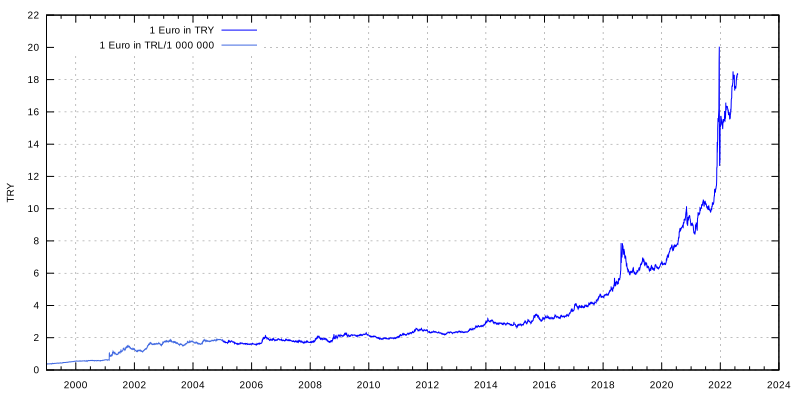
On 28 January 2004, the Grand National Assembly of Turkey passed a law that allowed for redenomination by the removal of six zeros from the Turkish lira, and the creation of a new currency. It was introduced on 1 January 2005, replacing the previous Turkish lira (which remained valid in circulation until the end of 2005) at a rate of YTL 1 (ISO 4217 code "TRY") = TL 1,000,000 in old lira (ISO 4217 code "TRL"). With the revaluation of the Turkish lira, the Romanian leu (also revalued in July 2005) briefly became the world's least valued currency unit. At the same time, the Government introduced two new banknotes with the denominations of ₺50 and ₺100.
In the transition period between January 2005 and December 2008, the second Turkish lira was officially called Yeni Türk lirası ("New Turkish lira"). The letter "Y" in the currency code was taken from the Turkish word yeni, meaning new. It was officially abbreviated "YTL" and subdivided into 100 new kuruş (yeni kuruş). Starting in January 2009, the "new" marking was removed from the second Turkish lira, its official name becoming just "Turkish lira" again, abbreviated "TL". All obverse sides of current banknotes have portraits of Mustafa Kemal Atatürk. The reverse sides of all coins (except for ₺1 commemorative coins) have portraits of Mustafa Kemal Atatürk. Since 2012, 9 different ₺1 circulating commemorative coins were introduced.
2018–present currency crisis
Main article: Turkish economic crisis (2018–current)
In 2018, the lira's exchange rate deteriorated rapidly, reaching ₺4.5 per US dollar by mid-May and ₺4.9 a week later. Economists generally attributed the accelerating loss of value to Recep Tayyip Erdoğan preventing the Central Bank of the Republic of Turkey from making necessary interest rate adjustments. Erdoğan, who claimed interest rates beyond his control to be "the mother and father of all evil", stated that "the central bank can't take this independence and set aside the signals given by the president." Despite Erdoğan's apparent opposition, Turkey's Central Bank raised interest rates sharply.
As of 2020, the Turkish lira lowered in value, with the currency going through a process of depreciation, consistently reaching all-time lows. The Turkish lira depreciated by over 400% compared to the US dollar and the euro since 2008, largely due to Erdoğan's expansionist foreign policy. Erdoğan has tried to fix the financial crisis with unorthodox banking methods.
The Turkish lira partially recovered in early 2021 with the government's increase in interest rates. However, the currency began to crash due to inflation and depreciation starting on 21 March 2021, after the sacking of Central Bank chief Naci Ağbal. The Turkish lira reached a then-all-time-low of ₺8.8 to the dollar on 4 June. The Turkish lira became one of the quickest collapsing currencies of 2021. The Turkish lira reached a new low of ₺8.9 to the dollar in September 2021. In late 2021, the Turkish lira began collapsing rapidly, with the exchange rate falling 9% against the US dollar, reaching an all-time low of ₺12.5 to the dollar. The Turkish lira continued to collapse in December, with the inflation rate reaching unseen levels, collapsing to ₺14.5 to the US Dollar, losing nearly all of its original value. On 17 December, the lira fell by 8.5%, raising the exchange rate to ₺16.5 to the US dollar. Despite the currency collapse, Erdoğan lowered interest rates down to 14% from 15%, causing the lira to lose half of its value since the start of 2021. The Turkish Lira continued to decline throughout 2022. The central bank governor Şahap Kavcıoğlu lowered interest rates by 150 basis points, from 12% to 10.5%, down from the 2021 low of 15%. The official inflation rate of the Lira through 2022 reached 83%, but independent reviews of the Turkish lira put the inflation rate even higher.
In 2023, Erdoğan began to follow orthodox banking methods. Under the guidance of Mehmet Şimşek and Hafize Gaye Erkan, the central bank began to rapidly increase interest rates. By the end of the year, the interest rate stood at 42.5%, and the annual inflation rate decreased to 53.86%, down from 83% in 2022. The central bank increased the interest rate to 50% in March 2024 under Fatih Karahan, the new governor, and has kept it as such as for eight consecutive months. This has resulted in the lira gaining value since May, when inflation peaked at 75.45%, but has decreased to 47.09% in November. The Turkish Lira has regained some valuation. Following the arrest of the mayor of Istanbul, Ekrem Imamoglu, in March 2025, Marketwatch reported that the Turkish lira reached a record low. The Turkish Lira began depreciating rapidly in early 2026 compared to the Euro and USD.
Coins
Main article: Coins of Turkey
From 1 January 2009, the prefix "new" was removed from the second Turkish lira, its official name in Turkey becoming "Turkish lira" again; new coins without the word "yeni" were introduced in denominations of 1kr., 5kr., 10kr., 25kr., 50kr. and ₺1. Also, the center and ring alloys of the 50kr. and ₺1 coins were reversed.
| Current Turkish lira coins http://www.darphane.gov.tr/en/products_new.php?parent_id=853&content_id=1354 | Image | Value | ||||||||||||||||
|---|---|---|---|---|---|---|---|---|---|---|---|---|---|---|---|---|---|---|
| (kuruş) | Technical parameters | Description | Date of | Obverse | Reverse | Diameter | ||||||||||||
| (mm) | Thickness | |||||||||||||||||
| (mm) | Mass | |||||||||||||||||
| (g) | Composition | Edge | Obverse | Reverse | first minting | issue | ||||||||||||
| [[File:1kr obverse.png | 42px]] | [[File:1kr reverse.png | 42px]] | 1kr. | 16.5 | 1.35 | 2.2 | 70% Cu, 30% Zn | Plain | Value, Crescent-star, year of minting | Snowdrop | "TÜRKİYE CUMHURİYETİ", | ||||||
| Mustafa Kemal Atatürk | 2008 | 1 January 2009 | ||||||||||||||||
| [[File:5kr obverse.png | 45px]] | [[File:5kr reverse.png | 45px]] | 5kr. | 17.5 | 1.65 | 2.9 | 65% Cu, 18% Ni, 17% Zn | Tree of life | |||||||||
| [[File:10kr obverse.png | 47px]] | [[File:10kr reverse.png | 47px]] | 10kr. | 18.5 | 3.15 | Rumi motif | |||||||||||
| [[File:25kr obverse.png | 51px]] | [[File:25kr reverse.png | 51px]] | 25kr. | 20.5 | 4 | Reeded | Kufic calligraphic | ||||||||||
| [[File:50kr obverse.png | 60px]] | [[File:50kr reverse.png | 60px]] | 50kr. | 23.85 | 1.9 | 6.8 | Ring: 65% Cu, 18% Ni, 17% Zn | ||||||||||
| Center: 79% Cu, 17% Zn, 4% Ni | Large reeded | Bosphorus Bridge and Istanbul silhouette | ||||||||||||||||
| [[File:1TL obverse.png | 65px]] | [[File:1TL reverse.png | 65px]] | ₺1 | 26.15 | 8.2 | Ring: 79% Cu, 17% Zn, 4% Ni | |||||||||||
| Center: 65% Cu, 18% Ni, 17% Zn | inscribed, T.C. letters and tulip figure | Rumi motif | ||||||||||||||||
| [[File:5 TL 2023 ön.png | 70px]] | [[File:5 TL 2023 arka.png | 70px]] | ₺5 | 28.15 | 8.25 | Ring: 64% Cu, 32% Zn, 4% Ni | |||||||||||
| Center: 64% Cu, 27% Ni, 9% Zn | Large reeded | Seljuk star, Türkiye Centenary logo | 2023 | 29 October 2023 |
Circulating commemorative coins
Since 2012, the Turkish State Mint has introduced ten commemorative coins in circulation.
File:1TL Sayıştay 150th reverse.png|150th anniversary of Court of Accounts (2012) File:1TL Turkish Olympics reverse.png|10th International Turkish Olympiad (2012) File:1TL July 15 reverse.png|Commemorative coin for martyrs and veterans of July 15th (2016) File:1TL Hagia Sophia reverse.png|Commemoration of Hagia Sophia's reversion to mosque (2020) File:Gaziantep hatıra parası.png|100th year of honoring Antep province with the ghazi title (2021)
- 2018: Commemoration of inauguration ceremony of the President Recep Tayyip Erdoğan
- 2020: 100th anniversary of Grand National Assembly of Turkey
- 2022: Commemoration of the opening ceremony of 1915 Çanakkale Bridge
- 2022: 100th anniversary of the Great Offensive
- 2023: 100th years of the republic (5 lira)
Banknotes
Main article: Banknotes of Turkey
A new series of banknotes, the "E-9 Emission Group" entered circulation on 1 January 2009, with the E-8 group ceasing to be valid after 31 December 2009 (although still redeemable at branches of the Central Bank until 31 December 2019). The E-9 banknotes refer to the currency as "Turkish lira" rather than "new Turkish lira" and include a new ₺200 denomination. The new banknotes have different sizes to prevent forgery. The main specificity of this new series is that each denomination depicts a famous Turkish personality, rather than geographical sites and architectural features of Turkey. The dominant color of the 5-Turkish-lira banknote has been determined as "purple" on the second series of the current banknotes.
| Current Turkish lira banknotes 9. Emission Group | Image | Value | |||||||||||
|---|---|---|---|---|---|---|---|---|---|---|---|---|---|
| (₺) | Dimensions | ||||||||||||
| (mm) | Main Colour | Description | Date of issue | Obverse | Reverse | Obverse | Reverse | Watermark | |||||
| [[File:5 Türk Lirası front.jpg | 91px]] | [[File:5 Türk Lirası reverse.jpg | 91px]] | 5 | 130 × 64 | Brown | Mustafa Kemal Atatürk | Aydın Sayılı: | |||||
| solar system, atom, left-handed Z-DNA helix. | Mustafa Kemal Atatürk, value | 1 January 2009 | |||||||||||
| [[File:5-II Türk Lirası front.jpg | 91px]] | [[File:5-II Türk Lirası reverse.jpg | 91px]] | Purple | 8 April 2013 | ||||||||
| [[File:10 Türk Lirası front.jpg | 95px]] | [[File:10 Türk Lirası reverse.jpg | 95px]] | 10 | 136 × 64 | Red | Cahit Arf: | ||||||
| Arf invariant, arithmetic series, abacus, binary sequence | 1 January 2009 | ||||||||||||
| [[File:20 Türk Lirası front.jpg | 99px]] | [[File:20 Türk Lirası reverse.jpg | 99px]] | 20 | 142 × 68 | Green | Mimar Kemaleddin: | ||||||
| Gazi University main building, aqueduct, circular motif and cube-globe-cylinder symbolizing architecture | |||||||||||||
| [[File:50 Türk Lirası front.jpg | 104px]] | [[File:50 Türk Lirası reverse.jpg | 104px]] | 50 | 148 × 68 | Orange | Fatma Aliye Topuz: | ||||||
| flower and literary figures | |||||||||||||
| [[File:100 Türk Lirası front.jpg | 108px]] | [[File:100 Türk Lirası reverse.jpg | 108px]] | 100 | 154 × 72 | Blue | Buhurizade Itri: | ||||||
| musical notes, instruments and Mevlevi figure | |||||||||||||
| [[File:200 Türk Lirası front.jpg | 112px]] | [[File:200 Türk Lirası reverse.jpg | 112px]] | 200 | 160 × 72 | Pink | Yunus Emre: | ||||||
| Yunus's mausoleum, rose, pigeon and the line "Sevelim, sevilelim" (Let us love, let us be loved) |
Currency sign
Main article: Turkish lira sign
The lira was originally symbolised as TL, inverting the characters of the Ottoman lira's sign, LT, which stood for "Livre Turque" in French. Historically English language sources used "£T" or "T£" for the currency, but it is unknown whether this notation was ever used within Turkey.
The current currency sign of Turkish lira was created by the Central Bank of the Republic of Turkey in 2012. The new sign was selected after a country-wide contest. The new symbol is composed of the letter L shaped like a half anchor, and embedded double-striped letter T angled at 20 degrees.
The design, created by Tülay Lale, was endorsed after a country-wide competition. It was chosen as the winner from a shortlist of seven submissions to the board of the Central Bank, selected from a total of 8,362 entries. The symbol resembles the first letter of the Turkish monetary unit, L, in the form of a half anchor with double stroke.
Prime Minister Recep Tayyip Erdoğan announced the new symbol on 1 March 2012. At its unveiling, Erdoğan explained the design as "the anchor shape hopes to convey that the currency is a 'safe harbour' while the upward-facing lines represent its rising prestige".
Faik Öztrak, vice chairman of the main opposition party CHP, alleged that the new sign resembles the initials TE of then-prime minister Tayyip Erdoğan in a reference to the tughra of Ottoman sultans. The new Turkish lira sign was also criticized for allegedly showing a similarity with an upside-down Armenian dram sign.
In May 2012, the Unicode Technical Committee accepted the encoding of a new character for the currency sign, which was included in Unicode 6.2 released in September 2012. On Microsoft Windows operating systems, when using Turkish-Q or Turkish-F keyboard layouts, it can be typed with the combination .
Circulation
Current exchange rates
Notes
References
References
- International Organization for Standardization. "Currency codes – ISO 4217". ISO.
- "10 Para, Turkey".
- "History of Paper Money". Central Bank of the Republic of Turkey.
- "701 Mevcûd Evrâk-ı Nakdiyyenin Yenileriyle İstibdâline Dâir Kânun". Prime Ministry.
- "Elyevm mevkii tedavülde bulunan evrakı nakdiye yerine, aynı evsafı kanuniyeyi haiz olmak ve aynı miktarda bulunmak üzere yeni evrakı nakdiye ihracı hakkında (1/750) numaralı kanun lâyihası ve Kavanin ve Muvazenei Maliye Encümenleri mazbataları.". Grand National Assembly of Turkey.
- "Historical exchange rates from 1953 with graph and charts".
- "Zoom on historical exchange rates graph".
- Official Gazette of the Republic of Turkey. "Law on the Currency of the Republic of Turkey".
- "Turkey introduces symbol for its national currency: A double-crossed 't' | Globalnews.ca".
- (16 May 2018). "Turkey's leader is helping to crash its currency". Washington Post.
- (16 May 2018). "Investors lose their appetite for Turkey". [[Financial Times]].
- (13 September 2018). "Turkey's Central Bank Raises Interest Rates". The New York Times.
- Gullo, M. T.. (28 April 2012). "Turkey's Somalia Adventure: The Quest for Soft Power and Regional Recognition". Centre for Policy Analysis and Research on Turkey (ResearchTurkey).
- (December 2019). "Turkish currency crisis – Spillover effects on European banks". Borsa Istanbul Review.
- (24 January 2020). "Exchange Rate Pass-Through Investigation for Turkish Economy". Frontiers in Applied Mathematics and Statistics.
- (22 October 2020). "Turkish lira hits new record low as central bank holds rates".
- "The Turkish lira is on its worst losing streak since 1999".
- (1 September 2020). "Turkey: Background andU.S. Relations In Brief".
- (21 May 2020). "FDD | Erdogan's Fourth Attempt to Take Over Turkey's Largest Private Bank".
- (17 February 2020). "Why Erdogan Aims to Seize Stake in No. 2 Turkish Bank". Bloomberg.com.
- "Erdogan's Long Arm in the US: Turkish Influence Operations Among American Muslims".
- (3 June 2021). "Turkish lira remains volatile after surprise dip in inflation data".
- "Turkey's lira hits new low as investors lose faith".
- (June 2021). "Erdogan Renews Rate-Cut Demands as Economy Erodes Support".
- Turak, Natasha. (2 June 2021). "Turkish lira hits record low after Erdogan renews call for interest rate cuts". [[CNBC]].
- (21 March 2021). "Turkey bulls are wrong footed after central bank hawks ouster".
- "Turkish lira plummets after Erdoğan fires hawkish central bank chief".
- "Turkish Markets Slide as Agbal's Exit Stokes Lira Turmoil".
- Cole, Wayne. (22 March 2021). "Asia stocks mostly steady, weather Turkish lira squall". Reuters.
- (24 September 2021). "Lira hits record lows as rate cut sets Turkey on uncertain path". Reuters.
- Koc, Cagan. (September 27, 2021). "Only Economist to Call Turkey Cut Sees Lower Rates, Weaker Lira".
- (23 September 2021). "Turkey cuts interest rate to send lira tumbling as inflation soars". Financial Times.
- Ewing, Jack. (23 September 2021). "Turkey's currency hits a new low after a surprise interest rate cut.". The New York Times.
- Hirtenstein, Jared Malsin and Anna. (25 November 2021). "Turks Abandon the Lira for Dollars as Currency Crisis Deepens". [[The Wall Street Journal]].
- (25 November 2021). "Turkish central bank, banks discuss rates after lira tumble". Reuters.
- Julia Horowitz, Isil Sariyuce and Jomana Karadsheh. (24 November 2021). "Turkey is going its own way on inflation. The lira is crashing". CNN.
- (24 November 2021). "Erdogan's credibility plunges along with lira – Al-Monitor: The Pulse of the Middle East".
- McNamara, Paul. (24 November 2021). "Turkey's lira plunge is a reminder of risks facing emerging markets". Financial Times.
- (24 November 2021). "Turkish Lira Takes Breather from Worst Losing Streak in 20 Years".
- Gall, Carlotta. (5 November 2021). "As Turkey Chafes at Erdogan, He Gets Spikier Abroad". The New York Times.
- (December 2021). "Erdogan's Plan Backfires with 'Desperation' in Turkish Lira".
- (2 December 2021). "Turkey risks further damage by using up 'borrowed' lira reserves – S&P Global". Reuters.
- Ng, Abigail. (18 November 2021). "Turkish lira hits all-time low before country's central bank meeting". CNBC.
- (30 November 2021). "Turkish Lira's Abrupt Fall Hits Turkmen Labor Migrants". Radio Free Europe/Radio Liberty.
- (16 December 2021). "Erdoğan intervenes after Turkish lira sinks to lowest level against dollar".
- Turak, Natasha. (16 December 2021). "Turkish central bank cuts rates, sending lira to record low". CNBC.
- Farooq, Umar. "Turkey raises minimum wage as lira crash, inflation sow hardship".
- Gall, Carlotta. (16 December 2021). "Turkish Currency Hits a New Low, Again". The New York Times.
- (17 December 2021). "Turkey's currency crisis deepens after Erdogan's latest rate cut". Reuters.
- Turak, Natasha. (20 October 2022). "Turkey slashes interest rates by 150 basis points despite inflation at 83%".
- (March 2023). "Turkish Lira crisis and its impact on sector returns". Finance Research Letters.
- (September 5, 2022). "Turkey's annual inflation passes 80% after interest rate cut".
- (19 August 2022). "Turkish lira slips toward record low in post-rate-cut selloff". Reuters.
- (21 December 2023). "Press Release on Interest Rates (2023-51)".
- "Turkey Inflation Rate 1960-2024".
- Lahiri, Indrabati. (21 November 2024). "Central Bank of Turkey keeps key interest rate unchanged".
- "Consumer Prices".
- Chisholm, Jamie. (2025-03-19). "Turkish president's main rival is arrested. The lira is crashing.".
- https://www.xe.com/en-us/currencyconverter/convert/?Amount=1&From=TRY&To=EUR
- "Public Announcement As to the Removal of the Prefix "New" From The New Turkish Lira".
- (21 December 2017). "Darphane açıkladı: Piyasada 1 milyon adet 'Türkçe Olimpiyatları' parası var". Diken.
- "100. yıl hatırası ölümsüzleştirildi!". Sabah.
- Türkiye Cumhuriyet Merkez Bankasi (Central Bank of the Republic of Turkey). (8 May 2007). "Public Announcement As to the Removal of the Prefix "New" From The New Turkish Lira". TCMB.
- (15 September 2006). "TL banknotes to be in circulation in 2009". Turkish Daily News.
- (3 October 2008). "Türk Lirası'nda yeni yüzler". [[NTV-MSNBC]].
- Türkiye Cumhuriyet Merkez Bankasi (Central Bank of the Republic of Turkey). (2 April 2013). "Press Release on the Issue of E-9 Emission Group II. Series Turkish Lira Banknotes". TCMB.
- "TLSimge". Central Bank of the Republic of Turkey.
- {{Cite EB1911
- (1961). "Middle East Record Volume 2".
- (December 1952). "The Insurance Law Journal 1952-12: Iss 359".
- (October 2011). "TL SİMGE YARIŞMASI ŞARTNAMESİ". Türkiye Cumhuriyeti Merkez Bankası.
- (March 2012). "TL Simgesi Açıklandı". [[Central Bank of the Republic of Turkey]].
- "Başkan Başçı'nın TL Simge Yarışması Basın Toplantısında Yaptığı Konuşma". Türkiye Cumhuriyet Merkez Bankası.
- "Türk lirasının yeni simgesi açıklandı". Haber 7.
- (2012-03-01). "Brand new Turkish Lira sign revealed". [[Hürriyet Daily News]].
- (2012-03-02). "Dünyada TL kullanımı 3'e katlandı, 'çıpa'lı simge 'güvenli liman' mesajı oldu". [[Hürriyet]].
- [http://www.todayszaman.com/news-273024-pm-erdogan-announces-symbol-for-turkish-lira.html "PM Erdoğan announces symbol for Turkish lira"], TodaysZaman.com, 1 March 2012
- [http://www.todayszaman.com/news-272940-.html "Turkey unveils symbol for national currency"] {{Webarchive. link. (27 November 2012 , TodaysZaman.com, 1 March 2012)
- (2012-03-01). "CHP'den, TL simgesi için ilginç iddia". [[Hürriyet]].
- (2012-03-02). "Paramızın artık haysiyeti var faizlerin daha da inmesi lazım". [[Hürriyet]].
- (15 May 2012). "Unicode 6.2 to Support the Turkish Lira Sign from announcements_at_unicode.org on 15 May 2012 (Unicode Mail List Archive)". Unicode.org.
- (23 October 2012). "Unicode 6.2.0". The Unicode Consortium.
- (2024-10-24). "Turkish Q Keyboard".

This article was imported from Wikipedia and is available under the Creative Commons Attribution-ShareAlike 4.0 License. Content has been adapted to SurfDoc format. Original contributors can be found on the article history page.
Ask Mako anything about Turkish lira — get instant answers, deeper analysis, and related topics.
Research with MakoFree with your Surf account
Create a free account to save articles, ask Mako questions, and organize your research.
Sign up freeThis content may have been generated or modified by AI. CloudSurf Software LLC is not responsible for the accuracy, completeness, or reliability of AI-generated content. Always verify important information from primary sources.
Report