From Surf Wiki (app.surf) — the open knowledge base
Turf Moor
Football stadium in Burnley, Lancashire, England

Football stadium in Burnley, Lancashire, England
| Field | Value | |
|---|---|---|
| name | Turf Moor | |
| image | Turf Moor - Harry Potts Way (east).jpg | |
| image_upright | 1.2 | |
| caption | View of Turf Moor from Harry Potts Way | |
| image_alt | A football stand photographed from a road | |
| address | 52-56 Harry Potts Way | |
| location | Burnley | |
| Lancashire, England | ||
| BB10 4BX | ||
| built | 1883 | |
| opened | 17 February 1883 | |
| owner | Burnley F.C. | |
| operator | Burnley F.C. | |
| surface | Desso GrassMaster | |
| tenants | {{plainlist | |
| seating_capacity | 21,944 | |
| record_attendance | 54,775 (Burnley vs Huddersfield Town, 23 February 1924) | |
| dimensions | 105 x | |
| coordinates | ||
| pushpin_map | United Kingdom Burnley#Lancashire | |
| pushpin_map_caption | Location in Burnley##Location in Lancashire |
Lancashire, England BB10 4BX
- Burnley F.C. (1883–present)
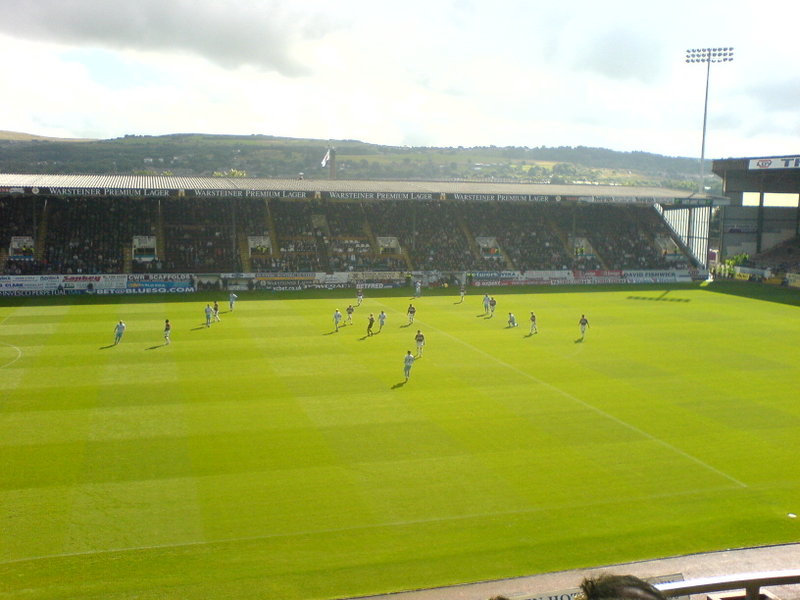
- Burnley Belvedere F.C. (1902–1904) Turf Moor is an association football stadium in Burnley, Lancashire, England, which has been the home of Burnley F.C. since 1883. This unbroken service makes Turf Moor the second-longest continuously used ground in English professional football. The stadium is situated on Harry Potts Way, named after the manager who won the 1959–60 First Division with the club, and has a capacity of 21,944.
The Turf Moor site has been used for sporting activities since at least 1843, when Burnley Cricket Club moved to the area. In 1883, they invited Burnley to use a pitch adjacent to the cricket field. The first grandstand was not built until 1885, while terraces were also added to each end of the ground in the same year. Between the mid-1950s and mid-1970s, all stands were rebuilt. Turf Moor underwent further refurbishment during the 1990s, when the Longside and the Bee Hole End terraces were replaced by all-seater stands following the recommendations of the Taylor Report. The ground comprises four stands: the Bob Lord Stand, the Cricket Field Stand, the North Stand and the Jimmy McIlroy Stand.
In 1886, Turf Moor became the first football ground to be visited by a member of the Royal Family, when Prince Albert Victor attended a friendly match between Burnley and Bolton Wanderers. The first Football League match at the ground took place in October 1888; Burnley's Fred Poland scored the first league goal at the stadium. In 1922, Turf Moor hosted its only FA Cup semi-final and, in 1927, it was the venue of an international match between England and Wales. The stadium's record attendance was set in 1924, when 54,775 people attended an FA Cup third-round game between Burnley and Huddersfield Town.
History
Early years and construction
Burnley is in Lancashire in Northern England on the edge of the Pennines; its River Brun drains the moors to the east. During the Middle Ages, the Turf Moor area was one of the town's commons and the inhabitants probably cut turf here for fuel. Sport has been played at the Turf Moor site since at least 1843, when Burnley Cricket Club made it their home. Before 1840, there was a short-lived attempt to host an annual horse (turf) race. In 1878, rugby football club Burnley Rovers played a side from Bacup in an evening match to demonstrate electric lighting. The pitch was surrounded by only three lamps which were powered by a small engine; the experiment cost £39 (the equivalent of £ as of ) but was unsuccessful as the darkness caused many spectators to leave early. In January 1883, the cricket club leased seven acres of land between the cricket field and Bee Hole Colliery to the east. The following month, they invited association football team Burnley to move from their original home at Calder Vale to the pitch adjacent to the cricket field. The cricket club also donated £65 (the equivalent of £ as of ) toward the setup costs. Burnley played their first match at Turf Moor on 17 February but lost 6–3 against Rawtenstall; according to a local newspaper, "a high wind made correct play impossible". Committee member Charles Riley subsequently appointed himself Turf Moor's first groundsman.
Attendances during the early years averaged around 2,000, although a crowd of 12,000 was at the ground in March 1884 to see Burnley play local rivals Padiham. Spectators had to congregate around the pitch or watch from the hill at the back of Turf Moor, so in 1885, the club built an 800-seater wooden grandstand along the south side of the ground, along Brunshaw Road (as it was then known), and installed uncovered standing areas (terraces) for 5,000 people at each end of the pitch. In the same year, a dispute broke out as the cricketers complained that the footballers left the shared dressing room uncleaned and did not pay toward repairs. In October 1886, Turf Moor became the first football ground to be visited by a member of the Royal Family: Prince Albert Victor attended the friendly match between Burnley and Bolton Wanderers, while he was in the town to open a new hospital.
Turf Moor hosted its first Football League match on 6 October 1888—an encounter between Burnley and Bolton Wanderers. Burnley forward Fred Poland scored the first league goal at the ground after five minutes, and the home side went on to defeat Bolton 4–1. In 1889, after more disputes, Burnley separated from the cricket club and agreed to pay £77 per year (the equivalent of £ as of ) to rent the stadium, and subsequently increased their ticket prices from four to six pence (the equivalent of £ as of ) to the dissatisfaction of the supporters. In 1891, another local football team, Burnley Union Star, disbanded and abandoned their ground, which included a grandstand. Burnley bought the stand and moved it to the north side of Turf Moor, where it became known as the Stars Stand. Turf Moor hosted its first floodlit football match in March of the same year, between Burnley and Nelson; 16 creosote-fuelled lamps were placed on poles at intervals along the sides of the pitch. Spectators reported that while the edges of the field were sufficiently lit, there was a dark area in the centre.
The Stars Stand was demolished in 1898 and replaced by a larger grandstand, which continued to be referred to as the Stars Stand by the supporters. In 1903, Burnley built a second tier on the Brunshaw Road Stand to accommodate club offices, and in September of that year, the club hosted its first annual general meeting at Turf Moor. The Stars Stand was extended in 1909 with new turnstiles and barricades erected in preparation for the FA Cup quarter-final game against reigning Football League champions Manchester United. By this time an L-shaped embankment had been constructed, possibly with spoil from the coal mine, stretching from the eastern goal around the northeast corner to the halfway line.
Development and decline
In 1913, the Burnley directors decided to demolish the Stars Stand for a second time and opted instead to expand the uncovered embankment. In 1922, Turf Moor hosted its only FA Cup semi-final, with around 46,000 spectators watching Huddersfield Town defeat Notts County 3–1. The Football Association demanded that the pitch be lengthened to 115 yd for the match, although afterwards it was returned to its original 111 yd. On 23 February 1924, Burnley beat Huddersfield 1–0 in the FA Cup third round in front of 54,775 supporters, still the record for Turf Moor. The ground hosted its only senior international fixture three years later when England played Wales. The Englishmen lost 2–1 after Burnley captain Jack Hill scored an own goal to give the visitors the win. In 1932, a hut and scoreboard were installed at the Bee Hole End embankment—named after the Bee Hole Colliery—with funds from Burnley's newly founded supporters' club.
In 1938, the club announced that a covered terrace would be built on the site of the old Stars Stand. The plan was delayed by the outbreak of the Second World War, In 1955, Burnley became one of the first clubs to set up a purpose-built training ground, on 80 acres of farmland at Gawthorpe Hall purchased by their new chairman, Bob Lord. The club installed permanent floodlights in 1957, which were first used during a friendly against local rivals Blackburn Rovers.
Burnley won the First Division title in 1959–60, and as a result, Turf Moor hosted its first ever European Cup match on 16 November 1960; Jimmy Robson and Jimmy McIlroy scored early in the first half as Burnley recorded a 2–0 victory over French side Stade de Reims. In 1969, the Cricket Field Stand was built at a cost of £180,000 (the equivalent of £ as of ) and incorporated the changing rooms, which made Turf Moor one of the few English grounds to have the players' tunnel behind one of the goals. It was the first stand to include oil-fired heating for supporters, with hot air blown through holes under the seats. The system was abandoned after two seasons due to the costs. The club also extended the open terrace at the Bee Hole End in 1970, with the aim of increasing its capacity to around 20,000.
Lord hired Cambridge Soil Services to re-lay the pitch in 1974, and to install new drainage technology and under-soil heating. Neither came into operation as Lord found them uneconomical, partly because of a major rise in oil prices. Burnley won the game 1–0 and defeated the Scots 2–1 in the return leg, securing a 3–1 aggregate victory before going on to win that season's cup final.
A drop in home attendances combined with increased debt caused a rapid decline in the team's fortunes between the late 1970s and the early 1990s. Burnley were left with little money to invest in the stadium's redevelopment and safety work. The author Simon Inglis noted that the Longside "symbolised how far Turf Moor, once deemed to be so modern, had fallen behind".
Conversion to all-seater
Following the Hillsborough disaster in 1989, in which a human crush on the terraces of the Hillsborough Stadium resulted in 97 fatalities, the Taylor Report was published. It recommended the introduction of all-seater stadiums in the top two divisions of English football by the start of 1994–95. Burnley competed in the second tier during the 1994–95 season but were relegated to the third tier at the end of the campaign. The club contracted the Lincolnshire-based Linpave company in September 1995 to build two stands in place of the Longside and the Bee Hole End terraces at a total cost of £5.2 million (the equivalent of £ as of ). The last match in front of the Longside was played on 16 September—Burnley won 2–1 against Hull City. The two-tiered North Stand was built in its place and was opened in April 1996 for the visit of Bristol Rovers. It was later renamed the James Hargreaves Stand following a sponsorship agreement. A day after the North Stand had opened, demolition of the Bee Hole End started. The Jimmy McIlroy Stand, named in honour of the former Burnley player, was completed in September 1996 and took the stadium's capacity to 22,619.
In 2006, Burnley sold Turf Moor and the Gawthorpe training ground to Longside Properties to address financial difficulties arising from the 2002 ITV Digital collapse, which had caused the club to lose over 30 per cent of its expected television revenue. Burnley's chairman Barry Kilby owned 51 per cent of Longside Properties' shares. In 2007, the club revealed plans for a £20 million (the equivalent of £ as of ) redevelopment of Turf Moor and Gawthorpe, to be carried out in six phases and expected to be completed by 2010. Among the ideas were the demolition of the Cricket Field and the construction of a stand incorporating a hotel, restaurant, business centre and cricket pavilion. Planning permission for the first phase of development was granted in April 2008, but in October, the club delayed the project as a result of the global financial crisis. The plans were again put on hold in 2010, due to Burnley's relegation from the Premier League and a projected recession.
Turf Moor and Gawthorpe returned to Burnley ownership under co-chairmen John Banaszkiewicz and Mike Garlick in 2013, after support from private investors. Following promotion back to the Premier League in 2014, the players' tunnel was relocated to the corner between the James Hargreaves and the Cricket Field Stands. In 2016, a new club shop was constructed between the Jimmy McIlroy and Bob Lord Stands as part of an extension to the stadium. In December 2020, the American investment company ALK Capital acquired an 84% stake in Burnley for £170 million in a leveraged takeover. Under the new owners, the Preston-based ADI installed digital signage and large LED screens at Turf Moor in 2021. Safe standing was introduced in a part of the Cricket Field Stand at the end of the 2023–24 season. The club announced several changes to the stadium ahead of its return to the Premier League in 2025–26, including switching the home and away sections within the Cricket Field Stand and relocating the players' tunnel from the north-west to the south-west corner of the ground.
During a pre-season friendly against Italian side Lazio at Turf Moor in August 2025, Burnley became the first football club in history to live stream a game in immersive virtual reality.
Structure and facilities


Turf Moor's pitch measures 105 x and is surrounded by four stands: the Bob Lord Stand, the Cricket Field Stand, the North Stand and the Jimmy McIlroy Stand. The two newest stands, the North and the Jimmy McIlroy, each have two tiers, while the Bob Lord and the Cricket Field are single-tiered. In 2010, Burnley installed a hybrid grass (Desso GrassMaster) pitch at a cost of £750,000 (the equivalent of £ as of ), which was funded by revenue from their stay in the Premier League. It replaced the natural grass surface which often cut up during the winter months. The stadium has a capacity of 21,944,
The North Stand was constructed in 1996. The television gantry and the press box are both situated at the back of the North. The stand's suite has been licensed since 2005 to hold civil wedding services and it can also be used for banqueting events. The Jimmy McIlroy Stand was erected in 1996 and is situated at the eastern side of the pitch with an approximate capacity of 6,000. A memorial garden is located behind the stand and includes a dugout replica with an image of former manager Brian Miller with his hands aloft, which was taken before Burnley's match against Orient in 1987; Burnley defeated their opponents in the final game of the season and avoided relegation from the Football League.
The Bob Lord Stand, constructed in 1974, It houses the club's trophy room as well as the directors' box and a corporate area. The Cricket Field, opened in 1969, is Turf Moor's oldest stand. The stand backs onto Burnley Cricket Club's pavilion and contains both teams' dressing rooms and the officials' lounge. the Ladbrokes Stand and the Barnfield Construction Stand for sponsorship reasons.
In 2011, Burnley opened the world's first higher education institution with university degrees in the football and sports industry. It was named the University Campus of Football Business and was set up at Turf Moor. Other campus locations were later opened at Wembley Stadium (London) and at the City of Manchester Stadium (Manchester).
A popular drink served at Turf Moor since the First World War is "Béné & Hot"—the French liqueur Bénédictine topped up with hot water. The East Lancashire Regiment soldiers acquired a taste for the liqueur while stationed at the birthplace of the beverage in Fécamp, Normandy, during the war. They drank it with hot water to keep warm in the trenches, and the surviving soldiers later returned to East Lancashire with the liqueur. More than 30 bottles are sold at each match, making Burnley one of the world's largest sellers of Bénédictine and Turf Moor the only British football ground to serve it.
Other events and uses
The stadium was used for a game between the Football League XI and the Scottish Football League XI in 1914, with the Scots beating their English counterparts 3–2. The Football League team featured Burnley players Teddy Hodgson, Eddie Mosscrop and Tommy Boyle, the latter scoring from a penalty kick. In 1922, Turf Moor hosted its only FA Cup semi-final, and in 1927, it staged its only senior international fixture when England played Wales. Turf Moor was one of the venues for the 1983 UEFA European Under-18 Championship, hosting a group stage match between Czechoslovakia and West Germany.
The England women's national team played their first match at Turf Moor in September 2003 against Australia, which was the stadium's first international women's fixture. Burnley-born Rachel Brown, a Burnley fan, was England's goalkeeper and kept a clean sheet in a 1–0 victory. The ground had previously hosted several women's charity matches in the early 1920s, the first occurring in March 1920 when Dick Kerr's Ladies played Liverpool Ladies in aid of the National Association of Discharged Sailors and Soldiers.
Football clubs other than Burnley have played "home" matches at the ground. In 1993, Accrington Stanley played their FA Cup first-round game against Scunthorpe United at Turf Moor, relocating the match from their Crown Ground home to attract a larger crowd. Turf Moor has also been used for other sporting activities than football, including an exhibition lacrosse match in 1912 and an American football game in 1987.
During the late 1980s, local club Colne Dynamoes were rapidly progressing through the English non-League system. Colne's benefactor and chairman-manager, Graham White, had a proposal for a groundshare rejected by the Burnley board, and also made an unsuccessful attempt to buy the club in 1989.
Records
Turf Moor has been Burnley's home ground since 1883. This unbroken service makes it the second-longest continuously used stadium in English professional football, behind Preston North End's Deepdale. Burnley are one of the best supported sides in English football per capita,
The highest attendance recorded at Turf Moor is 54,775 for a match against Huddersfield Town in the FA Cup third round on 23 February 1924. The highest attendance at a league match is 52,869 against Blackpool on 11 October 1947, during the 1947–48 First Division season, which also saw Burnley record their highest seasonal average attendance of 33,621.
Transport
Turf Moor is approximately 0.5 mi east of Burnley's town centre. The ground sits adjacent to the A671 and A6114 roads, and near to the M65 motorway. The closest railway station to the ground is Burnley Manchester Road, which is a 15-minute walk from Turf Moor. The other railway station is Burnley Central, which is a 20-minute walk away and is mainly served by local trains. The Burnley bus station is relatively close to the ground; a bus ride to Turf Moor takes about five minutes.
Notes
References
Citations
Sources
References
- Williamson (1999), p. 5
- Bennett (1946), p. 86
- Bennett (1947), p. 173
- Simpson (2007), p. 574
- Bennett (1948), pp. 258–259
- "Local News". ''Burnley Advertiser''. 26 September 1874. p. 2.
- Simpson (2007), pp. 12, 18
- Bennett (1951), p. 35
- Bennett (1951), p. 227
- Russell, David. (1988). "'Sporadic and curious': the emergence of rugby and soccer zones in Yorkshire and Lancashire, c. 1860–1914". Routledge.
- Bennett (1951), p. 228
- Simpson (2007), p. 30
- Bennett (1951), pp. 228, 230
- (18 September 1889). "Burnley Football Club and its charges". Burnley Express.
- Williamson (1999), pp. 15–16
- FA Cup during the same year]], and they were crowned [[1920–21 Burnley F.C. season
- "Burnley v Huddersfield Town, 23 February 1924". AFS Enterprises.
- Marshall, Tyrone. (24 March 2017). "Training ground move a sign of our ambition, says Burnley captain Tom Heaton as Clarets move into their new home".
- Rundle, Richard. "Burnley". Football Club History Database.
- "Burnley–Reims 1960". UEFA.
- Inglis (1996), p. 87
- {{Inflation. UK. 450000. 1974. UK{{Inflation-fn. UK. transfer]] to [[Everton F.C.. Celtic]] visited Turf Moor for the [[Anglo-Scottish Cup]] quarter-final [[Two-legged tie. first leg match]]. The Celtic fans [[Football hooliganism. rioted]] and hurled bottles, stones and iron railings, injuring 60 supporters.Simpson (2007), p. 368
- (14 November 2002). "Trip to the red rose county remembered for the wrong reasons".
- Simpson (2007), p. 521
- Lewis, Tom. (20 December 2007). "Anglo-Scottish Cup & Texaco Cup – Full Results". RSSSF.
- Quelch (2017), pp. 17–20
- Marshall, Tyrone. (9 March 2012). "Family marks 20th anniversary of tragic Turf Moor accident".
- (26 April 2016). "How the Hillsborough disaster unfolded". BBC News.
- Harris, Nick. (23 October 2011). "Football: Long haul to implement Taylor Report".
- Inglis (1996), pp. 87–88
- (23 April 1996). "Stand is delivered".
- Geldard, Suzanne. (28 October 2008). "North Stand sponsorship is a "plumb" deal for Burnley".
- Boden, Chris. (10 January 2013). "Burnley set to buy back Turf Moor and Gawthorpe".
- Quelch (2017), p. 227
- Hewitt, Andrew. (23 July 2007). "Turf Moor's £20m regeneration unveiled".
- Simpson (2007), p. 584
- Simpson (2007), p. 585
- Cruces, Emma. (3 April 2008). "Turf Moor redevelopment plans approved".
- Geldard, Suzanne. (8 October 2008). "Burnley's Turf Moor redevelopment plan faces delay".
- Flanagan, Chris. (11 October 2010). "Burnley stand plan put on hold".
- (5 July 2013). "Turf Moor buy-back complete". Eurosport.
- Jolly, Richard. (21 April 2014). "Burnley 2–0 Wigan Athletic".
- (12 May 2014). "Burnley move Turf Moor tunnel after stand decision".
- (11 December 2017). "Disabled Fans To Get New Facilities In Turf Moor Facelift". Burnley F.C..
- (9 August 2019). "Supporter Information: Accessible Stands and VAR". Burnley F.C..
- Wood, Liam. (1 February 2021). "Burnley chairman Alan Pace reported to be in market for takeover at Serie A club Spezia".
- Conn, David. (2 February 2021). "Burnley's US takeover has left club £90m worse off and loaded with debt".
- (12 May 2021). "Burnley & ADI To Light Up Turf Moor". Burnley F.C..
- Buck, Joe. (2 May 2024). "Newcastle United supporters set to be impacted as Burnley 'trial' new Turf Moor development".
- Scrafton, Matt. (28 July 2025). "Away fans relocated, tunnel and new arrival route: Burnley announce Turf Moor changes ahead of Premier League return".
- Bickerton, Jake. (30 July 2025). "Burnley FC unveils first-ever VR matchday broadcast".
- Faccini, Niccolò. (9 August 2025). "Burnley-Lazio 0–1: Cancellieri decide l'amichevole delle traverse. Zaccagni sbaglia dal dischetto, centrocampo in enorme difficoltà".
- "Turf Moor". Premier League.
- Thomas (2017), pp. 16–18
- (21 October 2010). "Turf Moor pitch could be best money Burnley FC spent".
- Staunton, Peter. "The Burnley Miracle".
- Johnson, William. (27 December 2001). "Burnley's head for heights". The Telegraph.
- Geldard, Suzanne. (8 July 2009). "Polishing for the Premier League – but Burnley still want Turf atmosphere".
- (27 February 2006). "Turf Moor wedding was just fan-tastic".
- "Private Parties & Events". Burnley F.C..
- (14 August 2018). "Turf Moor Memorial Garden: Official Opening". Burnley F.C..
- Duggan, Ciaran. (22 March 2019). "Brian Miller memorial to be unveiled at Turf Moor Memorial Garden".
- Davies, Tom. (26 April 2018). "Golden Goal: Neil Grewcock saves Burnley v Orient (1987)". The Guardian.
- Posnanski, Joe. (14 October 2014). "David and Goliath and Burnley".
- (18 February 2020). "Shop: You Can Now Personalise Gifts and Souvenirs In Store". Burnley F.C..
- (4 August 2017). "Turf Moor stand sponsorship comes to an end".
- "University Campus of Football Business (UCFB)". The PFA.
- (23 January 2017). "UCFB chairman and Burnley FC director to talk with students as next guest speaker". UCFB.
- (10 November 2015). "UCFB secures Manchester City Etihad deal".
- (7 August 2019). "Benedictine Man of the Match". Burnley F.C..
- (25 September 2018). "Turf Moor only football ground in the UK to serve Bénédictine".
- Simpson (2007), pp. 579–581
- (12 November 2015). "European U-18 Championship 1983". RSSSF.
- (29 August 2003). "Brown is glad to be on home Turf".
- Frith, Wilf. (30 April 2023). "Nottingham Forest Women win FAWNL Northern Premier title".
- Whalley, Mike. (May 2008). "The Colne Dynamoes debacle".
- Geldard, Suzanne. (8 January 2021). "Burnley chairman Alan Pace's plans to develop Turf Moor".
- "Burnley Performance Stats". ESPN.
- (March 2024). "Burnley – local data profile". Government Digital Service.
- Simpson (2007), pp. 244–245
- (March 2018). "Turf Moor Accessibility". Burnley Borough Council.
- (7 September 2016). "Away Day Guide: Burnley". Crystal Palace F.C..
This article was imported from Wikipedia and is available under the Creative Commons Attribution-ShareAlike 4.0 License. Content has been adapted to SurfDoc format. Original contributors can be found on the article history page.
Ask Mako anything about Turf Moor — get instant answers, deeper analysis, and related topics.
Research with MakoFree with your Surf account
Create a free account to save articles, ask Mako questions, and organize your research.
Sign up freeThis content may have been generated or modified by AI. CloudSurf Software LLC is not responsible for the accuracy, completeness, or reliability of AI-generated content. Always verify important information from primary sources.
Report