From Surf Wiki (app.surf) — the open knowledge base
Tupolev Tu-160
Russian strategic bomber aircraft
Russian strategic bomber aircraft
| Field | Value |
|---|---|
| name | Tu-160 |
| image | Tupolev Tu-160 RF-94109.jpg |
| image_caption | Tupolev Tu-160 overflying the Volga River near Saratov, Russia |
| type | Supersonic strategic heavy bomber |
| national_origin | Soviet Union/Russia |
| design_group | Tupolev |
| builder | Kazan Aircraft Production Association |
| first_flight | 18 December 1981 |
| introduction | April 1987 |
| produced | 1984–1992, 2002, 2008, 2017, 2021–present |
| number_built | 41 (9 test and 32 serial) |
| status | In service |
| primary_user | Russian Aerospace Forces |
| more_users | Soviet Air Forces (former) |
| Ukrainian Air Force (former) |
Ukrainian Air Force (former)
The Tupolev Tu-160 (; NATO reporting name: Blackjack) is a supersonic, variable-sweep wing nuclear-capable heavy strategic bomber and airborne missile platform designed by the Tupolev Design Bureau in the Soviet Union in the 1970s. The aircraft is large, longer than a Boeing B-52 Stratofortress at 54 m, with wingspan 56 m when spread, 36 m when swept back. The Tu-160 is operated by the Long Range Aviation branch of the Russian Aerospace Forces.
The Tu-160 entered service in 1987, the last strategic bomber designed for the Soviet Air Forces. It was built to serve as both a conventional and nuclear bomber. Production was stopped in 1992 following the dissolution of the Soviet Union in 1991, and the newly independent Russian and Ukrainian air forces inherited a fleet of 13 and 19 Tu-160s, respectively. Following protracted negotiations, the Russian Federation purchased eight Ukrainian Tu-160s, while the remaining 11 were scrapped in the late 1990s under the Nunn–Lugar Cooperative Threat Reduction agreement. Following these actions, the sole operator of the aircraft type became the Russian Aerospace Forces' Long Range Aviation branch, which still had 17 Tu-160s in service as of 2022. The type had its combat debut in November 2015 during the Russian military intervention in the Syrian Civil War, conducting numerous airstrikes using Kh-101 air-launched cruise missiles. Various overseas deployments have been conducted, including to distant nations such as Venezuela and South Africa.
Since the early 2000s, the active fleet has undergone several upgrades, largely focusing on various electronic systems. A program of modernising existing aircraft to a new Tu-160M standard and building new aircraft was embarked upon, with the first updated aircraft delivered in December 2014. Plans were announced in 2015 for the delivery of 50 new-built Tu-160Ms and the upgrading of 16 existing aircraft.
The new bombers are reported to have more sophisticated armament, engines, and avionics than the original Tu-160. In January 2022, the first newly-built Tu-160M performed a test flight, with two new aircraft planned for delivery in 2022 of ten on order.
Development
Origins
The first competition for a supersonic strategic heavy bomber was launched in the Soviet Union in 1967. In 1972, the Soviet Union launched a new multi-mission bomber competition to create a new supersonic, variable-geometry ("swing-wing") heavy bomber with a maximum speed of Mach 2.3, in response to the US Air Force B-1 bomber project. The Tupolev design, named Aircraft 160M, with a lengthened blended wing layout and incorporating some elements of the Tu-144, competed against the Myasishchev M-18 and the Sukhoi T-4 designs. Work on the new Soviet bomber continued despite an end to the B-1A and, in the same year, the design was accepted by the government committee. The prototype was photographed by an airline passenger at a Zhukovsky Airfield in November 1981, about a month before the aircraft's first flight on 18 December 1981. Production was authorized in 1984, beginning at the Kazan Aircraft Production Association (KAPO).
Modernization
In 2002, the Russian Defence Ministry and KAPO agreed to modernise 15 Tu-160s. In July 2006, the first overhauled and partially modernized aircraft was accepted into Russian service after testing; it reportedly received the capability to use conventional weapons but was not upgraded with new avionics as previously planned. The first modernized aircraft capable of carrying the new long-range Kh-555 conventional cruise missile was delivered to the Russian Air Force in April 2008; a follow-up contract for the modernization of three more aircraft is estimated to cost RUR3.4 billion (US$103 million).
The modernization appeared to be split into two phases, first concentrating on life extension with some initial communication–navigation updates, followed by engine upgrades after 2016. In November 2014, a Tu-160 upgraded with new radar and avionics performed its first flight. The aircraft was delivered to the Russian Air Force as the Tu-160M model in December 2014. The phase I update was due to be completed by 2016, but industrial limitations may delay it to 2019 or beyond.
Although Kuznetsov designed an NK-32M engine with improved reliability over the NK-32 engines, its successor company has struggled to deliver working units. Metallist-Samara JSC had not produced new engines for a decade when it was given a contract in 2011 to overhaul 26 of the existing engines; two years later, only four had been finished. A further improved engine was bench tested in 2012 and projected to potentially enter production as early as 2016.
On 2 February 2020, the modernized Tu-160M performed its first test flight at the airfield of the Kazan Aviation Plant named for I.Gorbunov. Deliveries started later that year, five aircraft were equipped with the new engines by August 2022. According to Vladimir Putin, 4 Tu-160M were delivered in 2023.
The CEO of Rostec has said that most of the bomber's systems and equipment will be more sophisticated than the initial Tu-160, particularly the armament, engines, and avionics.
Resumed production
.jpg)
In 2008, Russia revealed plans for one new Tu-160 to be delivered every one to two years with the aim of increasing the active inventory to 30 or more aircraft by 2025–2030. On 29 April 2015, Russian Defense Minister Sergei Shoigu, on order of President Putin, announced that Tu-160 production would resume. In May 2015, TASS reported that the Russian Air Force would purchase at least 50 KAPO-built Tu-160s. General Viktor Bondarev stated that development of the PAK DA would proceed alongside Tu-160 production.
On 16 November 2017, a newly assembled Tu-160, built from an unfinished airframe, was unveiled during a roll-out ceremony at KAPO, signifying a restoration of some production techniques (such as electron-beam welding and titanium work) that had fallen into disuse after the termination of serial production in 1992. The new aircraft was named Petr Deinekin after the first commanding officer of the Russian Air Force. According to Dmitri Rogozin, the serial production of wholly new airframes for the modernized Tu-160M2 should begin in 2019 with deliveries to the Russian Aerospace Forces in 2023.

The Petr Deinekin Tu-160 performed its first public flight on 25 January 2018, during President Vladimir Putin's visit to the KAPO plant, and a contract for ten upgraded Tu-160M2s was signed. On 12 January 2022 a new-build Tu-160M had its first low altitude basic test flight. Four aircraft were delivered on 21 February 2024.
Other proposed variants
A demilitarized, commercial version of the Tu-160, named Tu-160SK, was displayed at Asian Aerospace in Singapore in 1994 with a model of a small space vehicle named Burlak attached underneath the fuselage.
In January 2018, Vladimir Putin, while visiting the KAPO plant, floated an idea of creating a civilian passenger supersonic transport version of Tu-160. Experts quoted by the news media were skeptical about the commercial and technological feasibility of such a civilian conversion.
Design

The Tu-160 is a variable-geometry wing aircraft. The aircraft employs a fly-by-wire control system with a blended wing profile, and full-span slats are used on the leading edges, with double-slotted flaps on the trailing edges and cruciform tail. Titanium constitutes around 30% of the aircraft's 110 t empty weight, and the largest component (the swing wing hinge) weighs 6 t.
The Tu-160 is powered by four Kuznetsov NK-32 afterburning turbofan engines, the most powerful ever fitted to a combat aircraft. Unlike the American B-1B Lancer, which reduced the original Mach 2+ requirement for the B-1A to achieve a smaller radar cross-section, the Tu-160 retains variable intake ramps, and is capable of reaching Mach 2.05 speed at altitude. The Tu-160 is equipped with a probe-and-drogue in-flight refueling system for extended-range missions, although it is rarely used. The Tu-160 has an internal fuel capacity of 130 t. In February 2008, Tu-160 bombers and Il-78 refueling tankers practiced air refueling during air combat exercise, as well as MiG-31, A-50 and other Russian combat aircraft.

The aircraft carries a TsNPO Leninets Obzor-K (Survey, NATO: Clam Pipe) radar for tracking ground and air targets, and a separate Sopka Terrain-following radar. Although the Tu-160 was designed for reduced detectability to both radar and infrared signature, it is not a stealth aircraft.
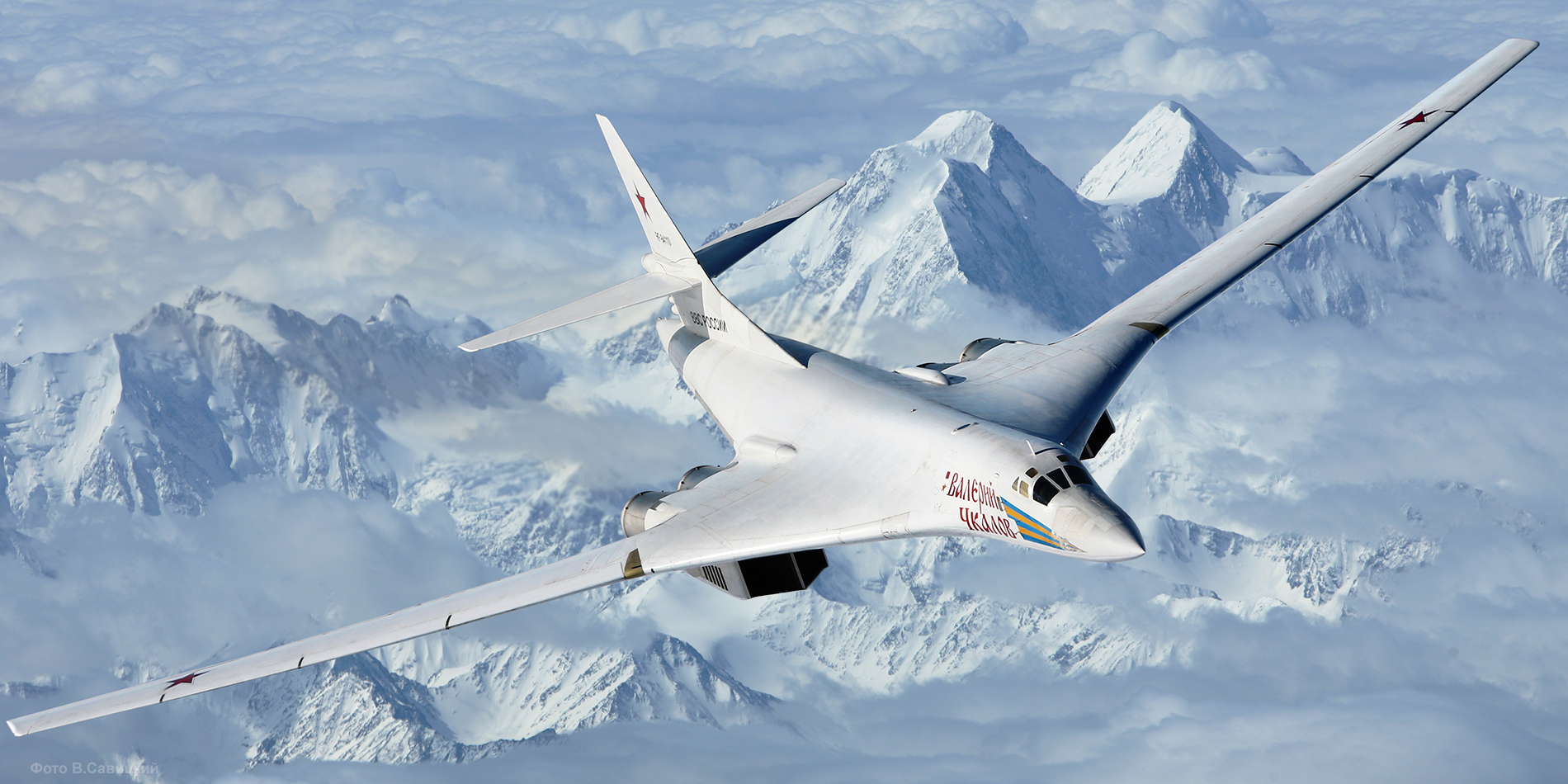
Weapons are carried in two internal bays, each capable of holding 22500 kg of free-fall weapons or a rotary launcher for missiles capable of carrying conventional or nuclear warheads. The aircraft's total weapons load capacity is 45,000 kg (99,208 lb). No defensive weapons are provided; the Tu-160 is the first post-World War II Soviet bomber to lack such defenses. In 2020, officials stated that the Russian Aerospace Forces is planning to arm the Tu-160 with new hypersonic missiles, in particular the nuclear-capable Kh-47M2 Kinzhal hypersonic air-launched ballistic missile.
While similar in appearance to the American B-1 Lancer, the Tu-160 is a different class of combat aircraft; its primary role being a standoff missile platform (strategic missile carrier). The Tu-160 is also larger and faster than the B-1B and has a slightly greater combat range, though the B-1B has a larger combined payload with external payload. Another noticeable difference is that the B-1's colour scheme is usually subdued dark gray to reduce visibility; the Tu-160 is painted with anti-flash white, giving it the nickname among Russian airmen "White Swan".
Operational history
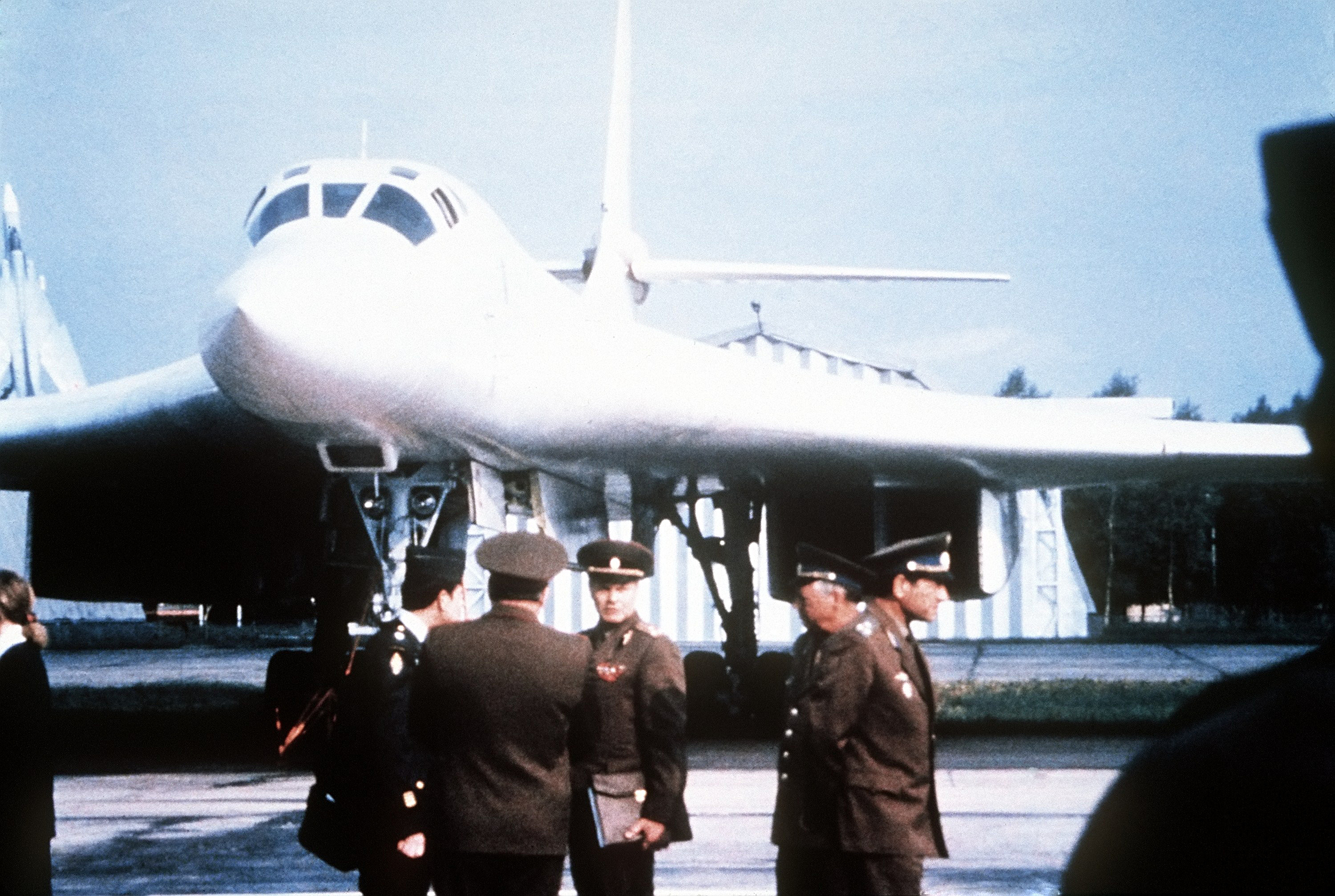
In April 1987, the Tu-160 entered operational service with the 184th Guards Heavy Bomber Regiment located at Pryluky, Ukrainian SSR. The regiment, previously operating Tu-16 and Tu-22M3 strategic bombers, was the first unit to receive the Tu-160. Squadron deployments to Long Range Aviation began that same month. The Tu-160's first public appearance in a parade came in 1989. During 1989 and 1990, a total of 44 world speed flight records in its weight class were set. In January 1992, Boris Yeltsin decided to end serial production of the Tu-160; 35 aircraft were completed by this time. Russia also unilaterally suspended flights of strategic aviation over remote regions.
A total of 19 Tu-160s were based inside the newly independent Ukraine during the dissolution of the Soviet Union. On 25 August 1991, the Ukrainian parliament decreed that the new nation would take control of all military units on its territory; a Defence Ministry was created that same day. By the mid-1990s, the Pryluky regiment had lost its value as a combat unit; 19 Tu-160s were effectively grounded due to a lack of technical support and spare parts. Ukraine considered the Tu-160s to be a bargaining chip in economic negotiations with Russia and of limited military value. While Russian experts, who examined the aircraft at the Pryluky Air Base in 1993 and 1996, assessed their technical condition as good, the US$3 billion price proposed by Ukraine was considered by Russia to be unacceptable. In April 1998, amid stalled negotiations, Ukraine decided to commence scrapping the fleet under the Nunn–Lugar Cooperative Threat Reduction agreement. In November, the first Tu-160 was deconstructed at Pryluky.
In April 1999, Russia resumed talks with Ukraine, proposing to purchase eight Tu-160 and three Tu-95MS bombers manufactured in 1991 (those in the best technical condition), as well as 575 Kh-55SM cruise missiles. An agreement was reached and a US$285 million contract was signed, the value of which was deducted from Ukraine's debt for natural gas. On 20 October 1999, a group of Russian military experts went to Ukraine to prepare the aircraft for the flight to Engels-2 air base. On 5 November, the first two aircraft, a Tu-160 and a Tu-95MS, departed Pryluky. During the following months, the rest were flown to Engels-2.

Alongside buying Ukrainian Tu-160s, Russia pursued other means of expanding its fleet. In June 1999, the Russian Defence Ministry and KAPO signed a contract for the delivery of a single near-complete bomber. Named Aleksandr Molodchiy, it was the second aircraft in the eighth production batch. It arrived at Engels-2 on 10 September and was commissioned into service on 5 May 2000. The unit operating the fleet from Engels-2 was the 121st Guards Heavy Bomber Regiment, which was formed up in early 1992 and received six aircraft by 1994. By the end of February 2001, the fleet stood at 15 with the addition of the eight Ukrainian Tu-160s and the new-build. The fleet was reduced to 14 due to the crash of the Mikhail Gromov during flight trials of a replacement engine on 18 September 2003. On 5 July 2006, a Tu-160 named Valentin Bliznyuk, named after the Tu-160's chief designer, entered service with the Russian Air Force after completing its overhaul, bringing the total number back to 15. Built in 1986, it was formerly used as a test aircraft by Tupolev.
On 22 April 2006, the commander of the Long-Range Aviation Lieutenant General Igor Khvorov reported a pair of Tu-160s flew undetected through a US-controlled sector during a military exercise in the Arctic.
On 17 August 2007, Russian President Vladimir Putin announced the resumption of strategic aviation flights, which had been suspended in 1991. On 14 September 2007, British and Norwegian fighters intercepted two Tu-160s in international airspace near the United Kingdom and Finland, as they were patrolling the North Atlantic. On 25 December 2007, two Danish Air Force F-16s were scrambled to intercept two Tu-160s near Danish airspace.
On 11 September 2007, according to Russian government sources, a Tu-160 deployed a massive fuel-air explosive device, called Father of All Bombs, for its first field test. Some US military analysts expressed skepticism that the weapon had been delivered by a Tu-160.
On 29 April 2008, a new Tu-160 named Vitaly Kopylov joined the Russian Air Force, increasing the total number of aircraft in service to 16. In early 2008, Tu-160s took part in an exercise with the Russian Navy in the Atlantic Ocean.
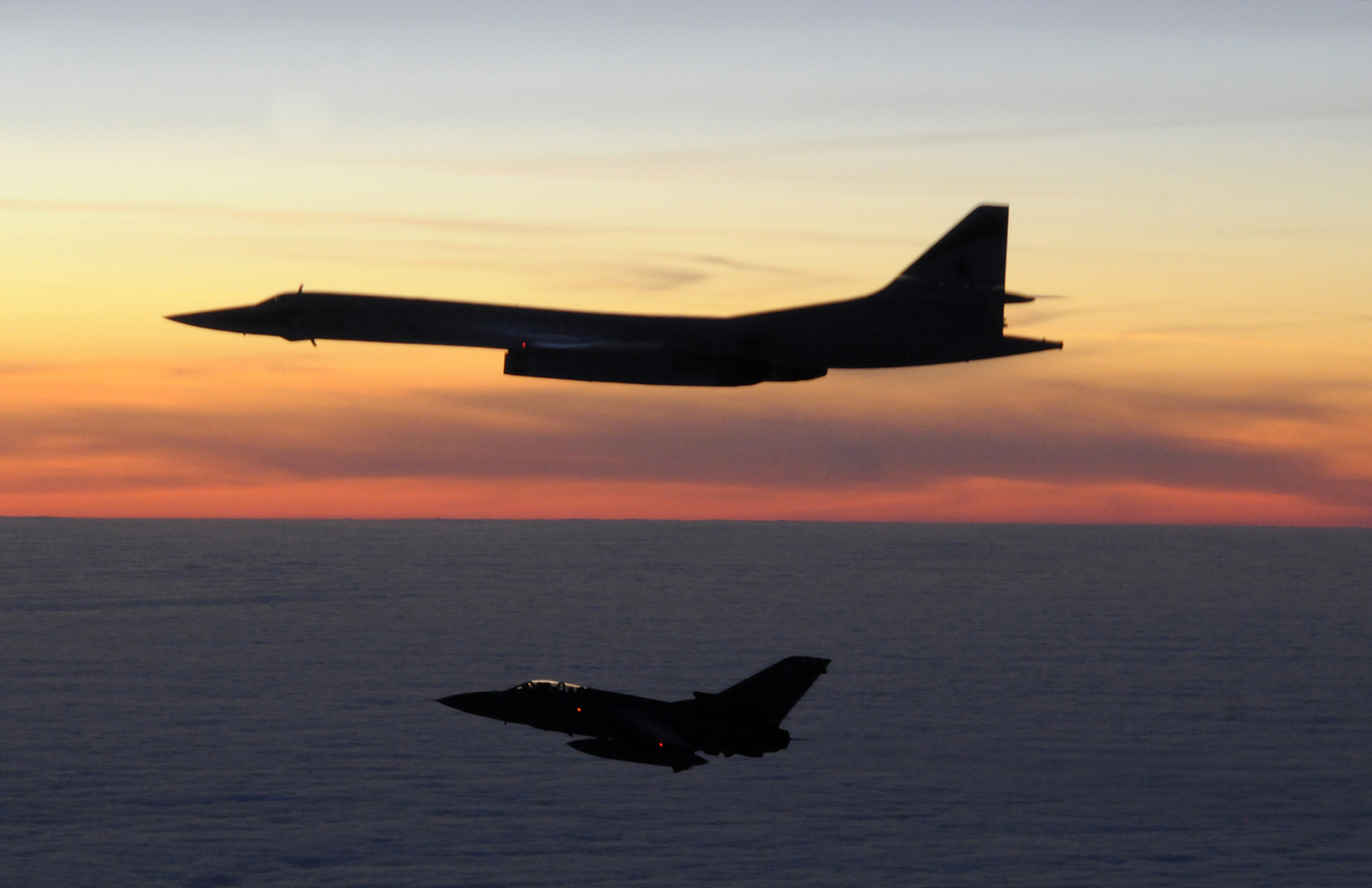
On 10 September 2008, two Tu-160s made an unprecedented deployment to Russia's ally Venezuela as part of military manoeuvres amid increasingly tense relations between Russia and the United States. The Russian Defence Ministry said Vasily Senko and Aleksandr Molodchiy would conduct training flights over neutral waters before returning to Russia. They were escorted by NATO fighters as they crossed the Atlantic Ocean.
On 12 October 2008, Tu-160s were involved in the largest Russian strategic bomber exercise since 1984. A total of 12 bombers, including Tu-160 and Tu-95 aircraft conducted a series of launches of their cruise missiles. Some bombers launched a full complement of missiles; it was the first time that a Tu-160 had ever fired a full complement of missiles.
On 10 June 2010, two Tu-160s carried out a record-breaking 23-hour patrol with a planned flight range of 18000 km, having flown along Russia's borders and over neutral waters in the Arctic and Pacific Oceans.
In August 2011, Russian media claimed that only four of the 16 Tu-160s were flightworthy. Flight International reported eleven were combat-ready by mid-2012;
On 1 November 2013, Aleksandr Golovanov and Aleksandr Novikov entered Colombian airspace on two separate occasions while flying from Venezuela to Nicaragua. Noting a lack of clearance, the Colombian government issued a letter of protest to the Russian government after the first violation. In the second violation, two Colombian Air Force IAI Kfirs stationed at Barranquilla intercepted and escorted the two Tu-160s out of Colombian airspace.

On 17 November 2015, as part of the Russian military intervention in the Syrian Civil War, several Tu-160 and Tu-95MS strategic bombers of the Russian Aerospace Forces fired Kh-101 air-launched cruise missiles from above the Mediterranean Sea, striking targets in Idlib and Aleppo provinces. In total, between 34 and 83 cruise missiles were fired, destroying 14 targets. In addition, Tu-22M3 strategic bombers hit numerous claimed Islamic State targets with unguided munitions. This operation also marked the combat debut for the Tu-160 and Tu-95MS.
In August 2018, several Russian military aircraft including two Tu-160, Tu-95MS strategic bombers and Il-78 aerial tankers were deployed for the first time to the Russian Far East as part of a long-range tactical flight exercise, flying 7,000 km non-stop flight from their home base in Saratov Oblast to Chukotka. During the exercise, the crews practised the combat use of cruise missiles at the Komi Test Range and performed aerial refueling.
In November 2018, a modernized Tu-160M test-fired a full complement of 12 Kh-101 cruise missiles at the Pemboy proving ground in the northeastern region of Komi Republic.
On 10 December 2018, two Tu-160s accompanied by an An-124 cargo plane and an Il-62 passenger plane, landed at the Maiquetía airport in Venezuela. On 23 October 2019, two Tu-160s accompanied by an An-124 and an Il-62 visited South Africa as part of strengthening ties between the two nations; the aircraft performed a 13 hours non-stop flight over the Caspian Sea, Arabian Sea, and Indian Ocean, covering 11000 km with mid-air refueling and landed at Waterkloof Air Force Base in South Africa. It was the Tu-160's first visit to the African continent.
On 11 November 2021, the Belarusian Defense Ministry announced that two Russian Tu-160s flew on a training mission over Belarus alongside Belarusian Air Force Sukhoi Su-30s.
The type was involved in the Russian invasion of Ukraine. According to Ukrainian sources, on 6 March 2022, a Tu-160 along with a Tu-95MS strategic bomber launched eight cruise missiles, presumably the Kh-101, at the Havryshivka Vinnytsia International Airport from the Black Sea area. On 26 June 2022, Ukrainian Air Force spokesman Yurii Ihnat reported four to six Kh-101 cruise missiles were launched by Tu-160 and Tu-95MS bombers at Kyiv from the Caspian Sea area.
On 20 January 2025, Ukraine launched a drone attack on the Gorbunov Kazan Aviation Plant in Kazan, Russia where the Tu-160 is built, about 1000 km from the border with Ukraine, causing several explosions. Russian sources stated that damage was minimal and all drone threats had been neutralized.
On 1 June, Ukraine claimed that Operation Spiderweb hit four Tu-160s at airfields inside Russia with swarms of small drones.
Potential operators
In 2022, retired Air Chief Marshal Anoop Raha said India was interested in purchasing Tu-160s. Reports emerged in late 2022 that India was in talks with Russia to acquire six Tu-160s that could make India the only country other than US, Russia and China to have operational strategic bombers.
Variants


;Tu-160: Production version. ;Tu-160S:Designation used for serial Tu-160s when needed to separate them from all the pre-production and experimental aircraft. ;Tu-160V: Proposed liquid hydrogen fueled version (see also Tu-155). ;Tu-160 NK-74: Proposed upgraded (extended range) version with NK-74 engines. ;Tu-160M: Upgraded version that features new weaponry, improved electronics and avionics.[[File:Vladimir Putin visited the Kazan Aircraft Production Association 05.jpg|thumb|A Tu-160M at [[Kazan Aircraft Production Association|Kazan]] in 2018]] ;Tu-160P (Tu-161): Proposed very long-range escort fighter/interceptor version. ;Tu-160PP: Proposed electronic warfare version carrying stand-off jamming and ECM gear (). ;Tu-160R: Proposed strategic reconnaissance version. ;Tu-160SK: Proposed commercial version, designed to launch satellites via the "Burlak" (, "hauler") launch system. ;Tu-160M2: Highly upgraded version featuring, new avionics, electronics, glass cockpit, communications and control systems, and a number of new weapons, as well as new more powerful and efficient engines giving it greater operational range. It will also have a new defensive system to protect it from incoming missiles. The first plane was to be ready by late 2021. There has been some discussion about whether radar absorptive materials have been applied, but most sources confine its upgrades to electronic warfare and enhanced range/avionics.
Operators
Current operators
;
- Russian Aerospace Forces – 18 Tu-160/M operational, of which 5 Tu-160 in repair and modernization. There are a further 2 Tu-160M under construction. According to Newsweek, 2 Tu-160M and 2 Tu-160M2 have been commissioned as of July 2025.
- 6950th Guards Air Base – Engels-2 air base, Saratov Oblast
- 121st Guards Heavy Bomber Aviation Regiment
- 6950th Guards Air Base – Engels-2 air base, Saratov Oblast
Former operators

;
- Soviet Air Forces Long Range Aviation – aircraft were transferred to the Russian and Ukrainian Air Forces after the dissolution of the Soviet Union.
- 201st Heavy Bomber Aviation Division – Pryluky Air Base, Chernihiv Oblast, Ukrainian SSR
- 184th Guards Heavy Bomber Aviation Regiment (GvTBAP) ;
- 201st Heavy Bomber Aviation Division – Pryluky Air Base, Chernihiv Oblast, Ukrainian SSR
- Ukrainian Air Force – inherited 19 Tu-160s from the former Soviet Union, and subsequently handed over 8 Tu-160s to Russia as exchange for gas debt relief in 1999; the remainder were scrapped under the Nunn–Lugar Cooperative Threat Reduction agreement led by the US.
- 201st Heavy Bomber Aviation Division – Pryluky Air Base, Chernihiv Oblast, Ukraine
- 184th Guards Heavy Bomber Aviation Regiment (GvTBAP)
- 201st Heavy Bomber Aviation Division – Pryluky Air Base, Chernihiv Oblast, Ukraine
- 1 Tu-160 in the Poltava Museum of Long-Range and Strategic Aviation
Specifications (Tu-160)

|prime units?=met
::::35.6 m wings swept (65°) ::::360 m2 wings swept |max takeoff weight kg=275000 |max takeoff weight note=
|eng1 kn-ab=245
|never exceed speed kmh= |never exceed speed note= |minimum control speed kmh= |minimum control speed note= |wing loading kg/m2=742 |thrust/weight=0.37 |fuel consumption kg/km=
--
- Two internal weapon bays for 45000 kg of ordnance. :* Two internal rotary launchers each holding 6 × Raduga Kh-55SM/101/102/555/BD cruise missiles (primary armament) or 12 × Raduga Kh-15 short-range nuclear missiles.
References
Notes
Bibliography
- The Directory of the World's Weapons. Leicester, UK: Blitz Editions, 1996. .
- Jackson, Paul. Jane's All The World's Aircraft 2003–2004. Coulsdon, UK: Jane's Information Group, 2003. .
- Taylor, Michael J. H. Brassey's World Aircraft & Systems Directory. London: Brassey's, 1996. .
References
- (27 November 2014). "The upgraded Tu-160 performed its first flight". Russian Aviation.
- "Largest military aircraft by weight, operational bomber". Guinness World Records.
- (28 April 2017). "Все бомбардировщики Ту-160 модернизируют". [[Rossiyskaya Gazeta]].
- (12 January 2022). "Первый вновь построенный ракетоносец Ту-160М совершил дебютный полет". РИА Новости.
- (4 January 2022). "Два Ту-160М пополнят дальнюю авиацию РФ в 2022 году".
- (12 January 2022). "Построенный "с нуля" стратегический бомбардировщик Ту-160М совершил первый полёт - "Ростех" -".
- "Russia flies newbuild Tu-160M bomber".
- Sergeyev. Pavel. link. [[Lenta.ru]]. (30 April 2008)
- "The Sukhoi T-4 & Tupolev Tu-160". v1.0.4 – 1 Mar 15 – greg goebel – public domain.
- (5 July 2006). "Tu-160 returns from overhaul". Russian Strategic Nuclear Forces.
- John Pike. "Tu-160 BLACKJACK (TUPOLEV)".
- Jennings, Gareth. (28 July 2013). "Russia continues Tu-160 'Blackjack' bomber modernisation work". IHS Jane's Defence Weekly.
- Karnozov, Vladimir. (15 October 2012). "IN FOCUS: Russian's next-generation bomber takes shape". Flight International.
- (20 November 2014). "Russia flies first radar- and avionics-upgraded Tu-160 bomber". IHS Jane's Defence Weekly.
- (19 December 2014). "Russian air force takes first modernised Tupolev bombers". Reed Business Information, RELX Group.
- (27 November 2014). "The upgraded Tu-160 performed its first flight".
- link. (16 September 2011). Ilya. Kramnik
- "Модернизированный Ту-160М выполнил первый полет". TASS.ru.
- "ЦАМТО / / ОДК поставила двигатели для пятого борта Ту-160М". Armstrade.org.
- (2023-12-19). "ЦАМТО / / Владимир Путин выступил на расширенном заседании коллегии Министерства обороны".
- Carlin, Maya. (7 June 2025). "NATO Isn't Ready for Russia's Modernized Tu-160 Bomber". [[The National Interest]].
- [http://www.tatar-inform.ru/news/2008/01/06/90895/ "На КАПО им.Горбунова испытали новый серийный Ту-160" {{in lang. ru.] {{Webarchive. link. (24 January 2008 ''Tatar-Inform Information Agency, [[Kazan]]'', 6 January 2008.)
- "Построенный с нуля стратегический ракетоносец Ту-160М совершил первый полет".
- Stevenson, Beth. (30 April 2015). "Russia to reestablish Tu-160 supersonic bomber production line". FlightGlobal.
- (28 May 2015). "Putin made decision to revive production of Tu-160M strategic bomber – Air Force commander".
- (25 January 2018). "Новый Ту-160 начал летные испытания".
- (16 November 2017). "Путин поздравил авиастроителей с новым стратегическим бомбардировщиком Ту-160М2". [[Zvezda (TV channel).
- (16 November 2017). "Рогозин доложил Путину о постройке новых ракетоносцев Ту-160М2".
- (25 January 2018). "Кадры демонстрационного полета Ту-160М "Петр Дейнекин"". [[Zvezda (TV channel).
- (25 January 2018). "Дальняя авиация получит 10 Ту-160М2 за 160 млрд рублей". [[Vedomosti]].
- (28 January 2018). "Посещение Казанского авиационного завода имени С.П.Горбунова".
- (26 January 2018). "First Tu-160M2 takes flight, production contract for ten aircraft signed". Russian Strategic Nuclear Forces.
- "Вновь изготовленный Ту-160М совершил первый полет".
- (February 2022}} In December 2022, [[United Aircraft Corporation]] announced that the second new-build Tu-160M and the fourth modernized Tu-160M were starting flight tests. It was also reported that the first new Tu-160 had completed factory testing.{{Cite web). "ПАО «ОАК»".
- Nikolov, Boyko. (2024-02-21). "Putin joins Kazan to unveil four deeply upgraded Tu-160M bombers".
- (2024-02-22). "Share of modern weapons in the Russian nuclear forces has reached 95%".
- "Burlak".
- [https://tvzvezda.ru/news/opk/content/201801251458-tfs8.htm Путин предложил сделать на базе Ту-160 гражданский авиалайнер] {{Webarchive. link. (7 February 2018 Zvezda TV, 25 January 2018.)
- [http://www.bbc.com/russian/features-42820724 Гражданский авиалайнер на базе ракетоносца Ту-160. Реально ли?] {{Webarchive. link. (14 February 2018 BBC, 25 January 2018.)
- (1996–2011). "Tupolev Tu-160 Blackjack". Werner Bergmans, Eindhoven, the Netherlands.
- "ODIN - OE Data Integration Network".
- (2013). "Russian Tu-160 Blackjack strategic bomber".
- [http://www.aerospaceweb.org/aircraft/bomber/tu160/ "Aircraft Museum – Tu-160 'Blackjack'."] {{Webarchive. link. (14 October 2007 Aerospaceweb.org, 16 August 2008. Retrieved 19 July 2009.)
- [http://www.airforceworld.com/bomber/eng/tu160-blackjack-bomber-russia-1.htm "Tu-160 bombers practice air refueling in Feb 2008 exercises"] {{Webarchive. link. (2 October 2011 AirForceWorld.com. Retrieved 3 September 2011.)
- "Overscan's guide to Russian Military Avionics".
- . ["Tupolev Tu-160 'Blackjack'"](http://www.milavia.net/aircraft/tu-160/tu-160.htm).
- (2002). ["The Great Book of Bombers: The World's Most Important Bombers from World War I to the Present Day"](https://books.google.com/books?id=OGTGKbnQgFEC&pg=PA481 }}{{Dead link). MBI Publishing Company.
- "Tu-160 (Blackjack) Russian Strategic Bomber".
- (6 May 2020). "Hypersonic Missiles Are Making Russia's Tu-160 Bombers Deadlier Than Ever".
- (13 January 2022). ""Hvite svaner": Russland har testfløyet det første nybygde Tu-160M". [[Teknisk Ukeblad]].
- ''The Directory of the World's Weapons'' 1996, p. 140.
- (2009). "'White swan' – Russian supersonic aircraft". Moscow Top News.
- (1998). "The Cold War: A Military History". John Murray, Random House.
- (25 July 2008). "Померяемся дальней авиацией?".
- (December 2005). "Ту-160 принят на вооружение".
- (18 September 2003). "Russian supersonic bomber crashes".
- (24 April 2006). "Russians claim bomber flights over US territory went undetected".
- (17 August 2007). "Russia orders long-range bomber patrols". [[USA Today]].
- (17 August 2007). "Russia Resumes Patrols by Nuclear Bombers". [[The New York Times]].
- Satter, Raphael G. [https://www.usatoday.com/news/world/2007-09-14-1452283135_x.htm "NATO jets intercept Russian warplanes."] {{Webarchive. link. (5 December 2008 ''[[USA Today]]'', 14 September 2007. Retrieved 19 July 2009.)
- (2008). "Expanding Eurasia: Russia's European Ambitions". CSIS Press.
- [http://news.bbc.co.uk/2/hi/europe/6990815.stm "Russia tests giant fuel-air bomb."] {{Webarchive. link. (29 March 2017 BBC News, 12 September 2007. Retrieved 3 August 2009.)
- Axe, David and Daria Solovieva. [https://www.wired.com/2007/10/russian-father "Did Russia Stage the Father of All Bombs Hoax?"] {{Webarchive. link. (15 April 2017 ''[[Wired (magazine)). Wired]]'', 4 October 2007. Retrieved 15 November 2014.
- (29 April 2008). "Модернизированный Ту-160 передали в состав ВВС России".
- (29 April 2008). "ВВС России получили новый самолет".
- [http://news.bbc.co.uk/2/hi/americas/7609577.stm "Russian bombers land in Venezuela."] {{Webarchive. link. (27 March 2010 BBC News, 11 September 2008.)
- [https://www.telegraph.co.uk/news/worldnews/europe/russia/3148912/Russia-plans-biggest-missile-test-for-24-years.html "Russia plans biggest missile test for 24 years."] {{Webarchive. link. (3 March 2016 ''The Daily Telegraph'', 7 October 2008.)
- Johnson, Reuben F. (11 November 2013). "Further delays for modernisation of Russian Air Force Tu-160 bombers". IHS Jane's Defence Weekly.
- Axe, David. (13 November 2013). "We Just Hunted Down All of Russia's Long-Range Bombers". War is Boring.
- (5 November 2013). "Colombia enviará nota de protesta a Rusia por violación del espacio aéreo". El Espectador.
- (5 November 2013). "Colombia says Russian bombers violated its airspace". Reuters.
- (7 November 2013). "Colombia Protests Violation of Airspace by Russian Bombers". The Moscow Times.
- (20 November 2015). "Russian bombers fly around Europe to strike Syria in 8,000 mile show of strength". [[The Daily Telegraph]].
- (15 March 2016). "Russlands militære intervensjon i Syria – bakgrunn, gjennomføring og konsekvenser". [[Norwegian Defence Research Establishment]].
- Cenciotti, David. (17 November 2015). "25 Russian long-range strategic bombers in action over Syria for the very first time". The Aviationist.
- (17 November 2015). "Paris attacks: Cameron to make case for Syria military action as EU troops could be sent to France". The Daily Telegraph.
- (16 August 2018). "Экипажи Ту-160 впервые в истории выполнили посадку на аэродром Анадырь в ходе учения дальней авиации".
- (17 August 2018). "Russian Supersonic Bombers Deploy Near Alaska 'For First Time in History'".
- (18 December 2018). "Russian strategic Tu-160 bomber test-fires 12 missiles".
- Vladimir Isachenkov. (10 December 2018). "Russia Just Sent Two Nuclear-Capable Bombers to Venezuela".
- (23 October 2019). "На аэродроме в ЮАР приземлились два российских ракетоносца Ту-160".
- (12 November 2021). "Why Are Russian Bombers Over Belarus?". The National Interest.
- (6 March 2022). "Missile strikes on Vinnytsia airfield launched from Black Sea".
- (26 June 2022). "Russian missiles on Kyiv launched with Tu-95, Tu-160 bombers – Air Force Command".
- (20 January 2025). "Explosions Rock Russian Nuclear Aviation Plant After Massive Drone Raid". [[Newsweek]].
- (20 January 2025). "Ukrainian Drones Target Industrial Plants in Russia's Tatarstan". [[Moscow Times]].
- [https://edition.cnn.com/2025/06/02/europe/inside-ukraine-drone-attack-russian-air-bases-latam-intl "New footage reveals the impact of Ukraine’s audacious drone attack on Russian air bases"]. CNN, 4 June 2025.
- [https://kyivindependent.com/enemy-bombers-are-burning-en-masse-ukraines-sbu-drones-hit-more-than-40-russian-aircraft/ "'Russian bombers are burning en masse' — Ukraine's SBU drones hit 'more than 40' aircraft in mass attack, source says"]. kyivindependent.com, 1 June 2025.
- Gaur, Madhavi. (2022-08-20). "India to buy Six Tu-160 long-range bombers from Russia". Adda 247.
- (2022-08-11). "Tupolev Tu-160 'White Swan' for Indian Indian Air Force? Facts about world's biggest bomber aircraft". Daily News & Analysis (DNA).
- Lt. Col. JS Sodhi. (23 August 2022). "Tupolev Tu-160: The ace of air warfare". Financial Express.
- ''Aviation and Cosmonautics'' magazine, 5.2006, pp. 10–11. {{OCLC. 24440468.
- "ПАО «ОАК»".
- (17 November 2017). "Russia Rolls Out New Tu-160M2, But Are Moscow's Bomber Ambitions Realistic? – The Drive".
- Franz-Stefan Gady, The Diplomat. "Russia to Receive Entire Fleet of Upgraded Supersonic Nuclear-Capable Bombers by 2030". The Diplomat.
- Majumdar, Dave. (23 March 2018). "Here's Why Russia's 'New' Tu-160M2 Could Be NATO's Worst Nightmare".
- (14 April 2017). "Russia to Launch Serial Production of Upgraded Tu-160M2 Strategic Bomber".
- (16 June 2017). "Russia Says Its Future Bombers Will Have Protection From 'All Missiles' – The Drive".
- "First newly-built Tu-160M to make maiden flight in 4th quarter of 2021".
- (24 May 2025). "NATO Should Worry: Russia's Tu-160M Is a Bomber Powerhouse".
- (13 April 2025). "Russia's 'New' Tu-160M Mach 2 Bomber Simply Summed Up in 4 Words".
- Cole, Brendan. (2025-07-03). "Russia is struggling to build warplanes".
- (April 2005). "Ukraine Bomber Decommissioning and Transfer Chronology".
- (24 April 2014). "How Americans destroyed Ukraines best Military devices, the Tu 160 Bomber".
- "Long Range Aviation Museum". Cooperative project of Fox Web Workshop and city executive committee Dept. of Culture and Tourism.
- link
- Jackson 2003, pp. 425–426.
- Taylor 1996, p. 103.
- "Tu-160 BLACKJACK (TUPOLEV)".
- link. airforce.ru
- (23 December 2018). "В Минобороны доказали превосходство Ту-160 над американским B-1B".
This article was imported from Wikipedia and is available under the Creative Commons Attribution-ShareAlike 4.0 License. Content has been adapted to SurfDoc format. Original contributors can be found on the article history page.
Ask Mako anything about Tupolev Tu-160 — get instant answers, deeper analysis, and related topics.
Research with MakoFree with your Surf account
Create a free account to save articles, ask Mako questions, and organize your research.
Sign up freeThis content may have been generated or modified by AI. CloudSurf Software LLC is not responsible for the accuracy, completeness, or reliability of AI-generated content. Always verify important information from primary sources.
Report