From Surf Wiki (app.surf) — the open knowledge base
Tupolev Tu-14
Soviet torpedo bomber

Soviet torpedo bomber
| Field | Value |
|---|---|
| name | Tu-14 |
| image | File:Tu-14 01 00089082.jpg |
| caption | Tu-14 light bomber |
| type | Light bomber; torpedo bomber |
| manufacturer | Tupolev |
| first_flight | 13 October 1949 |
| introduction | 1952 |
| retired | 1959 |
| primary_user | Soviet Naval Aviation |
| number_built | About 150 |
| developed_from | Tupolev '73' |
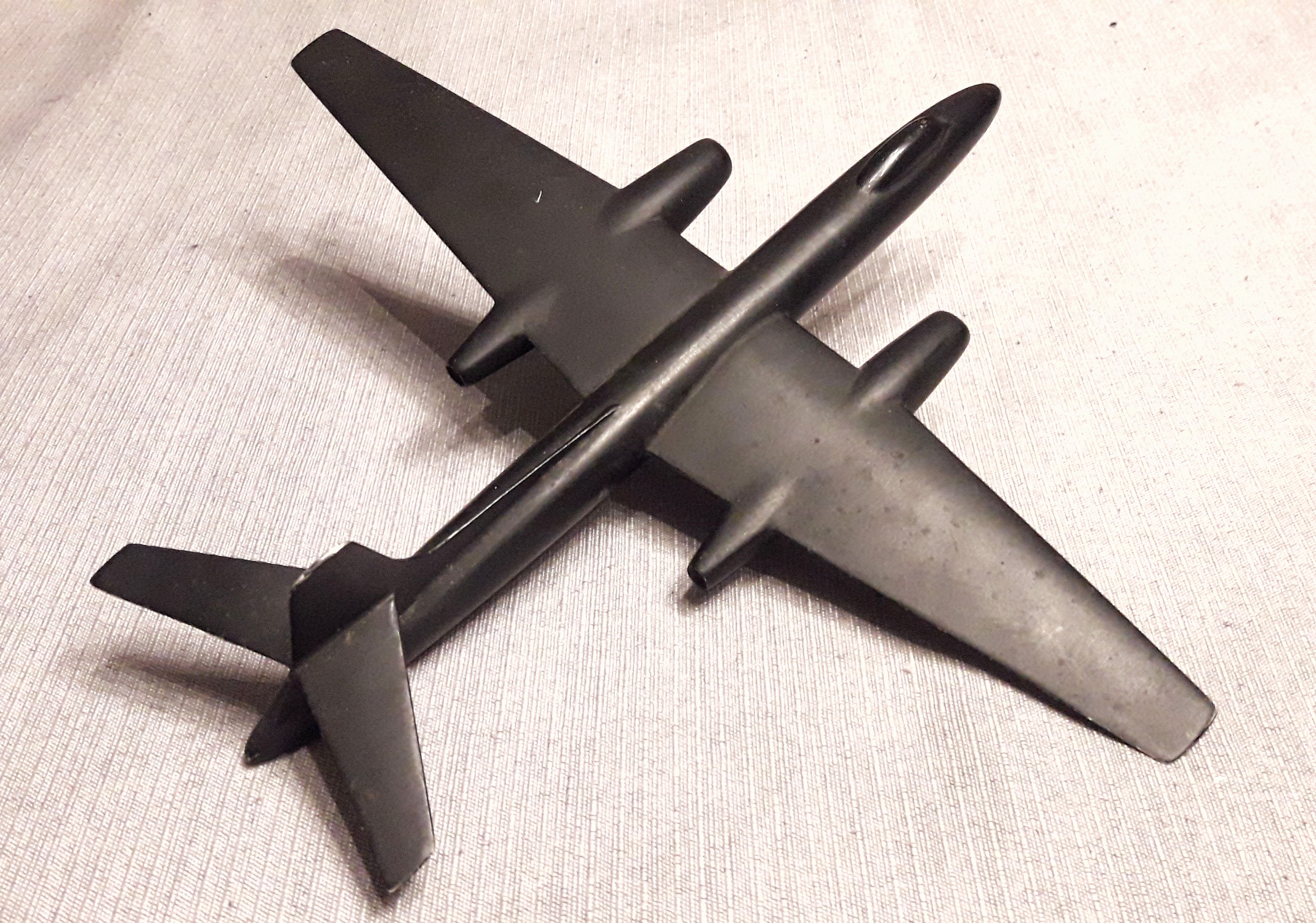
The Tupolev Tu-14 (NATO reporting name: Bosun) (USAF/DOD reporting name: Type 35), was a Soviet twinjet light bomber derived from the Tupolev '73', the failed competitor to the Ilyushin Il-28 'Beagle'. It was used as a torpedo bomber by the mine-torpedo regiments of Soviet Naval Aviation between 1952–1959 and allegedly exported to the People's Republic of China.
Development
The Tu-14 had its origin in the three-engined '73' design which used a pair of Rolls-Royce Nene turbojets under the wings and a single Rolls-Royce Derwent V in the tail, in an installation much like that of the central engine of a Boeing 727. The availability of the Klimov VK-1, a more-powerful version of the Nene, allowed the RD-500, Soviet version of Derwent, to be deleted from the preliminary design, which was given the internal designation of "81". The other major change was the addition of a PSBN navigation radar which required a fifth crewmember to operate. This was rejected by the VVS and Tupolev reworked the design to eliminate the dorsal and ventral turrets and reduce the crew to only three, the pilot, a bombardier-navigator, and a tail gunner. It retained the two fixed 23 mm Nudelman-Rikhter NR-23 cannon in the fuselage nose, but the design of the fuselage was changed to give the gunner his own separate pressurized compartment and a KDU-81 tail turret armed with another pair of NR-23 guns.
Construction of the prototype began in August 1949, using components from the canceled Tu-73S prototypes, and was completed in October. The manufacturer's tests were conducted between 13 October 1949 and 21 January 1950. Its State acceptance trials lasted from 23 January to 27 May 1950 and it was accepted for production, provided that the problems with the KDU-81 turret were resolved and that ejection seats were provided for the pilot and gunner, a hot air deicing was to be fitted and the gun mount in the nose revised. The first five preproduction aircraft did not incorporate these changes as they were built using Tu-73S components, after the factory in Irkutsk had prematurely begun production of that bomber. One of these was sent to Moscow where it was evaluated by Soviet Naval Aviation for use as a torpedo bomber. The sixth aircraft did incorporate all these changes as well as the navigator's ejection seat requested by Naval Aviation, and it was evaluated in May 1951. It was recommended for production as the Tu-14T and entered service in 1952 with Naval Aviation.
About 150 were produced and served with the mine-torpedo regiments of Naval Aviation until 1959. It was given the NATO reporting name Bosun. After it was withdrawn from service, several were used for various test programs, including one evaluating ramjet engines.
It was alleged by one author that up to 50 used Tu-14Ts were delivered to the Chinese People's Liberation Army Air Force although quantities and dates cannot be confirmed by said author. However, neither Russian language sources confirm this allegation nor any physical evidence (photographs, documents) exist to confirm this transfer of aircraft. It is possible that the author confused Tu-14 with Tupolev Tu-16 bombers the transfer of which to People’s Republic of China started in 1958.
The second preproduction Tu-14 was converted into a day or night photographic reconnaissance aircraft with the OKB designation of "89". The conversion was fairly minor and involved an unpressurized central cabin that housed two automatic pivoting cameras, two fuel tanks and another camera fitted in the bomb bay and another camera for oblique photography was mounted in the aircraft's tail for the daylight photography role. All cameras and their viewports were electrically heated to prevent misting and icing at altitude. For night photography, the fuel tanks and camera in the bomb bay were removed and a variety of flash bombs were carried to illuminate the targets. In addition, the screen of the PSBN-M navigation radar could be photographed by a special camera and both the pilot and navigator could record their own observations using a voice recorder.
Variants
- Tu-14 – Light bomber version (not accepted for service).
- Tu-14R – Reconnaissance version (prototype only). Also known as Tu-89.
- Tu-14T – Torpedo bomber version.
- '**81'''' - OKB designation of the **Tu-14 2 × VK-1''' prototype
- ''''93'''' – OKB designation of the proposed derivative of the Tu-14T with VK-5 or VK-7 engines; not built.
Operators
;
- Soviet Naval Aviation ;
- People's Liberation Army Air Force (allegedly)
Specifications (Tu-14 / '89T')


|prime units?=met General characteristics
|max takeoff weight kg=25350 |max takeoff weight lb= |max takeoff weight note= Powerplant
|eng1 kn-ab= |eng1 lbf-ab=
|eng2 kn-ab= |eng2 lbf-ab=
|eng3 kn-ab= |eng3 lbf-ab=
Performance
-
Landing speed: 187 km/h |never exceed speed kmh= |never exceed speed mph= |never exceed speed kts= |never exceed speed note= |minimum control speed kmh= |minimum control speed mph= |minimum control speed kts= |minimum control speed note= |wing loading kg/m2=311 |wing loading lb/sqft= |disk loading kg/m2= |disk loading lb/sqft= |fuel consumption kg/km= |fuel consumption lb/mi= |power/mass= |thrust/weight=0.3
-
Take-off run: 1200 m
-
Landing run: 1100 m Armament --
-
2 × 23 mm NR-23 cannon in the forward fuselage forward
-
2 × 23 mm NR-23 cannon in tail turret
References
Bibliography
References
- Duffy & Kandalov, p. 105
- "Designations of Soviet and Russian Military Aircraft and Missiles".
- Gordon & Rigamant, pp. 126–127
- Gordon & Rigamant, p. 128
- Gunston, p. 142
- However, the VVS had already decided to use the Il-28R reconnaissance version of the standard Il-28 by the time that the "89" first flew on 23 March 1951 and Tupolev decided not to submit it for State acceptance trials.Gordon & Rigamant, p. 129
- Duffy & Kandalov, p. 202
- Gunston, p. 142
- Gunston, pp. 140–142
This article was imported from Wikipedia and is available under the Creative Commons Attribution-ShareAlike 4.0 License. Content has been adapted to SurfDoc format. Original contributors can be found on the article history page.
Ask Mako anything about Tupolev Tu-14 — get instant answers, deeper analysis, and related topics.
Research with MakoFree with your Surf account
Create a free account to save articles, ask Mako questions, and organize your research.
Sign up freeThis content may have been generated or modified by AI. CloudSurf Software LLC is not responsible for the accuracy, completeness, or reliability of AI-generated content. Always verify important information from primary sources.
Report