From Surf Wiki (app.surf) — the open knowledge base
Tupolev Tu-134
Soviet short-range airliner

Soviet short-range airliner
| Field | Value |
|---|---|
| name | Tu-134 |
| image | File:Tretyakovo Tupolev Tu-134.jpg |
| caption | A Tretyakovo Air Transport Tu-134 at Domodedovo International Airport |
| type | Airliner |
| national_origin | Soviet Union |
| design_group | Tupolev |
| builder | Kharkiv State Aircraft Manufacturing Company |
| first_flight | 29 July 1963 |
| introduction | 9 September 1967 |
| status | In limited use |
| primary_user | Aeroflot (historical) |
| more_users | Soviet Air Force (historical) |
| Air Koryo | |
| ALROSA (historical) | |
| produced | 1966–1989 |
| number_built | 854 (852 + 2 prototypes) |
| developed_from | Tupolev Tu-124 |
Air Koryo ALROSA (historical)
The Tupolev Tu-134 (NATO reporting name: Crusty) is a twin-engined, narrow-body jet airliner built in the Soviet Union for short and medium-haul routes from 1966 to 1989. The original version featured a glazed-nose design and, like certain other Russian airliners (including its sister model, the Tu-154), it can operate from unpaved airfields.
One of the most widely used aircraft in former Comecon countries, the number in active service is decreasing because of operational safety concerns and noise restrictions. The model has seen long-term service with some 42 countries, with some European airlines having scheduled as many as 12 daily takeoffs and landings per plane. In addition to regular passenger service, it has also been used in various air force, army and navy support roles; for pilot and navigator training; and for aviation research and test projects. In recent years, a number of Tu-134s have been converted for use as VIP transports and business jets. A total of 854 Tu-134s were built of all versions (including test bed examples) with Aeroflot as the largest user by 1995, the Tu-134 had carried 360 million passengers for that airline.
Design and development
Following the introduction of engines mounted on pylons on the rear fuselage by the French Sud Aviation Caravelle, airliner manufacturers around the world rushed to adopt the new layout. Its advantages included clean wing airflow without disruption by nacelles or pylons and decreased cabin noise. At the same time, placing heavy engines that far back created challenges with the location of the centre of gravity in relation to the centre of lift, which was at the wings. To make room for the engines, the tailplanes had to be relocated to the tail fin, which had to be stronger and therefore heavier, further compounding the tail-heavy arrangement.
During a 1960 visit to France, Soviet leader Nikita Khrushchev was so impressed by the quiet cabin of the Caravelle, that on 1 August 1960 the Tupolev OKB received an official directive to design a new aircraft with a similar engine arrangement. The requirement was also driven by the need to replace slow, aging piston-engined Il-14s on domestic routes. In 1961, the Soviet state airline, Aeroflot, updated its requirement specifications to include greater payload and passenger capacity, and since Aeroflot's requirements dictated a larger aircraft than initially planned, the Soloviev Design Bureau developed the more powerful D-30 low-bypass turbofan engines.
The Tu-134 prototype, CCCP-45075, first flew on 29 July 1963, initially retaining the designation Tu-124A despite radical differences in design from the previous model (new engines, new wings, totally re-designed tail, etc). On 20 November 1963, the new airliner was officially designated Tu-134. Meanwhile in October 1963, the prototype British BAC One-Eleven, which had a similar T-tail layout, crashed with the loss of all crew while testing its stalling properties. The results of an exhaustive investigation by the British Accident Investigation Board prompted Tupolev to enlarge the tailplane on Tu-134s by 30% for greater control authority.
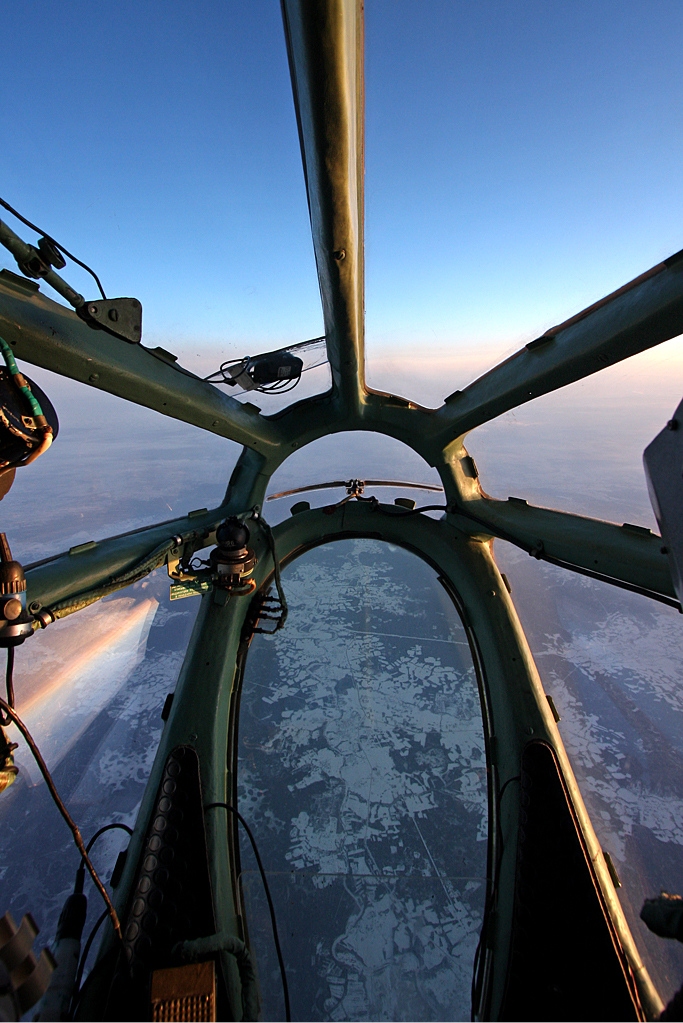
The design of the Tu-134 included a sharp wing sweepback of 35 degrees, compared to 25–28 degrees in its counterparts. The engines on early production Tu-134s lacked thrust reversers, which made the aircraft one of a handful of types from that era that used a brake parachute for landing in adverse conditions. The majority of onboard electronics operated on direct current. The lineage of early Soviet airliners could be traced directly to the Tupolev Tu-16 strategic bomber, and the Tu-134 carried over the glass nose for the navigator and the landing gear fitted with low-pressure tires to permit operation from unpaved airfields.
Serial production began in 1966 at the Kharkov Aviation Production Association, and production of the Tu-124 was discontinued. The Tu-134 was designed for short-haul lines with low passenger traffic. Originally the aircraft had 56 seats in a single class configuration, or 50 seats in a two-class configuration.
In 1968, Tupolev began work on an improved Tu-134 variant with a 76-seat capacity. The fuselage received a 2.1 m plug for greater passenger capacity and an auxiliary power unit in the tail. As a result, the maximum range was reduced from 3,100 kilometers to 2,770 kilometers. The upgraded D-30 engines now featured thrust reversers, replacing the parachute. The first Tu-134A, converted from a production Tu-134, flew on 22 April 1969. The first airline flight was on 9 November 1970. An upgraded version, the Tu-134B, was produced since 1980, with the navigator position abandoned, and seating capacity increased to 96 seats. A further version, the Tu-134D with increased engine thrust, was cancelled.
Operational history
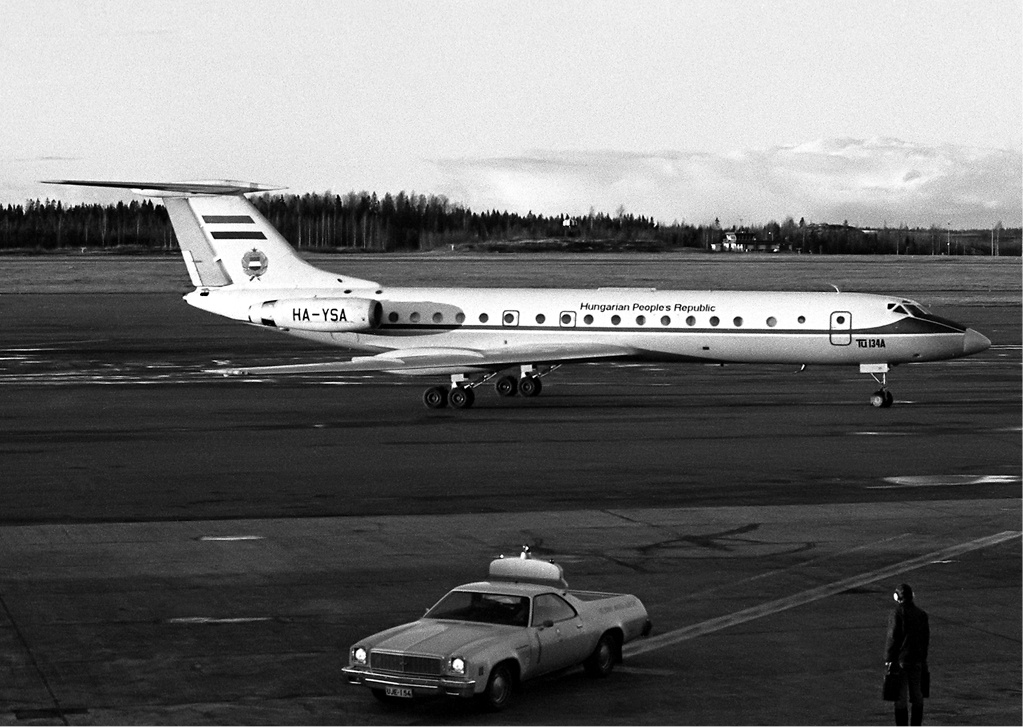
In September 1967, the Tu-134 made its first scheduled flight from Moscow to Adler. The Tu-134 was the first Soviet airliner to receive international certification from the International Civil Aviation Organization, which permitted it to be used on international routes. Due to this certification, Aeroflot used most of its Tu-134s on international routes. In 1968, the first export customers, Interflug of East Germany, LOT Polish Airlines and Malév Hungarian Airlines purchased the Tu-134. In 1969, the Tu-134 was displayed at the Paris Air Show.
From 1972, Aeroflot began placing the Tu-134 in domestic service to Baku, Yerevan, Kyiv, Kishinev, Krasnodar, Leningrad, Omsk, Riga, and Sochi from Sheremetyevo International Airport in Moscow.
In its early years, the Tu-134 developed a reputation for reliability and efficiency, especially when compared with previous Soviet designs. After the establishment of tougher noise standards in the ICAO regulations in 2002, the Tu-134 was banned from most western European airports for its high noise levels. In early 2006, 245 Tu-134s were still in operation, 162 of which were in Russia. After a fatal accident in March 2007, and at the instigation of Russian Minister of Transportation Igor Levitin, Aeroflot announced that it would be retiring its fleet, and the last Tu-134 was removed from service on 1 January 2008. Some were still in operations with Aeroflot subsidiaries on local routes within Russia. The Tu-134 also found a new life as a business jet with many having an expensive business interior installed. High fuel and maintenance costs are increasingly limiting the number used today.
In June 2011, as a response to RusAir Flight 9605 which resulted in 47 fatalities, Russian president Dmitry Medvedev ordered preparations for taking the Tu-134 out of use by 2012.
On 22 May 2019, the final passenger flight of the Tu-134 in Russia took place.
Many Tu-134s have been preserved as memorials at airports throughout the former Soviet Union. A former Malév Tu-134A (registration HA-LBE) is on display at the Aeropark at Budapest Ferenc Liszt International Airport in Hungary.
Variants
;Tu-124A :The prototype Tu-134 (CCCP-45075) retained this slightly confusing designation. All subsequent aircraft are identified as Tu-134. ;Tu-134 :The glass-nosed version. The first series could seat up to 64 passengers, and this was later increased to 72 passengers.
_(8019060107).jpg)


;Tu-134A :Second series, with upgraded engines, improved avionics, seating up to 84 passengers. All Tu-134A variants have been built with the distinctive glass nose and chin radar dome, but some were modified to the B standard with the radar moved to the nose radome. ;Tu-134A-2 :The glass nose was replaced. ;Tu-134A-3 :Second series, powered by two updated Soloviev D-30 turbofan engines. ;Tu-134A-5 :Most recent version. :Tu-134AK :Operated by the Russian Air Force and Roscosmos. ;Tu-134B :Second series, 80 seats, radar moved to the nose radome, eliminating the glazed nose. Some Tu-134B models have long-range fuel tanks fitted under the fuselage; these are visible as a sizable bulge. ;Tu-134BV :Space shuttle work model. ;Tu-134LK :Cosmonaut training version.
;Tu-134M :Projected modernized version of Tu-134B, powered by Progress D-436T1-134 engines. ;Tu-134S :Projected cargo version based on Tu-134A. ;Tu-134UBL :Tu-160 crew training version, with Tu-160 nose cone. ;Tu-134UBK :Naval version of Tu-134UBL. Only one was ever built. ;Tu-134BSh :Tu-22M crew trainer, fitted with a Tu-22M radar in the nose. ;Tu-134Sh-1 :Crew trainer with bomb racks for heavy bomber crews ;Tu-134Sh-2 :navigator trainer for tactical bomber crews ;Tu-134SKh :Crop survey version.
Current operators
As of 2024, only a few Tupolev Tu-134s remain in civil passenger airline service worldwide:
;
- Syrian Air Force ;
- Ukrainian Air Force - 15th Transport Aviation Brigade "Aircraft Designer Oleg Antonov" located at Boryspil International Airport
- Ukrainian Air Guard - 2 aircraft in service
• Federal Space Agency of the Russian Federation
• Russian Air Force
PRK
•Air Koryo operates 2 aircraft. They are the last commercial airline to operate the Tupolev 134.
Former operators
The following airlines, states and other entities at one point operated at least one Tu-134 aircraft:
Former civil operators
;/
- Aeroflot
- Polet Flight
- Yamal Airlines ;Afghanistan Afghanistan
- Ariana Afghan Airlines ;Albania Albania
- Albanian Airlines
- Albtransport Airlines ;Azerbaijan Azerbaijan
- Azerbaijan Airlines ;
- Balkan Bulgarian Airlines ;
- CSA Czech Airlines ;
- Estonian Air
- ELK Airways ;
- Georgian International Airlines
- Transair Georgia ;
- Malév Hungarian Airlines ;
- Air Kazakhstan
- Atyrau Airways
- Berkut Air
- Euro-Asia Air
- Kazair West
- Kazaviaspas ; Kyrgyzstan
- Kyrgyzstan Air Company – 1 crashed on December 28, 2011
- Kyrgyzstan Airlines ;
- Air Lithuania
- Lithuanian Airlines ;Moldova
- Air Moldova ;
- Imperial Air ;
- LOT Polish Airlines ;
- Interflug ;
- Aero Rent
- Aeroflot-Plus
- Alrosa-Avia
- BAL Bashkirian Airlines
- Center-South
- Izhavia
- Rossiya Airlines (government fleet)
- Samara Airlines
- Kosmos Airlines (3)
- Meridian Airlines (1)
- Sirius-Aero
- Turukhan Airlines
- UTair Express ;Syria
- Syrianair ;
- None ever acquired ;
- Ukraine Air Enterprise ;
- Vietnam Airlines ;/
- Aviogenex
Former military operators
; : People's Air and Air Defence Force of Angola ; : Armenian Air Force – 1 stored ; Belarus: Belarus Air Force ; Bulgaria: Bulgarian Air Force ; : Czech Air Force ; : Czechoslovak Air Force – Passed on to successor states ; : German Air Force – former operator, taken over from East German Air Force after German reunification ; : Georgian Air Force ; : East German Air Force ; : Moldovan Air Force ; : North Korean Air Force ; : Polish Air Force. Operated 2 from 1972 to 1977 (later LOT) and 2 from 1977 to 1992. Retired, replaced by 2 Tupolev Tu-154M. ;
- Soviet Air Force
- Soviet Naval Aviation. Passed on successor states.
- Soviet Space Agency
- Soviet Internal Troops – Prisoner Transport Service Syria
- Syrianair (1)
Accidents and incidents
Main article: List of accidents and incidents involving the Tupolev Tu-134
Specifications (Tu-134A)

|prime units?=met General characteristics
|max takeoff weight kg=47600 |max takeoff weight note= Powerplant
Performance
|never exceed speed kmh= |never exceed speed note= |minimum control speed kmh= |minimum control speed note= |wing loading kg/m2= |fuel consumption kg/km= |thrust/weight=
References
Sources
References
- {{usurped
- link. russianplanes.net
- (2021-03-08). "T134".
- link. (22 May 2019)
- "Aeropark Budapest Repülőmúzeum".
- "✈ russianplanes.net ✈ наша авиация".
- (15 February 2023). "The Military Balance 2023". Routledge.
- Flightradar24. "Live Flight Tracker - Real-Time Flight Tracker Map".
- Flightradar24. "Live Flight Tracker - Real-Time Flight Tracker Map".
- "Ямал АТК - карточка оператора".
- {{Harvnb. Kingsley-Jones. 2002
- "Aviation Safety Network – Imperial Air Peru".
- (March 2022). "Meridian Airline's website".
- {{harvnb. Fontanellaz. Cooper. Matos. 2020
- (2005). "OKB Tupolev : a history of the design bureau and its aircraft". Midland.
- "Tupolev Tu-134".
- "The Incomplete Guide to Airfoil Usage".
This article was imported from Wikipedia and is available under the Creative Commons Attribution-ShareAlike 4.0 License. Content has been adapted to SurfDoc format. Original contributors can be found on the article history page.
Ask Mako anything about Tupolev Tu-134 — get instant answers, deeper analysis, and related topics.
Research with MakoFree with your Surf account
Create a free account to save articles, ask Mako questions, and organize your research.
Sign up freeThis content may have been generated or modified by AI. CloudSurf Software LLC is not responsible for the accuracy, completeness, or reliability of AI-generated content. Always verify important information from primary sources.
Report