From Surf Wiki (app.surf) — the open knowledge base
Tupolev ANT-20
1930s Soviet large eight-engine aircraft

1930s Soviet large eight-engine aircraft
| Field | Value |
|---|---|
| name | ANT-20 |
| image | Tupolew ANT-20 1935.jpg |
| caption | ANT-20 "Maxim Gorky" |
| type | Propaganda aircraft/Transport |
| national_origin | Soviet Union |
| manufacturer | Tupolev |
| designer | |
| first_flight | 19 May 1934 |
| introduction | 1934 |
| retired | 1942 |
| primary_user | Soviet Union |
| more_users | |
| produced | |
| number_built | 2 |
| program cost | |
| unit cost | |
| developed_from | Tupolev ANT-16 |
| variants |
The '*Tupolev ANT-20 Maxim Gorky''' (, sometimes romanized as *Maksim Gorki'') was a Soviet eight-engine aircraft, the largest in the world during the 1930s. Its wingspan was similar to that of a modern Boeing 747, and was not exceeded until the 64.6 m wingspan Douglas XB-19 heavy bomber prototype first flew in 1941.
Overview
The ANT-20 was designed by Andrei Tupolev, using German engineer Hugo Junkers' original all-metal aircraft design techniques from 1918. It was constructed between 4 July 1933 and 3 April 1934, and was one of two aircraft of its kind built by the Soviets. The aircraft was named after Maxim Gorky and dedicated to the 40th anniversary of his literary and public activities. The ANT-20 was the largest known aircraft to have used the Junkers aviation firm's design philosophy of corrugated sheet metal for many of the airframe's key components, especially the corrugated sheet metal skinning of the airframe.
The Maxim Gorky was meant as the flagship of the Maxim Gorky propaganda squadron — Maxim Gorky Agiteskadril — which flew around the Soviet Union promoting the aims and achievements of Soviet Communism. For this purpose, it was equipped with a powerful radio set known as the "Voice from the sky" (), printing machinery, a library, radio broadcasting equipment, a photographic laboratory and a film projector with sound for showing films in flight. In a first in aviation the aircraft was equipped with a ladder which would fold on itself to become part of the floor.
The aircraft was the first to use both direct current and alternating current. The aircraft could be dismantled and transported by rail if needed. The aircraft set several carrying-capacity world records and is also the subject of a 1934 painting by Vasily Kuptsov, which is now in the collection of the Russian Museum at Saint Petersburg.
1935 Maxim Gorky crash
On 18 May 1935, the Maxim Gorky (with pilots I. V. Mikheyev and I. S. Zhurov) and three more aircraft (a Tupolev ANT-14, R-5 and I-5) took off for a demonstration flight over Moscow. The main purpose of the other three aircraft flying so close was to make evident the difference in size. The accompanying I-5 biplane piloted by Nikolai Blagin had performed two loop manoeuvres around the Maxim Gorky. On the third loop, they collided. The Maxim Gorky crashed into a low-rise residential neighbourhood west of present-day Sokol metro station. Forty-five people were killed in the crash, including the fighter pilot as well as both crew members and the 33 passengers on the Maxim Gorky, and an additional nine people on the ground.
ANT-20bis
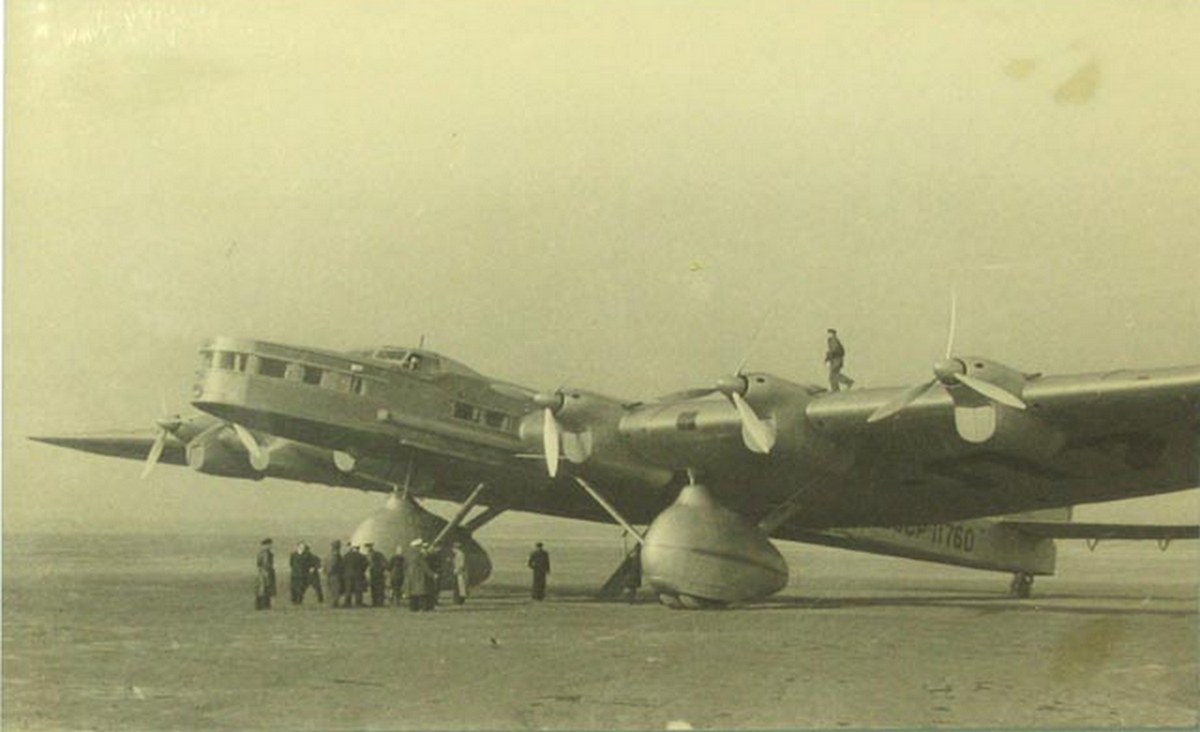
A replacement aircraft, the ANT-20bis (also designated PS-124 or Passazhirsky Samolyot 124, so named as it was built at Plant No. 124), had begun production the following year and first flew in 1938 (other sources mention 15 May 1939 as the date of the first flight). It was largely identical in design but with six more-powerful Mikulin AM-34FRNV engines. On 12 August 1939 it was sold to Aeroflot and served their transport routes in Russia and Uzbekistan. In December 1940, the aircraft was re-engined with two slightly more powerful Mikulin AM-35 engines in the inner positions (numbers three and four). On 14 December 1942, it crashed after the pilot allowed a passenger to take his seat momentarily and the passenger activated the stabilizer control mechanism via a switch on the pilot's armrest, raising the stabilizer and sending the airplane into a nosedive from an altitude of 500 m, killing all 36 on board.
Operators
;

Specifications
|prime units?=met General characteristics
|max takeoff weight kg=53000 |max takeoff weight note= Powerplant
Performance
|never exceed speed kmh= |never exceed speed note= |minimum control speed kmh= |minimum control speed note= |wing loading kg/m2= |fuel consumption kg/km= |power/mass=
References
References
- (March 1935). "News Paper Printed On Plane In Flight". [[Bonnier Corporation]].
- "CCCP-I20".
- Gunston 1995, p.396.
- "The Incomplete Guide to Airfoil Usage".
This article was imported from Wikipedia and is available under the Creative Commons Attribution-ShareAlike 4.0 License. Content has been adapted to SurfDoc format. Original contributors can be found on the article history page.
Ask Mako anything about Tupolev ANT-20 — get instant answers, deeper analysis, and related topics.
Research with MakoFree with your Surf account
Create a free account to save articles, ask Mako questions, and organize your research.
Sign up freeThis content may have been generated or modified by AI. CloudSurf Software LLC is not responsible for the accuracy, completeness, or reliability of AI-generated content. Always verify important information from primary sources.
Report