From Surf Wiki (app.surf) — the open knowledge base
Tuna
Tribe of fish

Tribe of fish
- Allothunnus: slender tunas
- Auxis: frigate tunas
- Euthynnus: little tunas
- Katsuwonus: skipjack tunas
- Thunnus: albacores, true tunas
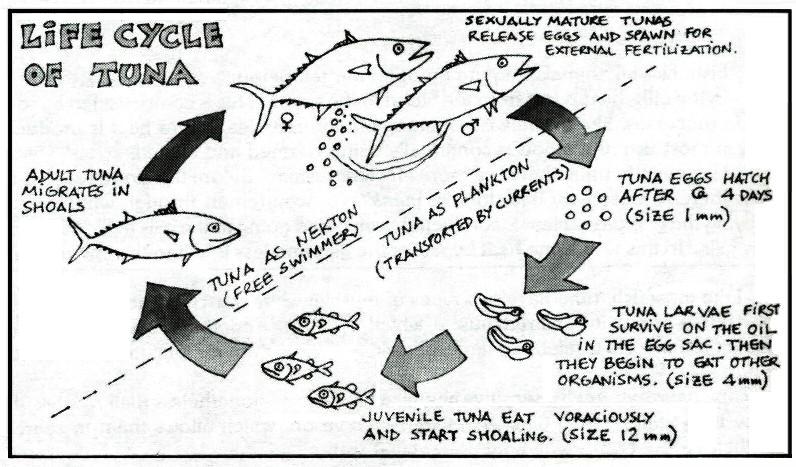
A tuna (: tunas or tuna) is a saltwater fish that belongs to the tribe Thunnini, a subgrouping of the Scombridae (mackerel) family. The Thunnini comprise 15 species across five genera, the sizes of which vary greatly, ranging from the bullet tuna (max length: 50 cm, weight: 1.8 kg) up to the Atlantic bluefin tuna (max length: 4.6 m, weight: 684 kg), which averages 2 m and is believed to live up to 50 years.
Tuna, opah, and mackerel sharks are the only species of fish that can maintain a body temperature higher than that of the surrounding water. An active and agile predator, the tuna has a sleek, streamlined body, and is among the fastest-swimming pelagic fish—the yellowfin tuna, for example, is capable of speeds of up to 75 km/h.
Found in warm seas, the tuna is commercially fished extensively as a food fish, and is popular as a bluewater game fish. As a result of overfishing, some tuna species, such as the southern bluefin tuna, are threatened with extinction.
Etymology
The term "tuna" comes from Spanish atún
A dated alternative term is "tunny".
In English, tuna has been referred to as Chicken of the Sea. This name persists today in Japan, where tuna as a food can be called シーチキン, literally "sea chicken".
Taxonomy
The Thunnini tribe is a monophyletic clade comprising 15 species in five genera: :* family Scombridae :** tribe Thunnini: tunas :*** genus Allothunnus: slender tunas :*** genus Auxis: frigate tunas :*** genus Euthynnus: little tunas :*** genus Katsuwonus: skipjack tunas :*** genus Thunnus: albacores and true tunas :**** subgenus Thunnus (Thunnus): bluefin group :**** subgenus Thunnus (Neothunnus): yellowfin group
The cladogram is a tool for visualizing and comparing the evolutionary relationships between taxa, and is read left-to-right as if on a timeline. The following cladogram illustrates the relationship between the tunas and other tribes of the family Scombridae. For example, the cladogram illustrates that the skipjack tunas are more closely related to the true tunas than are the slender tunas (the most primitive of the tunas), and that the next nearest relatives of the tunas are the bonitos of the tribe Sardini.
True species
The "true" tunas are those that belong to the genus Thunnus. Until recently, it was thought that there were seven Thunnus species, and that Atlantic bluefin tuna and Pacific bluefin tuna were subspecies of a single species. In 1999, Collette established that based on both molecular and morphological considerations, they are in fact distinct species.
The genus Thunnus is further classified into two subgenera: Thunnus (Thunnus) (the bluefin group), and Thunnus (Neothunnus) (the yellowfin group). : |}
Other species
The Thunnini tribe also includes seven additional species of tuna across four genera. They are:
:{| class="wikitable" |- ! colspan="9"| Other tuna species |- ! style="width:10em" | Common name ! style="width:11em" | Scientific name ! Maximum length ! Common length ! Maximum weight ! Maximum age ! Trophic level ! Source ! style="width:11em" |IUCN status |- | Slender tuna | Allothunnus fallai (Serventy, 1948) | [[File:LC IUCN 3 1.svg|LC IUCN 3 1.svg]] Least concern |- | Bullet tuna | Auxis rochei (Risso, 1810) | [[File:LC IUCN 3 1.svg|LC IUCN 3 1.svg]] Least concern |- | Frigate tuna | Auxis thazard (Lacépède, 1800) | [[File:LC IUCN 3 1.svg|LC IUCN 3 1.svg]] Least concern |- | Mackerel tuna, Kawakawa | Euthynnus affinis (Cantor, 1849) | [[File:LC IUCN 3 1.svg|LC IUCN 3 1.svg]] Least concern |- | Little tunny | Euthynnus alletteratus (Rafinesque, 1810) | [[File:LC IUCN 3 1.svg|LC IUCN 3 1.svg]] Least concern |- | Black skipjack tuna | Euthynnus lineatus (Kishinouye, 1920) | [[File:LC IUCN 3 1.svg|LC IUCN 3 1.svg]] Least concern |- | Skipjack tuna | Katsuwonus pelamis (Linnaeus, 1758) | [[File:LC IUCN 3 1.svg|LC IUCN 3 1.svg]] Least concern |}
Biology
_diagram_cropped.GIF)
Description
The tuna is a sleek, elongated and streamlined fish, adapted for speed. It has two closely spaced but separated dorsal fins on its back; The first fin is "depressible" – it can be laid down, flush, in a groove that runs along its back; it is supported by spines. Seven to ten yellow finlets run from the dorsal fins to the tail, which is lunate – curved like a crescent moon – and tapered to pointy tips. A tuna's pelvic fins are located below the base of the pectoral fins. Both dorsal and pelvic fins retract when the fish is swimming fast.
The tuna's body is countershaded to camouflage itself in deeper water when seen from above, its dorsal side is generally a metallic dark blue while the ventral or under side is silvery, often with an iridescent shine. The caudal peduncle, to which the tail is attached, is quite thin, with three stabilizing horizontal keels on each side.
Physiology
Thunnus are widely but sparsely distributed throughout the oceans of the world, generally in tropical and temperate waters at latitudes ranging between about 45° north and south of the equator. All tunas are able to maintain the temperature of certain parts of their body above the temperature of ambient seawater. For example, bluefin can maintain a core body temperature of 25 -, in water as cold as 6 C. Unlike other endothermic creatures such as mammals and birds, tuna do not maintain temperature within a relatively narrow range.
Tunas achieve endothermy by conserving the heat generated through normal metabolism. In all tunas, the heart operates at ambient temperature, as it receives cooled blood, and coronary circulation is directly from the gills. This allows the tuna to elevate the temperatures of the highly-aerobic tissues of the skeletal muscles, eyes and brain, which supports faster swimming speeds and reduced energy expenditure, and which enables them to survive in cooler waters over a wider range of ocean environments than those of other fish.
Also unlike most fish, which have white flesh, the muscle tissue of tuna ranges from pink to dark red. The red myotomal muscles derive their color from myoglobin, an oxygen-binding molecule, which tuna express in quantities far higher than most other fish. The oxygen-rich blood further enables energy delivery to their muscles.
For powerful swimming animals like dolphins and tuna, cavitation may be detrimental, because it limits their maximum swimming speed. Even if they have the power to swim faster, dolphins may have to restrict their speed, because collapsing cavitation bubbles on their tail are too painful. Cavitation also slows tuna, but for a different reason. Unlike dolphins, these fish do not feel the bubbles, because they have bony fins without nerve endings. Nevertheless, they cannot swim faster because the cavitation bubbles create a vapor film around their fins that limits their speed. Lesions have been found on tuna that are consistent with cavitation damage.
Fishing

Commerce
Tuna is an important commercial fish. The International Seafood Sustainability Foundation (ISSF) compiled a detailed scientific report on the state of global tuna stocks in 2009, which includes regular updates. According to the ISSF, the most important species for commercial and recreational tuna fisheries are yellowfin (Thunnus albacares), bigeye (T. obesus), bluefin (T. thynnus, T. orientalis, and T. macoyii), albacore (T. alalunga), and skipjack (Katsuwonus pelamis).{{cite web |url=http://www.iss-foundation.org/files/b45a4eb2-f9d7-4ed6-87a1-2efe2519baf6/ISSF_A-1%20Introduction.pdf
Based on catches from 2007, the report states:
The Australian government alleged in 2006 that Japan had illegally overfished southern bluefin by taking 12,000 to 20,000 tonnes per year instead of the agreed upon 6,000 tonnes; the value of such overfishing would be as much as US$2 billion. Such overfishing has severely damaged bluefin stocks. According to the WWF, "Japan's huge appetite for tuna will take the most sought-after stocks to the brink of commercial extinction unless fisheries agree on more rigid quotas".{{cite news |access-date=2 April 2008
In recent years, opening day fish auctions at Tokyo's Tsukiji fish market and Toyosu Market have seen record-setting prices for bluefin tuna, reflecting market demand. In each of 2010, 2011, 2012, 2013 and 2019, new record prices have been set for a single fish – the current record is 333.6 million japanese yen (US$3.1 million) for a 278 kg bluefin, or a unit price of JP¥ 1,200,000/kg (US$5,057/lb). The opening auction price for 2014 plummeted to less than 5% of the previous year's price, which had drawn complaints for climbing "way out of line". A summary of record-setting auctions are shown in the following table (highlighted values indicate new world records):
| Record bluefin tuna auctions at Tokyo's Tsukiji fish market and Toyosu Market | (Highlighted field indicates new record price for a single fish) | Year | Total | |||||||||||
|---|---|---|---|---|---|---|---|---|---|---|---|---|---|---|
| weight | Total sale | Unit price | Source | (JP ¥) | (US $) | (¥ / kg) | ($ / lb) | |||||||
| 2001 | 202 kg | ¥20.2 million | $173,600 | ¥100,000 / kg | $386 / lb | |||||||||
| 2010 | 232 kg | ¥16.28 million | $175,000 | ¥70,172 / kg | $343 / lb | |||||||||
| 2011 | 342 kg | ¥32.49 million | $396,000 | ¥95,000 / kg | $528 / lb | title=Fish story: Big tuna sells for record $396,000 | url=https://www.nbcnews.com/id/wbna40921151 | publisher=NBCNews.com | access-date=19 September 2012 | date=5 January 2011}} | ||||
| 2012 | 269 kg | ¥56.49 million | $736,000 | ¥210,000 / kg | $1,247 / lb | |||||||||
| 2013 | 221 kg | ¥155.4 million | $1.76 million | ¥703,167 / kg | $3,603 / lb | |||||||||
| 2019 | 278 kg | ¥333.6 million | $3.1 million | ¥1,200,000 / kg | $5,057 / lb |
In November 2011, a different record was set when a fisherman in Massachusetts caught an 881 lb tuna. It was captured inadvertently using a dragnet. Due to the laws and restrictions on tuna fishing in the United States, federal authorities impounded the fish because it was not caught with a rod and reel. Because of the tuna's deteriorated condition as a result of the trawl net, the fish sold for just under $5,000.
File:TunaFish.JPG|Tuna being weighed on Greek quay-side File:Tsukiji Fish market and Tuna edit.jpg|Tuna at Tsukiji fish market, Tokyo File:Tuna cut half japan.jpg|Tuna cut in half for processing at Tsukuji fish market
Methods
Besides for edible purposes, many tuna species are caught frequently as game, often for recreation or for contests in which money is awarded based on weight. Larger specimens are notorious for putting up a fight while hooked, and have been known to injure people who try to catch them, as well as damage their equipment.
- Phoenician technique for trapping and catching Atlantic bluefin tuna called Almadraba, still used today in Portugal, Spain, Morocco and Italy which uses a maze of nets. In Sicily, the same method is called Tonnara.
- Fish farming (cage system)
- Tuna ranching
- Longline fishing
- Purse seines
- Pole and line
- Harpoon gun
- Big game fishing
- Fish aggregating device
Association with whaling
In 2005, Nauru, defending its vote from Australian criticism at that year's meeting of the International Whaling Commission, argued that some whale species have the potential to devastate Nauru's tuna stocks, and that Nauru's food security and economy relies heavily on fishing. Despite this, Nauru does not permit whaling in its own waters and does not allow other fishing vessels to take or intentionally interact with marine mammals in its Exclusive Economic Zone. In 2010 and 2011, Nauru supported Australian proposals for a western Pacific-wide ban on tuna purse-seining in the vicinity of marine mammals – a measure which was agreed by the Western and Central Pacific Fisheries Commission at its eighth meeting in March 2012.
Association with dolphins
Dolphins swim beside several tuna species. These include yellowfin tuna in the eastern Pacific Ocean, but not albacore. Tuna schools are believed to associate themselves with dolphins for protection against sharks, which are tuna predators.
Commercial fishing vessels used to exploit this association by searching for dolphin pods. Vessels would encircle the pod with nets to catch the tuna beneath. The nets were prone to entangling dolphins, injuring or killing them. Public outcry and new government regulations, which are now monitored by NOAA have led to more dolphin-friendly methods, now generally involving lines rather than nets. There are neither universal independent inspection programs nor verification of dolphin safety, so these protections are not absolute. According to Consumers Union, the resulting lack of accountability means claims of tuna that is "dolphin safe" should be given little credence.
Fishery practices have changed to be dolphin friendly, which has caused greater bycatch including sharks, turtles and other oceanic fish. Fishermen no longer follow dolphins, but concentrate their fisheries around floating objects such as fish aggregation devices, also known as FADs, which attract large populations of other organisms. Measures taken thus far to satisfy the public demand to protect dolphins can be potentially damaging to other species as well.
Aquaculture
Increasing quantities of high-grade tuna caught at sea are reared in net pens and fed bait fish. In Australia, former fishermen raise southern bluefin tuna (Thunnus maccoyii) and another bluefin species. Farming its close relative, the Atlantic bluefin tuna, Thunnus thynnus, is beginning in the Mediterranean, North America and Japan. Hawaii approved permits for the first U.S. offshore farming of bigeye tuna in water 1300 ft deep in 2009. |access-date=11 August 2013
Japan is the biggest tuna consuming nation and is also the leader in tuna farming research. |access-date=13 May 2013
Food
Main article: List of tuna dishes
Fresh and frozen
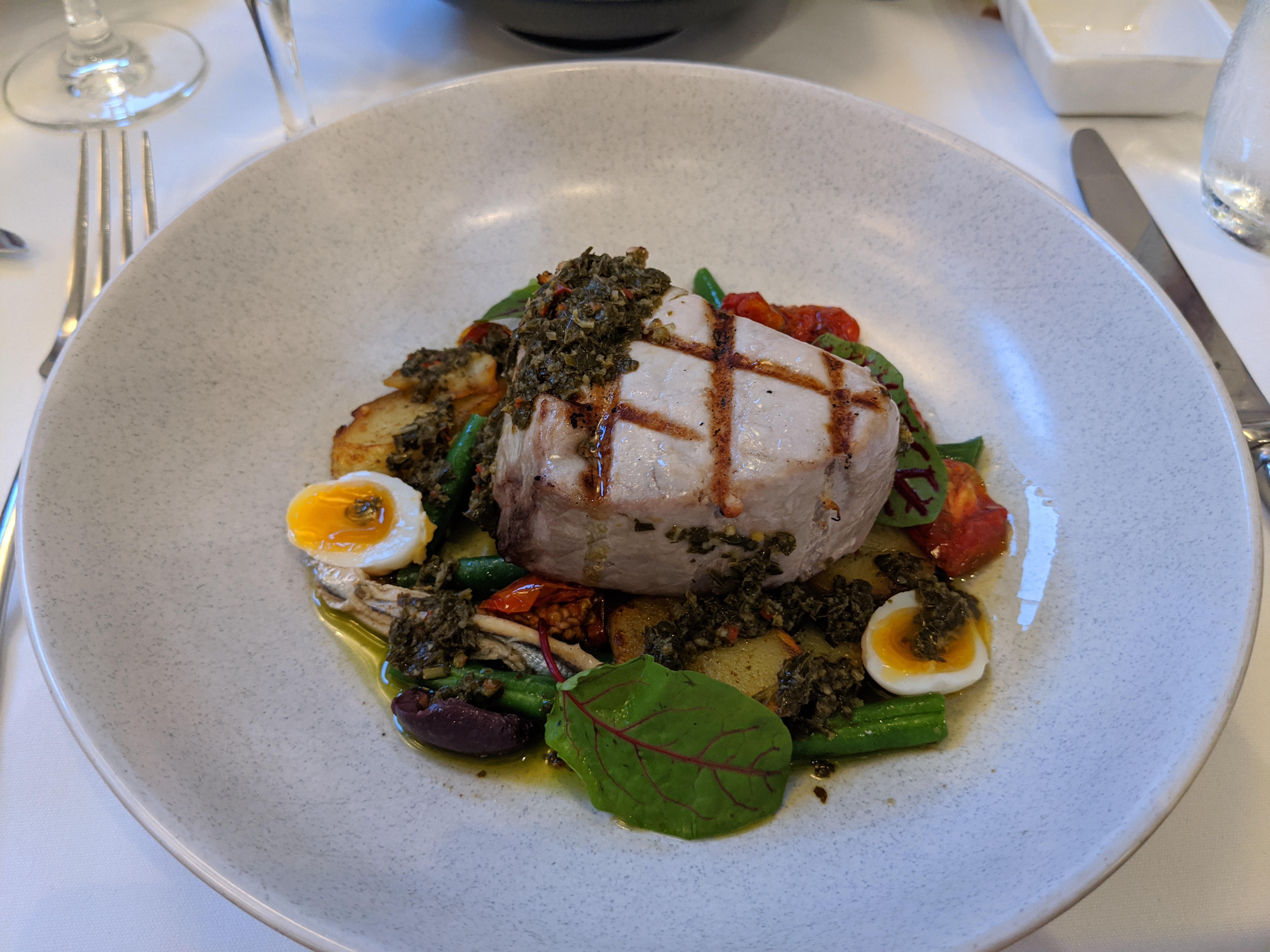
The fresh or frozen flesh of tuna is widely regarded as a delicacy in most areas where it is shipped, being prepared in a variety of ways. When served as a steak, the meat of most species is known for its thickness and firm texture. In the U.K., supermarkets began flying in fresh tuna steaks in the late 1990s, which helped to increase the popularity of using fresh tuna in cooking; by 2009, celebrity chefs regularly featured fresh tuna in salads, wraps, and char-grilled dishes.
Served raw
Various species of tuna are often served raw in Japanese cuisine as sushi or sashimi.
Commercial sashimi tuna may have their coloration fixated by pumping carbon monoxide (CO) into bags containing the tuna, and holding it at 4°C. For a 2-inch tuna steak, this requires 24 hours. The fish is then vacuum sealed and frozen. In Japan, color fixation using CO is prohibited.
Tuna consumption increases the risk of getting cancer. File:Tuna_Sushi.jpg| File:Tuna fish sandwiches for the National School Lunch Program (1).jpg| File:tuna steak.JPG| File:Tekkadon_001.jpg| File:Katsuobushi 02.jpg| File:Mojama de atun.JPG|
Canned

Tuna is canned in edible oils, in brine, in water, and in various sauces. Tuna may be processed and labeled as "solid", "chunked" ("chunk") or "flaked". When tuna is canned and packaged for sale, the product is sometimes called tuna fish (U.S.), a calque (loan translation) from the German Thunfisch. Canned tuna is sometimes used as food for pets, especially cats.
;Australia Canned tuna was first produced in Australia in 1903 and quickly became popular.
In the early 1980s canned tuna in Australia was most likely southern bluefin, it was usually yellowfin, skipjack, or tongol (labelled "northern bluefin" or "longtail").
Australian standards once required cans of tuna to contain at least 51% tuna, but those regulations were dropped in 2003. The remaining weight is usually oil or water.
;United States The product became more plentiful in the United States in the late 1940s. In 1950, 8,500,000 pounds of canned tuna were produced, and the U.S. Department of Agriculture classified it as a "plentiful food".
In the United States, 52% of canned tuna is used for sandwiches; 22% for tuna salads; and 15% for tuna casseroles and dried, prepackaged meal kits, such as General Mills's Tuna Helper line. Other canned tuna dishes include tuna melts (a type of sandwich where the tuna is mixed with mayonnaise and served on bread with cheese melted on top); salade niçoise (a salad made of tuna, olives, green beans, potatoes, hard-boiled eggs and anchovy dressing); and tuna burgers (served on buns).
In the United States, the Food and Drug Administration (FDA) regulates canned tuna (see part c).
;Precooked As tunas are often caught far from where they are processed, poor interim conservation can lead to spoilage. Tuna is typically gutted by hand, and later precooked for prescribed times of 45 minutes to three hours. The fish are then cleaned and filleted, canned (and sealed), with the dark lateral blood meat often separately canned for pet food (cat or dog). The sealed can is then heated under pressure (called "retort cooking") for 2–4 hours.{{cite web |access-date=11 August 2013 |archive-url=https://web.archive.org/web/20130812124832/http://www.dol.gov/whd/as/sec3.htm |archive-date=12 August 2013
;Light and white In some markets, depending upon the color of the flesh of the tuna species, the can is marked as "light" or "white" meat, with "light" meaning a greyish pink color and "white" meaning a light pink color. In the United States, only albacore can legally be sold in canned form as "white meat tuna"; in other countries, yellowfin is also acceptable.
; Ventresca tunaVentresca tuna Ventresca tuna (from ventre, the Italian word for belly), is a luxury canned tuna, from the fatty bluefin tuna belly, also used in sushi as toro.
Nutrition
Canned light tuna in oil is 29% protein, 8% fat, 60% water, and contains no carbohydrates, while providing 200 calories in a 100 gram reference amount (table). It is a rich source (20% or more of the Daily Value, DV) of vitamin D and phosphorus (table).
Mercury and health
Mercury content in tuna can vary widely. Among those calling for improved warnings about mercury in tuna is the American Medical Association, which adopted a policy that physicians should help make their patients more aware of the potential risks. A study published in 2008 found that mercury distribution in the meat of farmed tuna is inversely related to the lipid content, suggesting that higher lipid concentration within edible tissues of tuna raised in captivity might, other factors remaining equal, have a diluting effect on mercury content.{{cite journal
In March 2004, the United States FDA issued guidelines recommending that pregnant women, nursing mothers, and children limit their intake of tuna and other predatory fish.{{cite web | access-date = 2007-05-19 | archive-date = 19 May 2007 | archive-url = https://web.archive.org/web/20070519060018/http://www.cfsan.fda.gov/~dms/admehg3.html | access-date = 2012-04-02 | archive-date = 17 June 2012 | archive-url = https://web.archive.org/web/20120617174655/http://www.nrdc.org/health/effects/mercury/tuna.asp |access-date=2007-06-21 | work=Chicago Tribune | access-date = 2007-05-19 | archive-date = 10 April 2007 | archive-url = https://web.archive.org/web/20070410020238/http://www.consumerreports.org/cro/food/tuna-safety/overview/0607_tuna_ov.htm
A January 2008 report revealed potentially dangerous levels of mercury in certain varieties of sushi tuna, reporting levels "so high that the Food and Drug Administration could take legal action to remove the fish from the market."{{cite news |access-date=11 September 2009
Management and conservation
The main tuna fishery management bodies are the Western and Central Pacific Fisheries Commission, the Inter-American Tropical Tuna Commission, the Indian Ocean Tuna Commission, the International Commission for the Conservation of Atlantic Tunas, and the Commission for the Conservation of Southern Bluefin Tuna.{{cite news
In 2010, Greenpeace International added the albacore, bigeye tuna, Pacific bluefin tuna, Atlantic bluefin tuna, southern bluefin tuna, and yellowfin tuna to its seafood red list, which are fish "commonly sold in supermarkets around the world, and which have a very high risk of being sourced from unsustainable fisheries."
Bluefin tuna have been widely accepted as being severely overfished, with some stocks at risk of collapse. According to the International Seafood Sustainability Foundation (a global, nonprofit partnership between the tuna industry, scientists, and the World Wide Fund for Nature), Indian Ocean yellowfin tuna, Pacific Ocean (eastern and western) bigeye tuna, and North Atlantic albacore tuna are all overfished. In April 2009, no stock of skipjack tuna (which makes up roughly 60% of all tuna fished worldwide) was considered to be overfished.
The BBC documentary South Pacific, which first aired in May 2009, stated that, should fishing in the Pacific continue at its current rate, populations of all tuna species could collapse within five years. It highlighted huge Japanese and European tuna fishing vessels, sent to the South Pacific international waters after overfishing their own fish stocks to the point of collapse.
A 2010 tuna fishery assessment report, released in January 2012 by the Secretariat of the Pacific Community, supported this finding, recommending that all tuna fishing should be reduced or limited to current levels and that limits on skipjack fishing be considered.{{cite web |archive-url=https://web.archive.org/web/20131115074636/http://www.cookislandsnews.com/2012/January/Wed18/environment.htm |archive-date=2013-11-15
Research indicates that increasing ocean temperatures are taking a toll on the tuna in the Indian Ocean, where rapid warming of the ocean has resulted in a reduction of marine phytoplankton. The bigeye tuna catch rates have also declined abruptly during the past half century, mostly due to increased industrial fisheries, with the ocean warming adding further stress to the fish species.
References
Further references
- Clover, Charles. 2004. The End of the Line: How Overfishing Is Changing the World and What We Eat. Ebury Press, London.
- FAO: Species Catalog Vol. 2 Scombrids of the World. FAO Fisheries Synopsis No. 125, Volume 2. FIR/S125 Vol. 2.
- FAO: Review of the state of world marine fishery resources: Tuna and tuna-like species – Global, 2005 Rome.
- Majkowski, Jacek (1995) "Tuna and tuna-like species" In: Review of the state of world marine fishery resources, FAO Fisheries technical paper 457, FAO, Rome. .
- Majkowski J, Arrizabalaga H, Carocci F and Murua H (2011) "Tuna and tuna-like species" In: Review of the state of world marine fishery resources, pages 227–244, FAO Fisheries technical paper 569, FAO, Rome. .
- Standard of Identity for Canned Tuna (United States), Code of Federal Regulations: 21 CFR 161.190 – Canned tuna.
- Viñas J and Tudela S (2009) "A validated methodology for genetic identification of tuna species (genus Thunnus)" PLoS One, 4(10): e7606.
References
- "Tribe Thunnini Starks 1910".
- (April 1964). "Measurements of swimming speeds of yellowfin tuna and wahoo". [[Nature (journal).
- (2015). "tuna". Houghton Mifflin Harcourt Publishing Company.
- (1879). "thunnus". Perseus Digital Library.
- {{LSJ. qu/nnos. θύννος. longref
- {{LSJ. qu/nw. θύνω. shortref.
- (2004). "Tuna Comparative Physiology". The Journal of Experimental Biology.
- Collette, B.B.. (1999). "Mackerels, molecules, and morphology". Société Française d'Ichtyologie [u.a.].
- (2006). "Growth-dependent recruitment of Pacific bluefin tuna ''Thunnus orientalis'' in the northwestern Pacific Ocean". Marine Ecology Progress Series.
- (2018). "Encyclopedia of Reproduction".
- {{FishBase. (2012)
- Collette, B.. (2011). "''Allothunnus fallai''".
- {{FishBase. (2012)
- Collette, B.. (2011). "''Auxis rochei''".
- {{FishBase. (2012)
- Collette, B.. (2011). "''Auxis thazard''".
- {{FishBase. (2012)
- Collette, B.. (2011). "''Euthynnus affinis''".
- {{FishBase. (2012)
- Collette, B.. (2011). "''Euthynnus alletteratus''".
- {{FishBase. (2012)
- Collette, B.. (2011). "''Euthynnus lineatus''".
- {{FishBase. (2012)
- Collette, B.B.. (2021). "''Katsuwonus pelamis''".
- . (n.d.). ["Biological characteristics of tuna"](https://www.fao.org/figis/pdf/fishery/topic/16082/en?title=FAO%20Fisheries%20%26%20Aquaculture%20-%20Biological%20characteristics%20of%20tuna). *Fisheries and Aquaculture Department, [[Food and Agriculture Organization]]*.
- Gibbs, E.. "Fact Sheet: Tuna #P1412". Rhode Island Sea Grant.
- (21 April 2017). "Countershading". [[American Fisheries Society]].
- (1 July 2008). "Elevated red myotomal muscle temperatures in the most basal tuna species, ''Allothunnus fallai''". Journal of Fish Biology.
- (1984). "Temperature-induced changes in blood gas equilibria in the albacore, ''Thunnus alalunga'', a warm-bodied tuna". Journal of Experimental Biology.
- (16 October 2003). "Temperature dependence of the Ca2+-ATPase (SERCA2) in the ventricles of tuna and mackerel". American Journal of Physiology. Regulatory, Integrative and Comparative Physiology.
- (6 March 2008). "Speed limits on swimming of fishes and cetaceans". Journal of the Royal Society Interface.
- Bradford, Gillian. (16 October 2006). "Bluefin Tuna Plundering Catches Up With Japan". ABC News.
- Eilperin, Juliet. (29 November 2009). "Global approach now favored for marine conservation". Washington Post.
- Wright, Hillel. (9 January 2011). "Are Japan's fish lovers eating tuna to extinction?". [[Japan Times]].
- (5 January 2014). "Price of tuna nosedives at famous Tokyo auction despite dwindling stocks". [[The Toronto Star]].
- Buerk, Roland. (5 January 2010). "Tuna hits highest price in nine years at Tokyo auction". BBC News.
- (5 January 2011). "Fish story: Big tuna sells for record $396,000". NBCNews.com.
- (5 January 2012). "A single fish sells for nearly three-quarters of a million dollars". NBCNews.com.
- (4 January 2013). "A bluefin tuna sells for record $1.76M in Tokyo". usatoday.com.
- (2019-01-05). "Tuna sells for record $3 million in auction at Tokyo's new fish market". Reuters.
- (2011-11-15). "Man catches 881-pound tuna, seized by feds | The Sideshow – Yahoo! News". News.yahoo.com.
- Dorney, Sean. (2005-06-28). "Nauru defends whaling vote. 28/06/2005. ABC News Online". Abc.net.au.
- Western and Central Pacific Fisheries Commission. "Australia Proposals to Address the Impact of Purse Seine Fishing Activity on Cetaceans". WCPFC.
- "ENSENADA: El Puerto del Atun". Journalism.berkeley.edu.
- "Dolphin-safe tuna". Whale and Dolphin Conservation.
- (16 February 2009). "The ecological disaster that is dolphin safe tuna". Southern Fried Science.
- (2001). "Positive Reform of Tuna Farm Diving in South Australia in Response to Government Intervention". Occupational and Environmental Medicine.
- "Cultivation, seedling production, and selective breeding of bluefin tuna and other fish at the Kinki University Fisheries Laboratory". Flku.jp.
- Jung, Carolyn. (2008-05-21). "The rarest tuna of all – Japan's farmed Kindai". The San Francisco Chronicle.
- Raisfeld, Robin. (2008-05-04). "Can a Farmed Bluefin Tuna Save the Planet? – New York Magazine". Nymag.com.
- (2009-05-15). "FNArena". FNArena.
- "Stateline South Australia". Abc.net.au.
- Austin, Nigel. (2008-09-23). "Clean Seas teams up with Japan's Kinki Uni for tuna research". The Advertiser.
- (2009-11-12). "The Tank-Bred Tuna". [[Time (magazine).
- "Aussies Win 'Best Invention' Award". ThinkingAustralia.com.
- Hickman, Martin. (9 June 2009). "How Tuna Conquered the World". The Independent.
- Hui, Y. H.. (2004). "Handbook of Frozen Foods". CRC Press.
- ''[[Choice (Australian magazine). Choice]]'': Jan/Feb 2004.
- ''[[Choice (Australian magazine). Choice]]'', August 2003.
- link. (1 August 2008)
- Casa-Emellosthe, Ruth P.. (March 1, 1951). "News of Food: Tuna Provides Tempting Dishes; Canned Fish Plentiful Now and a Good Buy for Budget-Minded". [[New York Times]].
- "Tuna". ''Modern Marvels'', 4 February 2010.
- "CFR – Code of Federal Regulations Title 21". Accessdata.fda.gov.
- Ellis, Richard. ''Tuna: A Love Story.'' New York: Random House, 2009, p. 119. {{ISBN. 0-307-38710-0
- (31 July 2012). "Name That Tuna! The Little-Known, Sexy Varieties that Are Vastly Superior to the Supermarket Cans".
- (November 18, 2010). "Luxury Canned Tuna".
- (2008). "The Complete Idiot's Guide to Sushi and Sashimi". Alpha Books.
- . (2007). ["Sushi Menu"](http://www.sushiencyclopedia.com/sushi_menu.html).
- (2005-12-13). "How safe is tuna?". Chicago Tribune.
- (September 2008). "The Ecosystem-Based Management Fishery in the Bay of Bengal". Department of Fisheries, (DOF); Ministry of Agriculture and Cooperatives, Thailand.
- (1982). "Improving the acceptability of canned Mackerel tuna (''Euthynnus affinis'')". Fish Technology.
- {{cite court. (2009). link
- (2007-01-23). "Briefing: Joint Tuna RFMO Meeting, Kobe 2007".
- (2007-01-26). "Conference approves global plan to save tuna stocks".
- (2003-03-17). "Greenpeace International Seafood Red list". Greenpeace.org.
- Greenberg, Paul. (2010-06-21). "Tuna's End". The New York Times.
- Black, Richard. (17 October 2007). "Last rites for a marine marvel?". BBC News.
- Ito, Masami, "[http://search.japantimes.co.jp/cgi-bin/nn20100831i1.html Does Japan's affair with tuna mean loving it to extinction?]", ''[[Japan Times]]'', 31 August 2010, p. 3. {{dead link. (June 2016)
- (15 April 2009). "Status of the World Fisheries for Tuna: Section A-2 – Summary". ISSF.
- "Fragile Paradise".
- (28 January 2016). "A reduction in marine primary productivity driven by rapid warming over the tropical Indian Ocean". Geophysical Research Letters.
This article was imported from Wikipedia and is available under the Creative Commons Attribution-ShareAlike 4.0 License. Content has been adapted to SurfDoc format. Original contributors can be found on the article history page.
Ask Mako anything about Tuna — get instant answers, deeper analysis, and related topics.
Research with MakoFree with your Surf account
Create a free account to save articles, ask Mako questions, and organize your research.
Sign up freeThis content may have been generated or modified by AI. CloudSurf Software LLC is not responsible for the accuracy, completeness, or reliability of AI-generated content. Always verify important information from primary sources.
Report