From Surf Wiki (app.surf) — the open knowledge base
Tulln an der Donau
| Field | Value | |
|---|---|---|
| name | Tulln an der Donau | |
| settlement_type | Municipality | |
| image_skyline | GuentherZ 2010-04-24 0034 Tulln Hauptplatz.jpg | |
| image_caption | Main square with Marian column | |
| image_shield | AUT Tulln an der Donau COA.svg | |
| shield_size | 80x110px | |
| shield_link | ||
| pushpin_map | Austria | |
| pushpin_mapsize | 270 | |
| pushpin_map_caption | Location within Austria | |
| map_caption | Location within Tulln district | |
| <!-- Location --> | coordinates | |
| subdivision_type | Country | |
| subdivision_name | Austria | |
| subdivision_type1 | State | |
| subdivision_name1 | Lower Austria | |
| subdivision_type2 | District | |
| subdivision_name2 | Tulln | |
| parts_style | para | |
| p1 | ||
| leader_title | Mayor | |
| leader_name | Peter Eisenschenk (ÖVP) | |
| leader_name1 | ||
| area_footnotes | ||
| area_total_km2 | ||
| elevation_m | 180 | |
| population_as_of | ||
| population_footnotes | ||
| population_total | ||
| population_density_km2 | auto | |
| timezone | CET | |
| timezone_DST | CEST | |
| utc_offset | +1 | |
| utc_offset_DST | +2 | |
| registration_plate | TU | |
| postal_code_type | Postal code | |
| postal_code | 3425, 3430 | |
| area_code_type | Area code | |
| area_code | 02272 | |
| website | www.tulln.at |
Tulln an der Donau () is a historic town in the Austrian state of Lower Austria, the administrative seat of Tulln District. Because of its abundance of parks and gardens, Tulln is often referred to as Blumenstadt ("City of Flowers"), and "The City of Togetherness" following the initiative of Peter Eisenschenk, Mayor of Tulln.
Geography
The town is situated in the centre of the Tulln Basin stretching to the Vienna Woods in the south, about 40 km northwest of the Austrian capital Vienna. The main part of its built-up area is located on the southern bank of the Danube river.
Populated places
The municipality of Tulln an der Donau consists of the following cadastral communities: Frauenhofen, Langenlebarn-Oberaigen, Langenlebarn-Unteraigen, Mollersdorf, Neuaigen, Nitzing, Staasdorf, Trübensee, and Tulln Proper; while further subdivided into populated places (with population in brackets as of 1 January 2022).
- Frauenhofen (104)
- Langenlebarn-Oberaigen (1465)
- Langenlebarn-Unteraigen (1026)
- Mollersdorf (168)
- Neuaigen (547)
- Nitzing (373)
- Staasdorf (250)
- Trübensee (131)
- Tulln an der Donau (12.492)
History
Tulln is one of the oldest towns in Austria. Although it was settled in pre-Roman times (the name Tulln is presumably of Celtic origin), it gained importance as the Roman fort of Comagena (Comagenis). In the final years of Roman rule, Saint Severinus of Noricum is said to have visited the city, saving it from the barbarians.
The town was first mentioned as Tullina in an 859 deed, when the area was part of the Bavarian marcha orientalis. It gained importance as a residence of the noble House of Babenberg, ruling as Austrian margraves from 976 onwards. Tulln lost its significance after the Babenbergs relocated their residence to Vienna.
On 6 September 1683 the Polish cavalry of King John III Sobieski united here with Imperial (Austrian) forces, as well as troops from Saxony, Bavaria and Baden for the Battle of Vienna against the invading army of the Ottoman Empire. The 20th century was another period of growth, and in 1986, Tulln applied to become capital of Lower Austria, although Sankt Pölten eventually won.
Tulln today
An important sugar producing plant, Agrana Austria, is located in Tulln. Several important trade fairs, including camping equipment and boat shows, also take place in the town.
Various state institutions of Lower Austria, such as the fire brigade or the disaster relief service, have their seat in Tulln. The Federal School of Aviation is also located in Tulln.
The 37-seat town council is dominated by the Austrian People's Party, which currently holds 19 mandates. The town administration has lately carried out extensive urban traffic reform, extensively changing traffic lights with roundabouts, of which Tulln now has 22.
Transport
Two bridges span the Danube river in Tulln. The Franz Josef Railway crosses the Danube in Tulln, continuing via Krems an der Donau to Gmünd. Der Standard, a Viennese daily newspaper, is produced in Tulln.
Sights

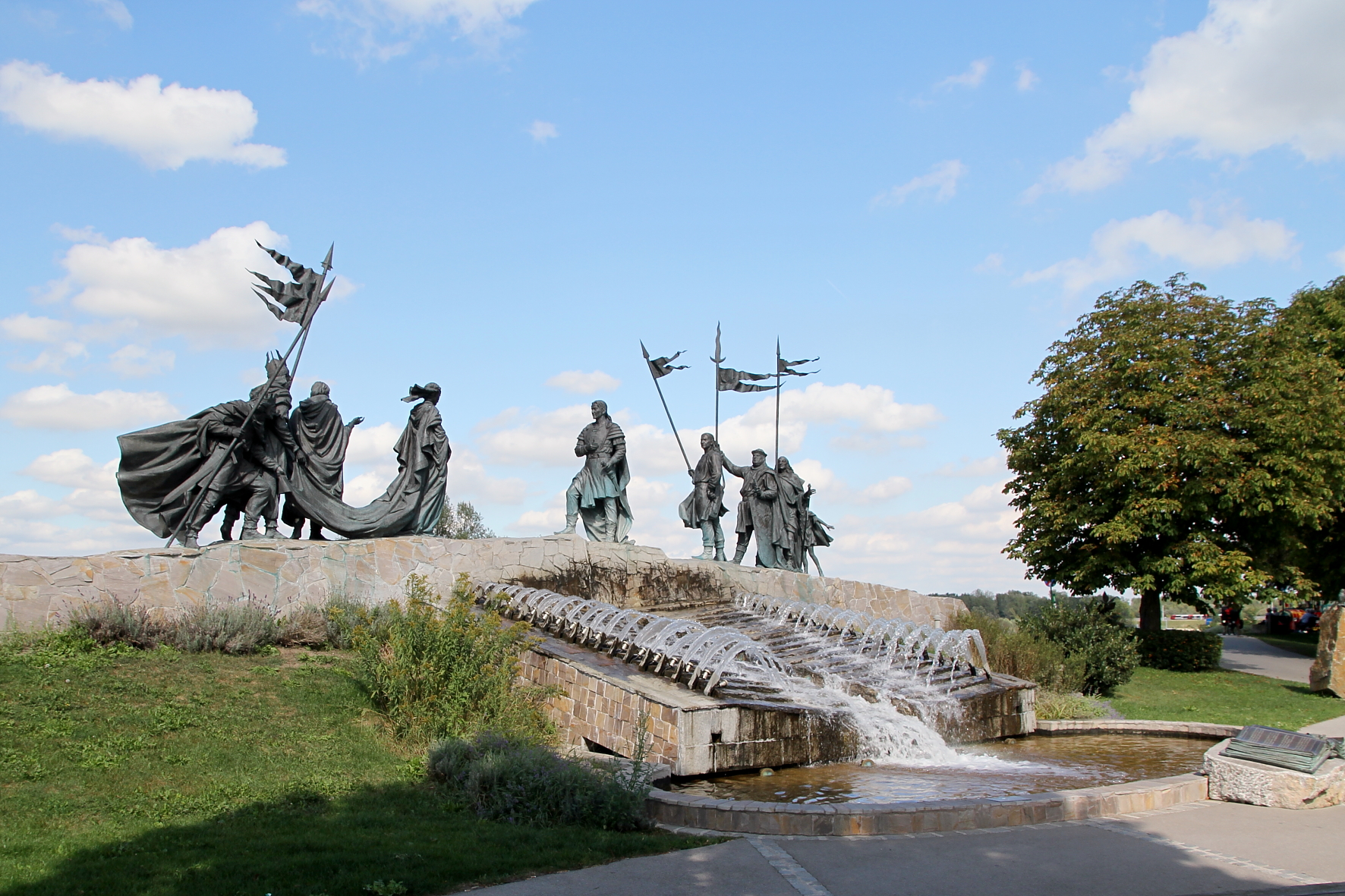
- According to the Nibelungenlied, it was in Tulln that Attila the Hun saw Kriemhild (the Nibelungenlieds name for Gudrun) and proposed to her. A fountain, the Nibelungen-Brunnen ("the Nibelungen Fountain") was dedicated to this event in 2005.
- The ship Regentag by Friedensreich Hundertwasser is riding at anchor by the Danube as a part of a modern art museum here since 2004. It was first heard of in the short documentary Hundertwasser's Rainy Day (1972).
- In 2008 a shopping mall, called Rosenarcade was built.
- Aubad is a well known lake in Tulln with many visitors and tourists during spring and summer time.
- Minoritenkloster, a convent.
- A 4th-century Roman tower.
Notable citizens

- Ferdinand Grossmann (1887–1970), choral conductor, vocal teacher and composer
- Egon Schiele (1890–1918), Austrian painter, was born in Tulln and the Egon-Schiele-Museum is dedicated to him.
- Siegfried Seidl (1911–1947), convicted and hanged WWII criminal, Nazi commandant of Theresienstadt.
- Leo Stopfer (born 1964), painter; acclaimed as the "Painter of the Ballet-Stars"
- Peter Balazs (born 1970), mathematician; works at the Acoustics Research Institute, Vienna
- Alex Machacek (born 1972), jazz guitarist and composer
- Doris Schretzmayer, (DE Wiki) (born 1972), actress
- Richard Koch, (DE Wiki) (born 1979), jazz trumpeter
Sport
- Thomas Sykora (born 1968), alpine skier, bronze medallist at the 1998 Winter Olympics
- Wolfgang Eibeck (born 1972), a retired Paralympic cyclist, multiple Paralympic Games medallist
- Nina Burger (born 1987), football player, played 108 games for Austria women
- Robert Dreissker (born 1989), professional wrestler
- Konstantin Kerschbaumer (born 1992), footballer who has played over 350 games
- Thomas Diethart (born 1992), ski jumper, team silver medallist at the 2014 Winter Olympics
- Nikola Dovedan (born 1994), footballer who has played over 360 games
References
References
- (21 November 2024). "Egon Schiele’s Hidden Obsessions Laid Bare". The New York Times.
This article was imported from Wikipedia and is available under the Creative Commons Attribution-ShareAlike 4.0 License. Content has been adapted to SurfDoc format. Original contributors can be found on the article history page.
Ask Mako anything about Tulln an der Donau — get instant answers, deeper analysis, and related topics.
Research with MakoFree with your Surf account
Create a free account to save articles, ask Mako questions, and organize your research.
Sign up freeThis content may have been generated or modified by AI. CloudSurf Software LLC is not responsible for the accuracy, completeness, or reliability of AI-generated content. Always verify important information from primary sources.
Report