From Surf Wiki (app.surf) — the open knowledge base
Tubular bells
Mallet percussion instrument
Mallet percussion instrument
| Field | Value |
|---|---|
| name | Tubular bells |
| names | |
| image | Yamaha Deagan chimes (from LA Percussion Rentals).jpg |
| image_capt | A set of chimes made by Yamaha |
| background | percussion |
| classification | Keyboard percussion |
| hornbostel_sachs | 111.232 |
| hornbostel_sachs_desc | Sets of percussion tubes |
| range | C4–F5 standard; extended range can include B3–G5, bass F3–B3, but can vary |
| builders |
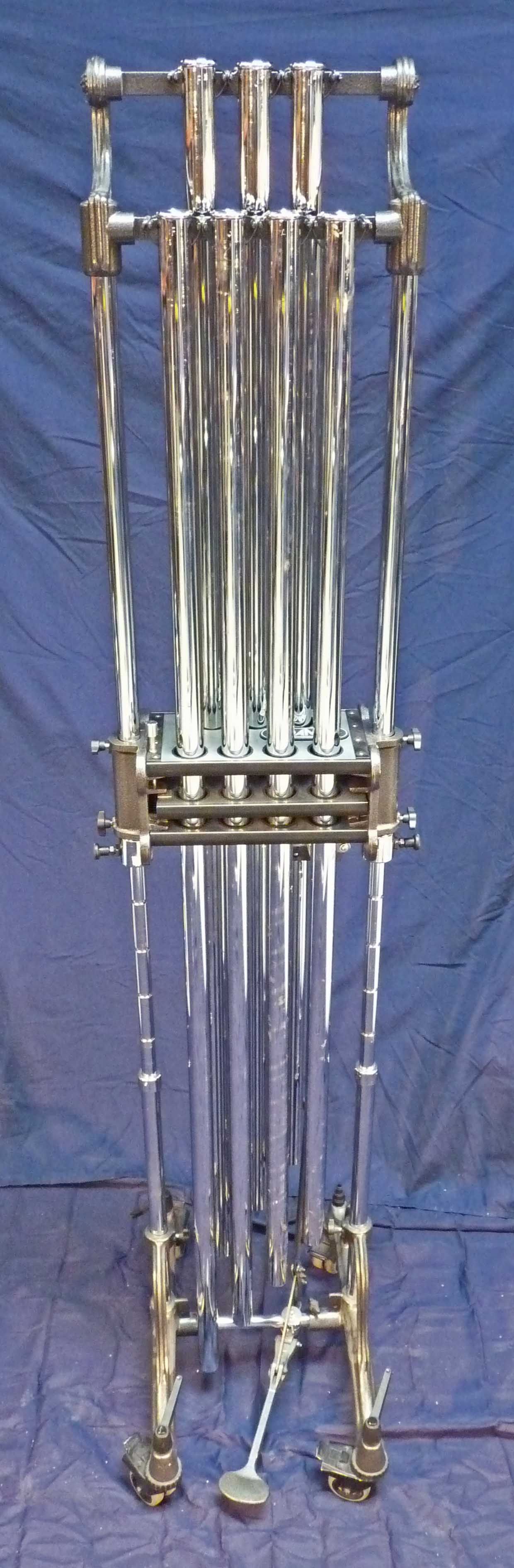
Tubular bells (also known as chimes) are musical instruments in the percussion family. Their sound resembles that of church bells, carillons, or a bell tower; the original tubular bells were made to duplicate the sound of church bells within an ensemble. Each bell is a metal tube, 30 - in diameter, tuned by altering its length. Its standard range is C4–F5, though many professional instruments reach G5. Tubular bells are often replaced by studio chimes, which are smaller and usually less expensive instruments. Studio chimes are similar in appearance to tubular bells, but each bell has a smaller diameter than the corresponding bell on tubular bells.
Tubular bells are usually struck on the top edges of the tubes with a rawhide- or plastic-headed hammer. A sustain pedal may be attached to the instrument to allow damping and un-damping of all the bells at once. Very loud high-pitched overtones can be produced by vibrating the bottoms of the tubes with a violin bow.
The tubes provide a purer tone than solid cylindrical chimes, such as those on a mark tree.
Chimes are often called for in orchestral and concert band repertoire. They rarely play melody, instead being used most often as a color to add to the ensemble sound; but chimes do occasionally have solos, particularly in imitation of church bells.
In tubular bells, modes 4, 5, and 6 appear to determine the strike tone and have frequencies in the ratios 92:112:132, or 81:121:169, "which are close enough to the ratios 2:3:4 for the ear to consider them nearly harmonic and to use them as a basis for establishing a virtual pitch". The perceived "strike pitch" is thus an octave below the fourth mode (i.e., the missing "1" in the above series).
Classical music
Tubular bells were first used orchestrally by Giuseppe Verdi in his operas Rigoletto (1851), Il trovatore (1853) and Un ballo in maschera (1859).
Notable uses in classical music:

- Giuseppe Verdi – Rigoletto (1851)
- Giuseppe Verdi – Il trovatore (1853)
- Giuseppe Verdi – Un ballo in maschera (1859)
- Modest Mussorgsky – Boris Godunov (1869, 1872, 1874)
- Pyotr Ilyich Tchaikovsky – 1812 Overture (1880)
- Pietro Mascagni – Cavalleria rusticana (1890)
- Ruggero Leoncavallo – Pagliacci (1892)
- Gustav Mahler – Symphony No. 2 (1895)
- Giacomo Puccini – Tosca (1900)
- Alexander Scriabin – Le Poème de l'extase (1908)
- Anton Webern – Six Pieces for large orchestra (1909–10, revised 1928)
- Claude Debussy – Ibéria (1910)
- Gustav Holst – The Planets (1914–16)
- Giacomo Puccini – Turandot (1926)
- Edgard Varèse – Ionisation (1931)
- Richard Strauss – Die schweigsame Frau (1935)
- Paul Hindemith – Symphonic Metamorphosis of Themes by Carl Maria von Weber (1944)
- Erich Wolfgang Korngold – Violin Concerto (1945)
- Benjamin Britten – Albert Herring (1945)
- Aaron Copland – Symphony No. 3 (1946)
- Olivier Messiaen – Turangalîla-symphonie (1946–48)
- Carl Orff – Antigonae (1949)
- Dmitri Shostakovich – Symphony No. 11 (1957)
- Olivier Messiaen – Chronochromie (1959–60)
- Arvo Pärt – Cantus in Memoriam Benjamin Britten (1977)
- David Stanhope – Folksongs for Band, Suite no. 3 (1991, revised 2016)
- Daron Hagen – Shining Brow (1993)
In popular music
Multi-instrumentalist Mike Oldfield's first album Tubular Bells, which provided the musical theme for the 1973 film The Exorcist, came about when, at the beginning of his "solo symphony" recording project in 1972, Oldfield discovered a set of tubular bells at The Manor Studio in Oxfordshire, England, used by the previous musician recording there, John Cale.
Other uses
Tubular bells can be used as church bells, such as at St. Alban's Anglican Church in Copenhagen, Denmark. These were donated by King Charles III (then Prince of Wales).
Tubular bells are also used in longcase clocks, particularly because they produce a louder sound than gongs and regular chime-rods and therefore could be heard more easily.
References
References
- The Study of Orchestration, 3rd, Ed., Samuel Adler, W. W. Norton & Co, Inc, (2002).
- (2001-01-20). "Tubular bells [chimes, orchestral chimes] (Fr. ''cloches''; Ger. ''Glocken'', ''Röhrenglocken''; It. ''campane'', ''campanelle)''".
- Rossing. (2000). "Science of Percussion Instruments". World Scientific.
- Moon, Grant. (25 May 2020). "Mike Oldfield on Tubular Bells: 'There's been nothing like it, before or since.'".
- "About the Church Building". St. Alban's Church.
This article was imported from Wikipedia and is available under the Creative Commons Attribution-ShareAlike 4.0 License. Content has been adapted to SurfDoc format. Original contributors can be found on the article history page.
Ask Mako anything about Tubular bells — get instant answers, deeper analysis, and related topics.
Research with MakoFree with your Surf account
Create a free account to save articles, ask Mako questions, and organize your research.
Sign up freeThis content may have been generated or modified by AI. CloudSurf Software LLC is not responsible for the accuracy, completeness, or reliability of AI-generated content. Always verify important information from primary sources.
Report