From Surf Wiki (app.surf) — the open knowledge base
Tskhinvali
Capital of South Ossetia/City in Georgia

Capital of South Ossetia/City in Georgia
| Field | Value |
|---|---|
| name | Tskhinvali |
| native_name | ka |
| os | |
| image_skyline | {{multiple image |
| border | infobox |
| perrow | 1/2/2/2/2 |
| total_width | 250 |
| image1 | Tskhinval.jpg |
| image2 | Parliament RSO.jpg |
| image3 | Армянская Церковь Сурб Аствацацин (Цхинвал).jpg |
| image_caption | From the top, left to right, View over Tskhinvali, Parliament Building, St. Astvatsatsin Church |
| pushpin_map | Georgia#Shida Kartli#South Ossetia |
| mapsize | 250px |
| map_caption | Location of Tskhinvali |
| subdivision_type | Country |
| subdivision_name | Georgia |
| subdivision_type1 | De facto state |
| subdivision_name1 | South Ossetia |
| subdivision_type2 | Mkhare |
| subdivision_name2 | Shida Kartli |
| subdivision_type3 | District |
| subdivision_name3 | Tskhinvali |
| established_title | Established |
| established_date | 1398 |
| area_total_km2 | 17.46 |
| population_as_of | 1 January 2019 |
| population_total | 32,180 |
| population_density_km2 | auto |
| elevation_m | 860 |
| timezone | Moscow time |
| utc_offset | +3 |
| coordinates | |
| blank_name | Climate |
| blank_info | Dfb |
| pushpin_relief | y |
| mapframe | yes |
| mapframe-zoom | 12 |
| mapframe-wikidata | yes |
| image_shield | Coat of Arms of Tskhinval.png |
| image_flag | Flag of Tskhinvali.gif |
os | mapframe-zoom = 12 | mapframe-wikidata = yes Tskhinvali or Tskhinval, occasionally called Stalinir during specific contexts, is the capital of the disputed de facto independent Republic of South Ossetia, internationally considered part of Shida Kartli, Georgia (except by Russia and four other UN member states). Tskhinvali Region was also known historically as Samachablo by Georgians. It is located on the Great Liakhvi River approximately 100 km northwest of the Georgian capital Tbilisi.
Name
The name of Tskhinvali is derived from the Old Georgian Krtskhinvali (ქრცხინვალი), from earlier Krtskhilvani (ქრცხილვანი), literally meaning "the land of hornbeams", which is the historical name of the city. See ცხინვალი for more.
From 1934 to 1961, the city was named Staliniri (სტალინირი, ), which was a compilation of Joseph Stalin's surname with Ossetian word "Ir" which means Ossetia. Modern Ossetians call the city Tskhinval (leaving off the final "i", which is a nominative case ending in Georgian); the other Ossetian name of the city is Chreba () which is only spread as a colloquial word. The name Chreba comes from the Georgian Ḳreba (კრება), literally meaning "gathering" due to the city historically serving as a trading point.
History
Humans first settled in the area around present-day Tskhinvali in the Bronze Age. The unearthed settlements and archaeological artifacts from that time are unique in that they reflect influences from both Iberian (east Georgia) and Colchian (west Georgia) cultures with possible Sarmatian elements.
Tskhinvali was first chronicled by Georgian sources in 1398 as a village in Kartli (central Georgia), though a later account credits the 3rd-century AD Georgian king Aspacures II of Iberia with its foundation as a fortress. By the early-18th century, Tskhinvali was a small "royal town" populated chiefly by monastic serfs. Tskhinvali was annexed to the Russian Empire along with the rest of eastern Georgia in 1801. Located on a trade route which linked North Caucasus to Tbilisi and Gori, Tskhinvali gradually developed into a commercial town with a mixed Georgian Jewish, Georgian, Armenian and Ossetian population. In 1917, it had 600 households with 38.4% occupied by Georgian Jews, 34.4% by Georgians, 17.7% by Armenians and 8.8% by Ossetians.
The town saw clashes between the Georgian People's Guard and pro-Bolshevik Ossetian peasants during the 1918–20 period, when Georgia gained brief independence from Russia. Soviet rule was established by the invading Red Army in March 1921, and a year later, in 1922, Tskhinvali was made a capital of the South Ossetian Autonomous Oblast within the Georgian SSR. Subsequently, the town became largely Ossetian due to intense urbanisation and to the Soviet korenizatsiya ("nativization") policy which induced an inflow of the Ossetians from the nearby rural areas into Tskhinvali. The settlement was essentially an industrial centre, with lumber mills and manufacturing plants, and had also several cultural and educational institutions such as a venerated Pedagogical Institute (currently Tskhinvali State University) and a drama theatre. According to the last Soviet census (in 1989), Tskhinvali had a population of 42,934, and according to the census of Republic of South Ossetia in 2015, the population comprised 30,432 people.
During the acute phase of the Georgian-Ossetian conflict of 1989 and following, Tskhinvali was a scene of ethnic tensions and ensuing armed confrontation between Georgian and Ossetian forces. The 1992 Sochi ceasefire accord left Tskhinvali in the hands of Ossetians.
Russo-Georgian War
Main article: Battle of Tskhinvali
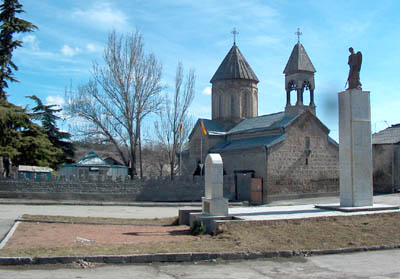
A considerable part of the population of South Ossetia (at least, 30,000 out of 70,000) fled into North Ossetia–Alania prior or immediately after the start of the Russo-Georgian War in August 2008. However, many civilians were killed during the shelling and the following Battle of Tskhinvali of 8 to 11 August 2008 (162 civilian deaths were documented by the Russian team of investigators and 365 – by the South Ossetian authorities). The town was heavily damaged during the battle due to extensive shelling by the Georgian Army. Andrey Illarionov visited the town in October 2008 and reported that Jewish Quarter was in ruins, though he observed that the ruins were overgrown with shrubs and trees, which indicates that the destruction took place during the 1991–1992 South Ossetia War. However, Mark Ames, who was covering the last war for The Nation, stated that Tskhinvali's main residential district, nicknamed Shanghai because of its population density (it's where most of the city's high-rise apartment blocks are located), and the old Jewish Quarter, were completely destroyed.
Geography
Climate
Located in the Caucasus, at 860 m above sea level, Tskhinvali has a humid continental climate (Köppen: Dfb), with an average annual precipitation of 805 mm. Summers are mild and winters are cold, with snowfalls.
Present
Currently, Tskhinvali functions as the capital of South Ossetia. Before the 2008 war it had a population of approximately 30,000. The town remained significantly impoverished in the absence of a permanent political settlement between the two sides in the past two decades.
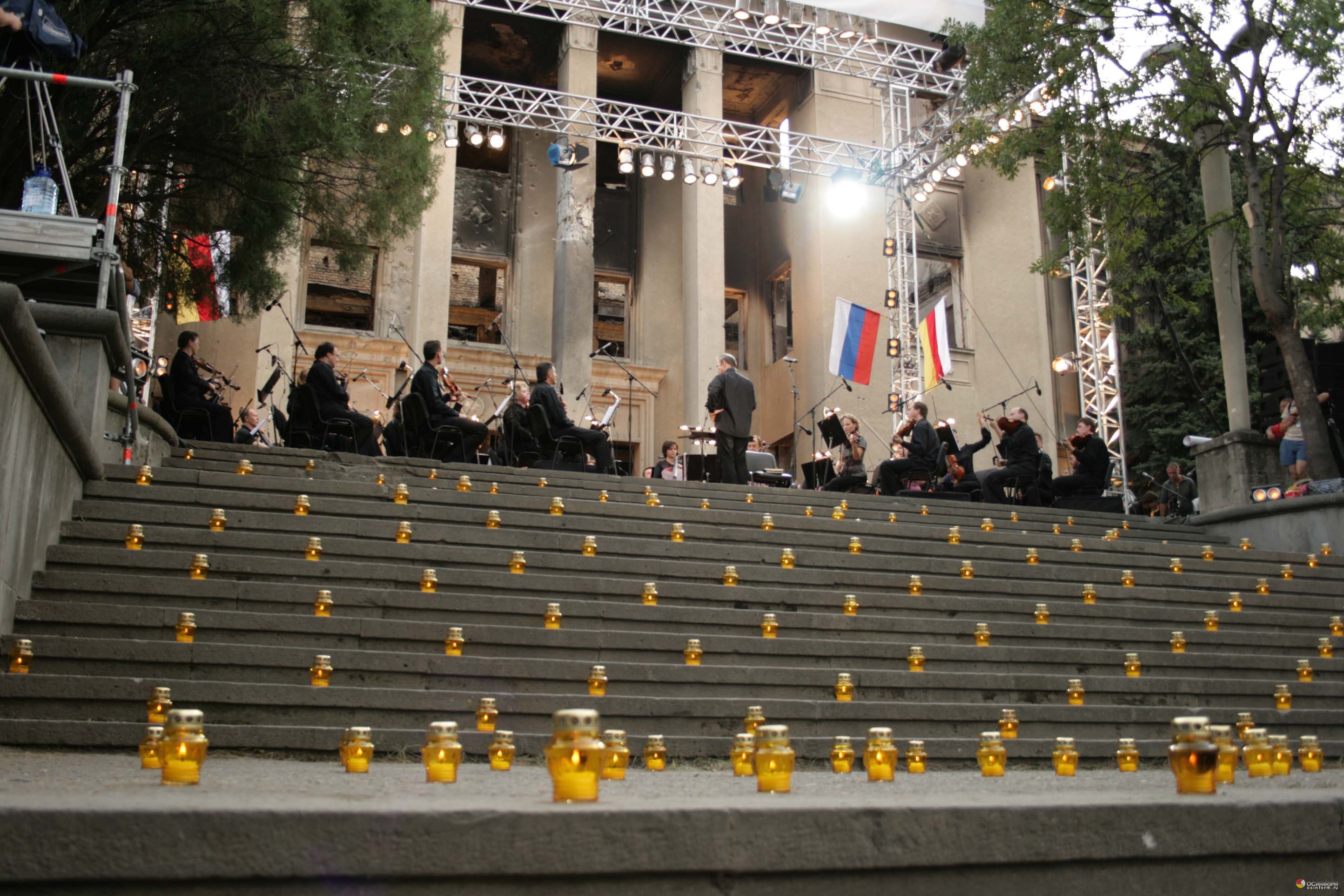
On 21 August 2008, Valery Gergiev, a conductor and director of the Mariinsky Theatre of Ossetian origin, conducted a concert near the ruined building of South Ossetian parliament in memory of the Ossetian victims of the Russo-Georgian War.
Transport
There was a railway service before 1991 at the Tskhinvali Railway station connecting the city with Gori.
International relations
Twin towns and Sister cities
Tskhinvali is twinned with the following cities:
- Arkhangelsk, Russia
- Vladivostok, Russia
Notable people
- David Baazov, founder of the Zionist movement in Georgia
- Kakhi Kakhiashvili, Olympic Champion weightlifter
- Arsen Kasabiev, weightlifter
- Yuri Kokoyev, footballer
- Vadim Laliev, former professional wrestler representing Armenia and Russia
- Temo Svirely, artist
- Guram Tskhovrebov, football player
- Irakli Okruashvili, a Georgian politician and a former Georgian Defence Minister
References
Notes
Citations
Sources
References
- {{South Ossetia-note
- [https://ugosstat.ru/statisticheskij-sbornik-za-i-kvartal-2019-g/ Статистический сборник за январь-июнь 2019 г.] Entry from 4 September 2019 on the website ''ugosstat.ru''. Retrieved 4 May 2021.
- https://eurasianet.org/south-ossetian-capital-to-take-on-name-honoring-stalin
- "Information on Tskhinvali/South Ossetia Region".
- {{in lang
- Bedoshvili, Guram. (2002). "Etymological-Explanatory Dictionary of Georgian Toponyms". Bakur Sulakauri Publishing.
- {{in lang
- The Permanent Committee on Geographical Names ([[UK]]) (2007) [https://web.archive.org/web/20140221153653/http://www.pcgn.org.uk/Georgia%20-%20South%20Ossetia-Jan07.pdf "Georgia: a toponymic note concerning South Ossetia"].
- Натиев, Ф.. (1873). "Цхинвали". Кавказъ.
- (2006-07-04). "Цхинвали. Электронная еврейская энциклопедия".
- United Nations High Commissioner for Refugees. "UNHCR – UNHCR secures safe passage for Georgians fearing further fighting". UNHCR.
- "Мы полагаем, что мы в полной мере доказали состав преступления - Пресс-центр - Интерфакс".
- "Список погибших жителей Южной Осетии".
- Илларионов Андрей. "Эхо Москвы :: Разворот Ситуация в Южной Осетии и Грузии: Андрей Илларионов". Эхо Москвы.
- "How To Screw Up A War Story: The New York Times At Work – By Mark Ames – The eXiled".
- "Climate: Tskhinval".
- (21 August 2008). "South Ossetians enjoy requiem concert in shattered capital". [[The Guardian]].
- (22 December 2008). "Архангельск и Цхинвал могут стать городами-побратимами".
- "Архангельская область восстанавливает югоосетинскую 5-ю школу - KP.RU".
- "АРХАНГЕЛЬСК - ЦХИНВАЛ: ДРУЖБУ УКРЕПЛЯЕТ СПОРТ".
- "Сообщение пресс-службы Министерства иностранных дел Республики Южная Осетия | Министерство иностранных дел".
This article was imported from Wikipedia and is available under the Creative Commons Attribution-ShareAlike 4.0 License. Content has been adapted to SurfDoc format. Original contributors can be found on the article history page.
Ask Mako anything about Tskhinvali — get instant answers, deeper analysis, and related topics.
Research with MakoFree with your Surf account
Create a free account to save articles, ask Mako questions, and organize your research.
Sign up freeThis content may have been generated or modified by AI. CloudSurf Software LLC is not responsible for the accuracy, completeness, or reliability of AI-generated content. Always verify important information from primary sources.
Report