From Surf Wiki (app.surf) — the open knowledge base
Tsesarevich
Title of the heir apparent or presumptive in the Russian Empire
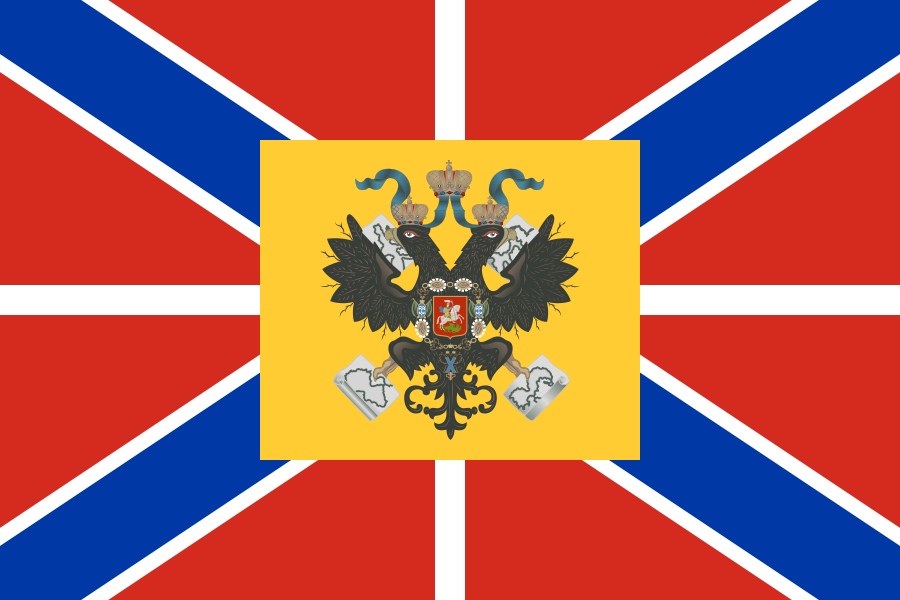
Title of the heir apparent or presumptive in the Russian Empire

Tsesarevich (, ) was the title of the heir apparent or presumptive in the Russian Empire. It either preceded or replaced the given name and patronymic.
Usage
It is often confused with the much more general term tsarevich, the title for any son of any tsar, including non-Russian rulers such as those of Crimea, Siberia, and Georgia.
Normally, there was only one tsesarevich at a time (an exception was Grand Duke Konstantin Pavlovich, who was accorded the title until death, even though law gave it to his nephew), and the title was used exclusively in Russia.
The title came to be used invariably in tandem with the formal style "Successor" (), as in "His Imperial Highness the Successor Tsesarevich and Grand Prince". The wife of the Tsesarevich was the tsesarevna ().
History
In 1721 Peter the Great discontinued use of "tsar" as his main title, and adopted that of imperator (emperor), whereupon the title of tsarevich (and "tsarevna", retained for life by Ivan V's daughters) fell into disuse. The Emperor's daughters were henceforth referred to as "tsesarevna" (Peter had no living son by this time). In 1762, upon succeeding to the imperial throne, Peter III accorded his only son Paul Petrovich (by the future Catherine the Great) the novel title of tsesarevich, he being the first of nine Romanov heirs who would bear it. However, at the time the title was conferred, Paul was recognised as Peter's legal son, but not as his legal heir. Nor would he be officially recognised as such by his mother after her usurpation of the throne.
More often he was internationally referred to by his other title of "Grand Duke" ("великий князь"; the actual meaning in Russian language is "Grand Prince". "Grand Duke", a title not used, would have been "великий герцог" "velikij gertsog" from German Herzog, duke), which pre-dated tsesarevich, being a holdover from the Rurikid days before the grand dukes of Muscovy adopted the title of tsar. When Paul acceded to the throne in 1796, he immediately declared his son Aleksandr Pavlovich tsesarevich, and the title was confirmed by law in 1797 as the official title for the heir to the throne (incorporated into Article 145 of the Fundamental Laws). In 1799 Paul I granted the title tsesarevich to his second son Constantine Pavlovich, who, oddly, retained the title even after he renounced the throne in 1825 in favor of their younger brother, Nicholas I.
Thenceforth, each Emperor's eldest son bore the title until 1894, when Nicholas II conferred it on his brother Grand Duke George Aleksandrovich, with the stipulation that his entitlement to it would terminate upon the birth of a son to Nicholas, who was then betrothed to Alix of Hesse. When George died in 1899, Nicholas did not confer the title upon his oldest surviving brother Michael Aleksandrovich, although Nicholas's only son would not be born for another five years. That son, Alexei Nikolaevich (1904–1918), became the Russian Empire's last tsesarevich.
Tsesarevich of Russia
| Picture | Name | Heir of | Birth | Became Heir to the Throne | Created Tsesarevich | Ceased to be Tsesarevich | Death | Tsesarevna | |
|---|---|---|---|---|---|---|---|---|---|
| [[File:Zar Pavel 1.gif | 80px]] | Tsesarevich Paul Petrovich | |||||||
| later Paul I | Catherine II | 1 October 1754 | 9 July 1762 | 7 January 1762 | 17 November 1796 | ||||
| became Emperor | 24 March 1801 | Wilhelmina Louisa of Hesse-Darmstadt | |||||||
| [[File:Jean-Louis Voille 004.jpg | 80px]] | Tsesarevich Alexander Pavlovich | |||||||
| later Alexander I | Paul I | 23 December 1777 | 17 November 1796 | 28 November 1796 | 24 March 1801 | ||||
| became Emperor | 1 December 1825 | Louise of Baden | |||||||
| [[File:Constantine Pavlovich by P.E.Rockstuhl (c.1809, Hermitage).jpg | 80px]] | Tsesarevich Constantine Pavlovich | Alexander I | 8 May 1779 | 24 March 1801 | 8 November 1799 | 27 June 1831 | Juliane of Saxe-Coburg-Saalfeld | |
| [[File:Alexander II young.jpg | 80px]] | Tsesarevich Alexander Nikolaevich | |||||||
| later Alexander II | Nicholas I | 29 April 1818 | 1 December 1825 | 10 September 1831 | 2 March 1855 | ||||
| became Emperor | 13 March 1881 | Marie of Hesse and by Rhine | |||||||
| [[File:Nicholas Alexandrovich, Tsarevich of Russia 2.jpg | 80px]] | Tsesarevich Nicholas Alexandrovich | Alexander II | 20 September 1843 | 2 March 1855 | 24 April 1865 | |||
| [[File:1865. Цесаревич Александр Александрович.jpg | 80px]] | Tsesarevich Alexander Alexandrovich | |||||||
| later Alexander III | 10 March 1845 | 24 April 1865 | 13 March 1881 | ||||||
| became Emperor | 1 November 1894 | Dagmar of Denmark | |||||||
| [[File:Nicholas1868.jpg | 80px]] | Tsesarevich Nicholas Alexandrovich | |||||||
| later Nicholas II | Alexander III | 18 May 1868 | 13 March 1881 | 1 November 1894 | |||||
| became Emperor | 17 July 1918 | ||||||||
| [[File:George Alexandrovich by S.Levitskiy (1889).jpg | 80px]] | Tsesarevich George Alexandrovich | Nicholas II | 9 May 1871 | 1 November 1894 | 10 July 1899 | |||
| [[File:Alexei Nikolaevich of Russia (3x4 cropped).jpg | 80px]] | Tsesarevich Alexei Nikolaevich | 12 August 1904 | 15 March 1917 | |||||
| Monarchy abolished | 17 July 1918 |
Tsesarevna of Russia
The wife of an heir-tsesarevich bore the title Tsesarevna () – Grand Duchess. In first years of Russian Empire the female heirs of Peter I of Russia bore this title: his daughters Elizabeth of Russia (born 1709), Anna Petrovna (1708–1728) and Natalia Petrovna (1718–1725). This word is not to be confused with Tsarevna, used before 18th century for all the Tsar's daughters and daughters-in-law.
Many princesses from Western Europe, who converted to Orthodox Christianity and changed their given names accordingly, were given the patronymic Fyodorovna not because their fathers were named "Theodore", but as an allegory based on the name of Theotokos of St. Theodore, the patron icon of the Romanov family.
| Picture | Name | Father | Birth | Marriage | Became Tsesarevna | Ceased to be Tsesarevna | Death | Spouse |
|---|---|---|---|---|---|---|---|---|
| [[File:Maria Alexandrovna by Winterhalter (1857, Hermitage).jpg | 80px]] | Maria Alexandrovna | ||||||
| born Marie of Hesse and by Rhine | Louis II, Grand Duke of Hesse | |||||||
| (Hesse-Darmstadt) | 8 August 1824 | 28 April 1841 | 2 March 1855 | |||||
| became Empress | 3 June 1880 | Tsesarevich Alexander Nikolaevich | ||||||
| [[File:Dagmar colour.jpg | 80px]] | Maria Feodorovna | ||||||
| born Dagmar of Denmark | Christian IX of Denmark | |||||||
| (Schleswig-Holstein-Sonderburg-Glücksburg) | 26 November 1847 | 9 November 1866 | 13 March 1881 | |||||
| became Empress | 13 October 1928 | Tsesarevich Alexander Alexandrovich |
Post-monarchy
After claiming the Russian throne in exile in 1924 Grand Duke Kirill Vladimirovich designated his son, Grand Duke Vladimir Kirillovich, Tsesarevich. Since 1997 the title has been attributed to Vladimir's grandson, George Mikhailovich Romanov, whose mother, Maria Vladimirovna, conferred it on him in her capacity as pretender to the throne. Those who refer to him by a dynastic title, however, more usually address him as "grand duke".
Until the end of the empire most people in Russia and abroad, verbally and in writing continued to refer to the Sovereign as "tsar". Perhaps for that reason the title of tsesarevich was less frequently used to refer to the heir apparent than either "tsarevich" or "grand duke".
References
References
- Sometimes transliterated as ''Cesarevich'' or ''Caesarevich''
- Macedonsky, Dimitry. (June 2005). "Hail, Son of Caesar! A Titular History of Romanov Scions". Arturo E. Beeche.
- (1980). "Burke's Royal Families of the World II". Burke's Peerage Ltd.
- {{cite EB1911
- "Елисавета Феодоровна". Православная энциклопедия.
This article was imported from Wikipedia and is available under the Creative Commons Attribution-ShareAlike 4.0 License. Content has been adapted to SurfDoc format. Original contributors can be found on the article history page.
Ask Mako anything about Tsesarevich — get instant answers, deeper analysis, and related topics.
Research with MakoFree with your Surf account
Create a free account to save articles, ask Mako questions, and organize your research.
Sign up freeThis content may have been generated or modified by AI. CloudSurf Software LLC is not responsible for the accuracy, completeness, or reliability of AI-generated content. Always verify important information from primary sources.
Report