From Surf Wiki (app.surf) — the open knowledge base
Trust Territory of the Pacific Islands
UN trust territory (1947–1994)
UN trust territory (1947–1994)
| Field | Value |
|---|---|
| conventional_long_name | Trust Territory of the Pacific Islands |
| common_name | Pacific Islands |
| empire | United States |
| status | United Nations Trust Territory under the administration of the United States |
| p1 | South Seas Mandate |
| flag_p1 | Flag of Japan (1870–1999).svg |
| s1 | Marshall Islands |
| flag_s1 | Flag of the Marshall Islands.svg |
| s2 | Federated States of Micronesia |
| flag_s2 | Flag of the Federated States of Micronesia.svg |
| s3 | Northern Mariana Islands |
| flag_s3 | Flag of the Northern Mariana Islands.svg |
| s4 | Palau |
| flag_s4 | Flag of Palau.svg |
| image_flag | Flag of the Trust Territory of the Pacific Islands.svg |
| flag | Flag of the Trust Territory of the Pacific Islands |
| flag_type | Flag |
| (1965–1980) | |
| image_coat | Trust Territory of the Pacific Islands seal.svg |
| symbol | Seal of the Federated States of Micronesia |
| symbol_type | Emblem |
| (1965–1980) | |
| image_map | TTPI-locatormap.png |
| image_map_caption | Location of the Trust Territory of the Pacific Islands in the Pacific |
| capital | Saipan |
| common_languages | English (official) |
| Micronesian languages | |
| title_leader | Chief of State |
| leader1 | Harry S. Truman |
| year_leader1 | 1947–1953 (first) |
| leader2 | Bill Clinton |
| year_leader2 | 1993–1994 (last) |
| title_deputy | High Commissioner |
| deputy1 | Louis E. Denfeld |
| year_deputy1 | 1947–1948 (first) |
| deputy2 | Janet J. McCoy |
| year_deputy2 | 1981–1987 (last) |
| legislature | Congress |
| era | Cold War |
| event_start | Trusteeship |
| date_start | July 18, |
| year_start | 1947 |
| event1 | Termination of administration (Marshall Islands) |
| date_event1 | October 21, 1986 |
| event2 | Termination of administration (Micronesia) |
| date_event2 | November 3, 1986 |
| event_end | Free Association and De jure independence of Palau |
| date_end | October 1, |
| year_end | 1994 |
| currency | United States dollar |
| footnote_a | Clinton was President when Palau's Compact of Free Association took effect. Ronald Reagan was President when the final status of the RMI, FSM, and CNMI took effect. |
| footnote_b | McCoy retired as High Commissioner in 1987. As Palau was still a part of the TTPI, it was administered by officials in the Office of Territorial and International Affairs until 1994. |
| iso3166code | PC |
(1965–1980) (1965–1980) Micronesian languages
The Trust Territory of the Pacific Islands (TTPI) was a United Nations trust territory in Micronesia administered by the United States from 1947 to 1994. The Imperial Japanese South Seas Mandate had been seized by the US during the Pacific War, as Japan had administered the territory since the League of Nations gave Japan a mandate over the area from Imperial Germany after World War I. However, in the 1930s, Japan left the League of Nations and invaded additional lands. During World War II, military control of the islands was contested, but by the war's end, the islands had come under the Allies' control. The Trust Territory of the Pacific was created to administer the islands as part of the United States while still under the auspices of the United Nations. Most of the island groups in the territory became independent states, with some degree of association kept with the United States: the Federated States of Micronesia, the Republic of the Marshall Islands and Palau are independent states in a Compact of Free Association with the US, while the Northern Mariana Islands remain under US jurisdiction, as an unincorporated territory and commonwealth.
History

Spain initially claimed the islands that later composed the territory of the Trust Territory of the Pacific Islands (TTPI). Subsequently, Germany established competing claims over the islands. The competing claims were eventually resolved in favor of Germany when Spain, following its loss of several possessions to the United States during the Spanish–American War, ceded its claims over the islands to Germany pursuant to the German–Spanish Treaty (1899). Germany, in turn, continued to retain possession until the islands were captured by Japan during World War I. The League of Nations formally placed the islands in the former South Seas Mandate, a mandate that authorized Japanese administration of the islands. The islands then remained under Japanese control until captured by the United States in 1944 during World War II.
The TTPI entered UN trusteeship pursuant to Security Council Resolution 21 on July 18, 1947, and was designated a "strategic area" in its 1947 trusteeship agreement. Article 83 of the UN Charter provided that, as such, its formal status as a UN trust territory could be terminated only by the Security Council and not by the General Assembly as with other trust territories. The United States Navy controlled the TTPI from a headquarters in Guam until 1951, when the United States Department of the Interior took over control, administering the territory from a base in Saipan.
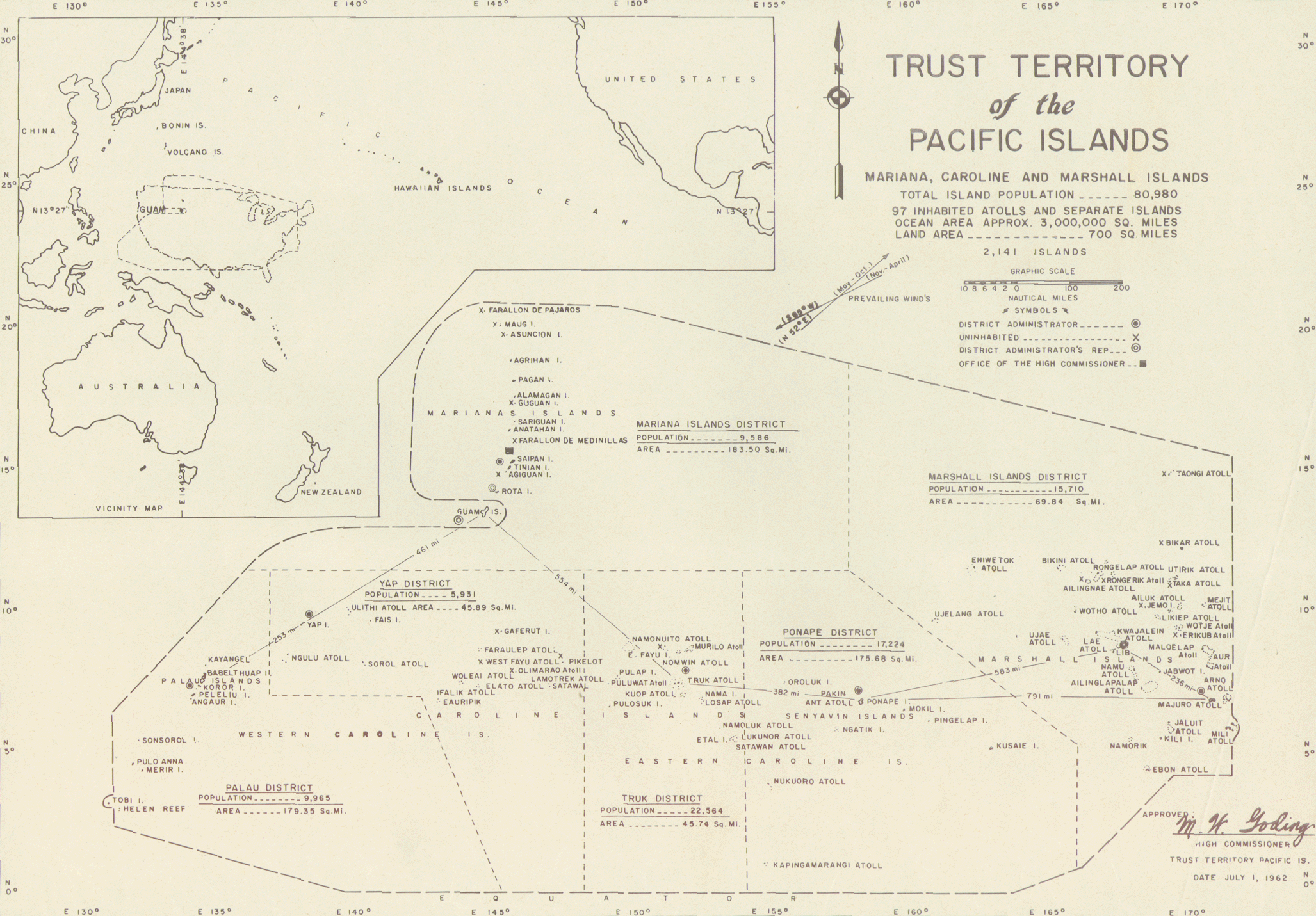
The Territory contained 100,000 people scattered over a water area the size of the continental United States. It was subdivided into six districts and represented a variety of cultures, with nine spoken languages. The Pohnpeians and Kosraeans, Marshallese and Palauans, Chuukese, Yapese and Chamorros had little in common, except they were in the same general area of the Pacific Ocean.
The large distances between people, the lack of an economy, and language and cultural barriers all worked against the union. The six district centers became upscale slums, containing deteriorated Japanese-built roads, electricity, modern music, and distractions, which alienated youth and elders. The remainder of the islands maintained their traditional way of life and infrastructure.
In the late 1960s, the US opposed the idea of eventual independence. Instead, they aimed for some form of association, perhaps with Hawaii. They estimated that perhaps 10-25% of the population favored independence.
A Congress of Micronesia first levied an income tax in 1971. It affected mainly foreigners working at military bases in the region.
On October 21, 1986, the US ended its administration of the Marshall Islands District. The termination of US administration of the Chuuk, Yap, Kosrae, Pohnpei, and the Mariana Islands districts of the TTPI soon followed on November 3, 1986. The Security Council formally ended the trusteeship for the Chuuk, Yap, Kosrae, Pohnpei, Mariana Islands, and Marshall Islands districts on December 22, 1990, pursuant to Security Council Resolution 683. On May 25, 1994, the Council ended the trusteeship for the Palau District pursuant to Security Council Resolution 956, after which the US and Palau agreed to establish the latter's independence on October 1.
Geography
In 1969, the 100 occupied islands comprised 700 sqmi over an area of 3000000 sqmi of sea. The latter area was comparable in size to the continental United States. The water area is about 5% of the Pacific Ocean.
Demographics
The islands' population was 200,000 in the latter part of the 19th century. The population decreased to 100,000 by 1969 due to emigration, war, and disease. At that time, the population inhabited less than 100 out of 2,141 of the Marshall, Mariana, and Caroline Islands.
- 1958: 70,724
- 1970: 90,940
Education
In 1947, the Mariana Islands' Teacher Training School (MITTS), a normal school serving all areas of the Trust Territory, opened in Guam. It moved to Chuuk in 1948, to be more central in the Trust Territory, The school, later known as Pohnpei Island Central School (PICS), is now Bailey Olter High School.
Palau Intermediate School, established in 1946, became Palau High School in 1962 as it added senior high grades. From the late 1960s to the middle of the 1970s, several public high schools were built or received additions in the Trust Territory. They included Jaluit High School, Kosrae High School, Marshall Islands High School in Majuro, Palau High, PICS, and Truk High School (now Chuuk High School). The Micronesian Occupational College in Koror, Palau, was also built. It later merged with the Kolonia-based Community College of Micronesia, which began operations in 1969, into the College of Micronesia-FSM in 1976.
Current status
Following the termination of the trusteeship, the territory of the former TTPI became four separate jurisdictions:
Sovereign states in free association with the United States
The following sovereign states have become freely associated with the United States under the Compact of Free Association (COFA).
- Marshall Islands – established 1979, COFA effective October 21, 1986
- Federated States of Micronesia – established 1979, COFA effective November 3, 1986
- Palau – established 1981, COFA effective October 1, 1994
Commonwealth in political union with the United States
- Northern Mariana Islands – new constitution partially effective January 1, 1978, and fully effective November 4, 1986.
References
Bibliography
References
- (2024). "Trust Territory of the Pacific Islands". [[Union of International Associations]].
- ''[[Encyclopædia Britannica]]'': [http://www.britannica.com/EBchecked/topic/437672/Trust-Territory-of-the-Pacific-Islands Trust Territory of the Pacific Islands]
- "Trust Territory of the Pacific Archives Photos". University of Hawaii at Manoa Hamilton Library.
- Kluge, P. F.. (December 1971). "Micronesia: America's Troubled Island Ward".
- (22 September 2006). "British Documents on the End of Empire Project Series B Volume 10: Fiji". University of London: Institute of Commonwealth Studies.
- Glenn B. Martineau. (September 1976). "Micronesia's Simplified Income Tax System". American Bar Association Journal.
- "Marshall Islands (07/00)".
- "Background Notes: Micronesia 6/96".
- Reagan, Ronald. "Proclamation 5564 of November 3,1986".
- (December 22, 1990). "Resolution 683 (1990)".
- "[USC04] 48 USC 1931: Approval of Compact of Free Association: Article VII".
- (March 1995). "Trusteeship Council formally suspends operation: Palau admitted to UN". [[UN Chronicle]].
- (May 23, 1969). "Remembering an adopted cousin". Time.
- "Trust Territory of the Pacific Islands Population and Housing Census 1957-1958".
- "Trust Territory of the Pacific Islands Population and Housing Census 1970".
- Wuerch, William L. and Dirk Anthony Ballendorf. ''Historical Dictionary of Guam and Micronesia'', 1994. {{ISBN
- Goetzfridt, Nicholas J. and Karen M. Peacock. ''Micronesian Histories: An Analytical Bibliography and Guide to Interpretations''. p. [https://books.google.com/books?id=oqqdbU0tBvAC&pg=PA190 190].
- and was renamed Pacific Islands' Teacher Training School (PITTS). It transitioned from being a [[normal school]] to a comprehensive secondary school, so it was renamed the Pacific Islands Central School (PICS). The school moved to Pohnpei in 1959. It was a three-year institution housing students who graduated from intermediate schools.Bureau of International Organization Affairs, Office of United Nations Political Affairs, 1961. p. [https://books.google.com/books?id=HSJl-F2gb9sC&q=%22Pacific+Islands+Central+School%22 137]. "The Pacific Islands Central School is the only public senior secondary school of the Territory. Students selected for further training after graduation from the district intermediate schools may attend the Pacific Islands Central School for three additional years of education."
- link. (2018-02-23 ")
- "[http://www.fsmembassydc.org/schools.html Higher Education in the Federated States of Micronesia] {{Webarchive. link. (2017-10-14 ." Embassy of the Federated States of Micronesia Washington DC. Retrieved on February 23, 2018. "Bailey Olter High School (former PICS) P.O. Box 250 Kolonia, Pohnpei FM 96941")
- "[http://www.palaumoe.net/phs/about.php About] {{Webarchive. link. (2018-03-03 ." [[Palau High School]]. Retrieved on February 22, 2018.)
- ''Compact of Free Association in the Micronesian States of Palau, the Federated States of Micronesia and the Marshall Islands: Environmental Impact Statement''. [[United States Department of State]], 1984. p. [https://books.google.com/books?id=_6g4AQAAMAAJ&pg=PA36 36]. "From the late 1960s to mid-1970s, the major high school complexes throughout the Trust Territory were constructed: notably,[...]additions to the Ponape High School[...]"
- Thomas, R. Murray. "The U.S. Trust Territory of the Pacific Islands (Micronesia)" (Chapter 3). In: Thomas, R. Murray and T. Neville Postlethwaite (editors). ''Schooling in the Pacific Islands: Colonies in Transition'' . [[Elsevier]], January 26, 2016. {{ISBN
- (March 27, 2014). "Northern Mariana Islands". Central Intelligence Agency.
This article was imported from Wikipedia and is available under the Creative Commons Attribution-ShareAlike 4.0 License. Content has been adapted to SurfDoc format. Original contributors can be found on the article history page.
Ask Mako anything about Trust Territory of the Pacific Islands — get instant answers, deeper analysis, and related topics.
Research with MakoFree with your Surf account
Create a free account to save articles, ask Mako questions, and organize your research.
Sign up freeThis content may have been generated or modified by AI. CloudSurf Software LLC is not responsible for the accuracy, completeness, or reliability of AI-generated content. Always verify important information from primary sources.
Report