From Surf Wiki (app.surf) — the open knowledge base
Troms
County in Northern Norway

County in Northern Norway
| Field | Value |
|---|---|
| name | Troms |
| fylke | yes |
| native_name | Romssa fylka |
| Tromssan fylkki | |
| former_name | Tromsø amt |
| image_skyline | Arnøyhøgda,_Laukslettinden,_Tjuvtinden_%26_Rødhetta,_2012_March.jpg |
| image_caption | Arnøyhøgda, Laukslettinden, Tjuvtinden and Rødhetta as seen over Skattørsundet in March 2012 |
| idnumber | 55 |
| map | none |
| county | Troms |
| district | Northern Norway |
| capital | Tromsø |
| established | 1866 |
| preceded | Finnmarkens amt |
| disestablished | 1 January 2020 |
| succeeded | Troms og Finnmark |
| established2 | 1 January 2024 |
| preceded2 | Troms og Finnmark |
| language | Neutral |
| webpage | www.tromsfylke.no |
| county_mayor | Kristina Torbergsen |
| county_mayor_party | Ap |
| county_mayor_as_of | 2023 |
| governor | Elisabeth Aspaker |
| governor_party | H |
| governor_as_of | 2017 |
| area_rank | 4 |
| area_total_km2 | 25877 |
| area_land_km2 | 24884 |
| area_water_km2 | 993 |
| area_water_percent | 3.8 |
| population_as_of | 30 September 2019 |
| population_rank | 15 |
| population_total | 166,375 |
| population_density_km2 | 6 |
| population_increase | 2 |
| income_per_capita | 133,300 |
| income_year | 2001 |
| GDP | 211,955 |
| GDP_year | 2001 |
| GDP_rank | 15 |
| GDP_rank_percent | 2.11 |
| coordinates |
Tromssan fylkki
Troms (; ; ; ) is a county in northern Norway. It borders Finnmark county to the northeast and Nordland county in the southwest. Norrbotten Län in Sweden is located to the south and further southeast is a shorter border with Lapland Province in Finland. To the west is the Norwegian Sea (Atlantic Ocean). The county had a population of 169,610 in 2024.
The entire county, which was established in 1866, is located north of the Arctic Circle. The Troms County Municipality is the governing body for the county, elected by the people of Troms, while the Troms county governor is a representative of the King and Government of Norway.
From 1 January 2020 to 31 December 2023 Troms was merged with the neighboring Finnmark county to create the new Troms og Finnmark county. This merger was reversed by the government resulting from the 2021 Norwegian parliamentary election.
General information
Name
Until 1919, the county was formerly known as Tromsø amt. On 1 July 2006, the Northern Sami name for the county, Romsa, was granted official status along with Troms.
The county (and the city of Tromsø) is named after the island Tromsøya on which it is located (Old Norse Trums). Several theories exist as to the etymology of Troms. One theory holds "Troms-" to derive from the old (uncompounded) name of the island (Old Norse: Trums). Several islands and rivers in Norway have the name Tromsa, and the names of these are probably derived from the word straumr which means "(strong) stream". (The original form must then have been Strums, for the missing s see Indo-European s-mobile.) Another theory holds that Tromsøya was originally called Lille Tromsøya (Little Tromsøya), because of its proximity to the much bigger island today called Kvaløya, that according to this theory was earlier called "Store Tromsøya" due to a characteristic mountain known as Tromma (the Drum). The mountain's name in Sámi, Rumbbučohkka, is identical in meaning, and it is said to have been a sacred mountain for the Sámi in pre-Christian times.
The Sámi name of the island, Romsa, is assumed to be a loan from Norse – but according to the phonetical rules of the Sami language the frontal t has disappeared from the name. However, an alternative form – Tromsa – is in informal use. There is a theory that holds the Norwegian name of Tromsø derives from the Sámi name, though this theory lacks an explanation for the meaning of Romsa. A common misunderstanding is that Tromsø's Sámi name is Romssa with a double "s". This, however, is the accusative and genitive form of the noun used when, for example, writing "Tromsø Municipality" (Romssa Suohkan).
Coat of arms
The coat of arms of Troms was made by Hallvard Trætteberg (1898–1987) and adopted by royal resolution on 15 January 1960. The official blazon in Norwegian ("På rød bunn en gull griff") translates to "On a field Gules a griffin [segreant] Or." Trætteberg chose to have the griffin as charge because that animal was the symbol of the mighty clan of Bjarne Erlingsson on Bjarkøy in the 13th century.
Geography

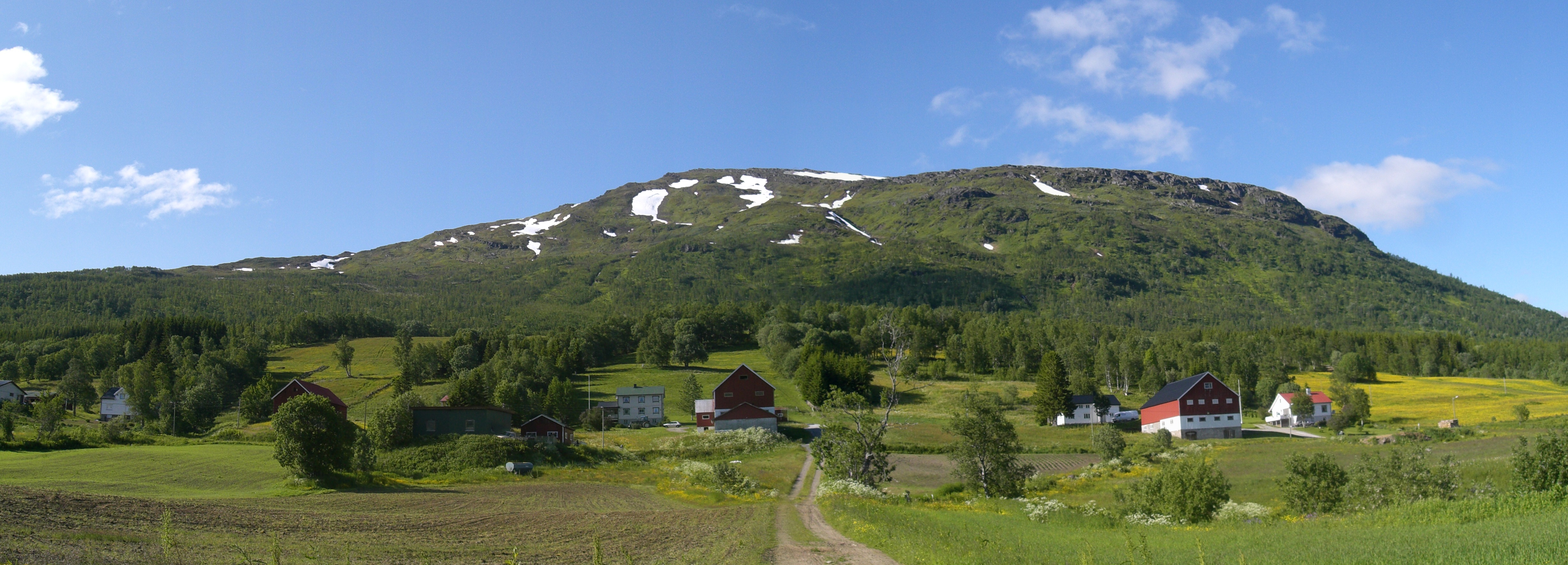
Troms is located in the northern part of the Scandinavian Peninsula. Due to the long distance to the more densely populated areas of the continent, this is one of the least polluted areas of Europe. Troms has a very rugged and indented coastline facing the Norwegian Sea. However, the large and mountainous islands along the coast provide an excellent sheltered waterway on the inside. Starting in the south, the largest islands are: northeastern part of Hinnøya (the southern part is in Nordland), Grytøya, Senja, Kvaløya, Ringvassøya, Reinøy, Vanna, and Arnøy. Some of these islands, most noteworthy Senja, have a rugged outer coast with steep mountains, and a more calm eastern shore. There are several large fjords that stretch quite far inland. Starting in the south, the largest fjords are Vågsfjorden, Andfjorden (partially in Nordland county), Malangen, Balsfjorden, Ullsfjorden, Lyngen, and Kvænangen. The largest lake is Altevatnet in the interior of the county.

There are mountains in all parts of Troms; the most alpine and striking are probably the Lyngen Alps (Lyngsalpene), with several small glaciers and the highest mountain in the county, Jiekkevarre with a height of 1833 m. Several glaciers are located in Kvænangen Municipality, including parts of the Øksfjordjøkelen, the last glacier in mainland Norway to drop icebergs directly into the sea (in the Jøkelfjord). The largest river in Troms (waterflow) is Målselva (in Målselv Municipality), and the largest (not the highest) waterfall is Målselvfossen at 600 m long and 20 m high. Marble is present in parts of Troms, and thus numerous caves, as in Salangen Municipality and Tjeldsund Municipality.
Climate

Located at a latitude of nearly 70°N, Troms has short, cool summers, but fairly mild winters along the coast due to the temperate sea; Torsvåg Lighthouse in Karlsøy Municipality has January 24-hr average of -1 C. Tromsø averages -4 C in January with a daily high of -2 C, while July averages 12 C with high of 15 C. Temperatures are typically below freezing for about 5 months (8 months in the mountains), from early November to the beginning of April, but coastal areas are moderated by the sea: with more than 130 years of official weather recordings, the coldest winter temperature ever recorded in Tromsø is -20.1 C in February 1985. The all-time high for Troms is 33.5 C recorded in Bardufoss 18 July 2018. Thaws can occur even in mid-winter. There is often snow in abundance, and avalanches were not uncommon in winter. With the prevailing westerlies, lowland areas east of mountain ranges have less precipitation than areas west of the mountains.
Skibotn (elevation: 46 m) in Storfjord Municipality is the location in Norway which has recorded the most days per year with clear skies (no clouds). Winter temperatures in Målselv Municipality and Bardu Municipality can get down to -35 C, while summer days can reach 30 C in inland valleys and the innermost fjord areas, but 15 to is much more common. Along the outer seaboard, a summer day at 15 C is considered fairly warm.
Sunlight
The aurora borealis is a common sight in the whole of Troms, but not in summer as there is no darkness. As with all areas in the polar latitudes, there are extreme variations in daylight between the seasons. As a consequence of this, the length of daylight increases (late winter and spring) or decreases (autumn) by 10 minutes from one day to the next.
| Jan | Feb | Mar | Apr | May | Jun | Jul | Aug | Sep | Oct | Nov | Dec |
|---|---|---|---|---|---|---|---|---|---|---|---|
| 11:31 – 12:17 | 08:16 – 15:43 | 06:07 – 17:41 | 04:43 – 20:48 | 01:43 – 23:48 | Midnight sun | Midnight sun | 03:44 – 21:50 | 05:56 – 19:20 | 07:54 – 17:04 | 09:25 – 13:32 | Polar night |
| Source: Almanakk for Norge; University of Oslo, 2010. Note: The sun is below the horizon until 15 January in Tromsø, but the low sun is blocked by mountains and not visible until 21 January. |
Nature


Moose, red fox, hare, stoat, and small rodents are common in all of Troms county. Brown bears are sighted in the interior parts of the county in the summer. Other animals that can be seen are reindeer (interior mountain areas, with Sami owners), wolverine (interior mountain areas), Eurasian otters (along the coast and rivers), Eurasian lynx (in the forests), and harbour porpoises in the fjords. Sperm whales, killer whales and humpback whales are often seen in Andfjorden. Some of the common birds are ptarmigan, sea eagles, European herring gulls, and great cormorants.
The sheltered valleys in the interior of Troms have the highest tree line (summer warmth and length is the limiting factor), with downy birch reaching an elevation of 700 m on the southern slope of Njunis; all over Troms county birch trees forms the tree lines, often 200 m above other trees. Rowan, aspen, willow, grey alder, and bird cherry are common in the lower elevations.
.jpg)
Scots pine reaches an elevation of almost 400 m in Dividalen, where some of the largest trees are 500 years old. The upper part of the valley is protected by Øvre Dividal National Park, which was enlarged in 2006. In 2011, the Rohkunborri National Park (571 km2) was established in Bardu Municipality, bordering Sweden and only a few kilometers south of Øvre Dividal National Park.
The inland valleys, like Østerdalen (with Altevatnet), Kirkesdalen, Dividalen, Rostadalen, Signaldalen, and Skibotndalen, are perfect for summer hiking, with their varied nature, mostly dry climate and not too difficult terrain, although there are many accessible mountains for energetic hikers.
Reisadalen is one of the most idyllic river valleys in Norway; from Storslett in Nordreisa Municipality the valley stretches south-southeast, covered with birch, pine, grey alder, and willow. The northern part of the valley is 5 km wide, with 1200 m high mountains on both sides; the southern part of the valley narrows to a few hundred metres (canyon), with increasingly dry climate. The valley floor is fairly flat with little height difference for 70 km (to Bilto); the Reisa river can be navigated by canoe or river boat for much of this distance. The salmon swim 90 km up the river, and some 137 different species of birds have been observed. Several rivers cascade down into the valley; the Mollisfossen waterfall is 269 m. The valley ends 120 km southeast of Storslett, as the vast and more barren Finnmarksvidda plateau takes over. Reisa National Park protects the upper part of the valley.
Economy

The city of Tromsø, in the north central part, is the county seat and an Arctic seaport, and seat of the world's northernmost university, renowned for research about the aurora borealis. The University of Tromsø has an astrophysical observatory located in Skibotn. Tromsø is the only municipality in the county with a strong population growth; most of the smaller municipalities experience decreasing populations as the young and educated moved to the cities, often in the southern part of Norway. Harstad is a commercial centre for the southern part of the county, and has been chosen by Statoil as its main office in Northern Norway.
Along the coast and on the islands, fishing is dominant. Important ports for the fishing fleet are Skjervøy, Tromsø, and Harstad. There is also some agriculture, especially in the southern part of the county, which has a longer growing season (150 days in Harstad). Balsfjord Municipality is often regarded to be the most northern municipality with substantial agricultural activity in Norway, although there is also agriculture further north.
The Norwegian armed forces are vital employers in the Troms, having the seat of the 6th army division, Bardufoss Air Station, helicopter wings and radar stations in the county. There are hospitals in Tromsø (university hospital and main hospital for North Norway) and Harstad.
While the busiest airport in Troms is Tromsø Airport, the southern part included Harstad/Narvik Airport, Evenes and Bardufoss Airport, with Sørkjosen Airport in the northeast. The E6 cuts through the county from Nordland into Gratangen Municipality in the south to Kvænangen Municipality in the north and then into Finnmark. The E8 highway runs from Tromsø to Finland via Nordkjosbotn and the Skibotn valley. There are several large bridges; some of the largest are Tjeldsund Bridge, Mjøsund Bridge, Gisund Bridge, Tromsø Bridge and Sandnessund Bridge. There are several undersea road tunnels; Rolla to Andørja (in Ibestad Municipality), Tromsøya to the mainland (Tromsø Municipality), Kvaløya to Ringvassøya (also in Tromsø), and Skjervøya to the mainland (in Skjervøy Municipality. The roads are well maintained, but have to go long detours around fjords. For this reason passenger boats are fairly popular, for example between Tromsø and Harstad, and there are also commercial flights inside the county of Troms.
There is no railway in Troms, but in 2013, the government of Finland expressed interest in building a railway from the Finnish rail network to port facilities at Skibotn, though they also stated that they could not finance much of the cost.
History

|1951|117564 |1961|127771 |1971|136805 |1981|146818 |1991|146816 |2001|151777 |2011|157554 |2021?|168953 |2031?|176342 Troms has been settled since the early Stone Age, and there are prehistoric rock carvings at several locations (for instance Ibestad and Balsfjord). These people made their living from hunting, fishing and gathering.
The first of the current ethnic groups to settle in the county were the Sami people, who inhabited Sápmi, an area much larger than today's Nordland, Troms and Finnmark counties. Archeological evidence has shown that a Norse iron-based culture in the late Roman Iron Age (200–400 AD), reaches as far north as Karlsøy Municipality (north of today's city of Tromsø), but not further northeast.
The Norse with their iron and agriculture settled along the coast and in some of the larger fjords, while the Sami lived in the same fjord areas, usually just into the fjord and in the interior. From the 10th century, Norse settlements start to appear along the coast further north, reaching into what is today the county of Finnmark.
Southern and Mid-Troms was a petty kingdom in the Viking Age, and considered part of Hålogaland. Ottar from Hålogaland met King Alfred the Great around 890. The Viking leader Tore Hund had his seat at Bjarkøya. According to the sagas, Tore Hund speared King Olav Haraldsson at the Battle of Stiklestad. He also traded and fought in Bjarmaland, today the area of Arkhangelsk in northern Russia. Trondenes (near today's Harstad) was also a central Viking power centre, and seems to have been a gathering place.
Demographics
The Kven residents of Troms are largely descendants of Finnish immigrants who arrived in the area before the 19th century from Finland because of war and famine. They settled mainly in the northeastern part of Troms, in the municipalities of Kvænangen, Nordreisa, Skjervøy, Gáivuotna-Kåfjord and Storfjord, and some also reached Balsfjord and Lyngen.
Municipalities
Troms county has a total of 21 municipalities.

- Balsfjord Municipality
- Bardu Municipality
- Dyrøy Municipality
- Gratangen Municipality
- Harstad Municipality
- Ibestad Municipality
- Gáivuotna-Kåfjord Municipality
- Karlsøy Municipality
- Kvæfjord Municipality
- Kvænangen Municipality
- Lavangen Municipality
- Lyngen Municipality
- Målselv Municipality
- Nordreisa Municipality
- Salangen Municipality
- Senja Municipality
- Skjervøy Municipality
- Sørreisa Municipality
- Storfjord Municipality
- Tjeldsund Municipality
- Tromsø Municipality
Photo gallery
File:Kirche Trondenes Altar.jpg|Inside Trondenes Church, the only medieval church in Troms File:Ersfjorden on Senja.jpg|Ersfjorden, Senja island File:Skjervoey Norwegen Kirche.jpg|Skjervøy Church in northern Troms at night, February 2004 File:Sorvik2.jpg|Sørvik in Harstad is at the southern tip of Troms File:Reindeer in Norway -Rekvika -Troms - Norway.jpg|Reindeer in Norway (Rekvika, Troms, Norway) File:Jøkelfjord - summer-evening.JPG|Summer evening in Jøkelfjord, Kvænangen.
Notable people
- Samuel Georg Simeon Wennberg, member of parliament
References
Other sources
References
- "Stadnamn og rettskriving". [[Kartverket]].
- "11342: Population and area (M) 2007 - 2024. Statbank Norway".
- (13 October 2021). "Jubel i nord etter skilsmissen: – Nå skal vi feire!". [[NRK]].
- "Offisielt samisk namn for Troms". Statens navnekonsulenter.
- "Troms". Arkivverket.no.
- "Hallvard Trætteberg: fylkesvåpen". Arkivverket.no.
- "Yr coldest recordings in February".
- "eKlima Web Portal". Norwegian Meteorological Institute.
- "Sunrise and daylight in Tromsø". Gaisma.
- "I jervens rike".
- "Øvre Dividal nasjonalpark utvidet".
- "Rohkunborri nasjonalpark er opprettet".
- "Mollisfossen".
- "Mektig vassdragsnatur".
- "Skibotn Astrophysical Observatory".
- Nilsen, Thomas. (2013-12-03). "Katainen: Railway to Arctic Ocean is a great opportunity". Barents Observer.
- link. (2013-10-23)
- Urbańczyk, Przemyslaw. (1992). "Medieval Arctic Norway". Institute of the History of Material Culture, Polish Academy of Sciences.
- Bandlien, Bjørn. "Bjarmeland".
- link. (2012-07-16)
- "Statistics Norway – Members of religious and life stance communities outside the Church of Norway, by religion/life stance. County. 2006–2010".
This article was imported from Wikipedia and is available under the Creative Commons Attribution-ShareAlike 4.0 License. Content has been adapted to SurfDoc format. Original contributors can be found on the article history page.
Ask Mako anything about Troms — get instant answers, deeper analysis, and related topics.
Research with MakoFree with your Surf account
Create a free account to save articles, ask Mako questions, and organize your research.
Sign up freeThis content may have been generated or modified by AI. CloudSurf Software LLC is not responsible for the accuracy, completeness, or reliability of AI-generated content. Always verify important information from primary sources.
Report