From Surf Wiki (app.surf) — the open knowledge base
Trochophore
Type of free-swimming marine larva

Type of free-swimming marine larva
A - episphere
B - hyposphere
1 - ganglia
2 - apical tuft
3 - prototroch
4 - metatroch
5 - nephridium
6 - anus
7 - protonephridia
8 - gastrointestinal tract
9 - buccal opening
10 - blastocoele]]
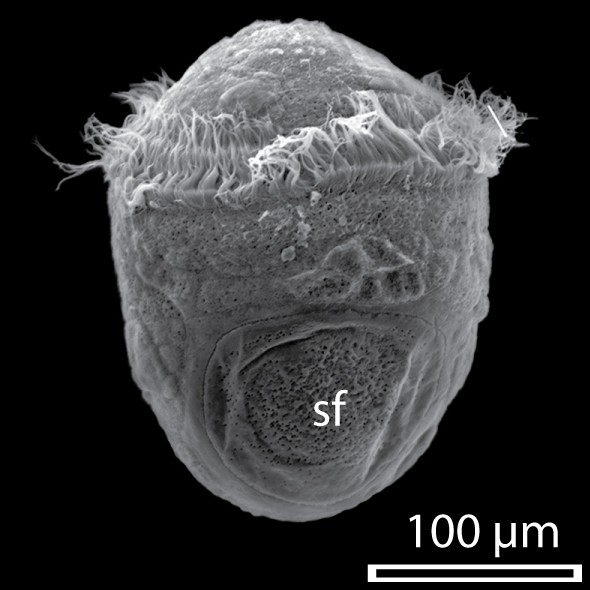
A trochophore () is a type of free-swimming planktonic marine larva with several bands of cilia.
By moving their cilia rapidly, they make a water eddy to control their movement, and to bring their food closer in order to capture it more easily.
Occurrence
Trochophores exist as a larval form within the trochozoan clade, which include the entoprocts, molluscs, annelids (including echiurans and sipunculans) and nemerteans. Together, these phyla make up part of the Lophotrochozoa; it is possible that trochophore larvae were present in the life cycle of the group's common ancestor.
Etymology
The term trochophore derives from the ancient Greek (), meaning "wheel", and () — or () —, meaning 'to bear, to carry', because the larva is bearing a wheel-shaped band of cilia.
Feeding habits
Trochophore larvae are often planktotrophic; that is, they feed on other plankton species.
Life cycle

The example of the development of the annelid Pomatoceros lamarckii (family Serpulidae) shows various trochophore stages (image: D-F):
D - early trochophore ;
E - complete trochophore ;
F - late trochophore ;
G - metatrochophore.

References
References
- Bailly, Anatole. "Greek-french dictionary online".
- (2006). "The development of the larval nervous system, musculature and ciliary bands of Pomatoceros lamarckii (Annelida): heterochrony in polychaetes.". Frontiers in Zoology.
- (2007). "Dynamic expression of ancient and novel molluscan shell genes during ecological transitions". BMC Evolutionary Biology.
This article was imported from Wikipedia and is available under the Creative Commons Attribution-ShareAlike 4.0 License. Content has been adapted to SurfDoc format. Original contributors can be found on the article history page.
Ask Mako anything about Trochophore — get instant answers, deeper analysis, and related topics.
Research with MakoFree with your Surf account
Create a free account to save articles, ask Mako questions, and organize your research.
Sign up freeThis content may have been generated or modified by AI. CloudSurf Software LLC is not responsible for the accuracy, completeness, or reliability of AI-generated content. Always verify important information from primary sources.
Report