From Surf Wiki (app.surf) — the open knowledge base
Trinity College (Connecticut)
Private college in Hartford, Connecticut, US
.jpg)
Private college in Hartford, Connecticut, US
| Field | Value |
|---|---|
| name | Trinity College |
| image | Trinity College Connecticut Seal.svg |
| image_upright | .7 |
| motto | Pro Ecclesia Et Patria (Latin) |
| mottoeng | For Church and Country |
| established | |
| former_names | Washington College (1823–1845) |
| type | Private liberal arts college |
| accreditation | NECHE |
| endowment | $834.7 million (2024) |
| faculty | 230 full-time and 45 part-time (spring 2022) |
| president | Daniel G. Lugo |
| students | 2,241 (spring 2022) |
| undergrad | 2,200 (spring 2022) |
| postgrad | 41 (spring 2021) |
| city | Hartford, Connecticut |
| country | U.S. |
| coordinates | |
| campus | Urban, 100 acre |
| colors | Blue and gold |
| sports_nickname | Bantams |
| mascot | Bantam |
| sporting_affiliations | NCAA Division III – NESCAC |
| academic_affiliations | |
| website | |
| logo | Trinity College Connecticut.svg |
| logo_upright | 1.1 |
Trinity College is a private liberal arts college in Hartford, Connecticut, United States. Founded as Washington College in 1823, it is the second-oldest college in the state of Connecticut. Coeducational since 1969, the college enrolls 2,235 students. The college is a member of the New England Small College Athletic Conference (NESCAC).
History
19th century
Bishop Thomas Brownell opened "Washington College" in 1824 to nine male students and the vigorous protest of Yale alumni. A 14-acre site was chosen, at the time about a half-mile from the city of Hartford.
The college was renamed "Trinity College" in 1845; the original campus consisted of two Greek Revival buildings. One of the Greek Revival buildings housed a chapel, library, and lecture rooms. The other was a dormitory for the male students.
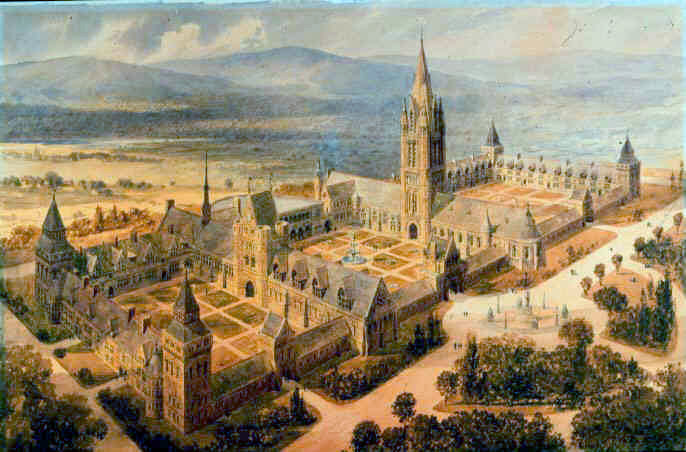
In 1872, Trinity College was persuaded by the state to move from its downtown "College Hill" location (now Capitol Hill, site of the state capitol building) to its current 100 acre campus a mile southwest. Although the college sold its land overlooking the Park River and Bushnell Park in 1872, it did not complete its move to its Gallows Hill campus until 1878. The original plans for the Gallows Hill site were drawn by the noted Victorian architect William Burges but were too ambitious and too expensive to be fully realized. Only one section of the proposed campus plan, the Long Walk, was completed.
By 1889, the library contained 30,000 volumes, and the school graduated over 900 students. Enrollment reached 122 in 1892.
20th century
President Remsen Ogilby (1920–1943) enlarged the campus, and more than doubled the endowment. The faculty grew from 25 to 62, and the student body from 167 to 530 men. Under President Keith Funston (1943–1951), returning veterans expanded the enrollment to 900.
In 1962, Connecticut Public Television (CPTV) began its first broadcasts in the Trinity College Public Library, and later in Boardman Hall, a science building on campus.
In 1968, the trustees voted to withdraw from the Association of Episcopal Colleges. Also in 1968, the trustees of Trinity College voted to make a commitment to enroll more minority students, providing financial aid as needed. This decision was preceded by a siege of the administrative offices in the Downes and Williams Memorial buildings during which Trinity students would not allow the president or trustees to leave until they agreed to the resolution.
Under the leadership of president Theodore D. Lockwood and Dean of Faculty Robert Works Fuller, the college entered on a period of reform. In 1969, Trinity College became coeducational and admitted its first female students, as transfers from Vassar College and Smith College.
21st century
Joanne Berger-Sweeney was inaugurated as the 22nd president of Trinity College in 2014. She was the first African-American and the first woman to serve in the position. She was succeeded by Daniel G. Lugo in 2025.
Academics
Trinity offers undergraduate degrees in 41 majors with options of 28 minors and a self-designed major, and Masters of Arts in a few subjects. Trinity is part of a small group of liberal arts schools that offer degrees in engineering. Trinity has a student-to-faculty ratio of 9:1. Its most popular undergraduate majors, by number out of 517 graduates in 2022, were:
- Political Science and Government (80)
- Economics (64)
- Psychology (41)
- Econometrics and Quantitative Economics (38)
- Engineering (28)
- Neuroscience (24)
- Biology/Biological Sciences (23)
Trinity College, Rome Campus
Trinity College, Rome Campus (TCRC), is a study abroad campus of Trinity College. It was established in 1970 and is in a residential area of Rome on the Aventine Hill close to the Basilica of Santa Sabina within the precincts of a convent run by an order of nuns.
Admissions
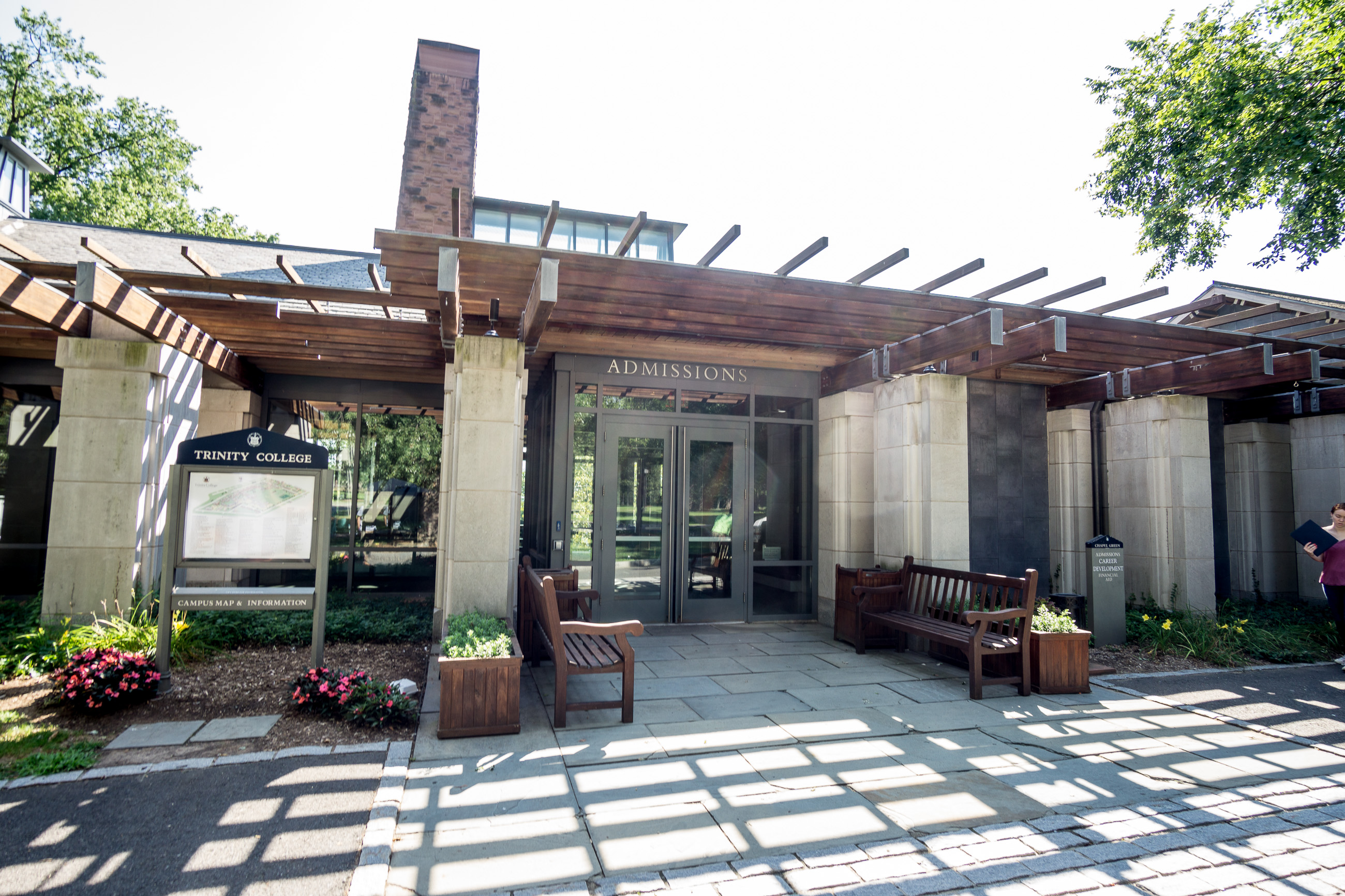
The 2020 annual ranking by U.S. News & World Report categorizes Trinity as "more selective".
For the Class of 2028 (enrolling fall 2024), Trinity received 7,592 applications, accepted 29%, and ultimately enrolled 547 students.
As of fall 2015, Trinity College did not require the SAT or ACT for students applying for admission. Of the 31% of enrolled freshmen submitting SAT scores, the middle 50% range was 630–710 for evidence-based reading and writing, and 670–750 for math, while of the 23% of enrolled freshmen submitting ACT results, the middle 50% range for the composite score was 29–32.
Rankings and reputation
Forbes magazine ranked Trinity College 17th amongst all liberal arts universities and 71st amongst all colleges and universities on its 2024-25 list. In 2024, Washington Monthly ranked Trinity College 26th among 194 liberal arts colleges in the U.S. based on its contribution to the public good, as measured by social mobility, research, and promoting public service. U.S. News & World Report ranked Trinity tied for 36th in its 2025 ranking of best national liberal arts colleges in the United States. It was also ranked 27th for best value school. However, these US News rankings likely reflect that Trinity joined the "Annapolis Group" in August 2007, an organization of more than 100 of the nation's liberal arts schools, in refusing to participate in the magazine's rankings. Trinity College is accredited by the New England Commission of Higher Education.
In 2016, authors Howard and Matthew Greene continued to include Trinity in the third edition of Hidden Ivies: 63 Top Colleges that Rival the Ivy League. The Princeton Review has given Trinity a 93 (out of 99) for selectivity and in 2017 named Trinity as a best value college. In 2022, Money.com magazine ranked Trinity College 55th among all colleges and universities in the nation.
Student life
Mascot
thumb|120px|Illustration of a bantam, Trinity's mascot Trinity's mascot, the bantam, was conceived by Joseph Buffington, class of 1875, who was a federal judge and trustee of the college.
Student publication
Main article: The Trinity Tripod
The Trinity Tripod, founded in 1904, is Trinity College's student newspaper.
Fraternities and sororities
According to the college, 18% of the student body are affiliated with a Greek organization.
In 2012, then-president James F. Jones proposed a social policy for Trinity College which made a commitment, among other things, to require all sororities and fraternities to achieve gender parity within two years or face closure. Trinity College's co-ed mandate for fraternities and sororities was withdrawn in September 2015 and replaced with the "Campaign for Community" effort to establish more inclusive social traditions on campus.
Hartford campus
Long Walk buildings

The first buildings completed on the current campus were Seabury and Jarvis halls in 1878. Together with Northam Towers, these make up what is known as the "Long Walk".
These buildings are an early example of Collegiate Gothic architecture in the United States, built to plans drawn up by William Burges, with F.H. Kimball as supervising architect. The Long Walk has been expanded and is connected with several other buildings.
On the northernmost end there is the chapel, whose western side is connected to the Downes and Williams Memorial building. Heading south, the next building is Jarvis Hall, named after Abraham Jarvis. Jarvis becomes Northam Towers heading south, then Seabury Hall. Seabury Hall, named for Samuel Seabury, is connected to Hamlin Hall. To Hamlin's east is Cook, then Goodwin and then Woodward.
The dormitories on the Long Walk end there, and the terminal building on the south end of the long walk is Clement/Cinestudio. Clement is the chemistry building; Cinestudio a student run movie theater. If one travels to the south of Hamlin there will be Mather Hall and the Dean of Students Office.
Main quadrangle
Trinity's campus features a central green known as the Main Quad, designed by Frederick Law Olmsted. The large expanse of grass is bound on the west by the Long Walk, on the east by the Lower Long Walk, on the north by the chapel, and on the south by the Cook and Goodwin-Woodward dormitories. Trinity's green is notable for its unusually large, rectangular size, running the entire length of the Long Walk and with no walkways traversing it. Trees on the Quad have been planted in a 'T' configuration (for Trinity) with the letter's base at the statue of Bishop Brownell (built 1867). and its top running the length of the Long Walk.
Film
Cinestudio is an art cinema with 1930s-style design. An article in the Hartford Advocate described this non-profit organization, which depends solely on grants and the efforts of volunteer workers who are paid in free movies.
Music
Trinity College hosts the Albert Schweitzer Organ Festival, one of the top competitions for young organists in North America. The festival features performances on the chapel organ, which was designed by Charles Nazarian, a college alumnus and pipe organ designer, in consultation with Clarence Watters, who was the chapel organist and head of the college's music department from 1932 to 1967. The organ incorporates pipes from the chapel’s original 1932 Aeolian-Skinner organ and was built in 1971 by Austin Organs of Hartford.
The Chapel Singers perform concerts on campus as well as on domestic and international tours. Trinity also hosts the annual Trinity International Hip Hop Festival. The festival was founded in 2006 with the goal of unifying Trinity with the city of Hartford.
Since 2006, Trinity's WRTC FM radio station has broadcast the Trinity Samba Fest from the Hartford waterfront featuring regional and international talent.
| Race and ethnicity | Total | Economic diversity | |||
|---|---|---|---|---|---|
| White | {{bartable | 61 | % | 2 | background:gray}} |
| Foreign national | {{bartable | 14 | % | 2 | background:orange}} |
| Hispanic | {{bartable | 9 | % | 2 | background:green}} |
| Black | {{bartable | 6 | % | 2 | background:mediumblue}} |
| Asian | {{bartable | 4 | % | 2 | background:purple}} |
| Other | {{bartable | 4 | % | 2 | background:brown}} |
| Low-income | {{bartable | 13 | % | 2 | background:red}} |
| Affluent | {{bartable | 87 | % | 2 | background:black}} |
Athletics
Main article: Trinity Bantams
Trinity's athletic teams teams are named the Bantams. They compete in the New England Small College Athletic Conference of the National Collegiate Athletic Association (NCAA) Division III. The College offers 27 varsity teams, plus club sports, intramural sports.
Notes
References
References
- (February 12, 2025). "U.S. and Canadian 2024 NCSE Participating Institutions Listed by Fiscal Year 2024 Endowment Market Value, Change in Market Value from FY23 to FY24, and FY24 Endowment Market Values Per Full-time Equivalent Student". National Association of College and University Business Officers (NACUBO).
- "College Navigator - Trinity College".
- "Common Data Set 2018–2019, Part B". Trinity College.
- "Majors and Minors". Trinity College.
- Albert E. Van Dusen, ''Connecticut'' (1961) pp 362-63
- Albert E. Van Dusen, ''Connecticut'' (1961) pp 362–63
- "Trinity College". Trincoll.edu.
- (1889). "Hartford, Conn., as a manufacturing, business and commercial center; with brief sketches of its history, attractions, leading industries, and institutions ..". Hartford (Conn) Board of Trade.
- "Our History | Connecticut Public Broadcasting Network". Cpbn.org.
- (1962-10-01). "CPTV Celebrates 50 Years: Present at the Creation - Connecticut Magazine - April 2013 - Connecticut". Connecticutmag.com.
- (2000). "Trinity College in the Twentieth Century: A History". Trinity College.
- (May 1981). "Exit Interview with Dr. Theodore Davidge Lockwood". Publications About Trinity.
- (24 January 2019). "The Passing of Former Trinity President Theodore D. Lockwood". Trinity College.
- (January 24, 2019). "Former Trinity College president, known for admitting the school's first female students, dies".
- https://www.trincoll.edu/president/about-president-berger-sweeney/
- https://www.trincoll.edu/news/leading-trinity-into-its-third-century-dan-lugo-begins-as-the-23rd-president/
- "Overview". U.S. News.
- "Trinity College". U.S. Dept of Education.
- "The Trinity College Rome Campus". trincoll.edu.
- "Trinity College".
- "The Trinity Tripod 2024-09-17: Tripod". Trinity College (Hartford.
- "Application Process". Trinity College.
- "Common Data Set 2018–2019, Part C". Trinity College.
- "Trinity College (CT)".
- "2024 Liberal Arts Colleges Ranking".
- "Trinity College – Profile, Rankings and Data {{!}} US News Best Colleges".
- (April 6, 2015). "Best National Liberal Arts Colleges".
- (August 16, 2007). "TRINITY COLLEGE JOINS GROUP OF TOP LIBERAL ARTS SCHOOLS WITHDRAWING FROM U.S. NEWS & WORLD REPORT'S COLLEGE RANKINGS". Trinity College.
- "Connecticut Institutions – NECHE". [[New England Commission of Higher Education]].
- (2016). "The Hidden Ivies, third Edition: 63 of America's Top Liberal Arts Colleges and Universities". HarperCollins.
- "Trinity College (CT) – the Princeton Review College Rankings & Reviews".
- (May 16, 2022). "The Best Colleges in America, Ranked by Value".
- "Trinity Traditions".
- e. "Trinity College - College Facts". Trincoll.edu.
- "Important Message about Student Life". trincoll.edu.
- http://www.trincoll.edu/NR/rdonlyres/49EA971F-5F57-43DA-A0F0-A276AE77F148/0/CampusMap2009.pdf {{Dead link. (April 2012)
- Thomas, Grace Powers. (1898). "Where to educate, 1898-1899. A guide to the best private schools, higher institutions of learning, etc., in the United States". Brown and Company.
- (September 25, 2008). "About". Cinestudio.
- [https://www.asofhartford.org Albert Schweitzer Organ Festival]. Retrieved 12 March 2024.
- [https://www.trincoll.edu/spiritualandreligiouslife/chapelmusic/trinity-college-chapel-organ/ Trinity College, Hartford: The Organ]. Retrieved 12 March 2024.
- (2006-04-29). "World hip-hop questions US rap".
- "Samba Fest". Trinity College.
- Hamad, Michael. (April 30, 2015). "Samba Fest: A Day Of Brazilian Culture, Music, Food". Hartford Courant.
- "Ninth Annual Samba Fest at Hartford Riverfront, May 2". MetroHartford Alliance.
- "College Scorecard: Trinity College". [[United States Department of Education]].
- "Trinity Athletics". Trinity College.
This article was imported from Wikipedia and is available under the Creative Commons Attribution-ShareAlike 4.0 License. Content has been adapted to SurfDoc format. Original contributors can be found on the article history page.
Ask Mako anything about Trinity College (Connecticut) — get instant answers, deeper analysis, and related topics.
Research with MakoFree with your Surf account
Create a free account to save articles, ask Mako questions, and organize your research.
Sign up freeThis content may have been generated or modified by AI. CloudSurf Software LLC is not responsible for the accuracy, completeness, or reliability of AI-generated content. Always verify important information from primary sources.
Report