From Surf Wiki (app.surf) — the open knowledge base
Trigamma function
Mathematical function
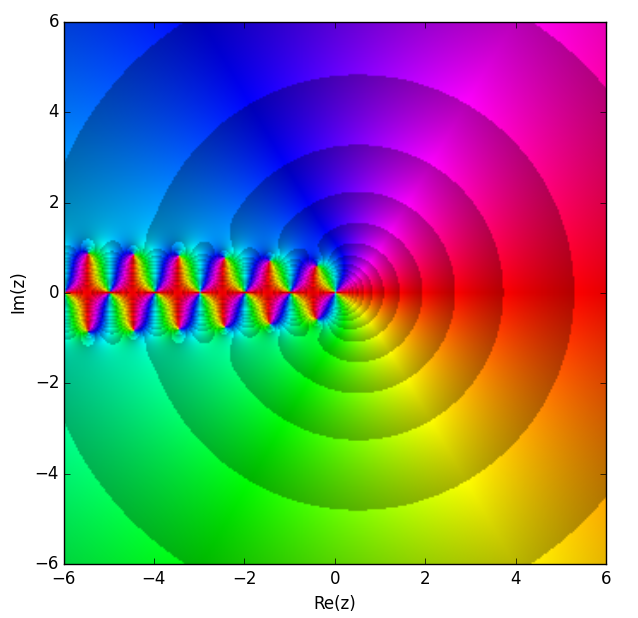
Mathematical function
In mathematics, the trigamma function, denoted ψ1(z) or ψ(1)(z), is the second of the polygamma functions, and is defined by
: \psi_1(z) = \frac{d^2}{dz^2} \ln\Gamma(z).
It follows from this definition that
: \psi_1(z) = \frac{d}{dz} \psi(z)
where ψ(z) is the digamma function. It may also be defined as the sum of the series
: \psi_1(z) = \sum_{n = 0}^{\infty}\frac{1}{(z + n)^2},
making it a special case of the Hurwitz zeta function
: \psi_1(z) = \zeta(2,z).
Note that the last two formulas are valid when 1 − z is not a natural number.
Calculation
A double integral representation, as an alternative to the ones given above, may be derived from the series representation: : \psi_1(z) = \int_0^1!!\int_0^x\frac{x^{z-1}}{y(1 - x)},dy,dx using the formula for the sum of a geometric series. Integration over y yields: : \psi_1(z) = -\int_0^1\frac{x^{z-1}\ln{x}}{1-x},dx
An asymptotic expansion as a Laurent series can be obtained via the derivative of the asymptotic expansion of the digamma function: :\begin{align} \psi_1(z) &\sim {\operatorname{d}\over\operatorname{d}!z} \left(\ln z - \sum_{n=1}^\infty \frac{B_n}{nz^n}\right) \ &= \frac{1}{z} + \sum_{n=1}^\infty \frac{B_n}{z^{n+1}} = \sum_{n=0}^{\infty}\frac{B_n}{z^{n+1}} \ &= \frac{1}{z} + \frac{1}{2z^2} + \frac{1}{6z^3} - \frac{1}{30z^5} + \frac{1}{42z^7} - \frac{1}{30z^9} + \frac{5}{66z^{11}} - \frac{691}{2730z^{13}} + \frac{7}{6z^{15}} \cdots \end{align} where B**n is the nth Bernoulli number and we choose .
Recurrence and reflection formulae
The trigamma function satisfies the recurrence relation
: \psi_1(z + 1) = \psi_1(z) - \frac{1}{z^2}
and the reflection formula
: \psi_1(1 - z) + \psi_1(z) = \frac{\pi^2}{\sin^2 \pi z} ,
which immediately gives the value for z : \psi_1(\tfrac{1}{2})=\tfrac{\pi^2}{2} .
Special values
At positive integer values we have that : \psi_1(n) = \frac{\pi^2}{6} - \sum_{k=1}^{n-1} \frac{1}{k^2}, \qquad \psi_1(1) = \frac{\pi^2}{6}, \qquad \psi_1(2) = \frac{\pi^2}{6} - 1, \qquad \psi_1(3) = \frac{\pi^2}{6} - \frac{5}{4}.
At positive half integer values we have that : \psi_1\left(n+\frac12\right)=\frac{\pi^2}{2}-4\sum_{k=1}^n\frac{1}{(2k-1)^2}, \qquad \psi_1\left(\tfrac12\right) = \frac{\pi^2}{2}, \qquad \psi_1\left(\tfrac32\right) = \frac{\pi^2}{2} - 4 .
The trigamma function has other special values such as:
: \psi_1\left(\tfrac14\right) = \pi^2 + 8G
where G represents Catalan's constant.
There are no roots on the real axis of ψ1, but there exist infinitely many pairs of roots zn, for quickly and their imaginary part increases slowly logarithmic with n. For example, and are the first two roots with Im(z) 0.
Relation to the Clausen function
The digamma function at rational arguments can be expressed in terms of trigonometric functions and logarithm by the digamma theorem. A similar result holds for the trigamma function but the circular functions are replaced by Clausen's function. Namely, : \psi_1\left(\frac{p}{q}\right)=\frac{\pi^2}{2\sin^2(\pi p/q)}+2q\sum_{m=1}^{(q-1)/2}\sin\left(\frac{2\pi mp}{q}\right)\textrm{Cl}_2\left(\frac{2\pi m}{q}\right).
Appearance
The trigamma function appears in this sum formula:
: \sum_{n=1}^\infty\frac{n^2-\frac12}{\left(n^2+\frac12\right)^2}\left(\psi_1\bigg(n-\frac{i}{\sqrt{2}}\bigg)+\psi_1\bigg(n+\frac{i}{\sqrt{2}}\bigg)\right)= -1+\frac{\sqrt{2}}{4}\pi\coth\frac{\pi}{\sqrt{2}}-\frac{3\pi^2}{4\sinh^2\frac{\pi}{\sqrt{2}}}+\frac{\pi^4}{12\sinh^4\frac{\pi}{\sqrt{2}}}\left(5+\cosh\pi\sqrt{2}\right).
Notes
References
- Milton Abramowitz and Irene A. Stegun, Handbook of Mathematical Functions, (1964) Dover Publications, New York. . See section §6.4
- Eric W. Weisstein. Trigamma Function -- from MathWorld--A Wolfram Web Resource
References
- (1991). "Structural properties of polylogarithms". American Mathematical Society.
This article was imported from Wikipedia and is available under the Creative Commons Attribution-ShareAlike 4.0 License. Content has been adapted to SurfDoc format. Original contributors can be found on the article history page.
Ask Mako anything about Trigamma function — get instant answers, deeper analysis, and related topics.
Research with MakoFree with your Surf account
Create a free account to save articles, ask Mako questions, and organize your research.
Sign up freeThis content may have been generated or modified by AI. CloudSurf Software LLC is not responsible for the accuracy, completeness, or reliability of AI-generated content. Always verify important information from primary sources.
Report