From Surf Wiki (app.surf) — the open knowledge base
Tricorne
Hat with the brim turned up on three sides
Hat with the brim turned up on three sides
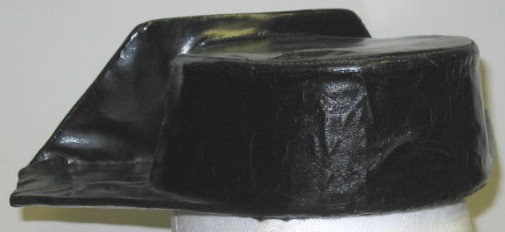
The tricorne or tricorn is a style of hat in a triangular shape, which became popular in Europe during the 18th century, falling out of style by the early 1800s. The word "tricorne" was not widely used until the mid-19th century. During the 18th century, hats of this general style were referred to as "cocked hats".
At the peak of its popularity, the tricorne varied greatly in style and size, and was worn not only by the aristocracy, but also as common civilian dress, and as part of military and naval uniforms. Typically made from animal fiber, the more expensive being of beaver-hair felt and the less expensive of wool felt, the hat's most distinguishing characteristic was that three sides of the brim were turned up (cocked) and either pinned, laced, or buttoned in place to form a triangle around the crown. The style served two purposes: first, it allowed stylish gentlemen to show off the most current fashions of their wigs, and thus their social status; and secondly, the cocked hat, with its folded brim, was much smaller than other hats, and therefore could be more easily tucked under an arm when going inside a building, where social etiquette dictates that a gentleman should remove his hat. Tricornes with laced sides could have the laces loosened and the sides dropped down to provide better protection from the weather, sun, and rain.
Tricornes had a rather broad brim, pinned up on either side of the head and at the back, producing a triangular shape. The hat was typically worn with one point facing forward, though it was not at all unusual for soldiers, who would often rest a rifle or musket on their right shoulder, to wear the tricorne pointed to the left to allow better clearance. The crown is low, unlike the steeple hats worn by the Puritans or the top hat of the 19th century.
Tricornes ranged from the very simple and cheap to the extravagant, occasionally incorporating gold or silver lace trimming and feathers. In addition, military and naval versions usually bore a cockade or other national emblem at the front. This style of hat remains in use in several countries to the present day as an item of ceremonial dress.
History
The tricorne appeared as a result of the evolution of the broad-brim round hat used by Spanish soldiers in Flanders during the 17th century. By pledging (binding) the brims, a triangular shape was obtained. This shape was favored by Spanish soldiers, as when standing at arms, their muskets could be held at their shoulders right or left without hitting the hat brim. War broke out between France and Spain in 1667 over the Spanish Netherlands, and during the subsequent struggle, its use spread to the French armies. The style was brought back to France, where its usage spread to the French population and the royal court of King Louis XIV, who made it fashionable throughout Europe, both as civilian and military wear. By the end of the 17th century, the tricorne was popular in both civilian fashion and in military uniforms. It remained one of the predominant styles of hat in Europe and European-influenced countries throughout the 18th century, e.g. in the United States the first five presidents, from George Washington to James Monroe, wore this style of hat according to the fashion of the 18th century. James Monroe earned the nickname "The Last Cocked Hat" because of this.
The tricorne quickly declined in use at the end of the 18th century. It evolved into the bicorne, which was widely used by military officers in Europe from the 1790s until World War I, not completely fading out of style until World War II. For enlisted soldiers, the tricorne was replaced by the shako at the turn of the 19th century, which had become the new dominant style of military headgear from 1800 on. Also at the turn of the 19th century, as the fashionable hat for civilian men, the tricorne was overtaken by the top hat. In 1917, the Women's Royal Naval Service introduced a smaller, modernised version of the tricorne for female officers.
Modern usage and legacy
File:Alabardero.JPG|Alabardero (Halberdier) of the Spanish Royal Guard Guardia Civil a caballo Dos de Mayo 2008 n5.jpg|Horse Guard of the Guardia Civil wearing a stylized tricorne during a ceremony in Madrid, Spain Koninklijk Koetsier 2013 74.JPG|Tricorne as worn at the {{Ill|Royal court of the Netherlands File:Defense.gov photo essay 110630-F-RG147-559.jpg|Tricorne worn by U.S. Army Old Guard Fife and Drum Corps Chelsea-pensioners.jpg|Chelsea Pensioners wearing their tricorne hats File:Seaton Town Cryer - panoramio.jpg|The town crier of Seaton in Devon, 2013 File:Ken Foster crop.jpg|Lord Mayor of Plymouth, 2009
Tricornes survive today as part of the traditional dress of the Chelsea Pensioners (UK) and the Old Guard Fife and Drum Corps of the United States Army, and the distinctive hat of the Spanish Guardia Civil, called a tricornio in Spanish, originates from the tricorne. In the UK, a black feathered tricorne hat is part of the ceremonial dress of most Lord Mayors; at the annual Lord Mayor's Show in November, the newly elected Lord Mayor of the City of London can usually be seen enthusiastically waving his tricorne at the crowds. In the British Parliament until recently, both the Lord Chancellor and the Speaker of the House of Commons used to carry plain black tricornes as part of their formal dress each day when on duty; only on rare occasions was it worn (on top of the full bottomed wig): by the Lord Chancellor when acting as a Lord Commissioner of the Sovereign, and by the Speaker when rebuking a Member at the Bar of the House. During the Introduction Ceremony, new members of the House of Lords were required to doff (remove and replace) a tricorne hat three times before the Lord Chancellor; however, hats were removed from the ritual in 1998.

In the United States, the tricorne is associated with the American Revolution and American Patriots of that era, especially Minutemen (militia members of the American Colonies), as well as the Continental Army who wore black tricorne hats of black felt. Participants in re-enactment events often don tricornes, and they also can be seen in sports culture as worn by fans of teams with Revolutionary names, such as the New England Patriots (an American football team), the New England Revolution (a Major League Soccer team), the United States men's national soccer team, the University of Massachusetts Amherst, and the George Washington University. The Tea Party movement also uses the tricorne as an icon to associate itself with the American Revolution.
In Spain, the traditional headdress of the Guardia Civil, the oldest law enforcement agency covering the whole country, is the tricornio hat, originally a tricorne. Its use now is reserved for parades or ceremonies. The Royal Corps of Halberdiers within the Spanish Royal Guard wear blue and white with a silver ribbon tricorne as part of their formal dress.
In France, synagogue officiants (usually not rabbis) wear the tricorne on formal occasions. In the French Navy and Air Force, tricornes are still worn by women as a piece of uniform.
The tricorne is a key feature in the Portuguese University of Minho's academic dress. Its origins are as far as the 18th century, as being the academic dress of Colégio de Estudos Superiores de S. Paulo, as depicted by tile panels in the Archbishop's Palace of Braga (now Rectorate of the University of Minho). Designated by "Tricórnio" (Portuguese for "tricorne"), this academic dress was redesigned and officially set in 1989.
In Canada, the tricorne is part of the ceremonial wear of the Speakers, both in the federal Parliament and in some provincial legislatures. It is also part of the ceremonial dress for justices of the Supreme Court of Canada.
In 1981, the milliner John Boyd made a famous pink tricorne hat for Diana, Princess of Wales. This style became known as the "Lady Di" design and was copied worldwide.
Gallery
File:Louis XIV 1685 Best.jpg|Figure of Louis XIV File:02 178 Vinkhuijzen Book illustrations of Historical description of the clothes and weapons of Russian troops.jpg|Russian soldier, File:900-231 Herzog Carl Alexander.jpg|Charles Alexander, –1737 File:1st Viscount Gage.jpg|Thomas Gage, 1743 File:Frederic II de prusse.jpg|Frederick the Great wearing a tricorne, File:Catherine II tricorne.jpg|Catherine the Great, File:Washington 1772.jpg|Colonel George Washington, 1772 File:John Trumbull - The Surrender of Lord Cornwallis at Yorktown, October 19, 1781 - 1832.4 - Yale University Art Gallery.jpg|Trumbull's depiction of the 1781 surrender of Lord Cornwallis at Yorktown File:Carlos III cazador.jpg|Charles III of Spain, –88 File:Картинка № 9 к статье «Петр I Алексеевич Великий». Военная энциклопедия Сытина. Том № 18. (Санкт-Петербург, 1911-1915).jpg|Peter the Great File:James Lowther Vanity Fair 24 October 1906.jpg|The British Speaker of the House of Commons carrying his tricorne, 1906. File:Women's Royal Naval Service. November 1942, Admiralty. Uniforms of the WRNS. A12614 2.jpg|The Women's Royal Naval Service modernised version of the tricorne in 1942.
References
References
- "Gentlemen of Fortune".
- "Digital Collection -Tricorn Hat".
- "Cocked Hats".
- Castells, Albert. "Los tercios viejos y la presencia española en Flandes", Espasa, Madrid, 1997
- Digital History, Steven Mintz. "Digital History". Digitalhistory.uh.edu.
- (May 3, 2002). "Real life at the White House: 200 years of daily life at America's most famous residence". Routledge.
- Robert S. Summer. "James Monroe". Presidents of the United States.
- "Cocked Hat".
- Kannik, Prebben. (1968). "Military Uniforms in Colour". Blandford Press.
- Baclawski, Karen. (1995). "The Guide to Historic Costume". Drama Book Publishers.
- Preston, Antony. (1987). "History of the Royal Navy in the 20th century". Presidio Pr.
- "Royal Hospital Chelsea".
- "About the Corps".
- "Some black shape".
- "The Lord Mayor's Show".
- Crewe, Emma. (2005). "Lords of Parliament: Manners, Rituals and Politics". Manchester University Press.
- "Revolutionary War – Headgear".
- "New England Patriots".
- "New England Revolution".
- "University of Massachusetts Official Athletic Site – Football".
- Van Dyke, Nella. (2014). "Understanding the Tea Party Movement". Routledge.
- "Uniformes de carácter histórico".
- "John Boyd". The FMD - FashionModelDirectory.com.
This article was imported from Wikipedia and is available under the Creative Commons Attribution-ShareAlike 4.0 License. Content has been adapted to SurfDoc format. Original contributors can be found on the article history page.
Ask Mako anything about Tricorne — get instant answers, deeper analysis, and related topics.
Research with MakoFree with your Surf account
Create a free account to save articles, ask Mako questions, and organize your research.
Sign up freeThis content may have been generated or modified by AI. CloudSurf Software LLC is not responsible for the accuracy, completeness, or reliability of AI-generated content. Always verify important information from primary sources.
Report