From Surf Wiki (app.surf) — the open knowledge base
Triarthrus
Genus of trilobite

Genus of trilobite
|T. beckii|Green, 1832 (type species) = Paradoxides beckii, Calymene beckii |T. billingsi|Barrande, 1872 |T. canadensis|Smith, 1861 |T. eatoni|(Hall, 1838) = T. macastyensis |T. glaber|Billings, 1859 |T. huguesensis|Förste, 1924 |T. latissimus|Månsson, 1998 |T. linnarssoni|Torslund, 1940 |T. novoaustralis|Smith et al., 2024 |T. rougensis|Parks, 1921 |T. sichuansis|Lu & Chang, 1974 |T. spinosus|Billings, 1857
Triarthrus is a genus of Upper Ordovician ptychopariid trilobite found in New York, Ohio, Kentucky, and Indiana, eastern and northern Canada, China and Scandinavia. It is the last of the Olenid trilobites, a group which flourished in the Cambrian period. The specimens of T. eatoni that are found in the Beecher's Trilobite Bed, Rome, New York area are exquisitely preserved showing soft body parts in iron pyrite. Pyrite preservation has given scientists a rare opportunity to examine the gills, walking legs, antennae, digestive systems, and eggs of trilobites, which are rarely preserved. Triarthrus is therefore commonly used in science texts to illustrate trilobite anatomy and physiology.
Distribution
- T. beckii Upper Caradoc and Ashgill, Snake Hill Formation, Cohoes, New York State; and Kentucky.
- T. billingsi Ashgill?, Quebec
- T. canadensis is known from the Upper Ordovician of Canada (Katian, lower Member of the Whitby Formation, Craigleith vicinity, Georgian Bay area; middle Member of the Whitby Formation, Whitby, Rogue River and Pickering, all Lake Simcoe area, Ontario)
- T. eatoni Upper Caradoc-Ashgill, N.Y., is known from the Upper Ordovician of Canada (Ashgill, lower Member of the Whitby Formation, Craigleith vicinity, Georgian Bay area, Lake Simcoe area, Ontario; and Quebec) and the United States (New York)
- T. glaber Ashgill, Quebec
- T. huguesensis Ashgill, Quebec
- T. latissimus Sweden
- T. linnarssoni Norway and Sweden
- T. rougensis Ashgill, Ontario
- T. sichuansis China
- T. spinosus is known from the Upper Ordovician of Canada (Katian, middle Member of the Whitby Formation, Rogue River and Pickering, both Lake Simcoe area, Ontario and Quebec), and the United States (New York).
- T. novoaustralis is known from Upper Ordovician of Australia (middle Katian, Malachis Hill Formation)
Taxonomy
Species previously assigned to ''Triarthrus''
- T. angelini = Bienvillia angelini
- T. belli = Parabolinella sp.
- T. caenigenus = Porterfieldia caenigena
- T. convergens = Porterfieldia convergens
- T. fisheri = Porterfieldia fisheri
- T. goldwyerensis = Porterfieldia goldwyerensis
- T. humilis = Porterfieldia humilis
- T. jachalensis = Porterfieldia jachalensis
- T. pacificus = Porterfieldia pacifica
- T. papilosus = Porterfieldia papilosa
- T. parapunctatus = Porterfieldia parapunctata
- T. parchaensis = Bienvillia parchaensis
- T. punctatus = Porterfieldia punctata
- T. rectifrons = Bienvillia rectifrons
- T. reedi = Porterfieldia caenigena
- T. shinetonensis = Bienvillia shinetonensis
- T. sinensis = Porterfieldia sinensis
- T. tetragonalis = Bienvillia tetragonalis
- T. thor = Porterfieldia thor
- T. variscorum = Parabolina frequens
Description
Exoskeleton
_(17966037580)_(cropped).jpg)
Triarthrus is an average size trilobite (up to about 5 cm) and its moderately convex body is about twice as long as wide (excluding spines). Like in all Olenidae, the headshield (or cephalon) of Triarthrus has opisthoparian sutures, and the right and left free cheeks that they define are yoked. The cephalon in Triarthrus is semicircular. The central raised area (or glabella) is approximately quadrate, and considerably wider than the posterior margin of the fixed cheeks (or fixigenae). The front of the glabella is close to the anterior border (or the preglabellar field is short), but the border furrow is absent in front of the glabella. The facial suture crosses in front of the glabella on the top of an inflated rim. The posterior end of the glabella consists of the occipital ring that is defined by a furrow crossing over the midline. The occipital ring carries a small node at its centre point, and may be adorned with a backward directed spine as long as the glabella. In front of the occipital furrow two pairs of lateral furrows emerge from the axial furrow almost perpendicularly and curve backwards as they cut toward the midline, but without reaching it. Anteriorly, one or two further furrows are isolated shallow slits or depressions. The fixigenae are very narrow (less than ¼ of the width of the glabella at the back of the eye, and less than ½ at the occipital ring). The librigenae are narrow, and with or without spines. The border is prominent elsewhere, and the eyes of small to medium size, sitting at the end of small palpebral lobes next to the frontal half of the glabella. The thorax consists of 13 to 16 segments, with the axis wider than pleural regions, obliquely truncated or rounded pleural tips, and the fulcrum placed very close to the axis. The tailpiece (or pygidium) is small, with 3 to 5 axial rings, distinctly segmented pleural fields, and an entire, evenly rounded margin.
Uncalcified parts
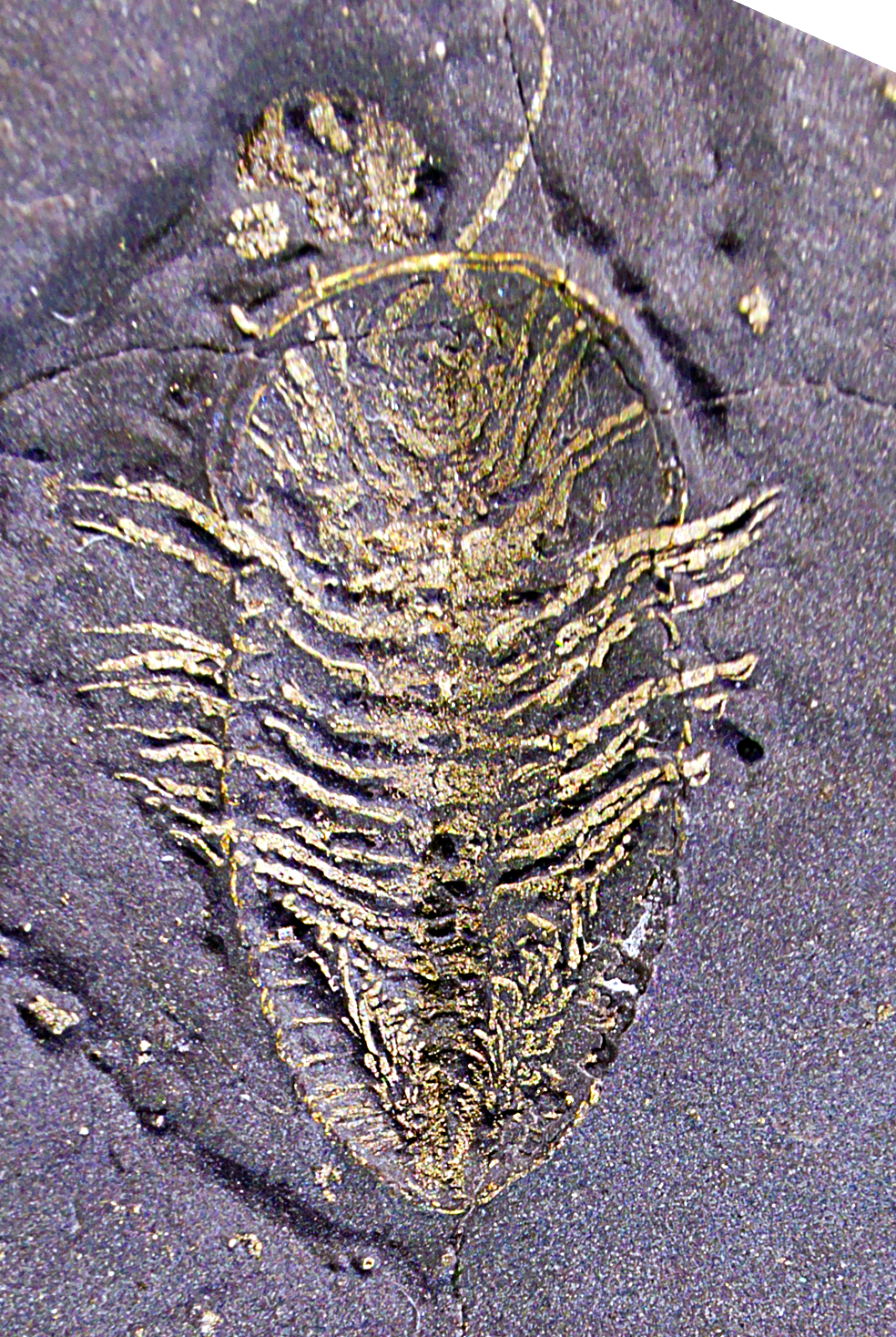
The foremost pair of extremities in trilobites are the antennas. In Triarthrus eatoni the antennas are probably flexible. From their attachment adjacent to the hypostome they stretch inward and forward, almost touching each other at the point where, from a dorsal viewpoint, they appear from under the cephalic margin, then bending outward and then forward again in a slight S-curve. They are about twice as long as the headshield (or cephalon), each consisting of 40 to 50 segments that are shorter than wide. As the preservation of soft tissue in T. eatoni is excellent, it is probable that it lacked cerci, the most backward pair of extremities known from Olenoides serratus.
Life cycle
Due to the existence of an excellently preserved deposit in the Frankfurt Shale near Rome, New York State, that suggests an entire population of Triarthrus eatoni was killed and quickly buried, it has been possible to make a plausible reconstruction of its life history. After hatching from roughly spherical eggs averaging ~0.2mm in diameter, the small protaspid and early meraspid stages supposedly lived between the plankton in the water column. This is derived from the fact that only exuviae of the early stages were found, making clear that they haven't died in the disaster that killed their elders. In this phase the larvae probably dispersed over large areas. After a few months, at about 2mm long T. eatoni started living at the sea floor. Here, it must have fed by filtering suspended food particles, probably comparable to the trunk limb filter-feeding Cephalocarida and Branchiopoda. The exoskeletons fall into five size categories, suggesting that T. eatoni had a distinct breeding season, likely annually, as is the case in almost all extant crustaceans (although some amphipods have two breeding periods per year). It could live through at least four breeding seasons, and at that age reach approximately 4 cm in length.
References
Sources
References
- Paleobiology Database. (1969). "Palaeozoic geology of the Lake Simcoe Area, Ontario". Geological Survey of Canada Memoirs.
- (22 Nov 2024). "Significance of a Late Ordovician Triarthrus (Trilobita, Olenidae) from New South Wales, Australia". Proceedings of the Linnean Society of New South Wales.
- (1980). "Evolution in a cline: the trilobite Triarthrus along an Ordovician depth gradient". Lethaia.
- (1983). "A revision of the Ordovician olenid trilobite ''Triarthrus''". Geological Magazine.
- Moore, R.C.. (1959). "Arthropoda I - Arthropoda General Features, Proarthropoda, Euarthropoda General Features, Trilobitomorpha". Geological Society of America/University of Kansas Press.
- Beecher, C.E.. (1893). "A larval form of ''Triarthrus''". [[American Journal of Science]].
- Beecher, C.E.. (1893). "On the thoracic legs of ''Triarthrus''". [[American Journal of Science]].
- Beecher, C.E.. (1902). "The ventral integument of trilobites". [[American Journal of Science]].
- Cisne, John L.. (1973). "Life History of an Ordovican {{sic". Ecology.
- (March 2017). "Pyritized in situ trilobite eggs from the Ordovician of New York (Lorraine Group): Implications for trilobite reproductive biology". Geology.
This article was imported from Wikipedia and is available under the Creative Commons Attribution-ShareAlike 4.0 License. Content has been adapted to SurfDoc format. Original contributors can be found on the article history page.
Ask Mako anything about Triarthrus — get instant answers, deeper analysis, and related topics.
Research with MakoFree with your Surf account
Create a free account to save articles, ask Mako questions, and organize your research.
Sign up freeThis content may have been generated or modified by AI. CloudSurf Software LLC is not responsible for the accuracy, completeness, or reliability of AI-generated content. Always verify important information from primary sources.
Report