From Surf Wiki (app.surf) — the open knowledge base
Trevi Fountain
Fountain in Rome, Italy

Fountain in Rome, Italy
| Field | Value | |
|---|---|---|
| name | Trevi Fountain | |
| native_name | Fontana di Trevi | |
| native_name_lang | Italian | |
| location | Rome, Italy | |
| place_type | Fountain | |
| image_place | [[File:Trevi Fountain, Rome, Italy 2 - May 2007.jpg | 300px]] |
| designer | Nicola Salvi | |
| height | 26.3 m | |
| length | 49 m | |
| construction | 1732– | |
| surface | Travertine stone | |
| imagesize | 270 | |
| coordinates | ||
| mapframe-wikidata | yes | |
| mapframe-marker | monument |
| mapframe-wikidata = yes | mapframe-marker = monument The Trevi Fountain () is an 18th-century fountain in the Trevi district in Rome, Italy, designed by Italian architect Nicola Salvi and completed by Giuseppe Pannini in 1762 and several others. Standing 26.3 m high and 49.15 m wide, it is the largest Baroque fountain in the city and one of the most famous fountains in the world.
History
Origins before 1629
The fountain, at the junction of three roads (tre vie), marks the terminal point of the "modern" Acqua Vergine—the revived Aqua Virgo, one of the aqueducts that supplied water to ancient Rome. In 19 BC, supposedly with the help of a virgin, Roman technicians located a source of pure water some 13 km from the city. (This scene is presented on the present fountain's façade.) However, the eventual indirect route of the aqueduct made its length some 22 km. This Aqua Virgo led the water into the Baths of Agrippa. It served Rome for more than 400 years.
During the 6th century AD, the aqueducts were not well maintained and the 14 functioning ones were damaged during the invasion of the Ostrogoths. Although compromised and greatly reduced in scope after the damage caused by the siege of the Goths of Vitiges in 537, the Acqua Vergine remained in use throughout the Middle Ages, with restorations attested as early as the 8th century, then again by the Municipality in the 12th century, on the occasion of which the conduit was also connected to other sources closer to the city, located in a place then called "Trebium".
The Acqua Vergine water aqueduct carries the water to the Trevi Fountain, after having collected it 10 km from the Italian capital. The aqueduct is still in use today, despite some interventions during which the fountain remained empty. Calcium-free water is thought to be one of the causes.
Commission, construction, and design
In 1629, Pope Urban VIII, finding the earlier fountain insufficiently dramatic, asked Gian Lorenzo Bernini to sketch possible renovations, but the project was abandoned when the Pope died. Though Bernini's project was never constructed, there are many Bernini touches in the fountain as it exists today. An early influential model by Pietro da Cortona, preserved in the Albertina, Vienna, also exists, as do various early 18th century sketches, most unsigned, as well as a project attributed to Nicola Michetti one attributed to Ferdinando Fuga and a French design by Edmé Bouchardon.
Competitions had become popular during the Baroque era to design buildings, fountains, as well as the Spanish Steps. In 1730, Pope Clement XII organized a contest in which Nicola Salvi initially lost to Alessandro Galilei – but due to the outcry in Rome over a Florentine having won, Salvi was awarded the commission anyway. Work began in 1732.

When Salvi designed the fountain, a palace (now the Palazzo Poli) was on the site so he incorporated the fountain into the rear of the building.
Salvi died in 1751 with his work half finished, but he had made sure a barber's unsightly sign would not spoil the ensemble, hiding it behind a sculpted vase, called by Romans the asso di coppe, the "Ace of Cups", because of its resemblance to a Tarot card. Four different sculptors were hired to complete the fountain's decorations: Pietro Bracci (whose statue of Oceanus sits in the central niche), Filippo della Valle, Giovanni Grossi, and Andrea Bergondi. Giuseppe Pannini (1718-1805), son of Giovanni Paolo Panini, was hired as architect.
The Trevi Fountain was finished in 1762 by Pannini, who substituted the present allegories for planned sculptures of Agrippa and Trivia, the Roman virgin. It was officially opened and inaugurated on 22 May by Pope Clement XIII. The majority of the piece is made from Travertine stone, quarried near Tivoli, about 35 km east of Rome.
The name of the fountain derives from the Latin word trivium, meaning "intersection of three streets". The statue is located right in the center of Via De' Crocicchi, Via Poli and Via Delle Muratte.
Restorations
The fountain was refurbished once in 1988 to remove discoloration caused by smog, and again in 1998; the stonework was scrubbed and all cracks and other areas of deterioration were repaired by skilled artisans, and the fountain was equipped with recirculating pumps. In January 2013, it was announced that the Italian fashion company Fendi would sponsor a 20-month, 2.2-million-euro restoration of the fountain, the most thorough in the fountain's history. Restoration work began in June 2014 and was completed in November 2015. The fountain was reopened with an official ceremony on the evening of 3 November 2015. The restoration included the installation of more than 100 LED lights to improve the nighttime illumination of the fountain.
2023 protest
On 21 May 2023, activists of the climate group Ultima Generazione (Last Generation) climate protest group vandalized the fountain by dyeing the water with charcoal. Rome Mayor Roberto Gualtieri criticized the attacks on heritage sites. As the fountain recirculates the water, cleaning of the fountain would need the 300,000 litres of polluted water to be emptied and replaced resulting in significant costs. Ryan Maue, the former chief scientist for the National Oceanic and Atmospheric Administration, stated the attack was done by "climate eco-anarchists".
Iconography
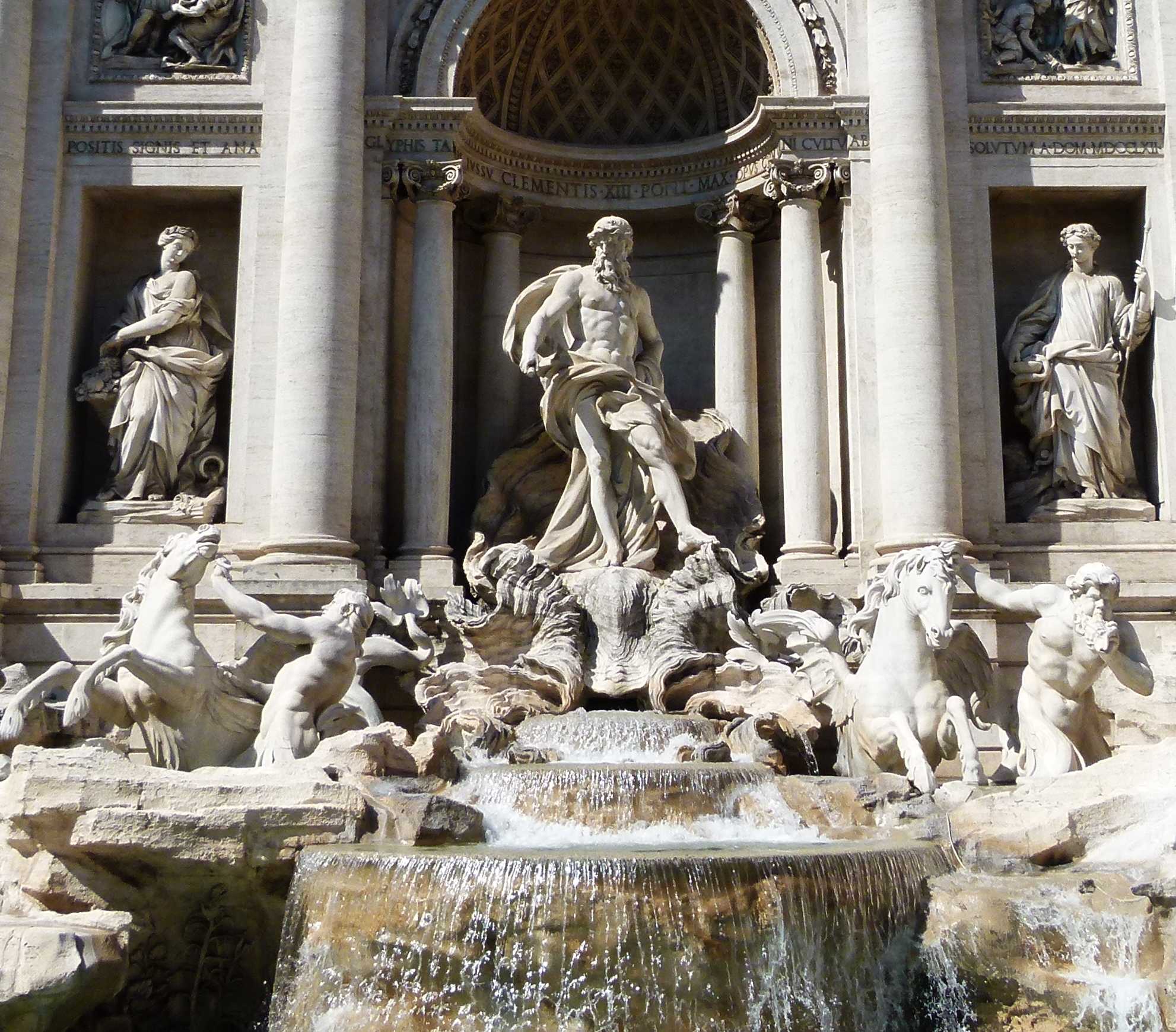
The backdrop for the fountain is the Palazzo Poli, given a new façade with a giant order of Corinthian pilasters that link the two main storeys. Taming of the waters is the theme of the gigantic scheme that tumbles forward, mixing water and rockwork, and filling the small square. Tritons guide Oceanus's shell chariot, taming hippocamps.
In the centre, a robustly-modelled triumphal arch is superimposed on the palazzo façade. The centre niche or exedra framing Oceanus has free-standing columns for maximal light and shade. In the niches flanking Oceanus, Abundance spills water from her urn and Salubrity holds a cup from which a snake drinks. Above, bas reliefs illustrate the Roman origin of the aqueducts.
The Tritons and horses provide symmetrical balance, with the maximum contrast in their mood and poses (by 1730, Rococo was already in full bloom in France and Germany).
Coin throwing

The best known and most persistent tradition consists of throwing a coin into the fountain before leaving "the eternal city", a superstition associated with the fountain being that whoever makes this gesture would favor a future return to the city. Coins are purportedly meant to be thrown while turning one's back to the fountain, using the right hand over the left shoulder. This was the theme of 1954's Three Coins in the Fountain and the Academy Award-winning song by that name which introduced the picture.
An estimated 3,000 euros are thrown into the fountain each day. In 2016, an estimated €1.4 million (US$1.5 million) was thrown into the fountain. The money thrown into the fountain is donated to the Caritas association, which uses it for charity work; however, there are regular attempts to steal coins from the fountain, although it is illegal to do so.
Due to the popularity of the fountain drawing in large crowds, Rome officials are considering options for limiting access to the fountain for tourists, such as accepting reservations. A platform will be built around the fountain's lower basin, accessible to a limited number of visitors. A queuing system was finally implemented following the fountain's reopening in December 2024, which came after a three-month restoration period. A maximum cap of 400 visitors was imposed.
In popular culture

The Trevi Fountain is depicted in the third movement, "The Trevi Fountain at Noon", of Ottorino Respighi's 1916 symphonic poem Fountains of Rome.
The fountain has appeared in several films, including Roman Holiday (1953); Three Coins in the Fountain (1954); Federico Fellini's classic, La Dolce Vita (1960); Sabrina Goes to Rome (1998); and The Lizzie McGuire Movie (2003). In Federico Fellini's 1960 film La Dolce Vita, Anita Ekberg wades into the fountain with Marcello Mastroianni.
In 1973, the Italian national postal service dedicated a postage stamp to the Trevi Fountain.
Lego released a set based on Trevi Fountain on March 1, 2025.
Replicas
An 11 m and 20.6 m similar façade construction as monument was built in 2023 at Serra Negra, Brazil. Another copy is located near Caesars Palace in Las Vegas.
Gallery
File:Fontana di Trevi di notte.JPG|Sculptures at night File:Trevi Fountain detail amk.jpg|Papal coat of arms File:Fontana di Trevi - Rome, Italy - November 6, 2010 (6212401026).jpg|Trevi Fountain as viewed from the right side
References
References
- "Trevi Fountain {{!}} fountain, Rome, Italy {{!}} Britannica".
- "Trevi Fountain".
- Though other etymologies have been suggested, this is the straightforward modern etymology adopted by Pinto 1986 and others.
- The technical Italian term for such a "terminal fountain" is a ("display"): Peter J. Aicher, "Terminal Display Fountains ("Mostre") and the Aqueducts of Ancient Rome" ''Phoenix'' '''47'''.4 (Winter 1993:339–352).
- Pinto, John A.. (1986). "The Trevi Fountain". [[Yale University Press]].
- (3 February 2019). "Trevi: LA FONTANA DI TREVI, sezione: restaurazione".
- John A. Pinto, "An Early Project by Nicola Michetti for the Trevi Fountain" ''The Burlington Magazine'' '''119''' No. 897 (December 1977:853–857).
- Pinto, John. (December 1983). "An Early Project by Ferdinando Fuga for the Trevi Fountain in Rome". The Burlington Magazine.
- Gross, Hanns. (1990). "Rome in the Age of Enlightenment: the Post-Tridentine syndrome and the ancient regime". Cambridge University Press.
- (12 January 2019). "Poli Palace - Trevi fountain". Turismoroma – Roma Turistico Officiale.
- Delli, Sergio. (1975). "Le strade di Roma: una guida alfabetica alla storia, ai segreti, all'arte, al folklore". Armando.
- Andrieux, Maurice. (1968). "Rome". Funk & Wagnalls.
- Minor, Vernon Hyde. (1997). "Passive Tranquillity: The Sculpture of Filippo Della Valle". American Philosophical Society.
- (2015). "The Pantheon: From Antiquity to the Present". Cambridge University Press.
- Powell, Lindsay. (2015). "Marcus Agrippa: Right-hand Man of Caesar Augustus". Pen and Sword.
- (2016). "The Trevi Fountain: Digital travel guide". Edizioni Polìmata.
- "The Trevi Fountain – The most beautiful fountain in the world".
- "fontana-di-trevi".
- (28 February 1988). "Trevi Fountain To Be Restored". The New York Times.
- Pullella, Philip. (28 January 2013). "Rome Trevi Fountain, symbol of Dolce Vita, to get big facelift". [[Reuters]].
- (3 November 2015). "Torna l'acqua a Fontana di Trevi, dopo il restauro firmato Fendi". Roma – La Repubblica.
- Squillaci, Laura. (3 November 2015). "La Fontana di Trevi torna all'antico splendore dopo il restauro". Rai News.
- (4 November 2015). "La Fontana di Trevi, applauso e flash salutano il ritorno dell'acqua". ANSA.it.
- (21 May 2023). "Rome climate protesters turn Trevi fountain water black". The Guardian.
- "Trevi Fountain water turns black in Rome climate protest". Reuters.
- (22 May 2023). "Climate activists dump charcoal in Rome's Trevi Fountain". CNN.
- "Watch: Activists turn Trevi Fountain water black". BBC News.
- (21 May 2023). "Italy recently suffered major flooding, so the climate eco-anarachists attacked the Trevi Fountain to get Europe to abandon fossil fuels and undergo extreme degrowth.". @RyanMaue.
- (1 January 1910). "Trevi Fountain: Overall view of fountain with the facade of Palazzo Poli". [[University of Notre Dame]].
- "Trevi Fountain".
- Éric Neuhoff, ''Fontaine de Trevi, histoire d'eau'' (in French), ''[[Le Figaro]]'', 18 August 2014, p. 20
- Cox, Josie. (13 April 2017). "Rome's Trevi Fountain generates €1.4m for city's charities in 2016, reports Caritas". The Independent.
- (26 November 2006). "Trevi coins to fund food for poor". BBC News.
- (13 April 2017). "Rome's Trevi Fountain Holds Nearly $1.5 Million in Loose Change".
- (February 16, 2024). "What happens to the coins tossed into Rome's Trevi Fountain?". [[Reuters]].
- (8 October 2003). "Trevi coins row re-surfaces". BBC News.
- (9 August 2002). "Trevi fountain 'copycat' thieves arrested". BBC News.
- Kassam, Ashifa. (2024-09-05). "Rome could limit access to Trevi fountain as it grapples with overtourism". The Guardian.
- "Rome's Trevi Fountain Will Get a Much-Needed Cleaning—and a Controversial New Entry Fee".
- Mackintosh, Thomas. (2024-12-23). "Rome to regulate Trevi Fountain crowds after restoration". BBC.
- (2024-12-23). "Rome's Trevi Fountain reopens to limited crowds". France 24.
- (28 December 1920). "The Three Arts". [[The Baltimore Sun.
- (9 March 2023). "ROMAN HOLIDAY FILMING LOCATIONS: COMPLETE GUIDE WITH MAP".
- (5 March 2009). "BBC NEWS – Europe – La Dolce Vita, 50 years and counting". bbc.co.uk.
- Silver, Alexandra. (17 May 2010). "Top 10 Iconic Movie Locations".
- (3 November 2015). "The Trevi Fountain and the Dolce Vita!". [[Euronews]].
- Brick Blog, Jay's. (January 14, 2025). "2025 LEGO Architecture Trevi Fountain (21062) officially revealed!". Jay's Brick Blog.
- (20 April 2023). "Réplica da 'Fontana di Trevi' fica pronta, e Serra Negra aguarda governador de SP para inaugurar atração".
- (2016-10-27). "Neo-Baroques". Brill/Rodopi.
This article was imported from Wikipedia and is available under the Creative Commons Attribution-ShareAlike 4.0 License. Content has been adapted to SurfDoc format. Original contributors can be found on the article history page.
Ask Mako anything about Trevi Fountain — get instant answers, deeper analysis, and related topics.
Research with MakoFree with your Surf account
Create a free account to save articles, ask Mako questions, and organize your research.
Sign up freeThis content may have been generated or modified by AI. CloudSurf Software LLC is not responsible for the accuracy, completeness, or reliability of AI-generated content. Always verify important information from primary sources.
Report