From Surf Wiki (app.surf) — the open knowledge base
Trent Bridge (bridge)
| Field | Value |
|---|---|
| name | Trent Bridge |
| image | TrentBridge2022.jpg |
| image_size | 240 |
| alt | A bridge with three arches spanning a wide river. The near bank is grass with some trees bare of leaves. The sky is blue with a couple small white clouds. |
| caption | View of Trent Bridge from the bank of the River Trent, West Bridgford |
| carries | Road traffic (, single carriageway) |
| crosses | River Trent |
| locale | Nottingham, Nottinghamshire, England |
| designer | Marriott Ogle Tarbotton |
| material | Iron and stone |
| width | 40 ft |
| mainspan | 100 ft |
| builder | Andrew Handyside and Company |
| begin | 1868 |
| complete | 1871 |
| heritage | Grade II listed |
| coordinates |
Trent Bridge is an iron and stone road bridge across the River Trent in Nottingham, England UK. It is the principal river crossing for entrance to the city from the south, although the upstream Clifton Bridge is both larger and busier.
History
Medieval bridge
The first bridge is thought to have been constructed on the site in 920. A second bridge which was started in 1156 had more than 20 stone arches and a chapel dedicated to St. James at one end. It was maintained by a religious organisation. On 21 February 1551 the responsibility for repair passed to Nottingham Corporation, through a royal charter which created the Bridge Estate.
It was known as Hethbeth bridge, Heath-beth bridge, or Heck-beck bridge.
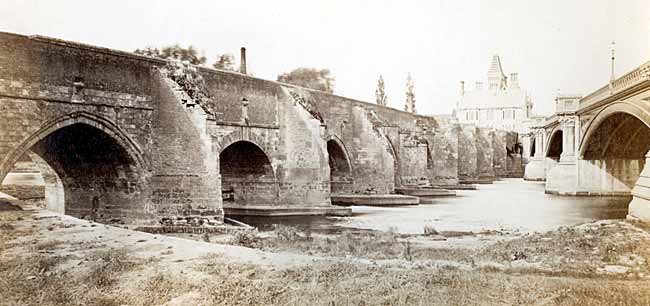
This bridge was damaged by floods several times, and the northern half was washed away during floods in 1683. The repaired bridge had fifteen arches across the river and flood areas, giving openings covering 347 ft in a total length of 538 ft. Although it was repaired, the foundations had become unsafe and a project to replace it was started in the 1860s.
Modern bridge
The bridge was designed by Marriott Ogle Tarbotton. Construction started in 1868 and was completed in 1871 by Derbyshire iron maker, Andrew Handyside. The general contractor was Benton and Woodiwiss of Derby. It was completed for a cost of £30,000 (equivalent to £ as of ). There were three main cast iron arch spans each 100 ft braced by wrought iron girders. The width between the parapets was 40 ft. It is a Grade II listed building. The carving on the bridge was executed by Mawer and Ingle of Leeds.
The new Trent Bridge formed part of a series of works along the banks of the river to improve flood defences by the construction of stepped, stone embankments.
Between 1924 and 1926 the bridge was widened to 80 ft by the Cleveland Bridge & Engineering Company.
Bridge Estate

.jpg)
The Bridge Estate was created by a royal charter of King Edward VI on 21 February 1551 with Nottingham Corporation as trustee. The objective was to provide funds to maintain and repair the bridge.
In 1882 the funds exceed the requirement of the objective, and three new objectives were agreed:
- Provide for the efficient maintenance and repair of Trent Bridge and the approaches to it.
- To set up a contingency fund for the possible construction of such new bridge or bridges over the River Trent as may be found necessary or desirable.
- The residue of such income is to be applied as the trustee thinks best for the improvement of the City of Nottingham and the public benefit of its inhabitants.
In 1945 the Bridge Estate was registered as charity 220716 with the Charity Commissioners.
Flood marks
| Floods levels at Trent Bridge | Rank | Date | Level at Trent Bridge | m | ft | 1 | February 1795 | 2 | October 1875 | 3 | March 1947 | 4 | November 1852 | 5 | February 1946 | 6 | January 1901 | 7 | May 1932 | 8 | December 1910 | 9 | December 1869 | 10 | July 1875 | 11 | November 2000 | 12 | January 1887 | 13 | 1857 | 14 | March 1864 | 15 | Normal Level |
|---|---|---|---|---|---|---|---|---|---|---|---|---|---|---|---|---|---|---|---|---|---|---|---|---|---|---|---|---|---|---|---|---|---|---|---|
| 24.55 m | |||||||||||||||||||||||||||||||||||
| 24.38 m | |||||||||||||||||||||||||||||||||||
| 24.30 m | |||||||||||||||||||||||||||||||||||
| 24.26 m | |||||||||||||||||||||||||||||||||||
| 24.10 m | |||||||||||||||||||||||||||||||||||
| 24.09 m | |||||||||||||||||||||||||||||||||||
| 24.04 m | |||||||||||||||||||||||||||||||||||
| 24.01 m | |||||||||||||||||||||||||||||||||||
| 23.81 m | |||||||||||||||||||||||||||||||||||
| 23.81 m | |||||||||||||||||||||||||||||||||||
| 23.80 m | |||||||||||||||||||||||||||||||||||
| 23.69 m | |||||||||||||||||||||||||||||||||||
| 23.49 m | |||||||||||||||||||||||||||||||||||
| 23.41 m | |||||||||||||||||||||||||||||||||||
| 20.7 m |


On the northern abutment of the bridge, the high water marks reached by floods since 1852 have been carved into the stonework. This practice was started during the period when the Hethbeth bridge still existed, and those earlier marks were transferred onto the new bridge. To enable a comparison to be made with the peak levels, a graduated series of heights in feet above sea level has also been added.
The highest flood mark is for the October 1875 flood, but the larger 1795 Candlemas flood, has been attributed with a height at the bridge of 24.55 m. Normal water level which is controlled by Holmes Sluices some 4 km downstream, is 20.7 m.{{cite web| url= http://planning.broxtowe.gov.uk/(S(23rl5y55ynbxgt45dzbahnar))/Published/DA5F20F8DC4F11DFA2F30017A4F8C9EE.pdf |title= Nottingham Left Bank Flood Alleviation Scheme Flood Risk Assessment |year=2001|publisher=broxtowe.gov.uk |accessdate=10 May 2013}}
Fame and popular culture
The bridge is one of Nottingham's most famous landmarks and sits at the heart of Nottingham's sporting district. The bridge lends its name to the nearby Nottinghamshire County Cricket Club Trent Bridge stadium, one of England's biggest and most famous cricket grounds. Nottingham Forest FC's City Ground stadium and Notts County FC's Meadow Lane stadium are nearby. The bridge has also been used in as the backdrop for the regional BBC East Midlands Today and ITV Central News.
The Riverbank public house overlooks the bridge in its former tollhouse.
In December 2002, the Nottingham Princess river cruise boat crashed into the central column of the bridge when it lost control in strong currents.
--{{River item box
References
References
- Bridges, law and power in medieval England, 700-1400. Alan Cooper
- History and antiquities of Nottingham. James Orange
- Labrum, E. A.. (1993). "Civil engineering heritage, eastern and central England". Thomas Telford.
- Nottingham: an illustrated history By J. V. Beckett, Ken Brand
- {{NHLE
- [http://www.genesreunited.co.uk/searchbna/viewrecord/bl/0001290/18710729/066/0006 ''Bedfordshire Mercury'' Bedfordshire, England Saturday 29 July 1871 p6 col5: "Opening of a new bridge"]
- Macdonald, Neil. (2012). "Reassessing flood frequency for the River Trent through the inclusion of historical flood information since AD1320". cost-floodfreq.eu.
- Stone, Richard. (2005). "River Trent". Phillimore.
- (2003). "Report on the investigation of Nottingham Princess striking Trent Bridge Nottingham". maib.gov.uk.
This article was imported from Wikipedia and is available under the Creative Commons Attribution-ShareAlike 4.0 License. Content has been adapted to SurfDoc format. Original contributors can be found on the article history page.
Ask Mako anything about Trent Bridge (bridge) — get instant answers, deeper analysis, and related topics.
Research with MakoFree with your Surf account
Create a free account to save articles, ask Mako questions, and organize your research.
Sign up freeThis content may have been generated or modified by AI. CloudSurf Software LLC is not responsible for the accuracy, completeness, or reliability of AI-generated content. Always verify important information from primary sources.
Report