From Surf Wiki (app.surf) — the open knowledge base
Transbay Tube
Underwater rail tunnel under San Francisco Bay
.gif)
Underwater rail tunnel under San Francisco Bay
| Field | Value | |||
|---|---|---|---|---|
| name | Transbay Tube | |||
| image | Toward the Transbay Tube.jpg | |||
| caption | View into a bored tunnel looking toward the Transbay Tube | |||
| line | {{Unbulleted list | |||
| {{ric | BART | Yellow | name | yes}} |
| {{ric | BART | Blue | name | yes}} |
| {{ric | BART | Green | name | yes}} |
| {{ric | BART | Red | name | yes}} |
| location | San Francisco Bay, California, US | |||
| coordinates | Oakland portal: | |||
| system | Bay Area Rapid Transit | |||
| start | Embarcadero station, San Francisco | |||
| end | West Oakland station, Oakland | |||
| opened | ||||
| owner | San Francisco Bay Area Rapid Transit District | |||
| character | Rapid transit | |||
| linelength | 3.6 mi | |||
| notrack | 2 | |||
| gauge | ||||
| el | Third rail, 1 kV DC | |||
| speed | 80 mph | |||
| hielevation | Sea level | |||
| lowelevation | 135 ft below sea level |
| | | |
|}}
The Transbay Tube is an underwater rail tunnel that carries Bay Area Rapid Transit's four transbay lines under San Francisco Bay between the cities of San Francisco and Oakland in California. The tube is 3.6 mi long, and attaches to twin bored tunnels. The section of rail between the nearest stations (one of which is underground) totals 6 mi in length. The tube has a maximum depth of 135 ft below sea level.
Built using the immersed tube technique, the Transbay Tube was constructed on land in 57 sections, transported to the site, and then submerged and fastened to the bottom – primarily by packing its sides with sand and gravel.
Opened in 1974, the tunnel was the final segment of the original BART system to open. All BART lines except the Orange Line operate through the Transbay Tube, making it one of the busiest sections of the system in terms of passenger and train traffic. During peak commute times, over 28,000 passengers per hour travel through the tunnel with headways as short as 2.5 minutes. BART trains can reach their highest speeds in the tube, up to 80 mi/hour, although trains typically operate at 70 mi/hour unless recovering from a delay.
Conception and construction
Early concepts
The idea of an underwater rail tunnel traversing San Francisco Bay from Oakland Point was suggested by the San Francisco eccentric Emperor Norton in a proclamation that he issued on May 12, 1872. Emperor Norton issued another proclamation on September 17, 1872, threatening to arrest the city leaders of Oakland and San Francisco for neglecting his earlier proclamation.
Official consideration to the idea was first given in October 1920 by Major General George Washington Goethals, the builder of the Panama Canal. The alignment of Goethals's proposed tube, from the foot of Market St. to the Oakland mole, was almost exactly the same as today's Transbay Tube. His proposal called for building on bay mud, which anticipated some of the seismic design aspects of the finished Transbay Tube, and was estimated to cost up to . A competing bridge-and-tunnel proposal was advanced in July 1921 by J. Vipond Davies and Ralph Modjeski, closer to the alignment of a proposed Southern Crossing, between Mission Rock and Potrero Point in San Francisco due east to Alameda. Davies and Modjeski were critical of the ventilation issues that would arise from a long combined automobile and rail tunnel, indirectly endorsing the idea of a dedicated tunnel for electric rail traffic. The Davies and Modjeski proposal was joined by twelve other proposed projects to cross the Bay in October 1921, several of which featured rail service through long tunnels.
In 1947, a joint Army-Navy Commission recommended an underwater tube as a means of relieving automobile congestion on the then-ten-year-old Bay Bridge. The recommendation was issued in a report undertaken to determine the feasibility of the Reber Plan.
Construction
Seismic studies commenced in 1959, including boring and testing programs in 1960 and 1964, and the installation of an earthquake recording system on the Bay floor. The tube's route was modified after preliminary surveys were unable to identify a continuous bedrock profile, requiring more precise boring and probing of the Bay floor. The route was deliberately chosen to avoid bedrock as much as possible so the tube was free to flex, avoiding concentrated bending stresses.
Design concepts and route alignment were completed by July 1960. A 1961 report estimated the cost of the Transbay Tube at . Construction was started on the tube in 1965, and the structure was completed after the final section was lowered on April 3, 1969. Prior to being fitted out, the tube was opened for visitors to walk through a small portion on November 9, 1969. The tracks and electrification needed for the trains were finished in 1973, and the tube was opened to service on September 16, 1974, five years after the originally-projected completion date, after clearing California Public Utilities Commission concerns regarding the automated dispatch system. The first test run was performed by a train under automatic control on August 10, 1973. Train No. 222 ran from to in seven minutes at 68 to and returned in six minutes at the full speed of 80 mi/hour, carrying approximately 100 passengers including BART officials, dignitaries and reporters.
The tunnel is set in a trench 60 ft wide with a gravel foundation 2 ft deep. Lasers were used to guide the dredging of the trench and the laying of the gravel foundation, maintaining route accuracy of within 3 in for the trench and 1.8 in for the foundation. Construction of the trench required dredging 5600000 cuyd of material from the Bay.
The structure is made of 57 individual sections that were built on land at the Bethlehem Steel shipyard on Pier 70 and towed out into the bay by a large catamaran barge. After the steel shell was completed, water-tight bulkheads were fitted and concrete was poured to form the 2.3 ft-thick interior walls and track bed. They were then floated into place (positioned above where they were to sit), and the barge was tethered to the Bay floor, acting as a temporary tension leg platform. The section was ballasted with 500 ST of gravel before being lowered into a trench packed with soft soil, mud, and gravel for leveling along the Bay's bottom. Once the section was in place, divers connected the section with the sections that had already been placed underwater, the bulkheads between placed sections were removed and a protective layer of sand and gravel was packed against the sides. Cathodic protection was provided to resist corrosive action from the Bay's salt water.
The project cost approximately $180 million in 1970 (equivalent to $ in ), with $90 million of that cost being spent on construction, the remainder going towards laying rails, electrification, ventilation and train control systems.
Configuration
.svg)
The western terminus of the Tube directly connects to the downtown Market Street subway near the Ferry Building, north of the Bay Bridge. The tube crosses under the western span of the Bay Bridge between the San Francisco Peninsula and Yerba Buena Island, and emerges in Oakland along 7th Street, west of Interstate 880.
The tube has 57 sections; each section ranges from 273 to long. To conform with the route, 15 tube sections were curved horizontally, 4 were curved vertically, 2 had horizontal and vertical curves, and the remaining 36 sections were straight. The steel shell is 5/8 in thick, and has just enough strength to support its own weight and resist hoop stresses; an external consultant, Professor Ralph Brazelton Peck, convinced project engineer Tom Kuesel that thin shells were adequate because the soil loads would naturally form an arch.
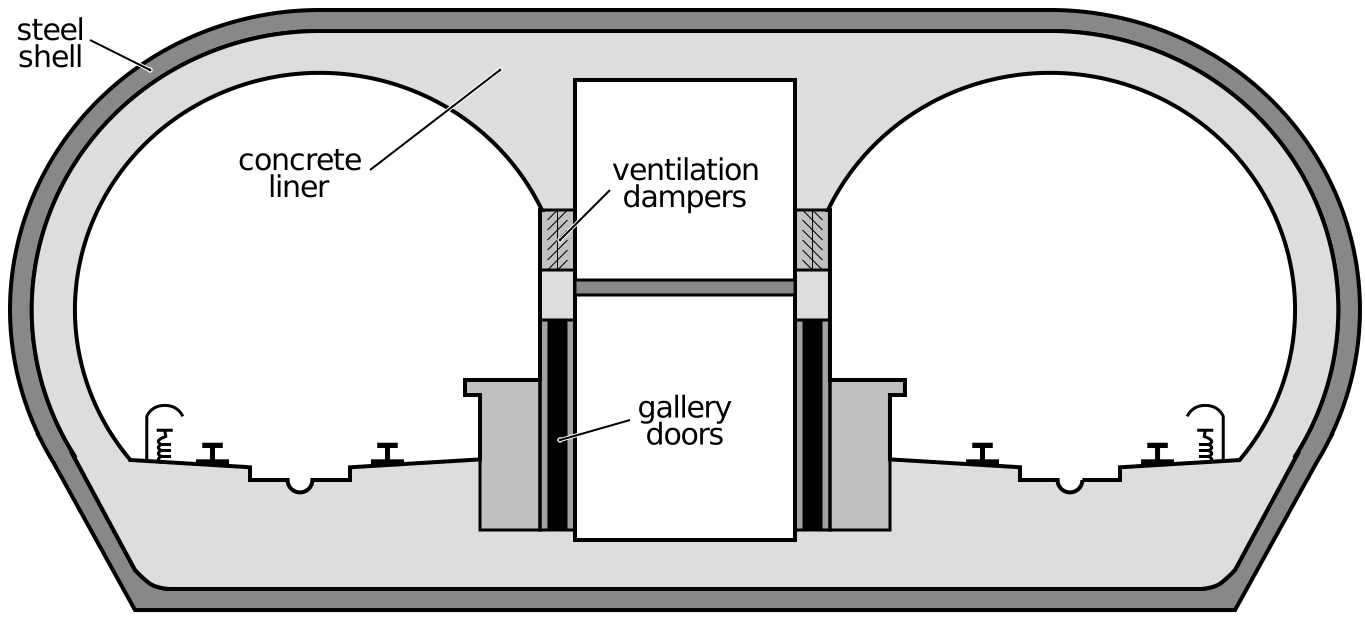
The tube consists of two tunnels and a central maintenance/pedestrian gallery. Each tunnel has a bore approximately 17 ft in diameter, with the track centerline offset 8 in towards the outside from the bore centerline. The tunnels flank a gallery which contains maintenance and control equipment in the upper gallery, including a pressurized water line for firefighting. Each tunnel has 56 doors opening into the lower gallery, spaced approximately 330 ft apart, numbered consecutively from the San Francisco side of the tube. The doors are locked from the gallery side and can be opened inwards (toward the gallery) from the tunnel through emergency hardware. Between doors, the tunnel has narrow 2.5 ft wide walkways adjacent to the gallery space.
The upper section of the gallery space is also used as a duct, moving 300000 cuft/min of air under forced circulation. The tunnels are vented to the atmosphere at the San Francisco and Oakland ends and are vented to each other (through the upper gallery) with remotely-operated dampers 6 ft long by 3 ft high over every third door.
Each end of the tube is secured to the vent structures with a patented sliding seismic joint which allows six degrees of freedom (translation along and rotation about three axes). As designed, the joints allow movement of up to 4.25 in along the tube's axis and up to 6.75 in vertically or laterally. A restaurant was constructed atop the San Francisco transition structure (vent) on a pier behind the Ferry Building. The Oakland vent structure is located in the middle of a Port of Oakland container yard.
Seismic retrofitting
The Transbay Tube has required earthquake retrofitting, both on its exterior and in the interior. The total cost of seismic retrofits was estimated at in 2004.
A 1991 study, commissioned at the recommendation of the Governor's Board of Inquiry in the wake of the 1989 Loma Prieta earthquake, However, settling of the tube within its trench and the Loma Prieta quake had reduced the allowable movement of the seismic joints to as little as 1.5 in.
The 1991 study was followed by a more detailed BART Seismic Vulnerability Study, published in 2002, which concluded the fill packed around the tube might be prone to soil liquefaction during an intense earthquake, which could allow the buoyant hollow tube to break loose from its anchorages or cause movement that would exceed the capacity of the sliding seismic joints. Retrofitting work required the fill to be compacted, to make it denser and less prone to liquefaction. Compaction started in Summer 2006 at the east end of the tube, on property belonging to the Port of Oakland. A 2010 paper concluded the distance the tube would rise due to liquefaction was limited based on model testing of potential liquefaction mechanisms, and questioned the justification for the compaction effort.
On the interior of the tube, BART began a major retrofitting initiative in March 2013, which involved installing heavy steel plates at various locations inside the tube that most needed strengthening, to protect them from sideways movement in an earthquake. A vehicle was custom-built to handle the 4 ST, 2.5 in thick plates; once hoisted in place, the plates were bolted to the existing concrete walls and welded together, end-to-end. The contract for was awarded to California Engineering Contractors for installation. In order to complete this work during 2013, BART closed one of the two bores of the tube early midweek (Tuesdays, Wednesdays and Thursdays), resulting in delays of 15–20 minutes. The work, originally estimated to last approximately 14 months, was completed by December 2013, after only 8 months of construction.
In December 2016, BART awarded a contract to perform further seismic retrofitting. In this phase, a new steel liner and higher-capacity pumps would be installed to reduce the possibility of flooding the tube, as the existing pumps would not be adequate in the worst-case seismic event. Work was projected to start in the summer of 2018 and is scheduled to take more than two years to complete. Service through the tube would be reduced or eliminated during the first hour and the last three hours of the service day.
Incidents and issues
January 1979 fire
On January 17, 1979, at approximately 6 p.m., an electrical fire broke out on a San Francisco-bound seven-car train (Train No. 117) as it was passing through the tube. One firefighter (Lt. William Elliott, 50, of the Oakland Fire Department) was killed by smoke and toxic fume inhalation (generated from burning plastic materials) during the effort to extinguish the blaze. The forty passengers and two BART employees aboard the stricken train were rescued by another train passing in the opposite direction. Poor communication and coordination had hampered the response, and the lessons learned during the fire played a key role in developing National Fire Protection Association transit industry guidelines (NFPA 130, Standard for Fixed Guideway Transit and Passenger Rail Systems).
Cause

The cause of the fire was traced to a damaged third rail collector shoe that caused electrical arcing on Train No. 117. Earlier that day, ten-car Train No. 363 had made an emergency stop in the Transbay Tube while traveling towards San Francisco at approximately 4:30 p.m., reporting smoke and a possible fire. Troubleshooting without an external inspection revealed No. 363 had broken derail bars on the number six and eight cars and an engaged parking brake on the number nine car. After clearing the derail bar circuits and manually releasing the parking brake, No. 363 was cleared to proceed and, upon reaching the end of the line in Daly City, was taken out of service for inspection. A line switchbox cover had fallen off No. 363 and was resting on the third rail, which was not seen by following operators until it jammed against the third rail coverboard, breaking the collector shoe on No. 117, which caused a short circuit and electrical arcing.
The train following No. 363 was dispatched to run in road manual mode, in which the train is controlled by the onboard operator, rather than by the computerized central control system. The operator of that train reported seeing derail bar debris between the tracks near where No. 363 had stopped, but that the tracks were clear and available for service. The train immediately following also ran in road manual mode, but subsequent trains were dispatched through the tube in automatic mode, including seven-car No. 117, the tenth train to enter the (normally) westbound tube after No. 363; No. 117 had 40 passengers onboard.
Response
No. 117 came to an emergency stop at 6:06 p.m., about 1.5 mi into the Transbay Tube, with the operator reporting thick smoke coming from his train. The collector shoe assemblies on the number five and six cars of No. 117 had broken after striking the line switchbox cover which had fallen off No. 363 and jammed into the cover of the third rail. The NTSB later concluded the resulting electrical arcing between the train and the energized third rail ignited components on the car, causing air tanks and suspension airbags to explode on the fifth and sixth cars. Central operations shut down power to the third rail, but restored it 40 seconds later in an effort to uncouple the lead portion of the train from the burning cars. This was unsuccessful, and vent fans were turned on at 6:08 p.m. to attempt to clear the smoke, and the third rail was again powered down at 6:15 p.m. A BART line supervisor who had been riding on the train helped gather passengers in the lead car, including one blind passenger.
BART central dispatch attempted to call the Oakland Fire Department, but unintentionally called San Francisco instead at 6:09 p.m. The Oakland Fire Department responded to the station, where nine firefighters and two BART policemen boarded Train No. 900 running in "road manual." No. 900 was forced to stop at approximately 1 mi into the tube to remove an auxiliary box cover and a derail bar from the track, and eventually stopped approximately 200 ft behind No. 117, where the train operator reported the third rail was damaged and the rear car was on fire with heavy black smoke. Upon reaching No. 117, the responders became separated, with one policeman and seven firefighters proceeding into the gallery between the tunnels, and the rest forced by the smoke to return to No. 900. However, the group in the gallery had left the door (westbound tunnel exit door #44) open to the tunnel for the others to follow; the returning policeman opened a second door (west #45) while setting up a maintenance telephone to communicate with central dispatch, but was forced by the smoke to abandon that position, leaving that door open as well.
Train No. 111, with over 1,000 passengers on board, had been holding at the last San Francisco stop, . At 6:21 p.m., No. 111 moved in automatic mode into the eastbound tunnel, stopping with its rearmost car at eastbound tunnel exit door #43, adjacent to the stricken No. 117. The passengers from No. 117 had been led through the train and out the operator's compartment window in the lead car, then along the smoke-filled westbound tunnel into the gallery via west door #42; they boarded the rescue train (No. 111) through door #43. After the rescued passengers boarded No. 111, firefighters searched No. 117 for any remaining passengers, informing central dispatch at 6:59 p.m. that all passengers had been evacuated. Dispatchers commanded No. 111 to proceed in automatic operation mode to West Oakland to transfer passengers to hospitals. The train quickly accelerated to its top speed of 80 mph creating pressure in the eastbound tunnel which drew smoke from the westbound tunnel through the open doors (west #44 and #45) into the gallery and the eastbound tunnel (through open eastbound door #43), completely filling the 670 ft gallery between doors #43 and #45. By this time, 10 more firefighters and a lieutenant had responded, entering the gallery through the Oakland vent structure. Having encountered smoke on their walk in, they had donned portable air masks with 30-minute supplies; they reached the gallery between doors #44 and #45 just as No. 111 departed, rapidly filling the gallery with thick smoke. The tunnel exit doors are locked from the gallery side and require a key to open; with smoke filling the gallery, the keyholes were obscured and the firefighters were unable to evacuate to the eastbound tunnel.
The firefighters began to make their way eastward in the gallery as a single-file human chain, through thick smoke. By the time they reached the area of door #51, their portable air masks were starting to run low, and Lt. William Elliott began to have trouble, requiring assistance from his fellow firefighters. At 7:09 p.m., a firefighter called for help from a phone box and upon reaching a clear section of the tunnel, train No. 377 was dispatched from West Oakland in "road manual" to rescue the firefighters; the train operator moved with passengers on board because she assumed the cause of the delay had been resolved. After the rescue train returned to West Oakland at approximately 8:10 p.m., the firefighters were taken to area hospitals for treatment. Elliott had exhausted his oxygen supply, and died of smoke inhalation and cyanide poisoning.
Aftermath
The response was delayed in part because of the coordination between BART central dispatch and the two cities' respective fire departments. San Francisco called BART central back at 6:19 p.m., but were advised that Oakland had already responded. Meanwhile, Oakland called San Francisco at 6:32 p.m. to advise them a train was on fire in the tunnel, so San Francisco dispatched a team to wait at Embarcadero at 6:36 p.m., but the San Francisco units did not proceed until 7:52 p.m. and did not arrive until 8:15 p.m. because of the difficulty in obtaining information from either Oakland or BART.
The fire initially was declared under control at 10:45 p.m., although the fires were not yet fully extinguished; a final declaration of control was made at 1:31 a.m. on January 18. Later that day, at approximately 6 p.m., Oakland firefighters responded to flare-up in the gutted train at BART's storage yard. BART would spend in tube repairs and safety improvements on top of losing in revenue due to the loss of tube service.
Train No. 363 sustained damage to its second, fifth, sixth, eight, and ninth cars. The line switch box cover was missing from the fifth car, and the sixth and eighth cars had broken derail bars. No. 117 had smoke damage to the interior of its first three cars; the fourth car was damaged by smoke and fire, and the fifth, sixth, and seventh cars were destroyed in the fire. No. 900 sustained heat damage to the first car, and all ten cars sustained smoke damage. The tunnel sustained heat damage in the vicinity of the fire; portions of the ceiling concrete had spalled and exposed the reinforcing steel, overhead cables were destroyed, and the steel handrail between doors #43 and #44 had been warped by the heat.
The shutdown of power to the third rail was cited as a possible contributing factor because No. 117 was unable to move in road manual for forty seconds. In addition, the operator and line supervisor aboard No. 117 were unable to uncouple the damaged cars using the existing on-board controls because of an apparent short in the train control circuit; to uncouple the car and isolate the short, someone would have had to leave the train and manually disconnect the electrical cable underneath the coupler to the damaged cars. Critically, nine minutes elapsed between the time that power was restored and when the line supervisor informed BART central they were unable to uncouple the cars, which allowed the fire to grow. On the other hand, the low passenger count and the presence of a line supervisor allowed the passengers to evacuate into the lead car quickly. Dispatching No. 111 with over 1,000 passengers onboard could have resulted in an even larger disaster if the control cables had failed in the eastbound tunnel due to the spread of the fire.
BART proposed new evacuation plans to the San Francisco and Oakland fire chiefs by February, but BART service through the Transbay Tube did not resume until April 1979, with California Public Utilities Commissioner Richard D. Gravelle warning "the patrons of BART who utilize its services should be fully aware that the instant order [to reopen service] does not in any way provide a guarantee of safe service." Both the Oakland and San Francisco fire departments criticized BART officials for failing to relinquish control of the emergency situation to the fire departments.
Earthquakes
As a precaution, BART's emergency plans dictate that trains stop during an earthquake, except for trains in the Transbay Tube or the Berkeley Hills Tunnel, which proceed to the nearest station. The lines are then inspected for damage, and resume normal operation if no damage is found.
The largest to date was the 1989 Loma Prieta earthquake. During the 1989 earthquake, a train passing through the Tube was ordered to stop, although the operator reported no apparent motion. After inspection, the tube was found to be safe, and was reopened just six hours later, with regular service resuming system-wide twelve hours after the quake. Many area highways were damaged by the event, and with the Bay Bridge closed for a month due to a section of the upper deck falling onto the lower deck on a truss section of the east span, the Transbay Tube was the only passable direct way between San Francisco and Oakland.
Pedestrians
In October 2012 and August 2013, pedestrians entered the Tube through the station, prompting shutdowns and delays in Transbay service. In late December 2016, a man entered the Tube through the portal at Embarcadero station and remained in it for more than an hour; while transit police were searching for him, trains continued to move through the Tube at slow speeds in manual mode.
Equipment failure
Service has been disrupted on multiple occasions after trains become stuck in the Transbay Tube, which is partially attributed to aging equipment. In addition to the 1979 fire, while moving through the Tube, a train split and was automatically stopped after a coupler failed in March 2010. Two maintenance vehicles collided within the Tube in September 2014, damaging a section of track and forcing BART traffic to rely on a single track. In January 2015, a train was forced to stop in the Tube after the brake inadvertently engaged on a car. A train in December 2016 was forced to switch to manual mode and proceed at reduced speed after stopping in the Tube, and another faulty brake forced a train to stop in the Tube in April 2017.
Noise
According to a 2010 survey by the San Francisco Chronicle, the Transbay Tube is the noisiest part of the BART system, with sound pressure levels inside the train reaching 100 decibels (comparable to a jackhammer). The noise, which according to BART "has been compared to banshees, screech owls, or Doctor Who's TARDIS run amok" is exacerbated by the concrete enclosure and the fact that tracks are curved when the tunnel crosses beneath the San Francisco–Oakland Bay Bridge, causing a high-pitched screeching sound. In 2015, after replacing 6500 ft and grinding down (smoothing) 3 mi of rail in the tube, BART reported a reduction of noise and positive feedback from riders.
Marine traffic
Ship traffic passing through the Bay can damage the anodes used in the Tube's cathodic protection system when dropping anchor. Since the anodes protrude from the filled trench surrounding the Tube, they are more vulnerable to damage. Marine traffic is restricted from dropping anchors when over the Tube, but BART conducts routine inspections for anode damage.
The Tube was closed briefly on January 31, 2014, after a drifting freighter dropped anchor near it at 8:45 a.m. to maintain position. The Coast Guard notified BART officials the anchor appeared to be close to the Tube at 11:55 a.m., based on the ship's position, leading to a suspension of Tube service for approximately 20 minutes while inspections were conducted. No damage was found, and the Tube was reopened at 12:15 p.m. Harbor pilots later noted the ship had anchored 1200 ft southwest of the Tube. Two trains that had been passing through the Tube were stopped in place while the inspection was conducted. Trains were delayed by 15 to 20 minutes, with normal service resuming around 1 p.m.
In April 2017, the derrick barge Vengeance, which was working for BART performing Tube anode maintenance, capsized and sank at night during a late winter storm. The barge came to rest atop the fill overlaying the Transbay Tube, but did not disrupt transit operations. The primary concern was the potential leakage of diesel fuel, and divers had stopped the leak within a day.
Future
In 2007, as BART celebrated the 50th anniversary of its creation, it announced its plans for the next 50 years. Determining the current tunnel will be at its operational capacity by the year 2030, the agency has plans which include a new separate Transbay Tube beneath San Francisco Bay that would run parallel to and south of the existing Transbay Tube. The proposed four-bore tunnel would emerge at the Salesforce Transit Center to provide connecting service to Caltrain and the planned California High-Speed Rail (CHSR) system. The second Tube would provide two tracks for BART trains, and two tracks for conventional/high-speed rail (the BART system and conventional U.S. rail use different and incompatible rail gauges and operate under different sets of safety regulations).
In 2018, BART and CCJPA, the agency responsible for Capitol Corridor commuter rail service, began planning to conduct a feasibility study to narrow the possible alignment options for the proposed second crossing. The study would continue to consider standard-gauge railway options in order to allow connections to Caltrain, CHSR, Capitol Corridor, and potentially other rail services.
In September 2022, two alternative routes were unveiled at a CCJPA meeting, one with a combined tunnel for BART and regional rail, and another route with two separate tunnels.
As of March 2023, a combined four-track tunnel or two separate tunnels for both BART and regular rail are no longer considered cost-effective due to reduced ridership in the Bay Area; planners will research one single tunnel dedicated to either BART service or regional rail service. Link21, the joint organization planning the tunnel, is considering four possible routes, two for regional rail and two for BART extensions. In November 2024, Link21 recommended standard gauge regional rail over BART broad gauge for the tunnel.
The BART Board of Directors approved the Link21 plan in June 2025.
In media
During construction, the Transbay Tube was also used briefly as a shooting location for the ending of George Lucas's film THX 1138. The final vertical climb out to daylight was actually filmed, with the camera rotated 90°, in the incomplete (and decidedly horizontal) Transbay Tube. The scene was filmed before installation of the track supports, with Robert Duvall's character using exposed reinforcing bars as a ladder.
The television adaptation of Terry Brooks's Shannara series of books, The Shannara Chronicles, is partly set in the Bay Area, and part of the journey/quest routes the protagonists through the Transbay Tube.
One of the early sections of the video game Dead Space features a sound sample taken from a ride through the Transbay Tube.
References
References
- . (September 17, 1974). ["BART Tube Link Opens"](https://news.google.com/newspapers?id=OoBIAAAAIBAJ&pg=6690%2C2167396). *Pittsburgh Post-Gazette*.
- "BART Transbay Tube & Transition Structure {{!}} SC Solutions".
- "A History of BART: The Project Begins {{!}} bart.gov".
- Strand, Robert. (September 14, 1974). "San Francisco gets its space age underwater trains". The Dispatch.
- (February 2016). "The Case for a Second Transbay Transit Crossing". Bay Area Council Economic Institute.
- Mallett, Zakhary. (September 7, 2014). "2nd Transbay Tube needed to help keep BART on track". San Francisco Chronicle.
- Minton, Torri. (September 17, 1984). "BART: It's not the system it set out to be". Spokane Chronicle.
- Norton I. (June 15, 1872). "Proclamation". The Pacific Appeal.
- [http://emperornortontrust.org/bridge/proclamations Bridge Proclamations], The Emperor Norton Trust.
- Norton I. (September 21, 1872). "Proclamation". The Pacific Appeal.
- . (July 7, 1921). ["San Francisco Bay Bridge Project Revived by New Plans"](https://books.google.com/books?id=kIEcAQAAMAAJ&pg=PA16). *Engineering News-Record*.
- . (August 18, 1921). ["Features of San Francisco Bay Bridge Report"](https://books.google.com/books?id=kIEcAQAAMAAJ&pg=PA268). *Engineering News-Record*.
- . (November 3, 1921). ["Thirteen Projects Submitted for San Francisco Bay Bridge"](https://books.google.com/books?id=kIEcAQAAMAAJ&pg=PA739). *Engineering News-Record*.
- Scott, Mel. (1985). "The San Francisco Bay Area: A Metropolis in Perspective". University of California Press.
- Bay Area Rapid Transit District. (n.d.). "History of the Tube". Bay Area Rapid Transit District.
- {{USBill. 79. h.res. 529
- . (1947). "Report of Joint Army-Navy Board on an additional crossing of San Francisco Bay". *Presidio of San Francisco, California*.
- (June 23–28, 1968). "Soil Studies for Seismic Design of San Francisco Transbay Tube". American Society for Testing and Materials.
- (2000). "Engineering Geology of the Bay Area Rapid Transit (BART) System, 1964–75".
- Parsons Brinckerhoff-Tudor-Bechtel. (1960). "Trans-bay tube: engineering report". San Francisco Bay Area Rapid Transit District.
- Parsons Brinckerhoff-Tudor-Bechtel. (June 1961). "Engineering Report to the San Francisco Bay Area Rapid Transit District". San Francisco Bay Area Rapid Transit District.
- . (March 31, 1969). ["BART Tunnel Completion Moves Near"](https://news.google.com/newspapers?id=vuAzAAAAIBAJ&pg=3681%2C7454411). *Lodi News-Sentinel*.
- . (November 10, 1969). ["BART Tube Is Opened For Sunday Visitors"](https://news.google.com/newspapers?id=fnwzAAAAIBAJ&pg=7115%2C3602744). *Lodi News-Sentinel*.
- Leavitt, Carrick. (September 16, 1974). "After three year wait BART goes down the tube". Ellensburg Daily Record.
- . (August 27, 1974). ["Bay Area Rapid Transit System to Open Last Link"](https://news.google.com/newspapers?id=y5VPAAAAIBAJ&pg=3945%2C5469255). *The Times-News*.
- . (August 11, 1973). ["Bay tube run made by BART"](https://news.google.com/newspapers?id=KJozAAAAIBAJ&pg=3805%2C3336413). *Lodi News-Sentinel*.
- (1996). "Tunnel Engineering Handbook". Kluwer Academic Publishers.
- . (January 12, 1978). ["Bay Tube is quake proof"](https://news.google.com/newspapers?id=SHozAAAAIBAJ&pg=6962%2C1035599). *Lodi News-Sentinel*.
- Wilson, Ralph. (2016). "History of Potrero Point Shipyards and Industry".
- . (2016). ["Bethlehem built section of the BART Tubes at Pier 70"](http://bethlehemshipyardmuseum.org/#!prettyPhoto).
- Walker, Mark. (May 1971). "BART—The Way to Go for the '70s". Popular Science Publishing Company.
- Gerwick Jr, Ben C.. (2007). "Construction of Marine and Offshore Structures". CRC Press.
- Godfrey Jr., Kneeland A.. (December 1966). "Rapid Transit Renaissance". American Society of Civil Engineers.
- . (January 23, 1975). ["Transit system safety studied"](https://news.google.com/newspapers?id=15wyAAAAIBAJ&pg=5188%2C3693266). *Lawrence Journal-World*.
- . (September 20, 1969). ["Mayors open Transbay Tube"](https://news.google.com/newspapers?id=vxxUAAAAIBAJ&pg=5756%2C3130622). *Lawrence Journal-World*.
- . (December 16, 1968). ["Bay Tube Gets Longer"](https://news.google.com/newspapers?id=C9shAAAAIBAJ&pg=6429%2C4969496). *Reading Eagle*.
- . (April 4, 1969). ["Final Section Of Transit Tube Lowered Into San Francisco Bay"](https://news.google.com/newspapers?id=Lhw_AAAAIBAJ&pg=4575%2C315976). *Lodi News-Sentinel*.
- . (July 24, 1997). ["Bay Area Rapid Transit System"](https://www.asme.org/about-asme/who-we-are/engineering-history/landmarks/195-bay-area-rapid-transit-system).
- "Tunnel construction sliding assembly".
- . (March 2004). ["Seismic retrofit for BART's Transbay tube"](http://tunneltalk.com/Immersed-tubes-Mar04-BART-seismic-retrofit.php).
- Glover, Malcolm. (October 16, 1980). "Ferry commuters set their sights on a motion picture's mirage". San Francisco Examiner.
- Sanders, Anthony. (March 1, 2021). "Oakland Fire Department Bay Area Rapid Transit (BART) Manual". Oakland Fire Department.
- Parsons Brinckerhoff Quade & Douglas, Inc.. (November 1991). "Transbay Tube Seismic Joints Post-Earthquake Evaluation". San Francisco Bay Area Rapid Transit District.
- Cabanatuan, Michael. (April 17, 2004). "SAN FRANCISCO – OAKLAND / BART warns of possible leaks in Transbay Tube in big quake". San Francisco Chronicle.
- Cabanatuan, Michael. (April 17, 2004). "SAN FRANCISCO – OAKLAND / BART warns of possible leaks in Transbay Tube in big quake". San Francisco Chronicle.
- . (October 16, 2006). ["Transbay Tube Earthquake retrofit keeps farmers market in place"](http://www.bart.gov/news/articles/2006/news20061016).
- . (October 16, 2006). ["BART awards first major construction contract to earthquake strengthen the Transbay Tube"](http://www.bart.gov/news/articles/2006/news20060413a).
- (August 2011). "Centrifuge Modeling of Seismically Induced Uplift for the BART Transbay Tube". American Society of Civil Engineers.
- "Earthquake Safety Program Technical Information". Bay Area Rapid Transit District.
- Jordan, Melissa. (March 20, 2013). "Late-night work over next 14 months will strengthen Transbay Tube against a quake".
- . (January 26, 2012). ["Next stage of Transbay Tube retrofit set to launch"](http://www.bart.gov/news/articles/2012/news20120126).
- (December 2, 2013). "Transbay Tube Retrofit Work Wraps Up Early Ending Late Night Single Tracking". Bay Area Rapid Transit District.
- Cabanatuan, Michael. (December 2, 2013). "Transbay Tube retrofit, and late-night delays, end". San Francisco Chronicle.
- Cabanatuan, Michael. (December 1, 2016). "Commuters beware: BART has 2-year plan to strengthen Transbay Tube". San Francisco Chronicle.
- . (2006). "Making Transportation Tunnels Safe and Secure". *Transportation Research Board*.
- Chisholm, Daniel. (1992). "Coordination Without Hierarchy: Informal Structures in Multiorganizational Systems". University of California Press.
- . (January 18, 1979). ["BART train burns in tunnel; one killed"](https://news.google.com/newspapers?id=0_JVAAAAIBAJ&pg=6644%2C4556399). *Eugene Register-Guard*.
- . (July 19, 1979). ["Railroad Accident Report: Bay Area Rapid Transit District fire on train No. 117 and evacuation of passengers while in the Transbay Tube"](https://www.ntsb.gov/investigations/AccidentReports/Reports/RAR7905.pdf). *National Transportation Safety Board*.
- . (January 19, 1979). ["Fire shuts down BART 'tube'"](https://news.google.com/newspapers?id=UbIzAAAAIBAJ&pg=3487%2C4325795). *Lodi News-Sentinel*.
- . (February 12, 1979). ["BART cancels request to reopen bay tube"](https://news.google.com/newspapers?id=ZLIzAAAAIBAJ&pg=1089%2C1856502). *Lodi News-Sentinel*.
- . (April 5, 1979). ["BART resumes tube service for first time since fatal fire"](https://news.google.com/newspapers?id=0hVWAAAAIBAJ&pg=4436%2C1433318). *Eugene Register-Guard*.
- . (October 14, 2015). ["BART to participate in statewide earthquake drill Thursday"](http://www.bart.gov/news/articles/2015/news20151014). *San Francisco Bay Area Rapid Transit District*.
- Jordan, Melissa. (2014). "Behind the Scenes of BART's Role as Lifeline for the Bay Area". San Francisco Bay Area Rapid Transit District.
- . (2010). ["Annex to 2010 Association of Bay Area Governments Local Hazard Mitigation Plan "Taming Natural Disasters""](http://resilience.abag.ca.gov/wp-content/documents/2010LHMP/BART-Annex-2011.pdf). *Association of Bay Area Governments*.
- Housner, George W.. (May 1990). "Competing Against Time: The Governor's Board of Inquiry on the 1989 Loma Prieta Earthquake". State of California, Office of Planning and Research.
- . (October 15, 2012). ["Man Walking In Transbay Tube Prompts Temporary BART Shutdown"](http://sanfrancisco.cbslocal.com/2012/10/15/man-walking-in-transbay-tube-prompted-temporary-bart-shutdown/). *CBS SFBayArea*.
- Alund, Natalie Neysa. (August 11, 2013). "BART trains back on track after man found walking in Transbay Tube". Oakland Tribune.
- Bodley, Michael. (December 30, 2016). "Man who sparked BART delays by running into Transbay Tube IDd". San Francisco Chronicle.
- (January 6, 2017). "BART systemwide meltdown after train gets stuck in West Oakland". San Francisco Chronicle.
- Lee, Henry K.. (March 17, 2010). "BART train splits in two in Transbay Tube". San Francisco Chronicle.
- (September 3, 2014). "BART reopens Transbay Tube track". San Francisco Chronicle.
- Williams, Kale. (January 7, 2015). "BART delays again after train gets stuck in Transbay Tube". San Francisco Chronicle.
- Veklerov, Kimberly. (December 20, 2016). "Train stuck in Transbay Tube causes major BART delays". San Francisco Chronicle.
- Bodley, Michael. (April 12, 2017). "BART back up after major service delays". San Francisco Chronicle.
- Cabanatuan, Michael. (September 7, 2010). "Noise on BART: How bad is it and is it harmful?".
- (August 13, 2015). "Riders notice a quieter ride following first of two tube shutdowns".
- Reisman, Will. (May 12, 2013). "BART working to protect Transbay Tube from elements, ships". San Francisco Examiner.
- (February 1, 2014). "BART tube reopened after anchor scare". San Francisco Chronicle.
- (January 31, 2014). "BART: No damage after container ship's anchor drops near Transbay Tube". The Mercury News.
- . (April 11, 2017). ["Close eye being kept on sunken barge atop BART's Transbay Tube"](http://www.sfexaminer.com/close-eye-kept-sunken-barge-atop-barts-transbay-tube/). *San Francisco Examiner*.
- Cabanatuan, Michael. (June 22, 2007). "BART's New Vision: More, Bigger, Faster". [[San Francisco Chronicle]].
- Hernández, Lauren. (November 14, 2018). "A second transbay tube for BART? It could happen". San Francisco Chronicle.
- (November 15, 2018). "New Transbay Rail Crossing Program Overview + Project Contracting Plan". BART.
- Kukura, Joe. (22 September 2022). "Check 'Em Out! We Have Our First Renderings of the Second Transbay Tube".
- Cano, Ricardo. (February 28, 2023). "BART's second Transbay Tube could get quashed as planners scale back megaproject". San Francisco Chronicle.
- (February 12, 2025). "Concepts - Link21".
- Chang, Tilly (December 16, 2024) [https://www.sfcta.org/sites/default/files/2024-12/SFCTA_Board_ExecutiveDirectorsReport_2024-12-17.pdf Memorandum to the San Francisco County Transportation Board]. Retrieved January 4, 2025
- (June 16, 2025). "Bay Area's Link 21 Project advances as standard-gauge rail project". Mass Transit Magazine.
- Dowd, Katie. (June 27, 2021). "Before BART opened the Transbay Tube, they let George Lucas film a movie inside".
- (2004). "Artifact from the Future: The Making of THX 1138". Warner Bros..
- Dowd, Katie. (March 10, 2016). "MTV show uses BART's Transbay Tube as the key to saving the world". San Francisco Chronicle.
- (October 7, 2008). "Dead Space sound design: In space no one can hear interns scream. They are dead.". Original Sound Version.
- {{YouTube. Vpw5ejzSB4M
- SFGATE, Katie Dowd. (January 13, 2019). "'The worst sound in the history of man': How BART trains turned terror in 'Dead Space'".
This article was imported from Wikipedia and is available under the Creative Commons Attribution-ShareAlike 4.0 License. Content has been adapted to SurfDoc format. Original contributors can be found on the article history page.
Ask Mako anything about Transbay Tube — get instant answers, deeper analysis, and related topics.
Research with MakoFree with your Surf account
Create a free account to save articles, ask Mako questions, and organize your research.
Sign up freeThis content may have been generated or modified by AI. CloudSurf Software LLC is not responsible for the accuracy, completeness, or reliability of AI-generated content. Always verify important information from primary sources.
Report