From Surf Wiki (app.surf) — the open knowledge base
Transatlantic relations
Relations between countries bordering the Atlantic Ocean

Relations between countries bordering the Atlantic Ocean
wider trans-atlantic relations
Transatlantic relations refer to the historic, cultural, political, economic and social relations between countries on both side of the Atlantic Ocean. Sometimes it specifically means relationships between the Anglophone North American countries (the United States and Canada), and particular European countries or organizations, although other meanings are possible.
There are a number of issues over which the United States and Europe generally disagree. Some of these are cultural, such as the U.S. use of the death penalty, some are international issues such as the Middle East peace process where the United States is often seen as pro-Israel and where Europe is often seen as pro-Arab (or at least neutral), and many others are trade related. The current U.S. policies are often described as being unilateral in nature, whereas the European Union and Canada are often said to take a more multilateral approach, relying more on the United Nations and other international institutions to help solve issues. There are many other issues upon which they agree.
Definition
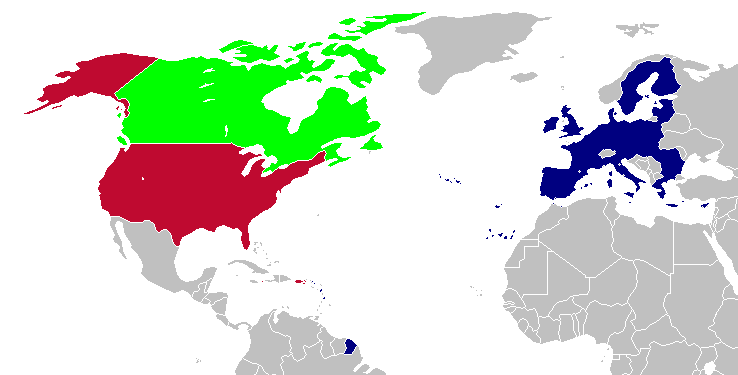
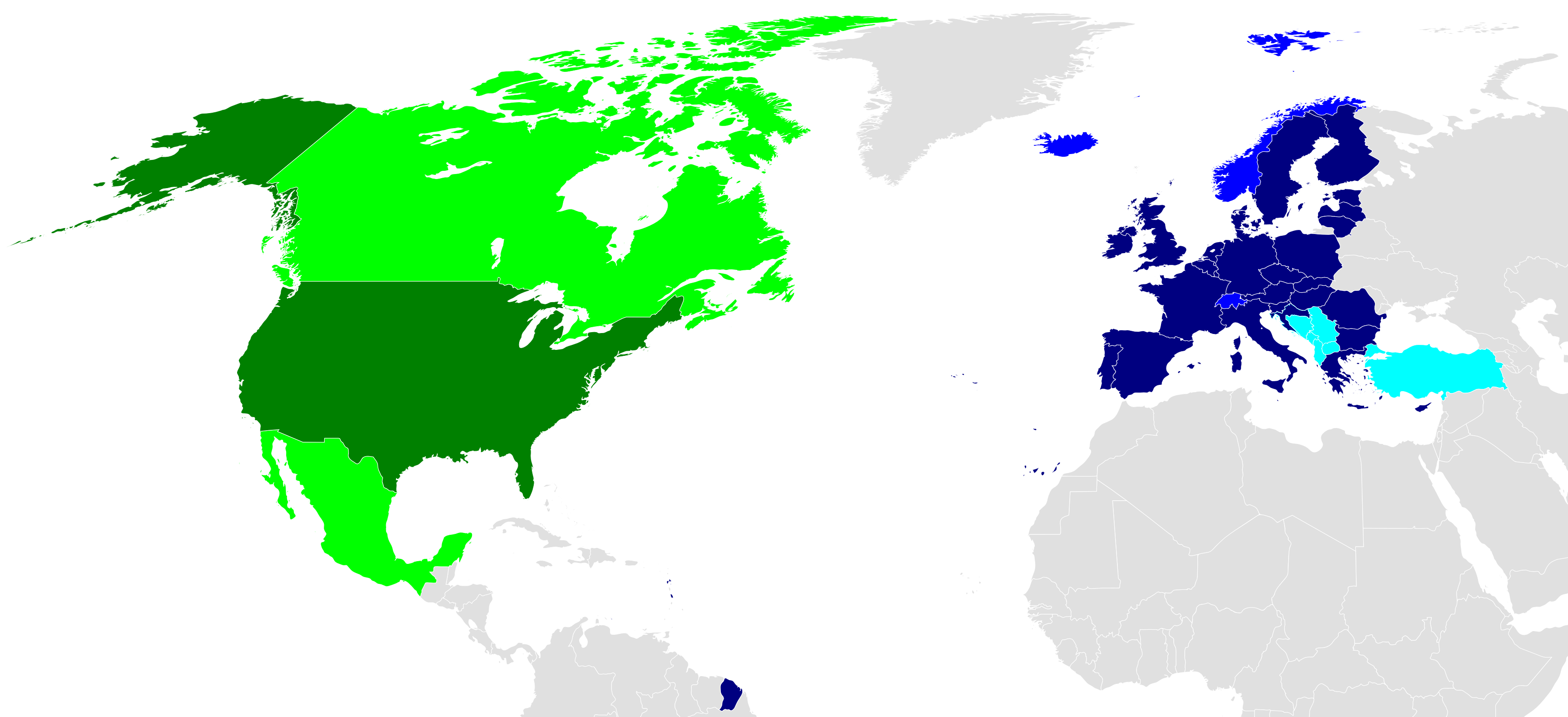
Transatlantic relations can refer to relations between individual states or to relations between groups of states or international organizations with other groups or with states, or within one group. For example:
Within a group:
- Intra-NATO relations :e.g. Canada–NATO relations Between groups:
- EU - North American Free Trade Agreement (NAFTA) relations
- European Free Trade Area (EFTA) - NAFTA relations
- Transatlantic Free Trade Area (theoretical)
- CARIFORUM - European Commission (Economic Partnership Agreements) Between a group and a state:
- Canada–European Union relations
- United States–European Union relations
- Canada - EFTA Free Trade Agreement Between states:
- Germany–United States relations
- Canada–France relations, etc.
By language and culture
- Commonwealth of Nations
- Community of Portuguese Language Countries
- Dutch Union
- La Francophonie
- Latin Union The boundaries of which states are part of Transatlantic relations depends on the context. The term may be used as a euphemism to a specific bilateral relationship, for example, Anglo-American relations. The boundary could be drawn so as only to refer member states of the EU plus the US, when discussing Euro-American relations. In other circumstances it may include Canada, or non-EU countries in Europe. The term may also be used in the context of the wider Atlantic world including Africa and Latin America.
History
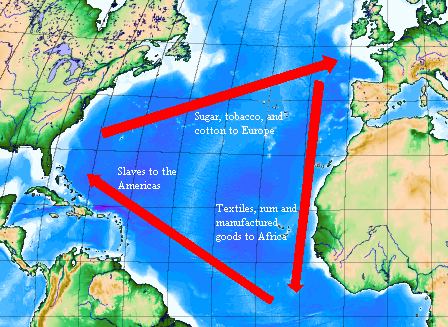
The early relationship between Europe and America was based on colonialism and mercantilism. The majority of modern states in the Americas can be traced back to colonial states that were founded by European nations, states that were very different from the pre-Columbian civilizations and cultures that had existed before.
Even after the United States (and later Canada) became independent, the main relationship between the two continents was one-way migration.
Politically the United States tried to keep a distance from European affairs, and Canada was subordinate to British foreign policy.
During the First World War however both North American states found themselves fighting in Europe and engrossed in European politics. President Woodrow Wilson's Fourteen Points helped to redraw the map of Europe.
Although the Roosevelt administration wanted to enter the war against Germany, the vast majority of Americans were too isolationist and disillusioned at their experience in World War I to seek involvement in the World War II, at least until the U.S. was attacked by Japan at Pearl Harbor on December 7, 1941, and Adolf Hitler declared war on the United States on December 11, 1941. Once involved, the US became pivotal to the war effort and therefore European politics.
After the second war the United States and Canada both desired a permanent role in the defence of Europe, and European states wanted protection from the Soviet Union. The result was the North Atlantic Treaty Organization, which became the lynchpin of Transatlantic relations during the Cold War.
Atlanticism is a philosophy which advocates for close cooperation between North America and Europe.
References
Bibliography
- Jussi M. Hanhimaki, Benedikt Schoenborn and Barbara Zanchetta, "Transatlantic Relations since 1945. An Introduction", Routledge, London, 2012.
References
- Portero, Florentino. (May 29, 2002). "Las relaciones transatlánticas". [[Elcano Royal Institute]].
- [http://www.efta.int/content/free-trade/fta-countries/canada EFTA] {{Webarchive. link. (2008-04-22)
- "Foreign Affairs Department, Canada".
This article was imported from Wikipedia and is available under the Creative Commons Attribution-ShareAlike 4.0 License. Content has been adapted to SurfDoc format. Original contributors can be found on the article history page.
Ask Mako anything about Transatlantic relations — get instant answers, deeper analysis, and related topics.
Research with MakoFree with your Surf account
Create a free account to save articles, ask Mako questions, and organize your research.
Sign up freeThis content may have been generated or modified by AI. CloudSurf Software LLC is not responsible for the accuracy, completeness, or reliability of AI-generated content. Always verify important information from primary sources.
Report