From Surf Wiki (app.surf) — the open knowledge base
Training (meteorology)
Repeated areas of rain
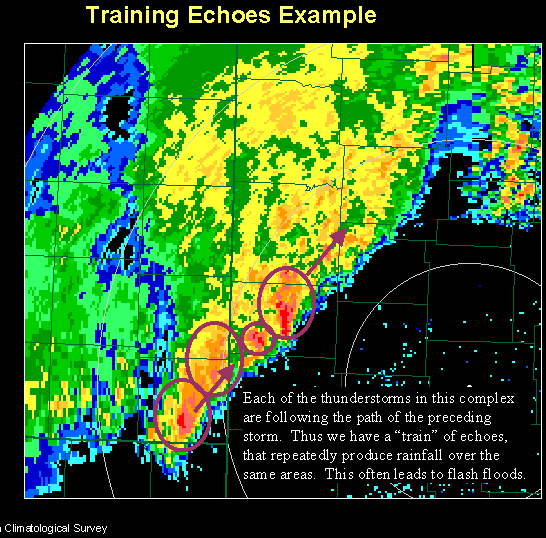
Repeated areas of rain
In meteorology, training denotes repeated areas of rain, typically associated with thunderstorms, that move over the same region in a relatively short period. Training thunderstorms are capable of producing excessive rainfall totals, often causing flash flooding.{{cite web | title = Glossary at T |author-link = National Weather Service
Formation
Showers and thunderstorms along thunderstorm trains usually develop in one area of stationary instability, and are advanced along a single path by prevailing winds. Additional showers and storms can also develop when the gust front from a storm collides with warmer air outside of the storm. The exact process repeats in the new storms until overall conditions in the surrounding atmosphere become too stable to support thunderstorm activity. Showers and storms can also develop along stationary fronts, and winds move them down the front. The showers that often accompany thunderstorms are usually thunderstorms that are not entirely developed.
Hazards
A series of storms continually moving over the same area, dumping heavy rains, can cause flash flooding. Each storm usually produces heavy rain, and after a significant amount of rain falls from the storms which have moved over the same area, flooding occurs.
Thunderstorm training
Thunderstorm training is used to refer specifically to training occurring with thunderstorms. It forms when storms tend to back build. This type of training can quickly cause flash flooding, especially if the thunderstorms are strong.
References
This article was imported from Wikipedia and is available under the Creative Commons Attribution-ShareAlike 4.0 License. Content has been adapted to SurfDoc format. Original contributors can be found on the article history page.
Ask Mako anything about Training (meteorology) — get instant answers, deeper analysis, and related topics.
Research with MakoFree with your Surf account
Create a free account to save articles, ask Mako questions, and organize your research.
Sign up freeThis content may have been generated or modified by AI. CloudSurf Software LLC is not responsible for the accuracy, completeness, or reliability of AI-generated content. Always verify important information from primary sources.
Report