From Surf Wiki (app.surf) — the open knowledge base
Train (clothing)
Long back-portion of a formal garment that trails behind the wearer
.jpg)
Long back-portion of a formal garment that trails behind the wearer
In clothing, a train describes the long back portion of a robe, coat, cloak, skirt, overskirt, or dress that trails behind the wearer.
It is a common part of ceremonial robes in academic dress, court dress or court uniform. It is also a common part of a woman's formal evening gowns or wedding dresses.
Types of train
Fashion
- Court train – worn for formal court occasions, the court train had to fall in with strict dress codes which differed from court to court. For example, the French court code set in 1804 by Jean-Baptiste Isabey prescribed a four-inch maximum width for embroidered train borders for non-Royal wearers. In Britain it was required to be three yards in length at the minimum.
- Double train – two trains attached to the same dress, or a single train divided into two trains.
- Fishtail train – a train popular at various times from the 1870s onwards, flaring out from midway down a close-fitting skirt.
- Demi-train – a short train formed by having the back of the garment slightly longer than the front.
Wedding dress
Trains in modern (20th and 21st century) bridal wear have their own terminology:
- Cathedral train – also known as a monarch train, this can measure up to 8 ft. A royal cathedral train is considered the longest, most formal train, measuring up to 10 ft or more.
- Chapel train – a medium length train up to five feet (1.1 to 1.5 metres) long.
- Court train – in bridal terminology, a court train is a narrow train extending 1 metre behind.
- Sweep train – a short train that does not necessarily reach the floor. It is so called because it might just sweep the ground.
- Watteau train – a modern version of the pleated backs (called 'Watteau pleats') seen in 18th century sack-back gowns.
Brides of the Ndebele people of South Africa traditionally wear long beaded trains hung from the shoulder, known as nyoga (snake).
Trains as part of uniform
Trains are a common feature of the Royal mantles of Kings and Princes, as well as the mantles of many chivalric orders.
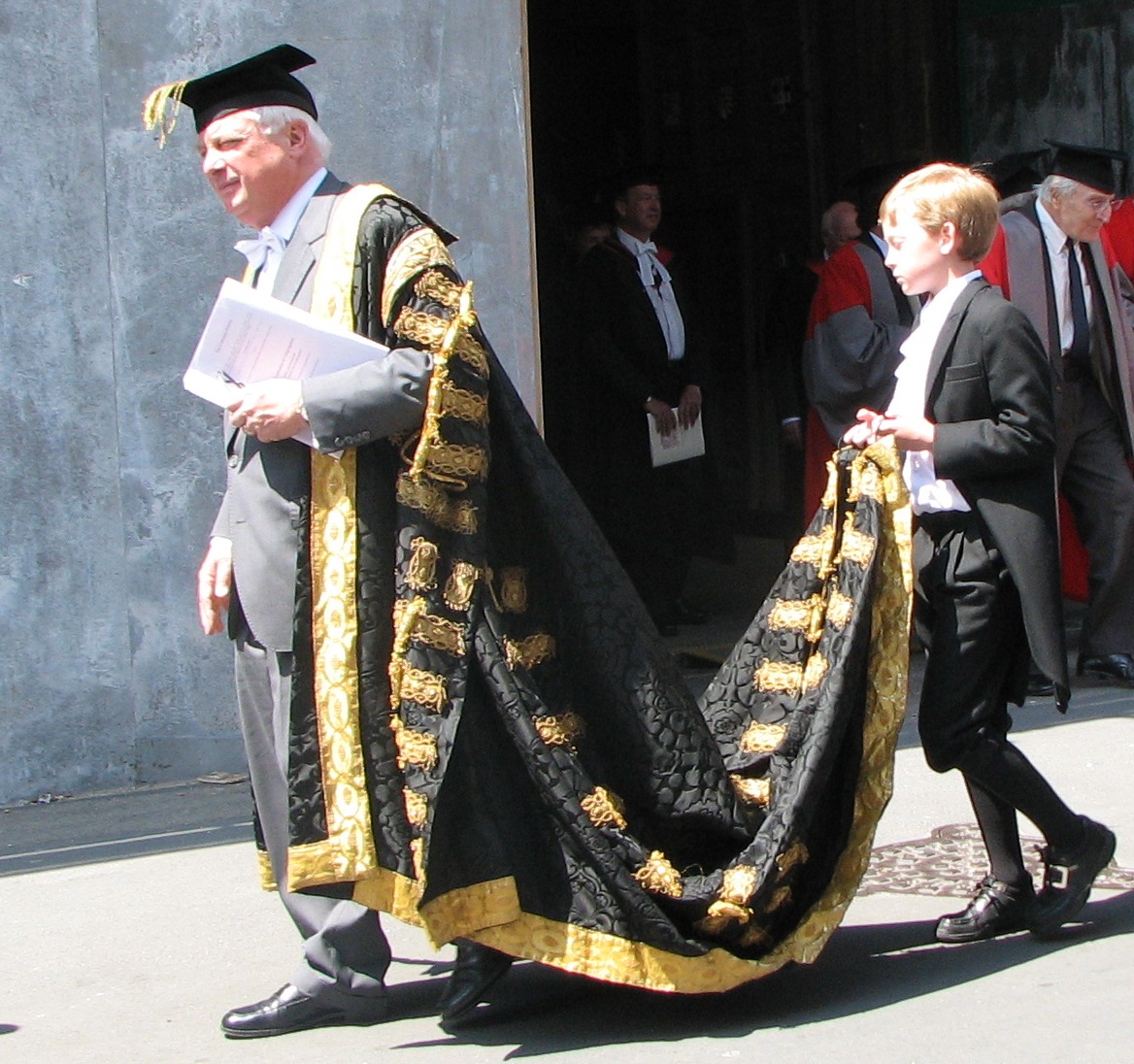
Officers of older, traditional universities generally wear distinctive and more elaborate dress. The Chancellor and the Vice-Chancellor may wear a black damask lay type gown with a long train. In France the train is now usually hooked to the inner side of the robe.
The Lord Chief Justice of England and Wales, when robed, dresses like a High Court Judge with the distinction of a train to their scarlet robe.
.JPG)
Judges of the Court of Appeal wear the black silk damask gown, trained and heavily embellished with gold embroidery.
French court dress includes a train, now buttoned to the inside of the robe and suspended by fabric bands, a vestige of the former practice of lawyers carrying their trains.
The Lord Chancellor, the Speaker of the House of Commons, and other high dignitaries also wear similar embroidered black robes with trains.
The Lord Mayor of London also wears a robe with a train.
A trained robe, the cappa magna (great cape) remains in use in the Catholic Church for certain ceremonial occasions. Cardinals, bishops, and certain other honorary prelates are entitled to wear the cappa magna, but within the territory of their jurisdiction.
Eastern Orthodox bishops also traditionally use a cloak with a long train known as the Mandyas, which may have parallels with the development of the Catholic cappa magna.

For male peers, the Coronation robe is a cloak of crimson velvet extending to the feet and open in the front (with white silk satin ribbon ties) with train trailing behind. The Parliament robe of a British peer is a full-length garment of scarlet wool with a collar of white miniver fur, cut long as a train, but this is usually kept hooked up inside the garment.
Court dresses for women were commonly fifteen yards in length. Court dresses for noble women sometimes had trains both behind and in front of the dress.
Examples of Japanese Imperial court clothing, such as sokutai for men and jūnihitoe for women, include a long train extending from the back of the robe. They are still in use by the Imperial Household of Japan for ceremonial occasions.
History

Trains declined in popularity in the late nineteenth century when they were targeted by public health campaigns in Europe and the United States that argued they brought germs from the streets into the wearers' homes. The issue was the subject of a cartoon published in Puck in 1900 entitled "The Trailing Skirt: Death Loves a Shining Mark."
Gallery
File:Legal Service for Wales 2013 (180).JPG|The Lord Chief Justice, 2013 File:George Wyatt Truscott Vanity Fair 4 November 1908.JPG|The scarlet robe, with train, depicting the Lord Mayor of London File:John Charles Spencer, Viscount Althorp, 3rd Earl Spencer (1782-1845) by Henry Pierce Bone.jpg|Chancellor of the Exchequer Robe of State File:Troy - Jean-Baptiste Colbert (1655-1746), marquis de Torcy.jpg|Mantle of the Knights of the Order of the Holy Spirit, France File:Hoare - William Pitt, 1st Earl of Chatham.jpg|Coronation robes of an earl, by William Pitt File:Cardeal franc rodé.jpg|Cardinal Rode wearing a winter cappa magna File:Bishop Irenaeus (Ćirić).jpg|Serbian Orthodox bishop in mandyas File:FWIV.jpg|King Frederick William IV of Prussia in mantle File:Izabel Bavor.jpg|Isabeau of Bavaria with long ermine-lined train; c. late 14th century or early 15th century File:La Comtesse de Mailly (ca. 1698).jpg|Mantua with train, 1698 File:Pauline Bonaparte princesse Borghese.jpg|Pauline Bonaparte manteau de cour, a train attached at chest level, introduced by Napoleon, 1808 File:Fashion Plate (Court Dress) LACMA M.83.161.213.jpg|Court dress and train, English, 1822 File:Victor Meirelles - Dona Tereza Cristina.jpg|Empress Teresa Cristina of Brazil in court dress and train of green velvet with gold embroidery, 1864 Image:Toulmouche Love Letter Detail.jpg|Evening gown with train, 1883 File:La Bulaquena by Juan Luna.jpg|Saya de cola (lit. "skirt train") of the traje de mestiza during the late 19th century (erroneously referred to as a Maria Clara gown) from the Philippines. Note the manner of the woman's arms and hands, which depict the traditional method of holding the train at the time. File:Liv med släp till brud- och hovpresentationsklänning, Storbritannien - Livrustkammaren - 13441.tif|Court presentation dress and train, 1897 File:Bride 1920s.jpg|Short wedding dress with long train attached, 1920s Image:Weddingring 2007-6-23-1.jpg|Japanese bride in a white dress with train, 2007
References
References
- (October 2006). "Court train (manteau de cour), ca. 1809". The Metropolitan Museum of Art.
- ''Dress and Insignia Worn at His Majesty's Court''. Various editions 1898-1937
- (2012). "Fashion: The definitive history of costume and style". Dorling Kindersley.
- (2004). "The wedding gown book: how to find the gown that perfectly fits your body, personality, style, and budget". Quarry Books.
- (2004). "The everything wedding book: the ultimate guide to planning the wedding of your dreams". Adams Media.
- "A Natural History of the Wedding Dress".
- (1847). "The Oxford and Cambridge review, Volume 4". Oxford University.
- (27 July 2010). "Australian National University, Academic and Ceremonial Dress Order 2010".
- "National University of Ireland, Academic Dress Booklet".
- [https://archive.org/stream/dressinsigniawor00greauoft#page/n37/mode/2up ''Dress worn at Court'', 1921 edition.]
- "Dans le secret des robes noire des avocat".
- Campbell, Una (1989). ''Robes of the Realm''. Michael O'Mara Books Ltd: London. pp. 53-54.
- (1992). "The London Encyclopaedia". [[Macmillan Publishers.
- "FIU.edu".
- {{London Gazette. (2 December 1952)
- Cox, Noel (1999). "The Coronation and Parliamentary Robes of the British Peerage." ''Arma, the Journal of the Heraldry Society of Southern Africa''. Vol. 5, no. 1, pp. 289–293. Retrieved on 2007-10-19.
- (2010). "The Dictionary of Fashion History". Berg.
- [http://www.britannica.com/eb/article-9068548/sokutai Encyclopædia Britannica: ''Sokutai'']
- Emily Mullin. (May 10, 2016). "How Tuberculosis Shaped Victorian Fashion". [[Smithsonian (magazine).
- Ingrid Loschek ''Reclams Mode- und Kostümlexikon.'' Reclam, Stuttgart 1987, {{ISBN. 3-15-010448-3, S. 156.
This article was imported from Wikipedia and is available under the Creative Commons Attribution-ShareAlike 4.0 License. Content has been adapted to SurfDoc format. Original contributors can be found on the article history page.
Ask Mako anything about Train (clothing) — get instant answers, deeper analysis, and related topics.
Research with MakoFree with your Surf account
Create a free account to save articles, ask Mako questions, and organize your research.
Sign up freeThis content may have been generated or modified by AI. CloudSurf Software LLC is not responsible for the accuracy, completeness, or reliability of AI-generated content. Always verify important information from primary sources.
Report