From Surf Wiki (app.surf) — the open knowledge base
Toyota Prius (XW10)
Automobile
Automobile
| Field | Value |
|---|---|
| name | Toyota Prius (XW10) |
| image | 1998 Toyota Prius NHW10 Silver Strara Metallic (front).jpg |
| manufacturer | Toyota |
| production | 1997–2001 (NHW10) |
| September 2000–2003 (NHW11) | |
| model_years | 2001–2003 |
| assembly | Toyota, Aichi, Japan (Takaoka Plant, later Motomachi plant) |
| class | Subcompact car |
| body_style | 4-door sedan |
| layout | Front-engine, front-wheel-drive |
| platform | Toyota MC platform |
| engine | NHW10 |
| Toyota Hybrid System | |
| Gasoline: 1.5 L 1NZ-FXE DOHC I4 | |
| 13.5:1 compression | |
| 43 kW (58 hp) @ 4000 rpm | |
| 102 N·m (75 lb·ft) @ 4000 rpm | |
| Electric: 288 V motor | |
| 30 kW (40 hp) @ 940 rpm | |
| 305 N·m (225 lb·ft) @ 0 rpm | |
| NHW11 | |
| Toyota Hybrid System | |
| Gasoline: 1.5 L 1NZ-FXE DOHC I4 VVT-i | |
| 13.0:1 compression | |
| 52 kW (70 hp) @ 4500 rpm | |
| 110 N·m (82 lb·ft) @ 4200 rpm | |
| Electric: 273.6 V motor | |
| 33 kW (44 hp) @ 1040 rpm | |
| 350 N·m (258 lb·ft) @ 0 rpm | |
| SULEV | |
| battery | 1.78 kWh, Ni-MH, 273.6 V, 6.5 Ah |
| transmission | 1-speed planetary gear |
| drivetrain | Power-split Hybrid |
| wheelbase | 2550 mm |
| length | NHW10: 4275 mm |
| NHW11: 4308 mm | |
| width | 1695 mm |
| height | NHW10: 1491 mm |
| NHW11: 1463 mm | |
| weight | NHW11: 1254 kg |
| successor | Toyota Prius (XW20) |
September 2000–2003 (NHW11) Toyota Hybrid System Gasoline: 1.5 L 1NZ-FXE DOHC I4 13.5:1 compression 43 kW (58 hp) @ 4000 rpm 102 N·m (75 lb·ft) @ 4000 rpm Electric: 288 V motor 30 kW (40 hp) @ 940 rpm 305 N·m (225 lb·ft) @ 0 rpm NHW11 Toyota Hybrid System Gasoline: 1.5 L 1NZ-FXE DOHC I4 VVT-i 13.0:1 compression 52 kW (70 hp) @ 4500 rpm 110 N·m (82 lb·ft) @ 4200 rpm Electric: 273.6 V motor 33 kW (44 hp) @ 1040 rpm 350 N·m (258 lb·ft) @ 0 rpm SULEV NHW11: 4308 mm NHW11: 1463 mm
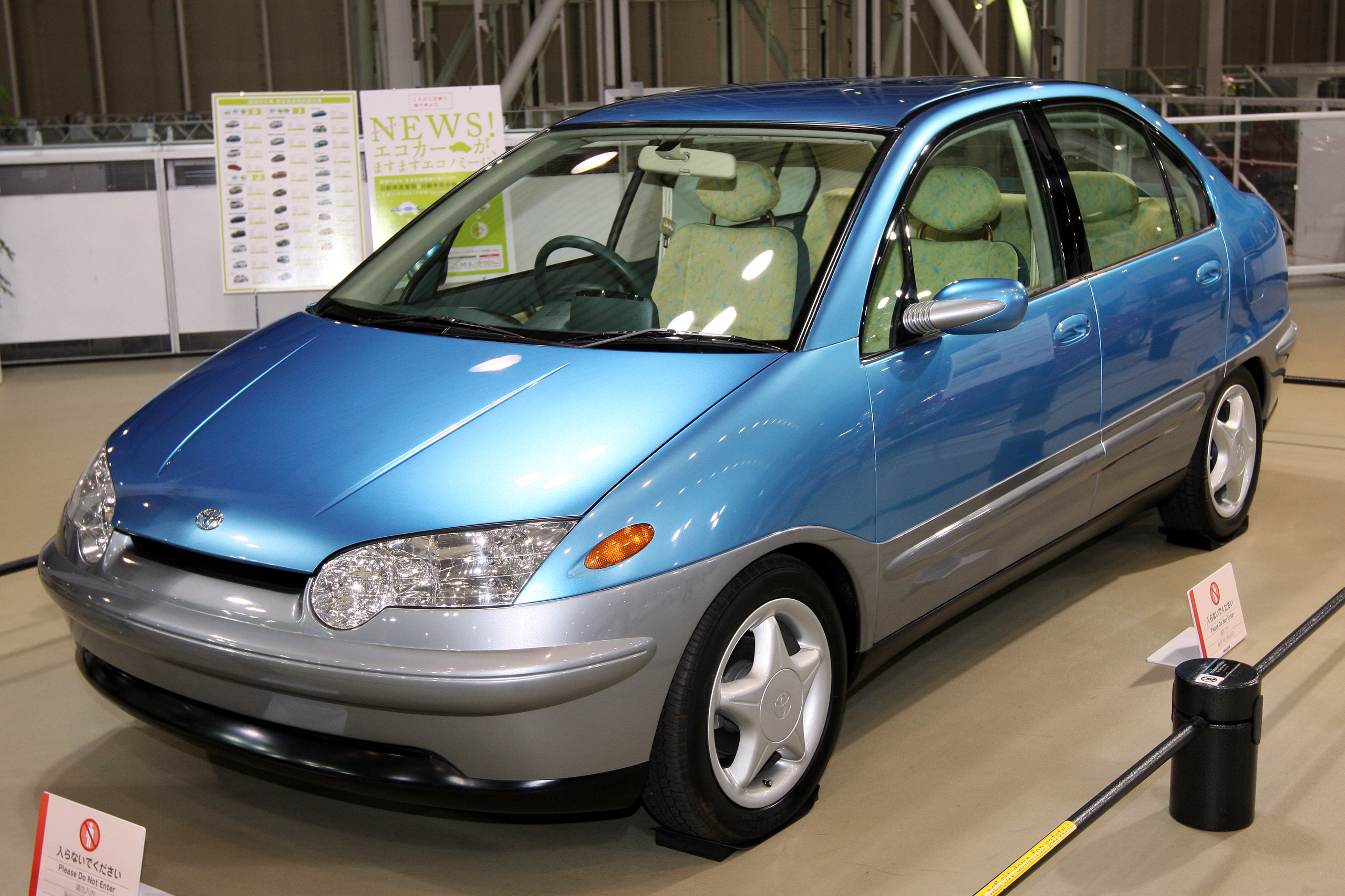
The Toyota Prius (XW10) is a subcompact hybrid car that was produced by Toyota between 1997 and 2003 in Japan. The XW10 is divided into the NHW10 and its NHW11 counterpart, both of which represent the first generation of Prius series. The Toyota Prius is the first mass-produced hybrid car, and was released 2 years ahead of other manufacturers. While the NHW10 was available exclusively to Japan, it was subsequently introduced to worldwide markets in September 2000 with the NHW11. Toyota sold about 123,000 first generation Prius. Toyota's XW10 series Prius is notable as the first vehicle based on the Toyota MC platform.
Planning and concept
On 16 January 1992, the Toyota Motor Corporation announced the Earth Charter, a document outlining goals to develop and market low emission vehicles.
In September 1993, Toyota R&D Executive Vice President Yoshirio Kimbara created G21, a committee to research cars for the 21st century. On 1 February 1994, the first official meeting of the G21 project team took place. The team determined the goal of G21 is to create a car that is resource and environmentally friendly while retaining the benefits of modern cars. The development effort was led by Takehisa Yaegashi, who was tasked with building a car that bridged the gap between electric and gasoline powered vehicles.
In 1994, Toyota executive Takeshi Uchiyamada was given the task of creating a new car that would be both fuel efficient and environmentally friendly. In late 1994, the G21 team designed a concept car with a hybrid engine for the 1995 Tokyo Motor Show. The vehicle was named "Prius," the Latin word for "prior" or "before." It was shown on 27 October 1995. In late 1996, test driving began.
After reviewing over 100 hybrid designs, the engineering team ultimately settled on a continuously variable transmission (CVT) design based largely on a 2000 TRW patent application, but many technical and engineering problems had to be solved within the three years that the team was given to bring the car to the Japanese market, a goal they barely achieved as the first Prius went on sale in December 1997. One major problem was the longevity of the battery, which needed to last between 7 and 10 years. The solution the engineers came up with was to keep the battery pack between 60% and 40% charged, proving to be the "sweet spot" for extending the battery life to roughly that of the other car components. A Toyota spokesperson stated that "Toyota chose this name because the Prius vehicle is the predecessor of cars to come."
Markets
The XW10 was initially manufactured at the Takaoka plant, but would later be moved to the Motomachi plant in Toyota City, Aichi, Japan.
Japan
The first Prius, model NHW10, went on sale on 10 December 1997. Many of these cars were exported as second-hand vehicles to New Zealand and other countries. In New Zealand, there is report that high voltage battery failures are common among grey imports of the NHW10, which are not supported by official distributors outside Japan.
To handle the voltage between the battery and electric motor, the semiconductor core inverter unit was modeled on heavy-duty transistors used by the Shinkansen bullet train. The first production model NHW10 Toyota Prius was rolled out of Toyota's Takoka factory in Toyota City, Aichi near Nagoya in December 1997, followed by the start of two years of Japan-only sales.
.jpg)
As uncovered by engineer testing, the NHW10 Prius was vulnerable to reduced performance in hotter climates and at higher altitudes; as a result, early examples featured an instrument-panel indicator warning should the hybrid system be in danger of shutting down. This gauge, designed in the shape of a turtle, was used until 1999.
The first generation Prius, at its launch, became the world's first mass-produced gasoline-electric hybrid car. Japan sales goals were 12,000 units annually, at a price of per vehicle. The vehicle's introduction served as Toyota's launch effort for a new generation of 'green' vehicles aimed at reducing air pollution and increasing fuel efficiency. Toyota initially forecasted that hybrids will account for a third of the world's auto market as early as 2005.
The NHW10 Prius styling originated from California designers, who were selected over competing designs from other Toyota design studios.
NHW11
Other markets
The 2001–2003 model year Prius for the United States market (NHW11) was powered by a 1.5-liter Atkinson cycle four-cylinder gasoline engine, a permanent magnet AC electric motor, and a nickel-metal hydride (Ni-Mh) battery pack of just 1.78 KWh (Voltage: 273.6 V; Capacity: 6.5 Ah). The gasoline engine developed 70 hp and 82 ft.lbf of torque. The electric motor generated a maximum of 44 hp and 258 ft.lbf of torque.
The NHW11 Prius became more powerful partly to satisfy the higher speeds and longer distances that North Americans drive. Air conditioning was standard equipment.
The vehicle was the second mass-produced hybrid on the American market, after the two-seat Honda Insight.
In the United States, the NHW11 was the first Prius to be sold. The Prius was marketed between the smaller Echo and the larger Corolla. The published retail price of the car was . The California Air Resources Board (CARB) classified the car as a Super Ultra Low Emission Vehicle (SULEV). At one time, Prius owners were eligible for up to a tax deduction from their gross income. In contrast with the prior NHW10 model, Toyota executives claimed that the company broke even financially on sales of the NHW11 Prius.
European sales began in September 2000. The official launch of the Prius in Australia occurred in 2001 after the 2001 Sydney Motor Show, although sales were slow until the NHW20 model arrived.
In 2006, Toyota recalled about 8,500 2001 and 2002 model year Prius vehicles because of an incorrectly manufactured crankshaft position sensor.
In 2009, after being investigated by the California Air Resources Board, Toyota extended a campaign nationwide for owners of MY 2001–2003 Prius for starting problems caused by improper working throttle body that led to electronic control module malfunction.
Fuel consumption
United States
In the United States, the Environmental Protection Agency (EPA) test results must be posted on new vehicle windows, and are the only fuel consumption figures that can be advertised. The following are current official EPA figures for the 2001-2003 model years, based on its 2008 restructuring of fuel economy tests:
- 42 mpgus city driving
- 41 mpgus highway driving
- 41 mpgus combined
Original listed figures on new vehicle windows, based on pre-2008 testing procedures, for 2001-2003 model years were:
- 52 mpgus city driving
- 45 mpgus highway driving
- 48 mpgus combined
Awards
- 1997–98 Car of the Year Japan
- 2003 Scientific American names Toyota Motor Corporation as "Business Leader of the Year" ("Scientific American 50"; December, 2003) for its singular accomplishment in the commercialization of affordable hybrid cars.
References
References
- Chang-Ran Kim. (2003-10-02). "Hybrids Can Be Cheap to Make, Toyota Says". Rainforest Action Network.
- (2010-10-07). "Worldwide Prius Cumulative Sales Top 2M Mark; Toyota Reportedly Plans Two New Prius Variants for the US By End of 2012". Green Car Congress.
- Toyota Europe News. (2013-07-03). "Worldwide Prius sales top 3-million mark; Prius family sales at 3.4 million". Green Car Congress.
- "Toyota Prius Chronological History".
- Dawson, Chester. (2005-06-20). "Takehisa Yaegashi: Proud Papa Of The Prius". [[BusinessWeek]].
- (2005-11-28). "Leading engineer behind the Toyota Prius hybrid car". EE Times.
- "Epicyclic Continuously Variable Transmission".
- Wald, Matthew L.. (2006-10-25). "Still Miles to Go for the Plug-In Vehicle". [[The New York Times]].
- (2007-03-12). "The plurals of 'Prius'". [[The Boston Globe]].
- Taylor, Alex. (2006-02-24). "Birth of the Prius". Fortune.
- "Prius Model History". Clean Green Car Company.
- "Search results for 'prius 199*'". [[TradeMe]].
- "Performance Economy Cars". AutoSpeed.
- Emily Thornton. (1997-12-15). "Japan's hybrid cars". Business Week.
- "2001 Toyota Prius Review Summary". Source Interlink Media.
- Russ, Carey. "Toyota Prius (2001)". The Auto Channel.
- "Test Drive Notes: Toyota Prius 2001". Car Talk.
- Pollack, Andrew. (2000-11-19). "BEHIND THE WHEEL:Toyota Prius-It's Easier to Be Green". New York Times.
- "Alternative Fuel Vehicles (AFVs) and Hybrid Electric Vehicles (HEVs): Trend of sales by HEV models from 1999–2009". Alternative Fuels and Advanced Vehicle Data Center (U.S. DoE).
- "2001 Toyota Prius Lineup". Internet Autoguide.
- [https://archive.today/20120731075638/http://www.epa.gov/greenvehicles/Detailsresult.do?vehicle_ID=7159 EPA Green Vehicle Guide].
- Tsukada, M., [http://www2.aia.pref.aichi.jp/voice/no13/13_cutting_edge.html Aichi's Artisanship in the Auto Industry] {{Webarchive. link. (19 December 2012 , Aichi Voice (Cutting Edge).)
- [http://www.caradvice.com.au/1697/more-toyota-prius-coming-to-australia/ More Toyota Priuses Coming to Australia], Australian Car Advice, 1 March 2007. Retrieved 2007-12-20.
- (2006-07-18). "Toyota Announces Special Service Campaign on Selected Echo and Prius Vehicles". Automotive.com.
- Jensen, Christopher. (2010-07-13). "Toyota Extends Warranty on Troubled 2001–2003 RAV4". New York Times Wheels blog.
- "EPA estimates: 2001 Prius". U.S. EPA.
- "Car of the year Japan".
This article was imported from Wikipedia and is available under the Creative Commons Attribution-ShareAlike 4.0 License. Content has been adapted to SurfDoc format. Original contributors can be found on the article history page.
Ask Mako anything about Toyota Prius (XW10) — get instant answers, deeper analysis, and related topics.
Research with MakoFree with your Surf account
Create a free account to save articles, ask Mako questions, and organize your research.
Sign up freeThis content may have been generated or modified by AI. CloudSurf Software LLC is not responsible for the accuracy, completeness, or reliability of AI-generated content. Always verify important information from primary sources.
Report