From Surf Wiki (app.surf) — the open knowledge base
Toyama (city)
| Field | Value | |
|---|---|---|
| <!-- See Template:Infobox settlement for additional fields and descriptions --> | name | Toyama |
| native_name | 富山市 | |
| settlement_type | Prefecture capital and Core city | |
| <!-- images, nickname, motto --> | image_skyline | Toyama montage 0.png |
| image_caption | (From top, left to right : Kureha Hills •Tomiiwa Canal Kansui Park • Toyama Black Ramen• Toyama Glass Museum• Toyama Light Rail • Avile • Toyama Drug Sales • Sogawa Ferio • Fugan Canal) | |
| image_flag | Flag of Toyama, Toyama.svg | |
| image_seal | Emblem of Toyama, Toyama.svg | |
| motto | ||
| image_map | Toyama in Toyama Prefecture Ja.svg | |
| map_caption | Location of Toyama in Toyama Prefecture | |
| pushpin_map | Japan | |
| pushpin_label_position | ||
| pushpin_map_caption | ||
| coordinates | ||
| coor_pinpoint | ||
| coordinates_footnotes | tags -- | |
| <!-- location --> | subdivision_type | Country |
| subdivision_name | ||
| subdivision_type1 | Region | |
| subdivision_name1 | Chūbu (Hokuriku) | |
| subdivision_type2 | Prefecture | |
| subdivision_name2 | Toyama | |
| subdivision_name3 | ||
| established_title | First official recorded | |
| established_date | 6th century AD | |
| established_title2 | City settled | |
| established_date2 | April 1, 1889 | |
| named_for | ||
| seat_type | ||
| seat | ||
| government_footnotes | tags -- | |
| leader_title | Mayor | |
| leader_name | Hirohisa Fujii | |
| leader_name1 | ||
| <!-- display settings --> | total_type | |
| unit_pref | ||
| <!-- area --> | area_magnitude | |
| area_footnotes | tags -- | |
| area_total_km2 | 1241.77 | |
| area_note | ||
| elevation_footnotes | tags -- | |
| elevation_m | ||
| population_footnotes | tags -- | |
| population_total | 415844 | |
| population_as_of | June 1, 2019 | |
| population_density_km2 | auto | |
| population_demonym | ||
| population_metro_footnotes | (2015) | |
| population_metro | 1066328 (16th) | |
| <!-- time zone(s) --> | timezone1 | JST |
| utc_offset1 | +9 | |
| <!-- postal codes, area code --> | postal_code_type | Postal code |
| postal_code | 930-8510 | |
| area_code_type | ||
| area_code | ||
| blank_name_sec1 | Symbols | |
| blank_info_sec1 | ||
| blank1_name_sec1 | • Tree | |
| blank1_info_sec1 | Zelkova serrata | |
| blank2_name_sec1 | • Flower | |
| blank2_info_sec1 | Helianthus annuus | |
| blank3_name_sec1 | • Flowering tree | |
| blank3_info_sec1 | Camellia japonica | |
| blank7_info_sec1 | ||
| blank_name_sec2 | Phone number | |
| blank_info_sec2 | 076-431-6111 | |
| blank1_name_sec2 | Address | |
| blank1_info_sec2 | 7-38 Shinsakuramachi, Toyama-shi, Toyama-ken | |
| <!-- website, footnotes --> | website |
Toyama is the capital city of Toyama Prefecture, Japan, located on the coast of the Sea of Japan in the Chūbu region on central Honshū, about 200 km north of the city of Nagoya and 300 km northwest of Tokyo. , the city had an estimated population of 415,844 in 176,643 households, and a population density of 335 persons per km2. Its total area was 1241.77 sqkm. The city has been designated an environmental model city by the national government for its efforts to reduce the emission of greenhouse gases.
Geography
Located in the middle of its prefecture, Toyama is a seaside city by the coast of the Sea of Japan. Its municipal territory borders with the Gifu Prefecture and with the municipalities of Imizu, Namerikawa, Tonami, Nanto, Hida and Takayama. The nearest towns are Imizu (west), and Namerikawa (east), both by the sea and part of the Toyama urban area. The nearest major city is Kanazawa, the capital of Ishikawa Prefecture, which is 65 km away.
Climate
Toyama has a humid subtropical climate (Köppen climate classification Cfa) with hot, humid summers and cool winters. Precipitation is abundant throughout the year, particularly in July, September and from November through January. Despite winter in Toyama being relatively mild, its position near the Sea of Japan places it within the heavy snow belt of Japan and on average 3.8 m of snow falls each season, almost all of it from December through March, as well as occasionally experiencing some tremendous amounts of snowfall.
| Jan record high C = 20.9 | Feb record high C = 22.5 | Mar record high C = 28.3 | Apr record high C = 32.4 | May record high C = 33.3 | Jun record high C = 37.2 | Jul record high C = 38.8 | Aug record high C = 39.8 | Sep record high C = 38.3 | Oct record high C = 33.3 | Nov record high C = 29.2 | Dec record high C = 24.8 | Jan record low C = -11.9 | Feb record low C = -11.1 | Mar record low C = -7.0 | Apr record low C = -2.2 | May record low C = 2.3 | Jun record low C = 7.7 | Jul record low C = 13.0 | Aug record low C = 14.1 | Sep record low C = 8.9 | Oct record low C = 1.9 | Nov record low C = -2.0 | Dec record low C = -8.5 |script-title=ja:気象庁 / 平年値(年・月ごとの値) | access-date = May 19, 2021}}
History
Early history
The area of present-day Toyama city was part of ancient Etchū Province. The Toyama Plain is good farmland and historically it was a point of strategic and traffic importance since prehistoric times.
Feudal period
During the Sengoku period, it was frequently a battlefield, coming under the control of warlord Sassa Narimasa, who built a castle town around Toyama Castle and channeled rivers to bringing about a flourishing agricultural industry.
Early modern ages
;Edo period The area subsequently became part of Kaga Domain under the Maeda clan during the Edo period, during which time a positive industrial promotion policy was implemented on the production of Chinese medicine and washi (Japanese paper). Also, thanks to the improvement of kitamaebune sea transportation routes, these industries thrived and Toyama became known nationwide as the province of medicine.
Meiji period
After the Meiji Restoration, with the creation of the municipalities system, the city of Toyama was established on April 1, 1889, as one of the first 30 cities in Japan. Economically, the area developed heavy and chemical industries based on abundant hydroelectric electricity. Toyama has become one of the most influential cities on the Sea of Japan with its good water supply, drainage system and thriving agricultural, forestry, fishery, commercial and manufacturing industries.
World War II
During World War II, Allied prisoners of war (POWs) were sent to Toyama as forced labor. The city was almost completely destroyed on the night of August 1–2, 1945. At the time of the bombing, the city was a center for aluminum, ball-bearing and special steel production. Left unscathed however, were the war-related factories just outside the city. The city during the time had a population of around 150,000 residents. The city also held Kakure Kirishitan, or "Hidden Christians" in Japan, forced from Nagasaki into internment camps after the Tokugawa government tried to punish them for their Christian beliefs. Higasiaimon-cho Street in Toyama City in late Meiji era.jpg|Higasiaimon-cho Street in Toyama City in late Meiji era. File:Firebombing of Toyama.jpg|Bombing of Toyama in World War II Toyama City before Bombing of Toyama(1).jpg|Toyama before World War II
Contemporary ages
2005 mergers
On April 1, 2005, the towns of Ōsawano and Ōyama (both from Kaminiikawa District), the towns of Fuchū and Yatsuo, and the villages of Hosoiri and Yamada (all from Nei District) were merged into Toyama. Kaminiikawa District and Nei District were both dissolved as a result of this merger.
Demographics
Per Japanese census data, the population of Toyama has recently plateaued after a long period of growth. | 1970 | 350,085 | 1980 | 391,554 | 1990 | 408,942 | 2000 | 420,804 | 2010 | 421,953 | 2020 | 413,938
Surrounding municipalities
;GifuGifu Prefecture
- Hida
- Takayama ;NaganoNagano Prefecture
- Ōmachi ;ToyamaToyama Prefecture
- Funahashi
- Imizu
- Kamiichi
- Namerikawa
- Nanto
- Tateyama
- Tonami
Government
Toyama has a mayor-council form of government with a directly elected mayor and a unicameral city legislature of 38 members.
Sister cities
Toyama is twinned with:
| City | Country | State | Since |
|---|---|---|---|
| Mogi das Cruzes | BRABrazil | São Paulo | November 8, 1979 |
| Durham | USAUnited States | North Carolina | June 13, 1989 |
| Wellington | AUSAustralia | New South Wales | August 24, 1992 |
| Gwangju | KORSouth Korea | Special cities | 2011 |
;Friendship city
| City | Country | State | Since |
|---|---|---|---|
| Qinhuangdao | CHNChina | Hebei | May 8, 1981 |
Economy
Hokuriku Electric Power Company (colloquially known as Hokuden), the regional power-supply monopoly, is based in Toyama. Bearing parts and industrial robot company Nachi-Fujikoshi and software company INTEC are also headquartered in Toyama.
Regional banks include Hokuriku Bank, First Bank of Toyama, and Toyama Bank.
Education

Colleges and universities
- Toyama College
- Toyama National College of Technology
- Toyama Prefectural University
- Toyama University of International Studies
- University of Toyama
Primary and secondary education
Toyama has 65 public elementary schools and 26 public middle schools operated by the city government. There is also one public elementary school and one public middle school operated by the national government. The city has fourteen public high schools operated by the Toyama Prefectural Board of Education. and one public combined middle/high school operated by the national government. There are also seven private high schools. Toyama Shogyo High School is a commercial high school.
Transportation
_sa.jpg)


Airways
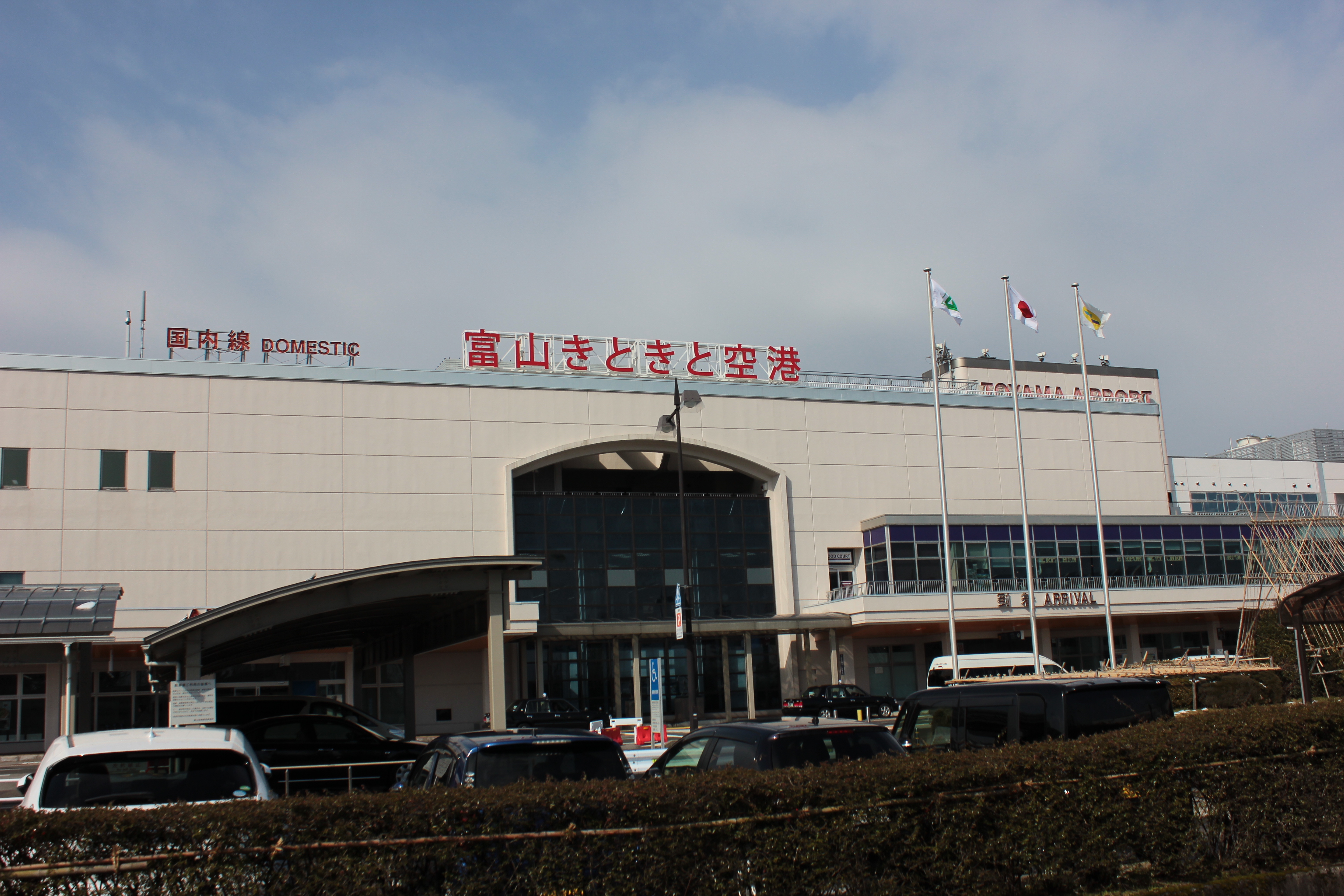
Airports
- Toyama Airport
Railways
High-speed rail
;[[File:JR logo (west).svg|22px]]West Japan Railway Company (JR West)
- Hokuriku Shinkansen:
Conventional lines
;[[File:JR logo (west).svg|22px]]West Japan Railway Company (JR West)
- Takayama Main Line: - - - - - - - - - ;[[File:JR logo (central).svg|22px]]Central Japan Railway Company (JR Tōkai)
- Takayama Main Line: - ;[[File:Ainokaze Toyama Railway logo.png|22px]] Ainokaze Toyama Railway
- Ainokaze Toyama Railway Line: - Kureha - Toyama - Higashi-Toyama - Mizuhashi - ;18pxToyama Chihō Railway
- Main Line: - - - - -
- Kamidaki Line: - - - - - - - - - - - -
- Tateyama Line: -
Tramways
;18pxToyama Chihō Railway
- Toyama Light Rail Toyamakō Line
- Toyama City Tram Line
Roads
Expressway
- [[File:JP Expressway E8.svg|30px|link=|alt=]] Hokuriku Expressway : Nagaresugi IC - Toyama IC - Toyama-nishi IC
Japan National Route
Seaways
Seaport
- Port of Toyama
Local attractions


- Botanic Gardens of Toyama
- Kitadai Site, Jomon period site, National Historic Site
- Kurobe Dam
- Museum of Modern Art of Toyama
- Ōzuka-Senbōyama Sites, Yayoi period settlement ruins and Kofun, National Historic Site
- Sugusaka Site, Japanese Paleolithic period site, National Historic Site
- Toyama Athletic Recreation Park Stadium, home of Toyama's representative in the J.League, Kataller Toyama football club
- Toyama Castle
- the smallest shinto shrine
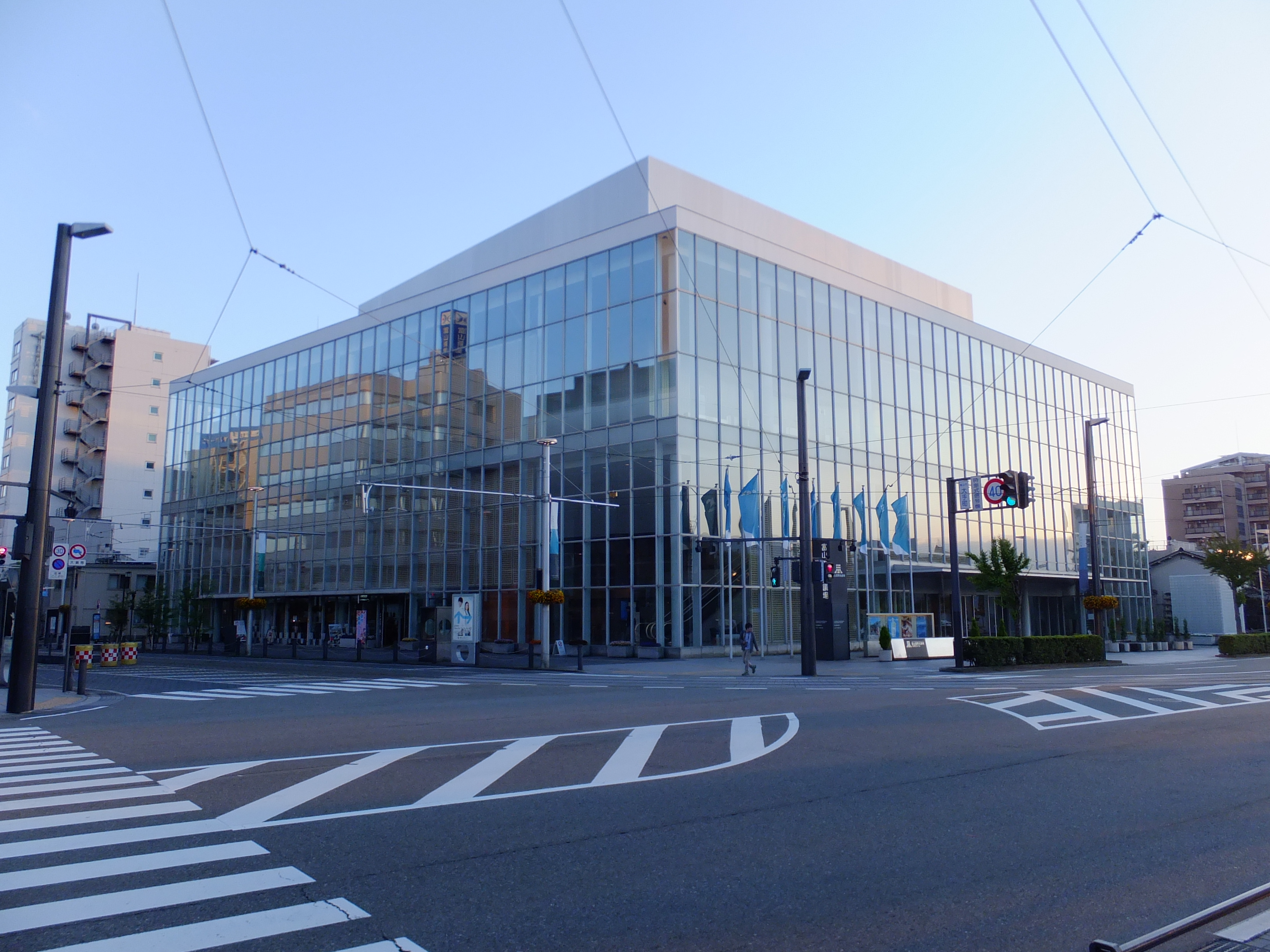
- Toyama Glass Art Museum
- Toyama International Conference Center
- Toyamaken Gokoku Shrine
- Yasuda Castle ruins, National Historic Site
Culture
20250614-P1069186.jpg)

Festivals and events
- Toyama Chindon Contest (Toyama Band of musical sandwichmen contest) – proposed by the Toyama Chamber of Commerce in 1955 and is held annually in early April. This event has become a festival, and many bands of sandwichmen (men wearing sandwich boards for advertisements) participate, attracting many tourists every year.
- Kaze No Bon – held annually on September 1 to 3, in the Yatsuo region.
Notable people
- Gaku Matsumoto, actor
- Eikichi Minato, politician, Mayor of Toyama
- Ryūzō Sejima, Japanese army officer, business leader
- Koichi Tanaka, chemist, 2002 Nobel Prize in Chemistry winner.
- Tamisuke Watanuki, politician
- Kaede Yamada, member of Korean girl-group tripleS
- Hikaru Masai, Japanese singer, member of Kalafina
- Masato Nakazawa, former Japanese baseball player
- Rui Hachimura, basketball player for the Los Angeles Lakers in the NBA
References
References
- "UEA Code Tables". Center for Spatial Information Science, University of Tokyo.
- NHK Publishing. (24 May 2016)
- "official city statistics".
- {{OSM. r. 4807827. Toyama
- Pennington, Matthew. (25 April 2015). "'The truth needs to be told' about Japan's war history, some vets say". Stars and Stripes.
- [http://home.att.net/~sallyann6/b29/56years-4508a.html Info on att.net] {{Webarchive. link. (2007-02-28)
- "Nagaoka Air Raid | Comparison to Other Cities".
- "Toyama (Japan): Cities, Towns and Villages in Prefecture - Population Statistics, Charts and Map".
- "市の国際交流". Toyama.
- "[http://www.rikuden.co.jp/annual/anre2013.pdf Annual Report 2013]". [[Hokuriku Electric Power Company]]. Retrieved on August 28, 2014.
- "[http://www.nachi-fujikoshi.co.jp/eng/company/index.html Corporate Info]". [[Nachi-Fujikoshi]]. Retrieved on August 27, 2014.
- "[https://www.intec.co.jp/english/company/about/ About INTEC]". INTEC. Retrieved on August 27, 2014.
- "[http://www.hokuhoku-fg.co.jp/english/info/corporate/ Corporate Data]". Hokuhoku Financial Group. Retrieved on August 28, 2014.
- "Toyama Glass Art Museum – English Site".
- (September 13, 2022). "TOYAMA INTERNATIONAL CONFERENCE CENTER".
- link. (2013-05-12 . (2008). ''Visit Toyama''. Retrieved Jan. 6, 2013, from prefectural web site, English version.)
This article was imported from Wikipedia and is available under the Creative Commons Attribution-ShareAlike 4.0 License. Content has been adapted to SurfDoc format. Original contributors can be found on the article history page.
Ask Mako anything about Toyama (city) — get instant answers, deeper analysis, and related topics.
Research with MakoFree with your Surf account
Create a free account to save articles, ask Mako questions, and organize your research.
Sign up freeThis content may have been generated or modified by AI. CloudSurf Software LLC is not responsible for the accuracy, completeness, or reliability of AI-generated content. Always verify important information from primary sources.
Report