From Surf Wiki (app.surf) — the open knowledge base
Touchard polynomials
Sequence of polynomials
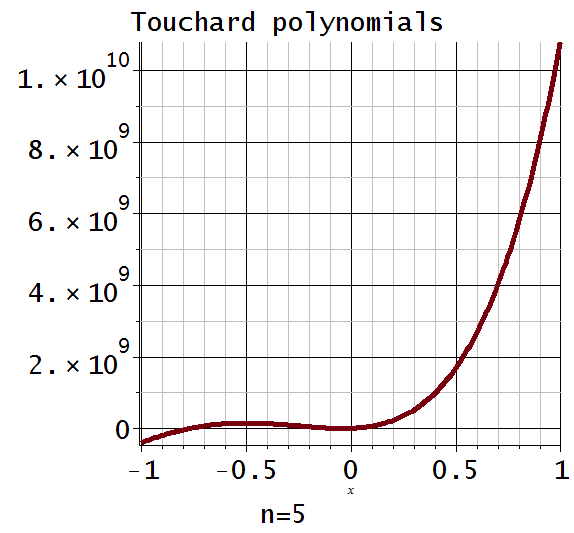
Sequence of polynomials
The Touchard polynomials, studied by , also called the exponential polynomials or Bell polynomials, comprise a polynomial sequence of binomial type defined by
:T_n(x)=\sum_{k=0}^n S(n,k)x^k=\sum_{k=0}^n \left{ {n \atop k} \right}x^k,
where S(n,k)=\left{ {n \atop k} \right} is a Stirling number of the second kind, i.e., the number of partitions of a set of size n into k disjoint non-empty subsets.
The first few Touchard polynomials are :T_1(x)=x, :T_2(x)=x^2+x, :T_3(x)=x^3+3x^2+x, :T_4(x)=x^4+6x^3+7x^2+x, :T_5(x)=x^5+10x^4+25x^3+15x^2+x.
Properties
Basic properties
The value at 1 of the nth Touchard polynomial is the nth Bell number, i.e., the number of partitions of a set of size n: :T_n(1)=B_n.
If X is a random variable with a Poisson distribution with expected value λ, then its nth moment is E(X**n) = T**n(λ), leading to the definition: :T_{n}(x)=e^{-x}\sum_{k=0}^\infty \frac {x^k k^n} {k!}.
Using this fact one can quickly prove that this polynomial sequence is of binomial type, i.e., it satisfies the sequence of identities: :T_n(\lambda+\mu)=\sum_{k=0}^n {n \choose k} T_k(\lambda) T_{n-k}(\mu).
The Touchard polynomials constitute the only polynomial sequence of binomial type with the coefficient of x equal 1 in every polynomial.
The Touchard polynomials satisfy the Rodrigues-like formula: :T_n \left(e^x \right) = e^{-e^x} \frac{d^n}{dx^n};e^{e^x}.
The Touchard polynomials satisfy the recurrence relation :T_{n+1}(x)=x \left(T_{n}(x) + T'{n}(x)\right) and :T{n+1}(x)=x\sum_{k=0}^n{n \choose k}T_k(x). In the case x = 1, this reduces to the recurrence formula for the Bell numbers.
A generalization of both this formula and the definition, is a generalization of Spivey's formula
T_{n+m}(x) = \sum_{k=0}^n \left{ {n \atop k} \right} x^k \sum_{j=0}^m \binom{m}{j} k^{m-j} T_j(x)
Using the umbral notation T**n(x)=T**n(x), these formulas become: :T_n(\lambda+\mu)=\left(T(\lambda)+T(\mu) \right)^n, :T_{n+1}(x)=x \left(1+T(x) \right)^n.
The generating function of the Touchard polynomials is :\sum_{n=0}^\infty {T_n(x) \over n!} t^n=e^{x\left(e^t-1\right)}, which corresponds to the generating function of Stirling numbers of the second kind.
Touchard polynomials have contour integral representation: :T_n(x)=\frac{n!}{2\pi i}\oint\frac{e^{x({e^t}-1)}}{t^{n+1}},dt.
Zeroes
All zeroes of the Touchard polynomials are real and negative. This fact was observed by L. H. Harper in 1967.{{Cite journal | doi-access = free
The absolute value of the leftmost zero is bounded from above by{{Cite journal :\frac1n\binom{n}{2}+\frac{n-1}{n}\sqrt{\binom{n}{2}^2-\frac{2n}{n-1}\left(\binom{n}{3}+3\binom{n}{4}\right)}, although it is conjectured that the leftmost zero grows linearly with the index n.
The Mahler measure M(T_n) of the Touchard polynomials can be estimated as follows: : \frac{\lbrace\textstyle{n\atop \Omega_n}\rbrace}{\binom{n}{\Omega_n}}\le M(T_n)\le\sqrt{n+1}\left{{n\atop K_n}\right}, where \Omega_n and K_n are the smallest of the maximum two k indices such that \lbrace\textstyle{n\atop k}\rbrace/\binom{n}{k} and \lbrace\textstyle{n\atop k}\rbrace are maximal, respectively.
Generalizations
- Complete Bell polynomial B_n(x_1,x_2,\dots,x_n) may be viewed as a multivariate generalization of Touchard polynomial T_n(x), since T_n(x) = B_n(x,x,\dots,x).
- The Touchard polynomials (and thereby the Bell numbers) can be generalized, using the real part of the above integral, to non-integer order:
- :T_n(x)=\frac{n!}{\pi} \int^{\pi}_0 e^{x \bigl(e^{\cos(\theta)} \cos(\sin(\theta))-1 \bigr)} \cos \bigl(x e^{\cos(\theta)} \sin(\sin(\theta)) -n\theta\bigr) , d\theta, .
References
References
- Touchard, Jacques. (1956). "Nombres Exponentiels Et Nombres De Bernoulli". Canadian Journal of Mathematics.
- Roman, Steven. (1984). "The Umbral Calculus". Dover.
- Boyadzhiev, Khristo N.. (2009). "Exponential polynomials, Stirling numbers, and evaluation of some gamma integrals". Abstract and Applied Analysis.
- Brendt, Bruce C. "RAMANUJAN REACHES HIS HAND FROM HIS GRAVE TO SNATCH YOUR THEOREMS FROM YOU".
- "Bell Polynomial".
- "Implications of Spivey's Bell Number Formula".
- "On the Mahler measure of the Bell polynomials".
This article was imported from Wikipedia and is available under the Creative Commons Attribution-ShareAlike 4.0 License. Content has been adapted to SurfDoc format. Original contributors can be found on the article history page.
Ask Mako anything about Touchard polynomials — get instant answers, deeper analysis, and related topics.
Research with MakoFree with your Surf account
Create a free account to save articles, ask Mako questions, and organize your research.
Sign up freeThis content may have been generated or modified by AI. CloudSurf Software LLC is not responsible for the accuracy, completeness, or reliability of AI-generated content. Always verify important information from primary sources.
Report