From Surf Wiki (app.surf) — the open knowledge base
Top-hat filter
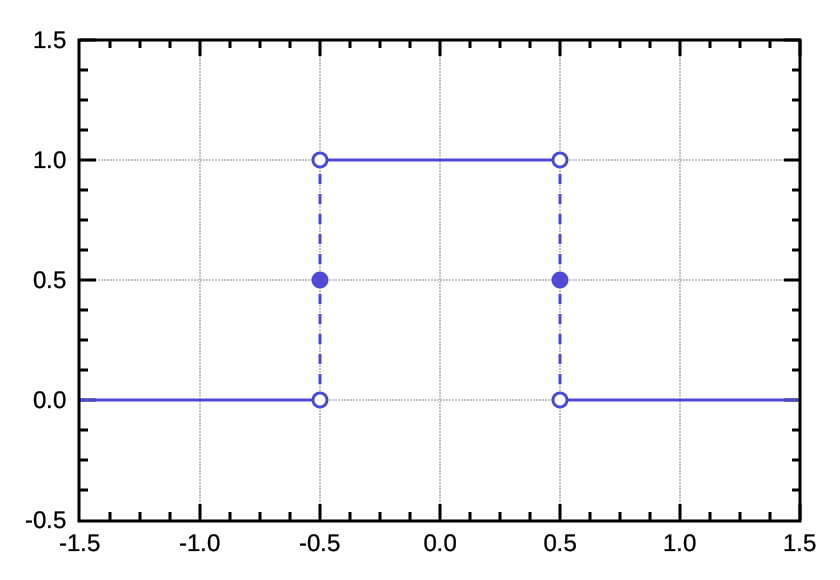
Top-hat filters are several real-space or Fourier space filtering techniques. The name top-hat originates from the shape of the filter, which is a rectangle function, when viewed in the domain in which the filter is constructed.
Real space
In real-space the filter performs nearest-neighbour filtering, incorporating components from neighbouring y-function values. Despite its ease of implementation, its practical use is limited as the real-space representation of a top-hat filter is the sinc function, which has the often undesirable effect of incorporating non-local frequencies.
Analogue implementations
Exact non-digital implementations are only theoretically possible. Top-hat filters can be constructed by chaining theoretical low-band and high-band filters. In practice, an approximate top-hat filter can be constructed in analogue hardware using approximate low-band and high-band filters.
Fourier space
In Fourier space, a top hat filter selects a band of signal of desired frequency by the specification of lower and upper bounding frequencies. Top-hat filters are particularly easy to implement digitally.
References
References
- (2008). "Discrete Fourier Analysis and Wavelets: Applications to Signal and Image Processing". [[John Wiley & Sons.
This article was imported from Wikipedia and is available under the Creative Commons Attribution-ShareAlike 4.0 License. Content has been adapted to SurfDoc format. Original contributors can be found on the article history page.
Ask Mako anything about Top-hat filter — get instant answers, deeper analysis, and related topics.
Research with MakoFree with your Surf account
Create a free account to save articles, ask Mako questions, and organize your research.
Sign up freeThis content may have been generated or modified by AI. CloudSurf Software LLC is not responsible for the accuracy, completeness, or reliability of AI-generated content. Always verify important information from primary sources.
Report