From Surf Wiki (app.surf) — the open knowledge base
Tooting (crater)
Volcanic crater on Mars
Volcanic crater on Mars
| Field | Value |
|---|---|
| titlecolor | #FA8072 |
| title | Tooting |
| image | Martian impact crater Tooting based on day THEMIS.png |
| coordinate_title | Coordinates |
| globe | Mars |
| coordinates | |
| diameter | 28 km |
| depth | 1,200 m |
| eponym | London suburb |
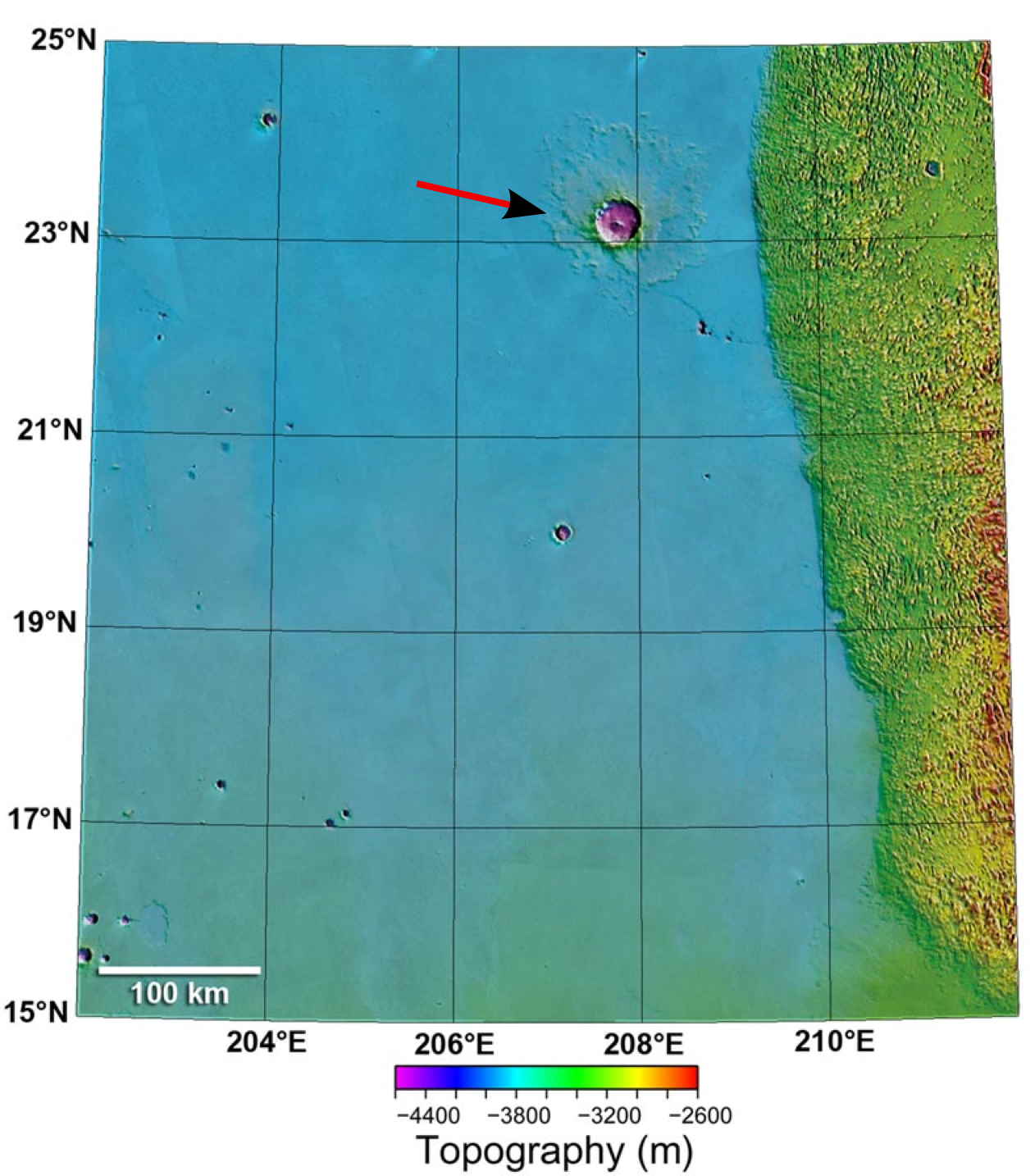
Tooting is an impact crater (of the rampart crater type) with volcanic features at 23.1°N, 207.1°E, in Amazonis Planitia (Amazonis quadrangle), due west of the volcano Olympus Mons, on Mars. It was identified by planetary geologist Peter Mouginis-Mark in September 2004. Scientists estimate that its age is on the order of hundreds of thousands of years, which is relatively young for a Martian crater. A later study confirms this order of magnitude estimate. A preliminary paper describing the geology and geometry of Tooting was published in 2007 by the journal Meteoritics and Planetary Science, vol. 42, pages 1615–1625. Further papers have been published, including a 2010 analysis of flows on the walls of Tooting crater by A. R. Morris et al. (Icarus vol. 209, p. 369–389), and a 2012 review paper by P.J. Mouginis-Mark and J.M. Boyce in Chemie der Erde Geochemistry, vol. 72, p. 1–23. A geologic map has also been submitted in 2012 to the U.S. Geological Survey for consideration and future publication.
Naming
Tooting is named after the London suburb of the same name. This is in accordance with the International Astronomical Union's rules for planetary nomenclature, which specify that craters on Mars less than 60 km in diameter should be named after "villages of the world with a population of less than 100,000". The discoverer named it after his home town because he "thought [his] mum and brother would get a kick out of having their home town paired with a land form on Mars". This caused a stir in the British press, with many well-known media outlets reporting on the issue.
Geology
The crater's youth was inferred from the lack of superimposed cratering, preserved impact melt in the crater, and that the central peak of the crater has not been buried by sediment.
Research published in the journal Icarus has found pits in Tooting Crater that are caused by hot ejecta falling on ground containing ice. The pits are formed by heat forming steam that rushes out from groups of pits simultaneously, thereby blowing away from the pit ejecta.


Due to the flatness of the surrounding lava flows (at 3872 m below Martian datum), it is possible to infer much about the crater's formation and ejecta blanket. For example, the volume of ejecta deposited from the formation of the crater is estimated to be 450 cubic kilometres and that this process took less than half an hour.
Comparison
Tooting has been compared to the craters Santa Fe and Endeavour (of Opportunity [MER-B] fame).
Source of Martian Meteorites
Tooting has been suggested as the most likely source of depleted Shergottite meteorites that were ejected 1.1 million years ago.
References
References
- "Gazetteer of Planetary Nomenclature".
- "Tooting Crater's Tangled Tale".
- "Cratering age considerations for young terranes in the inner Solar System".
- "Categories for Naming Features on Planets and Satellites".
- (2005-11-01). "Mars crater named after Tooting". [[BBC News]].
- Brown, Andrew. (2005-11-02). "Why Tooting is on another planet". [[The Guardian]].
- (2005-11-01). "Life on Mars - But the force is with Tooting". [[The Times]].
- Boyce, J. et al. 2012. "Origin of small pits in martian impact craters". ''Icarus''. 221: 262-275.
- Tornabene, L. et al. 2012. "Widespread crater-related pitted materials on Mars. Further evidence for the role of target volatiles during the impact process". ''Icarus''. 220: 348–368.
- (2006). "Ejecta Thickness of the Martian Impact Crater Tooting". American Geophysical Union, Fall Meeting.
- (March 2015). "Degradation of Endeavour Crater, Mars". Universities Space Research Association.
- (2021-11-03). "The Tharsis mantle source of depleted shergottites revealed by 90 million impact craters". Nature Communications.
- Gough, Evan. (2021-11-08). "We Now Know Exactly Which Crater the Martian Meteorites Came From".
This article was imported from Wikipedia and is available under the Creative Commons Attribution-ShareAlike 4.0 License. Content has been adapted to SurfDoc format. Original contributors can be found on the article history page.
Ask Mako anything about Tooting (crater) — get instant answers, deeper analysis, and related topics.
Research with MakoFree with your Surf account
Create a free account to save articles, ask Mako questions, and organize your research.
Sign up freeThis content may have been generated or modified by AI. CloudSurf Software LLC is not responsible for the accuracy, completeness, or reliability of AI-generated content. Always verify important information from primary sources.
Report