From Surf Wiki (app.surf) — the open knowledge base
Tonpa Shenrab Miwoche
Founder of the Bon tradition
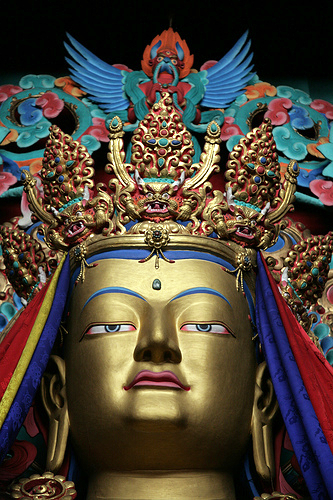
Founder of the Bon tradition


Tonpa Shenrab (, ), also known as Shenrab Miwo (), Shenrab Miwoche, Buddha Shenrab, Guru Shenrab, and by a number of other titles, is the legendary founder and reformer of the Bon religious tradition of Tibet. Bönpos usually add the honorific “Tonpa” (“founder” or “teacher”) before his name.
The story of Tonpa Shenrab was revealed in a fourteenth-century terma of Loden Nyingpo.
Existence
"[Shenrab Miwo] occupies a position very similar to that of [Gautama Buddha
Etymology
The name Shenrab Miwo is in the [Zhang-Zhung language, which is a relative of Old Tibetan. It appears to be the Zhangzhung word for "bodhisattva" (equivalent to Tibetan shégya sempa, ).
“Tonpa” means “Founder/Teacher”; “Shenrab” is interpreted by Bönpos as “Buddha.” The term “Yungdrung” also has Buddhist connotations: “Yungdrung” means Vajra, and “Yungdrung Tsulpa” means Bodhisattva.
Biography
Accounts of Tonpa Shenrab’s life are found in three principal sources, the Dodü (), Zermik (), and Ziji (). The first two are considered terma revealed in the 10th or 11th century; the third is part of the oral lineage ().
Chronology according to traditions
Bön tradition asserts that Tonpa Shenrab lived in a remote antiquity, long before Śākyamuni. According to standard Bön chronology, he was born in 16,017 BCE in the land of Olmolungring and lived for 82 years, first marrying and teaching sciences such as logic, phonology, astronomy, and medicine, then renouncing royal life at age 31, attaining realization at Mount Kailash, and spreading Bön until his passing.
Alternative narratives, sometimes framed in more “historical” terms, place Shenrab in the early 1st millennium BCE. A few accounts describe him as the first king who unified Tibet and founded the Zhangzhung kingdom in the 6th century BCE; others identify him as a Zhangzhung prince active in the 4th century BCE. Still other traditions claim his birth as early as 1917 BCE.
Life and deeds
Like Gautama, Tonpa Shenrab was of royal birth. At thirty-one, he renounced his inheritance to pursue enlightenment, embraced renunciation and austerities, and spread the doctrine of Bön. He eventually arrived in Zhangzhung, near Mount Kailash.
From childhood, he displayed great abilities—teaching sciences, emanating multiple forms to aid beings, and traveling widely. At 16 he married, at 18 fought demons, at 20 taught in China and India, and by 26 began preaching. At 31 he became a monk, attained realization, and lived until age 82.
Bönpos believe Shakyamuni’s previous life was “Prince White Banner” and that Shenrab was his teacher. They credit him with creating Zhangzhung culture, including crafts, linguistics, medicine, astronomy, and inner Bön doctrine, and even claim he was the source of world culture and Buddhism itself.
Tibetan Buddhists criticize such narratives as imitations of the Buddha’s life, calling Bön an “outer path” (). Today, Bön is administratively placed under the Buddhist Association of China.
Aspects of Shenrab Miwoche
Shenrab Miwoche is said to have three aspects or forms:
- the tulku () or nirmaṇakāya, Shenrab Miwoche;
- the dzokku () or sambhogakāya, Shenlha Okar and
- the bönku () or dharmakāya, Tapihritsa.
References
Sources
- Bellezza, John Vincent. (2010). "gShen-rab Myi-bo, His life and times according to Tibet’s earliest literary sources." Revue d’Etudes Tibétaines Number 19 October 2010, pp. 31–118.
- Unknown author (2005). The Bonpo's Tradition. (Accessed: January 17, 2007).
References
- Schaik, Sam van. ''Tibet: A History''. Yale University Press 2011, pp. 99–100.
- Karmey, Samten G. (1975). ''A General Introduction to the History and Doctrines of Bon'', pp. 175–176. Memoirs of the Research Department of the Toyo Bunko, No. 33. Tokyo.
- (1992). "gShen". Namgyal Institute of Tibetology.
- 《藏族浩繁庞大的鬼 灵神佛信奉体系——苯教“万神殿”》.《西藏艺术研究》1996年第3期.刘志群
- (2008). "Yungdrung Bonpo website – Shenrab Miwo". Yungdrung Bonpo.
- "Yungdrung Bön".
- link. (2007-09-26)
This article was imported from Wikipedia and is available under the Creative Commons Attribution-ShareAlike 4.0 License. Content has been adapted to SurfDoc format. Original contributors can be found on the article history page.
Ask Mako anything about Tonpa Shenrab Miwoche — get instant answers, deeper analysis, and related topics.
Research with MakoFree with your Surf account
Create a free account to save articles, ask Mako questions, and organize your research.
Sign up freeThis content may have been generated or modified by AI. CloudSurf Software LLC is not responsible for the accuracy, completeness, or reliability of AI-generated content. Always verify important information from primary sources.
Report