From Surf Wiki (app.surf) — the open knowledge base
Tommotiid
Extinct clade of lophophorates
Extinct clade of lophophorates
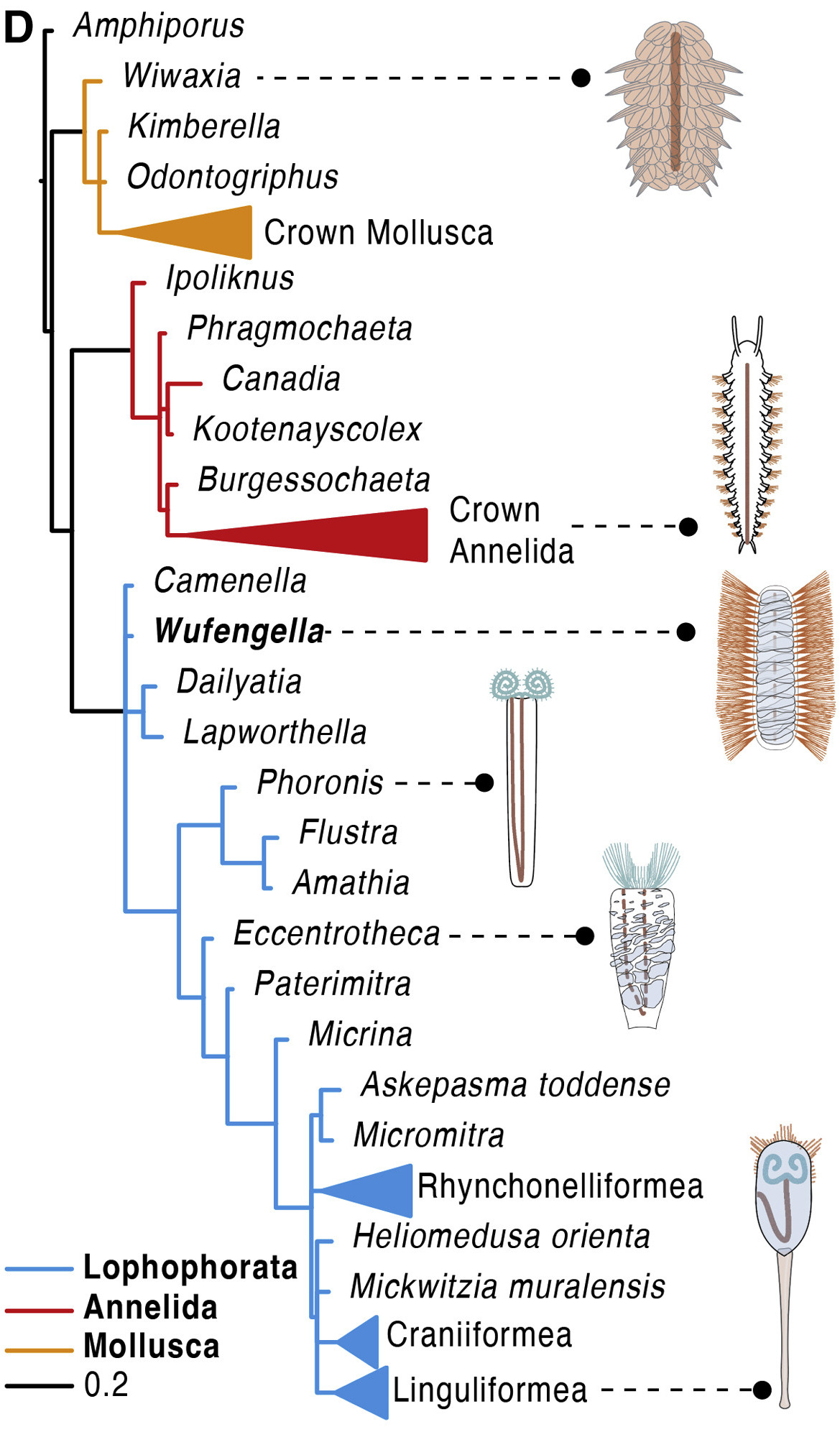
Tommotiids are an extinct group of Cambrian invertebrates thought to be early total-group lophophorates (the group containing Bryozoa, Brachiopoda, and Phoronida), including members of the lophophorate stem group, as well as early diverging members of the crown group.
The majority of tommotiids are mineralised with calcium phosphate rather than calcium carbonate,{{Cite book |contribution = Early skeletal fossils |author = Bengtson, S. |editor = Lipps, J.H. |editor2 = Waggoner, B.M. |title = Neoproterozoic-Cambrian Biological Revolutions |year = 2004 |series = The Paleontological Society Papers |volume = 10 |pages = 67–78 |url = http://www.cosmonova.org/download/18.4e32c81078a8d9249800021554/Bengtson2004ESF.pdf |accessdate = 2008-07-18 |url-status = dead |archiveurl = https://web.archive.org/web/20081003122817/http://www.nrm.se/download/18.4e32c81078a8d9249800021554/Bengtson2004ESF.pdf|archivedate=2008-10-03
Micrina and Paterimitra possess bivalved shells in their larval phases, which preserve characters that might position them in the Linguliformea and Rhynchonelliformea stem lineages respectively. This would indicate that the brachiopod shell represents the retention of a larval character.
For a long part of their history, the tommotiids were only known from disarticulated shells - a complete organism had not been found. The 2008 discovery of Eccentrotheca offered the first insight into a complete organism, and permitted a reconstruction of the animal as a sessile, tube-like animal made up of a spiral of overlapping plates. Articulated specimens of Paterimitra, discovered a year later, suggest a similar form and lifestyle - it is possible that many tommotiids need redescribing as sessile tube-dwellers. Eccentrotheca and other similar sessile tommotiids were likely filter feeders, similar to modern lophophorates.
However, the discovery of the articulated camenellan Wufengella showed that it was a free-living worm-like animal, suggesting that it was not a crown-group lophophorate, as the last living common ancestor of all living lophophorates has been predicted to be sessile, as bryozoans, brachiopods and phoronids are. This indicates that tommotiids are paraphyletic, with some tommotiids more closely related to bryozoans, brachiopods and phoronids than to other tommotiids.
These discoveries have produced an alternative model for the origin of the brachiopods; it suggested that they evolved by the reduction of sessile tube-like organisms, until only two shells were left. This contrasts with the brachiopod fold hypothesis which suggests that they formed by the folding of a halkieriid-like organism.
Taxonomy
Five families are recognized: | Tommotiidae | Missarzhevsky in Rozanov et al., 1969 | Tannuolinidae |Fonin and Smirnova, 1967 | Sunnaginiidae |Landing, 1984 | Kennardiidae |Laurie, 1986 | Lapworthellidae |Missarzhevsky in Rozanov and Missarzhevsky, 1966
| Taxon | vauthors=Skovsted CB, Brock GA, Topper TP, Paterson JR, Holmer LE | title=Scleritome construction, biofacies, biostratigraphy and systematics of the tommotiid Eccentrotheca helenia sp. nov. from the Early Cambrian of South Australia | journal=Palaeontology | volume=54 | issue=2 | pages=253–286 | year=2011 | doi= 10.1111/j.1475-4983.2010.01031.x | doi-access= | bibcode=2011Palgy..54..253S }} |
|---|---|---|---|---|---|---|---|---|---|---|
| Kulparina | Stem paterinid | |||||||||
| Paterimitra | Stem paterinid | |||||||||
| Askepasma | Stem (or crown?) paterinid | |||||||||
| Tannuolina | Stem linguliform | |||||||||
| Micrina | Stem Linguliform | |||||||||
| Mickwitzia | Stem (or crown?) linguliform | |||||||||
| Camenella | Stem brachiozoan | |||||||||
| Dailyatia | Stem brachiozoan | |||||||||
| Lapworthella | Stem brachiozoan | |||||||||
| Eccentrotheca | Stem phoronid or brachiopod | |||||||||
| Wufengella | Stem lophophorate |
References
References
- (2015). "Discovery of the youngest known tommotiid from the middle Cambrian (Drumian) Nelson Limestone of Antarctica". Diva.
- (June 2008). "The Early Cambrian tommotiid ''Micrina'', a sessile bivalved stem group brachiopod". Biology Letters.
- Taylor, Christopher. (2008-06-27). "Back to the Scleritome - Tommotiids Revealed!". Catalogue of Organisms.
- (February 2008). "The scleritome of ''Eccentrotheca'' from the Lower Cambrian of South Australia: Lophophorate affinities and implications for tommotiid phylogeny". Geology.
- (2016). "A silicified tommotiid from the lower Cambrian of Greenland". Bulletin of Geosciences.
- (2011). "First record of a bivalved larval shell in Early Cambrian tommotiids and its phylogenetic significance". Palaeontology.
- (May 2009). "The scleritome of ''Paterimitra'': an Early Cambrian stem group brachiopod from South Australia". Proceedings of the Royal Society B: Biological Sciences.
- (September 2022). "A Cambrian tommotiid preserving soft tissues reveals the metameric ancestry of lophophorates". Current Biology.
- (2014). "The tommotiid ''Kelanella'' and associated fauna from the early Cambrian of southern Montagne Noire (France): Implications for camenellan phylogeny". Palaeontology.
- (2011). "Scleritome construction, biofacies, biostratigraphy and systematics of the tommotiid ''Eccentrotheca helenia'' sp. nov. from the Early Cambrian of South Australia". Palaeontology.
This article was imported from Wikipedia and is available under the Creative Commons Attribution-ShareAlike 4.0 License. Content has been adapted to SurfDoc format. Original contributors can be found on the article history page.
Ask Mako anything about Tommotiid — get instant answers, deeper analysis, and related topics.
Research with MakoFree with your Surf account
Create a free account to save articles, ask Mako questions, and organize your research.
Sign up freeThis content may have been generated or modified by AI. CloudSurf Software LLC is not responsible for the accuracy, completeness, or reliability of AI-generated content. Always verify important information from primary sources.
Report