From Surf Wiki (app.surf) — the open knowledge base
Tokyo Metropolitan Police Department
Prefectural police department in Japan

Prefectural police department in Japan
| Field | Value |
|---|---|
| agencyname | Tokyo Metropolitan Police Department |
| nativenamea | 警視庁 |
| nativenamer | Keishichō |
| patch | Asahikage.svg |
| patchcaption | Asahikage |
| logo | Keishicho.jpg |
| logocaption | Headquarters building |
| badge | Tokyo MPD.svg |
| badgecaption | Patch |
| abbreviation | TMPD |
| formed | 9 January 1874 |
| preceding1 | |
| country | Japan |
| international | |
| divname | Kantō region |
| subdivname | Tokyo |
| governingbody | Tokyo Metropolitan Government |
| constitution1 | |
| police | Yes |
| local | Yes |
| speciality1 | |
| oversightbody | Tokyo Metropolitan Public Safety Commission |
| headquarters | 1-1 Kasumigaseki 2-chome, Chiyoda-ku, Tokyo 100-8929 |
| sworntype | Sworn |
| sworn | 43,566 |
| unsworntype | Police Administrative Civilians |
| unsworn | 3,015 |
| multinational | |
| minister1name | |
| minister1pfo | |
| chief1name | Yūji Sakoda |
| chief1position | Superintendent General |
| chief2name | Tetsuro Kamata |
| chief2position | Deputy Superintendent General |
| child1agency | |
| unittype | Bureau |
| unitname | |
| officename | |
| stations | 102 |
| airbases | |
| lockups | |
| vehicle1type | Patrol Car |
| vehicles1 | 1292 |
| vehicle2type | Motorcycle |
| vehicles2 | 958 |
| boat1type | Security boat |
| boats1 | 22 |
| aircraft1type | Helicopter |
| aircraft1 | 14 |
| animal1type | Dog |
| animals1 | 36 |
| animal2type | Horse |
| animals2 | 16 |
| person1name | |
| person1reason | |
| person1type | |
| programme1 | |
| activity1name | |
| anniversary1 | |
| award1 | |
| website | Tokyo Metropolitan Police Department |
| Tokyo Metropolitan Police Department |
Tokyo Metropolitan Police Department
The Tokyo Metropolitan Police Department (TMPD), known locally as simply the Metropolitan Police Department (MPD), is the prefectural police of Tokyo Metropolis, Japan. Founded in 1874, the TMPD is the largest police force in Japan by number of officers, with a staff of more than 40,000 police officers and over 2,800 civilian personnel.
The TMPD is headed by a Superintendent-General, who is appointed by the National Public Safety Commission and approved by the prime minister. It manages 10 divisions and 102 stations across the Metropolis.
The TMPD's headquarters are located in Kasumigaseki, Chiyoda, Tokyo. Built in 1980, it is 18 stories tall, and is a large wedge-shaped building with a cylindrical tower. The HQ building is located opposite of Sakurada Gate of Tokyo Imperial Palace, which is the reason why it is metonymically called "Sakurada Gate".
History
The TMPD was established by Japanese statesman Kawaji Toshiyoshi in 1874. Kawaji, who had helped establish the earlier rasotsu in 1871 following the disestablishment of the Edo period police system, was part of the Iwakura Mission to Europe, where he gathered information on Western policing; he was mostly inspired by the police of France, especially the National Gendarmerie on which the rasotsu were based. On 9 January 1874, the TMPD was established as part of the Home Ministry, with Kawaji serving as its first Superintendent-General.
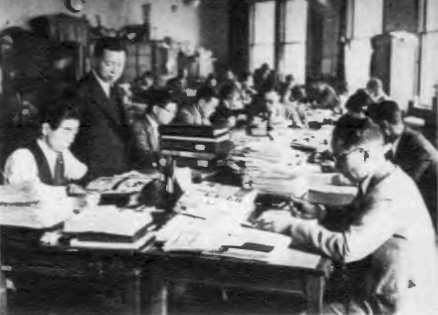
By the 1880s, the police had developed into a nationwide instrument of government control, and their increasing involvement in political affairs was one of the foundations of the authoritarian state in the Empire of Japan during the first half of the 20th century. By the 1920s and 1930s, police across Japan, including the TMPD, were responsible not only for law enforcement and public security, but also firefighting, labor dispute mediation, censorship, upholding public morality, issuing permits, and government regulation of businesses, construction, and public health.
When Japan surrendered at the end of World War II, the TMPD was placed under Allied control in occupied Japan. The Supreme Commander for the Allied Powers viewed the existing Japanese police system as undemocratic and sought to reform it, so in 1947 the Old Police Law was passed, decentralizing Japanese police and reorganizing them into municipal police and rural police; as a municipal police force, the TMPD was limited to the 23 wards of Tokyo, but the "Metropolitan" part of the name remained. Police firefighting duties were also split off to independent fire departments, with the TMPD's Fire Bureau developing into the Tokyo Fire Department in 1948. However, issues concerning manpower and efficiency among smaller and spread out municipalities arose, so in 1954 the amended Police Law was passed, reunifying the police into prefectural divisions under the National Police Agency; as part of the amendment, the TMPD regained jurisdiction over the Tokyo metropolitan area.
In 2017, the TMPD established the Cyber Attack Countermeasures Center, consisting of 100 officers from the Cyber Attack Special Investigation Unit, originally from the PSB.
To prepare for the G20 summit in 2019, the TMPD announced the establishment of the Water Response Team in order to police bodies of water near G20 summit venues.
In response to concerns raised by the Okawahara Kakoki Incident, the PSB created the Public Security Investigation and Guidance Office through the Public Security and General Affairs Division.https://www.sankei.com/article/20251001-IMRJNZPW2ZLIFBI3276BHW3O7E/
Scandals
In 1978, the TMPD was investigated when a uniformed officer killed a female university student inside her residence.
In 1997, an officer was caught falsifying evidence in an amphetamine investigation.
In 2007, the TMPD was under scrutiny after a serving officer used his officially-issued firearm to commit a murder–suicide.
In 2014, the chief of Kamata Police Station in Ōta was disciplined after a police officer assigned there committed suicide following severe workplace harassment.
In 2024, an investigation found that police departments across Japan, including Tokyo, did have a high rate of systematic racial profiling against foreigners, despite previously low records of racial profiling incidents.
Organization
The TMPD is under the command of a Superintendent-General and reports directly to the Tokyo Metropolitan Public Safety Commission. The Superintendent-General can be appointed and replaced at any time as long as the prime minister and the TMPSC receives their approval.
Since the TMPD is autonomous, it does not operate under the authority of any Regional Police Bureau.
The TMPD has nine bureaus that report to the Deputy Superintendent General:
- Administration Bureau
- Personnel and Training Bureau
- Traffic Bureau
- Community Police Affairs Bureau
- Security Bureau
- Public Security Bureau
- Criminal Investigation Bureau
- Community Safety Bureau
- Organized Crime Control Bureau
The TMPD also operates its own academy, the Metropolitan Police Academy.
Ranks and insignia
The ranks used in the TMPD have been slightly revised in 2013, changing only the English translation of some of the ranks used by the force.
Otherwise, these ranks have been observed throughout its history. (Note that Deputy Superintendent-General is, strictly speaking, a post rather than a rank).
- Superintendent-General (four gold rising suns)
- Deputy Superintendent-General (post gold-wreathed gold emblem with three gold bars)
- Senior Commissioner (gold-wreathed gold emblem with three gold bars), formerly Superintendent Supervisor
- Commissioner (gold-wreathed gold emblem with two gold bars), formerly Chief Superintendent
- Assistant Commissioner (gold-wreathed gold emblem with one gold bar), formerly Senior Superintendent
- Superintendent (gold-wreathed silver emblem with three gold bars)
- Chief Inspector (gold-wreathed silver emblem with two gold bars), formerly Inspector
- Inspector (gold-wreathed silver emblem with one gold bar), formerly Assistant Inspector
- Sergeant (silver-wreathed silver emblem with three gold bars)
- Senior Police Officer (silver-wreathed silver emblem with two gold bars)
- Police Officer (silver-wreathed silver emblem with one gold bar)
Gallery
File:Tokyo Metropolitan Police Department Toyota Crown Patrol Car GRS214.jpg|Toyota Crown assigned to traffic duty in Tachikawa File:Tokyo Metropolitan Police Department Nissan Fairlady Z NISMO Z34.jpg|Nissan Fairlady Z NISMO Z34 used for highway patrol File:Tokyo Metropolitan Police Department Shibuya-1 with raised lightbar.jpg|Toyota Crown with a raised lightbar in Shibuya File:Tokyo Metropolitan Police Department motorcycle unit escorting 2015Tokyo Marathon.jpg|Yamaha FJR1300 escorting the 2015 Tokyo Marathon File:Tokyo Metropolitan Police Department Mitsubishi Fuso Canter Small type security vehicle.jpg|Mitsubishi Fuso Canter converted into an internal security vehicle for use by the TMPD's Riot Police Unit File:Tokyo Metropolitan Police Eurocopter EC155B1 JA15MP departing Tokyo Heliport.jpg|Eurocopter EC155 used by the TMPD at Tokyo Heliport File:Metropolitan Police Boat Takao P6059114.jpg|TMPD Boat Takao in Ariake File:Two police officers near Shibuya.jpg|TMPD officers outside a kōban near Shibuya Station File:Police at Yasukuni Shrine - Tokyo - Japan (47855249322).jpg|TMPD patrol officers outside Yasukuni Shrine File:ERT operators stood in lines.jpg|TMPD Riot Police Unit Emergency Response Team officers with their equipment File:The Moat of The Imperial Palace.JPG|TMPD HQ seen from Tokyo Imperial Palace File:Ogasawara Police Station 2017-11-27.jpg|The police station in Ogasawara, about 1000 km away from HQ
Notes
References
References
- "Police of Japan".
- "Metropolitan Police Department Headquarters(Spot)|Chiyoda Tourism Association".
- TMPD. "2019 Tokyo Metropolitan Police Department".
- (2018-10-07). "霞が関、桜田門、兜町…「別の意味」でも使われる東京の地名 {{!}} マネーポストWEBマネーポストWEB".
- (2021). "History". [[National Police Agency (Japan)]].
- "警視庁に「サイバー攻撃対策センター」が発足".
- (13 May 2019). "東京五輪警備へ初の対テロ部隊 警視庁". [[Sankei Shimbun]].
- (21 September 2007). "Top Tokyo cop reprimanded for alleged murder by officer". [[The Japan Times]].
- Clegg, Cara. (23 April 2014). "'Power harassment' in Japan's police force blamed for officer's suicide". SoraNews24.
- (April 30, 2024). "'We were told to target foreigners': Ex-officer on systematic racial profiling by Japan police". The Mainichi.
- (8 May 2025). "Racial Profiling in Japan is Prevalent but Unseen". New York Times.
- "The Present Police Organizations of Japan and the Philippines".
- Nakahara, Hidenori. (1956). "The Japanese Police".
- (1982). "The Police of Japan". [[National Police Agency of Japan]].
- Metropolitan Police Department, [http://www.keishicho.metro.tokyo.jp/kankatu/kankatsu.htm police stations] {{Webarchive. link. (2014-08-03, [http://www.keishicho.metro.tokyo.jp/1/ogasawara/index.htm Ogasawara] {{Webarchive). link. (2014-10-02: [http://www.keishicho.metro.tokyo.jp/1/ogasawara/gaiyo.htm 管内の概況] {{Webarchive). link. (2014-08-09)
This article was imported from Wikipedia and is available under the Creative Commons Attribution-ShareAlike 4.0 License. Content has been adapted to SurfDoc format. Original contributors can be found on the article history page.
Ask Mako anything about Tokyo Metropolitan Police Department — get instant answers, deeper analysis, and related topics.
Research with MakoFree with your Surf account
Create a free account to save articles, ask Mako questions, and organize your research.
Sign up freeThis content may have been generated or modified by AI. CloudSurf Software LLC is not responsible for the accuracy, completeness, or reliability of AI-generated content. Always verify important information from primary sources.
Report