From Surf Wiki (app.surf) — the open knowledge base
Tokyo Big6 Baseball League
Japanese college baseball conference
Japanese college baseball conference
| Field | Value |
|---|---|
| name | Tokyo Big6 Baseball League |
| image | Tokyo Big 6.png |
| color | color:white; background:#003882 |
| font_color | #FFFFFF |
| sport | Baseball |
| commissioner | Akio Kaneko |
| region | Kantō, Japan |
| headquarters | Tokyo, Japan |
| inaugural | 1914 |
| champion | Waseda University |
| (49th title) | |
| most_champs | Waseda University |
| (49 titles) | |
| tv | Sports Bull, Abema, NHK |
| website | Big6.gr.jp |
| map | Map of states with Tokyo Big Six Baseball League schools.png |
| map_size | 250 |
(49th title) (49 titles)
The Tokyo Big6 Baseball League is an intercollegiate baseball conference that features six prominent universities in the Tokyo area. It is the oldest collegiate baseball conference in Japan and the oldest baseball league overall in Japan. Before the start of the Japanese High School Baseball Championship on following year of 1915, the 1936 establishment of the Japanese Baseball League and subsequent growth (after 1950) of Nippon Professional Baseball, the Big6 League was widely considered the highest level of baseball in Japan.
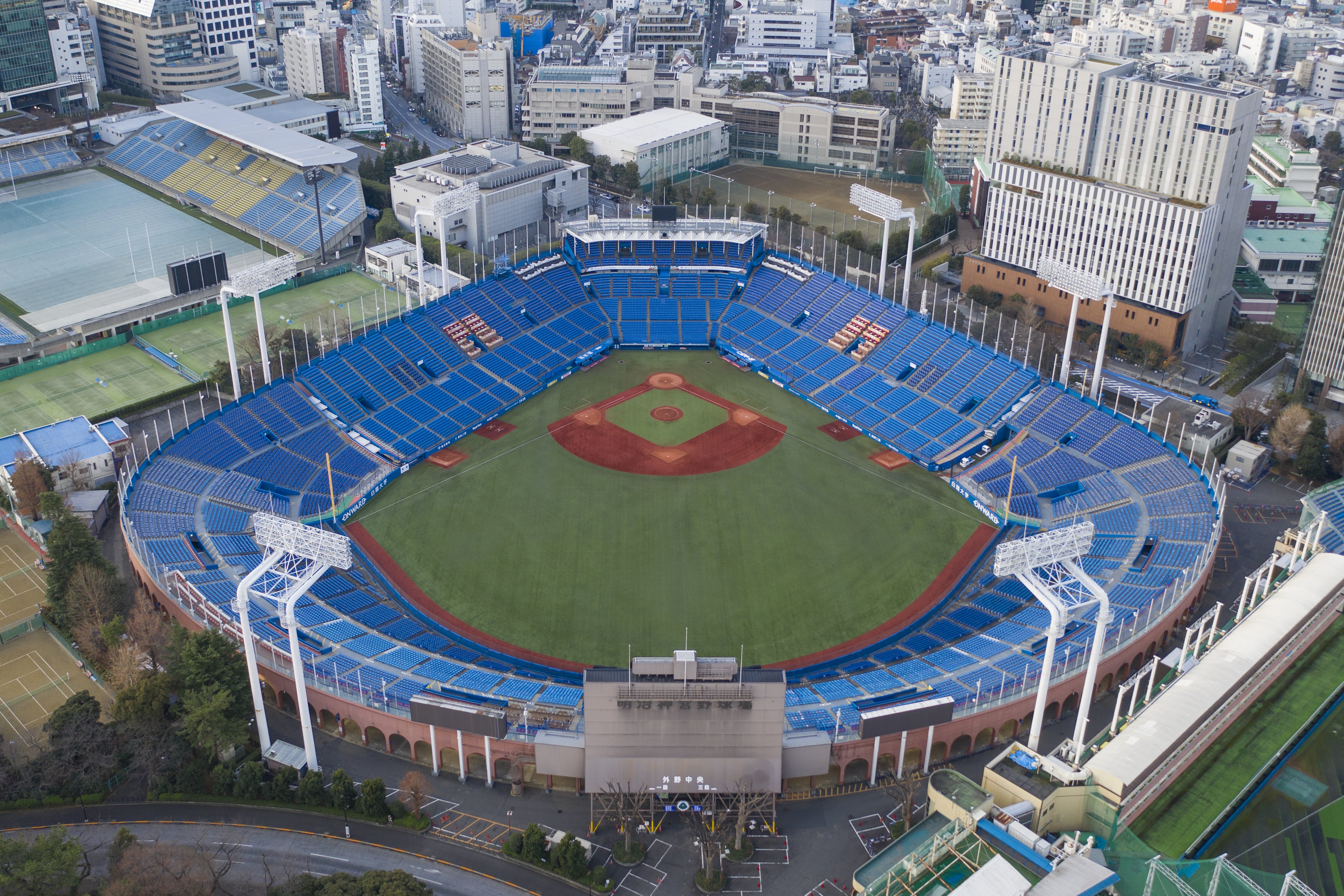
All games are played at Meiji Jingu Stadium in Kasumigaoka, Shinjuku in downtown Tokyo. Games are known to be rowdy and celebratory, with cheerleading squads and bands working themselves and the crowd into a frenzy.
It is also the origin of the Tokyo 6 Universities nickname that is given to the same six universities.
History
The league has its origins in the Waseda, Keio, and Meiji University League, a three-school conference that began play in 1914 (albeit irregularly). Waseda and Keio had held their first match in 1903. Hosei University joined the league as a guest in 1916 and officially in 1917; the "Four Universities League" expanded to admit Rikkyo in 1921 (becoming the "Five Universities League") and Tokyo in 1925. That year, the suspended Waseda-Keio series was revived for the first time in 19 years, leading to the foundation of the Six Universities League.
In 1926, with the cooperation of the federation, the Meiji Jingu Stadium was completed, and was later expanded to a capacity of 55,000 people in 1931. The Regents Cup was awarded for the fall league match. The league was suspended in 1943 due to World War II, but immediately after the end of the war, on October 28, 1945, a six-college alumni game was held, culminating in a game between Waseda and Keio University at Meiji Jingu on November 18.
Since the end of the US occupation of Japan in 1952, there have been no interruptions in conference play.
On April 1, 2013, the league registered as a general incorporated foundation, the Tokyo Six Universities Baseball Federation.
According to the league's website, 119 players and executives associated with Tokyo Big6 have been inducted into the Japanese Baseball Hall of Fame.
Schedule and rules
The six teams play short, eight-weekend seasons in the spring and autumn of each year. Each team plays a short series against each of the five other teams in the league. The series format is similar to a three-game playoff, where the first to two wins is given a series victory. Home field is alternated, and all games are played at Meiji Jingu Stadium. Should a team sweep the first two games, the third game is not played.
The champion of the league is determined by the team with the most series victories. The champion team is given the Emperor's Cup. This is unique in Japan in that the other Emperor's cups are given to national champions in other sports such as Emperor's Cup of Football. The spring champion is allowed to participate in the while the fall champion is allowed to compete in the .
The league uses rules that are similar to that of Nippon Professional Baseball's Central League (and, until recently, the MLB National League): the designated hitter rule is not used, and the pitcher is required to bat. Also, unlike American college baseball, non-wood bats are banned.
Members
| Institution | Location | Baseball team founded | Joined | All-time | ||||
|---|---|---|---|---|---|---|---|---|
| record | Titles | Last | ||||||
| title | Type | Colors | ||||||
| Hosei University | Chiyoda, Tokyo | 1915 | 1917 | 1234–912–132 | 46 | Spring | ||
| 2020 | Private | |||||||
| Keio University | Minato, Tokyo | 1892 | 1914 | 1271–884–105 | 40 | Autumn | ||
| 2023 | Private | |||||||
| Meiji University | Fuchū, Tokyo | 1910 | 1914 | 1302–867–117 | 43 | Spring | ||
| 2023 | Private | |||||||
| Rikkyo University | Toshima, Tokyo | 1909 | 1921 | 972–1180–108 | 13 | Spring | ||
| 2017 | Private | |||||||
| University of Tokyo | Bunkyo, Tokyo | 1917 | 1925 | 257–1728–63 | — | — | Public | |
| Waseda University | Shinjuku, Tokyo | 1901 | 1914 | 1339–804–97 | 49 | Spring | ||
| 2025 | Private |
Current as of spring 2025 File:Keio University ball team LCCN2014696186.jpg|Keio University (1914) File:Tokyo Imperial University Baseball Club players in 1925.jpg|University of Tokyo (1925) File:1930年秋の法政大学野球部(後列左端が藤田信男).jpg|Hosei University (1930) File:渡台した明大野球部(台南球場).jpg|Meiji University (1956) File:Rikkyo University-5.jpg|Rikkyo University (2017) File:Waseda University Baseball Club 201108b.jpg|Waseda University (2020)
Champions

Waseda University has the most league championships with 49. Hosei University has 46 titles, Meiji University has won 43 times and Keio University has captured 40 league titles. Rikkyo trails with 13, while the University of Tokyo has yet to win a championship.
| University | Number of championships |
|---|---|
| Waseda | 49 |
| Hosei | 46 |
| Meiji | 43 |
| Keio | 40 |
| Rikkyo | 13 |
| Tokyo | 0 |
Current as of spring 2025
Rivalry
Waseda vs. Keio: ''Sōkeisen''
.jpg)
The series between Waseda and Keio, Sōkeisen, attracts the most attention and is greatly enjoyed by the students, not least because it causes classes at both universities to be canceled. The game is still broadcast on NHK and it is the only series played during the last week of the season.
The Sōkeisen actually predates the establishment of the Tokyo Big6 League by over 20 years, beginning in 1903. The games often caused much tension between the two student bodies, often spilling out of the stadium and leading to the cancellation of games.
The addition of Meiji (1914), Hosei (1917) and Rikkyo (1921) would do little to remedy the rivalry. This state would continue until the addition of Tokyo Imperial University and the official establishment of the Tokyo Big6 Baseball League.
The name is a combination of the two university's names first kanji characters and the character for battle or match, sen. Sō, is the alternate reading of Wa in Waseda (also from the short name, Sōdai), while Kei is the first character of Keio.
Notable alumni
Hosei alumni
- Tadashi Wakabayashi (Hanshin Tigers → Mainichi Orions)
- Koichi Tabuchi (Hanshin Tigers → Seibu Lions)
- Koji Yamamoto (Hiroshima Toyo Carp)
- Suguru Egawa (Yomiuri Giants)
- Takehiko Kobayakawa (Hiroshima Toyo Carp → Yakult Swallows)
- Atsunori Inaba (Yakult Swallows → Hokkaido Nippon Ham Fighters)
Keio alumni
- Kaoru Betto (Hanshin Tigers / Ōsaka Tigers → Mainichi Orions)
- Motoshi Fujita (Yomiuri Giants)
- Yoshinobu Takahashi (Yomiuri Giants)
Meiji alumni
- Senichi Hoshino (Chunichi Dragons)
- Katsunori Nomura (Yakult Swallows → Hanshin Tigers → Yomiuri Giants → Tohoku Rakuten Golden Eagles)
- Kenshin Kawakami (Chunichi Dragons → Atlanta Braves)
Rikkyo alumni
- Shigeo Nagashima (Yomiuri Giants)
- Tadashi Sugiura (Nankai Hawks)
- Kazushige Nagashima (Yakult Swallows → Yomiuri Giants)
- Takeo Kawamura (Yokohama BayStars)
- Kazuhito Tadano (Cleveland Indians → Oakland Athletics)
Tokyo alumni
- Masatoshi Akihara (film director)
- Takeshi Shina (a member of the House of Representatives (Japan))
- Hirohisa Fujii (former Minister of Finance (Japan), a member of the House of Representatives (Japan))
- Kaoru Yosano (former Minister of Finance (Japan), a member of the House of Representatives (Japan))
Waseda alumni
-
Haruyasu Nakajima (Yomiuri Giants)
-
Tatsuro Hirooka (Yomiuri Giants)
-
Akinobu Okada (Hanshin Tigers → Orix BlueWave / Orix Buffaloes)
-
Hiroo Ishii (Kintetsu Buffaloes → Yomiuri Giants)
-
Satoru Komiyama (Lotte Orions / Chiba Lotte Marines → Yokohama BayStars → New York Mets)
-
Tsuyoshi Wada (Fukuoka Daiei Hawks / Fukuoka SoftBank Hawks → Norfolk Tides → Chicago Cubs)
-
Norichika Aoki (Tokyo Yakult Swallows → Milwaukee Brewers → Kansas City Royals)
-
Shugo Fujii (Tokyo Yakult Swallows)
-
Shinichi Takeuchi (Tokyo Yakult Swallows)
-
Hiroyasu Tanaka (Tokyo Yakult Swallows)
-
Takashi Toritani (Hanshin Tigers)
-
Daisuke Ochi (Yomiuri Giants)
-
Yuki Saito (Hokkaido Nippon Ham Fighters)
-
Yuki Saito (pitcher for Waseda University)--
Notes
References
- Tohto University Baseball League
- Kansai Big Six Baseball League
References
- "一般財団法人 東京六大学野球連盟". Tokyo Six Universities Baseball Federation.
- "一般財団法人 東京六大学野球連盟".
- "一般財団法人 東京六大学野球連盟".
- It is often reversed, 慶早戦, ''Keisōsen'', by the student body at Keio University.
- A victory no longer guarantees the cancellation of classes at Waseda University.
- (2007-06-03). "College baseball: Waseda wins Big 6 league".
- Though the university officially uses the name ''Rikkyo'' University, ''Rikkyo'' remains on the team's jerseys. This article uses ''Rikkyo'' accordingly.
- [http://betty.jp/tokyo6/ 東京六大学野球の面白さ]
- [http://www.baywell.ne.jp/users/drlatham/baseball/yakult/fans/cheers.htm The Yakult Swallows Home Plate]
This article was imported from Wikipedia and is available under the Creative Commons Attribution-ShareAlike 4.0 License. Content has been adapted to SurfDoc format. Original contributors can be found on the article history page.
Ask Mako anything about Tokyo Big6 Baseball League — get instant answers, deeper analysis, and related topics.
Research with MakoFree with your Surf account
Create a free account to save articles, ask Mako questions, and organize your research.
Sign up freeThis content may have been generated or modified by AI. CloudSurf Software LLC is not responsible for the accuracy, completeness, or reliability of AI-generated content. Always verify important information from primary sources.
Report