From Surf Wiki (app.surf) — the open knowledge base
Tobu Railway
Japanese railway company

Japanese railway company
| Field | Value | |
|---|---|---|
| name | Tobu Railway Co., Ltd. | |
| native_name | 東武鉄道株式会社 | |
| native_name_lang | ja | |
| romanized_name | Tōbu Tetsudō kabushiki gaisha | |
| logo | [[File:Tōbu Tetsudō Logo.svg | frameless]] |
| type | Public KK | |
| traded_as | ||
| industry | Rail-focused conglomerate | |
| foundation | ||
| location_city | 18-12 Oshiage 2-chome, Sumida-ku, Tokyo | |
| (Registered in Tokyo Skytree East Tower, 1-2 Oshiage 1-chome, Sumida-ku, Tokyo) | ||
| location_country | Japan | |
| location | Tobu-kan | |
| area_served | Tokyo, Saitama, Chiba, Gunma, Tochigi | |
| key_people | Nezu Kaichirō (former Representative Director) | |
| (Chairman) | ||
| Yutaka Tsuzuki (President) (Representative Director) | ||
| services | Passenger railway | |
| assets | ¥1.3 trillion | |
| owner | Investment trusts (JTSB 6.13%, TMTBJ 4.19%) | |
| Fukoku Life (2.47%) | ||
| SSBTC Treaty 505234 (2.26%) | ||
| Mizuho Bank (2.20%) | ||
| num_employees | 3,470 () | |
| subsid | Various, including the operating company of Tokyo Skytree, Tobu Bus, Asahi Motor | |
| homepage |
(Registered in Tokyo Skytree East Tower, 1-2 Oshiage 1-chome, Sumida-ku, Tokyo) (Chairman) Yutaka Tsuzuki (President) (Representative Director) Fukoku Life (2.47%) SSBTC Treaty 505234 (2.26%) Mizuho Bank (2.20%)
The Tobu Railway Company, Ltd. is a Japanese commuter railway and keiretsu holding company in the Greater Tokyo Area as well as an intercity and regional operator in the Kantō region. Excluding the Japan Railways Group companies, Tobu's 463.3 km rail system is the second longest in Japan after Kintetsu. It serves large portions of Saitama Prefecture, Gunma Prefecture and Tochigi Prefecture, as well as northern Tokyo and western Chiba Prefecture. The Tobu Railway Company is listed in the First Section of the Tokyo Stock Exchange and is a constituent of the Nikkei 225 index.
The Tobu corporate group is also engaged in road transportation (bus/taxi), real estate, and retail. It is the owner of the Tokyo Skytree, the third tallest tower in the world. The company is a member of the Fuyo Group keiretsu.
The name "Tobu" is formed from the kanji for east and Musashi, the initial area served.
History
Tobu is one of the oldest railway companies in Japan. It was established in November 1897 and began operation between Kita-Senju and Kuki in August 1899. The Tojo Railway was founded in 1911 as a separate company, but shared its president and head office with Tobu.

In 1905, Nezu Kaichirō became the president of Tobu Railway and successfully helped to grow the company to one of the largest private rail operators in the Kanto region.
In 1924, Tobu began operating its first electric train on the Isesaki Line between Asakusa (later Narihirabashi, today Tokyo Skytree Station) and Nishiarai.
Tobu was the first railway in the Kanto region to adopt quadruple tracks, on the Kita-Senju to Takenotsuka sector in 1974. The Tobu Dobutsu Koen (Tobu Animal Park) opened in 1981.
Railway network
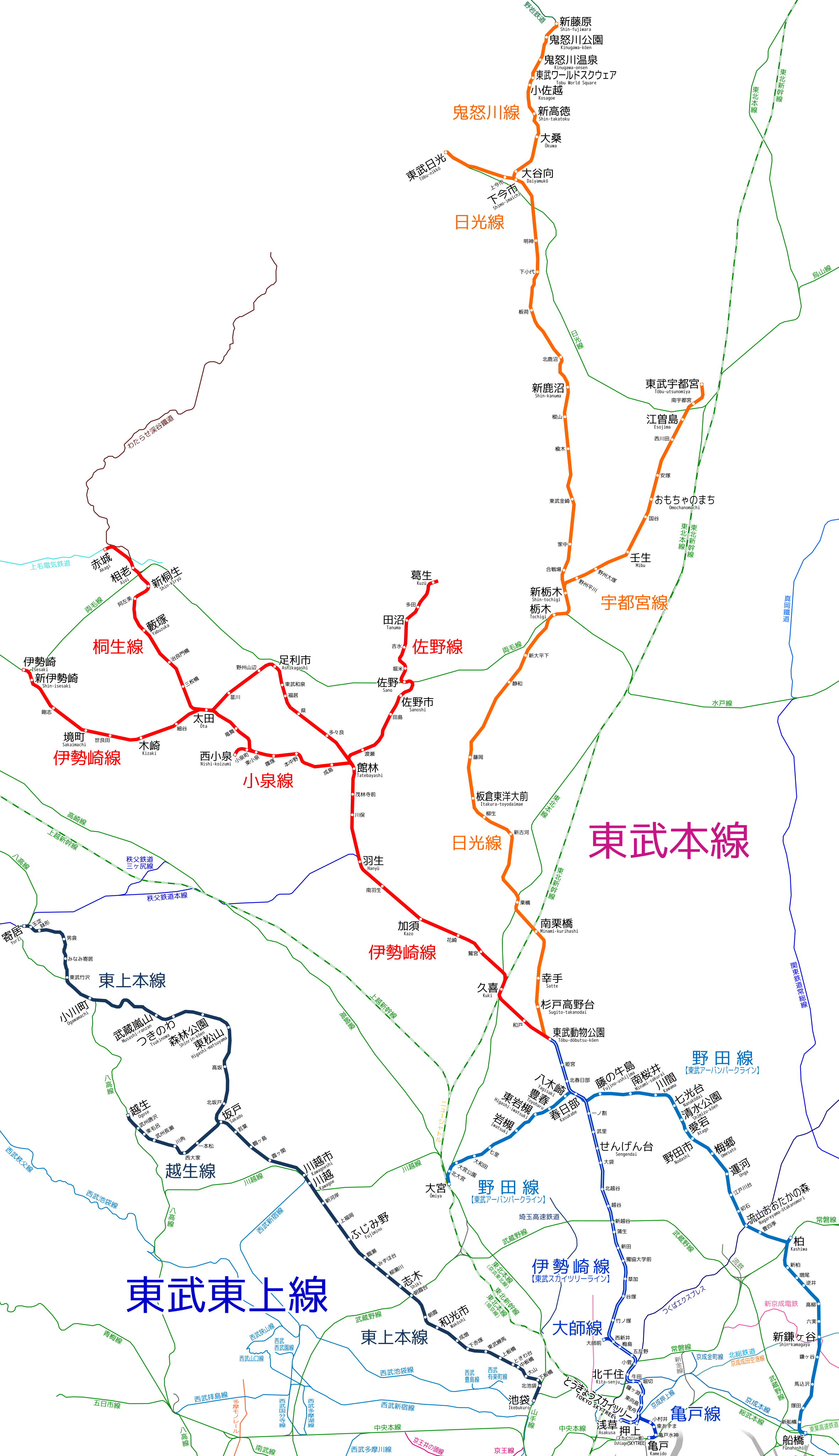
Tobu has two isolated networks which are connected by the Chichibu Railway for ferrying of its rolling stock.
The Tobu Main Line network has a tree topology starting at in Tokyo, with the Isesaki Line as the trunk, and the Tobu Kameido Line, Daishi Line, Tobu Urban Park Line, Tobu Sano Line, Koizumi Line, Tōbu Kiryū Line, and Nikkō Line forming the branches, with further branches into the Tobu Utsunomiya Line and Tobu Kinugawa Lines. It offers surcharged, seat-reserved limited express services from Tokyo to Nikkō and Kinugawa.
The Tojo Line runs northwest from in Tokyo to central and western Saitama Prefecture. A branch, the Ogose Line, runs to from .
Tobu's terminals in Tokyo are at (Main Line express services), (most other Main Line services) and (Tojo Line). The Skytree and Isesaki Lines interoperate with the Tokyo Metro Hibiya Line, Tokyo Metro Hanzomon Line and the Tokyu Den-en-toshi Line to serve central, southwestern Tokyo and Kanagawa Prefecture, while the Tojo Line interoperates with the Tokyo Metro Fukutoshin Line, Tokyo Metro Yurakucho Line, Tokyu Toyoko Line and Minatomirai Line to serve central and southwest Tokyo and Kanagawa Prefecture.
Main lines
| Name | Symbol | Stations | Length | |
|---|---|---|---|---|
| Skytree Line | [[File:Tobu Skytree Line (TS) symbol.svg | 20px]] | – | 41.0 km |
| Kameido Line | – | 3.4 km | ||
| Daishi Line | – | 1.0 km | ||
| Isesaki Line | [[File:Tobu Isesaki Line (TI) symbol.svg | 20px]] | – | 73.5 km |
| Sano Line | – | 22.1 km | ||
| Koizumi Line | – , – | 12.0 km | ||
| Kiryū Line | – | 20.3 km | ||
| Nikkō Line | [[File:Tobu Nikko Line (TN) symbol.svg | 20px]] | – | 94.5 km |
| Utsunomiya Line | – | 24.3 km | ||
| Kinugawa Line | – | 16.2 km | ||
| Urban Park Line (Formerly Noda Line) | [[File:Tobu Noda Line (TD) symbol.svg | 20px]] | – – | 62.7 km |
Tobu Tojo lines
| Name | Symbol | Stations | Length | |
|---|---|---|---|---|
| Tojo Line | [[File:Tobu Tojo Line (TJ) symbol.svg | 20px]] | – | 75.0 km |
| Ogose Line | – | 10.9 km |
Rolling stock
, Tobu Railway operates a fleet of 1,890 electric multiple unit (EMU) vehicles, the third largest fleet for a private railway operator in Japan after Tokyo Metro (2,728 vehicles) and Kintetsu (1,905).
Express EMUs
- 300/350 series EMU (introduced 1991, 300 series variant operated until 2017)
- 200/250 series EMU Ryōmō (introduced 1991)
- 100 series EMU Spacia (introduced 1990)
- 634 series EMU Skytree Train (introduced 2012)
- 500 series 3-car EMUs (introduced in April 2017)
- N100 series EMU Spacia X (introduced July 2023)
Eight new three-car 500 series EMU trains were introduced on limited express services on lines from Asakusa on 21 April 2017.
File:Tobu-Series100 orange.jpg|100 series File:Tobu railway 200kei.JPG|200 series File:Tobu Railway 350 Limited Express Kirifuri.jpg|350 series Kirifuri limited express File:Tobu Railway 634kei.JPG|634 series Skytree Train File:Tobu-Series500.jpg|A 500 series EMU in April 2017 File:Tobu_Series-N100-N101.jpg|N100 series Spacia X
Commuter EMUs
- 8000 series EMU (introduced 1963)
- 800/850 series EMU
- 9000 series EMU (introduced 1981)
- 10000 series EMU (introduced 1983)
- 20000 series EMU (introduced 1988)
- 30000 series EMU (introduced 1996)
- 50000 series EMU (introduced 2005)
- 60000 series EMU (introduced June 2013)
- 70000 series EMU (since 7 July 2017)
- 80000 series EMU (since 8 March 2025)
- 90000 series (Future)
File:TOBURAILWAY SERIES8000 8126・8549F(Tc8649) NODALINE 01.jpg|8000 series File:Tobu-Tojo-Line-Series9101F.jpg|9000 series File:Tobu-Series10000_11003.jpg|10000 series File:Tobu-Type20400-21444.jpg|20000 series File:Tobu-Series30000_31604.jpg|30000 series File:Tobu-Tojo-Line-Series51009F.jpg|50000 series File:Tobu-Series60000-61606F.jpg|60000 series File:Tobu-Series70000-71701.jpg|70000 series
Steam locomotive
Tobu plans to operate steam-hauled tourist services on the Kinugawa Line from 10 August 2017 using JNR Class C11 steam locomotive C11 207 loaned from JR Hokkaido together with JNR Class DE10 diesel locomotive DE10 1099 purchased from JR East, a fleet of six 12 and 14 series coaches purchased from JR Shikoku, and two Yo 8000 brake vans purchased from JR Freight and JR East.
Withdrawn types
Express EMUs
- 1700/1720 series
- 1800 series
- 5700 series
- 6000 series
- 6050 series File:Tobu DRC kinu.jpg|1720 series File:Tobu 5700 genjin train nishiarai.jpg|5700 series File:Tobu EC 6000 at Asakusa Sta2.jpg|6000 series File:Tobu-Nikko-Line-Series6050-6172.jpg|6050 series
Commuter EMUs
- 2000 series
- 3000 series
- 5000 series (1979–2006)
- 7300 series
- 7800 series
File:Tobu 2000 2409 nishiarai.jpg|2000 series File:Tobu 3070 3574 Nikko Line 19930504.jpg|3000 series File:Tobu 5050 5157 Tochigi 20060606.JPG|5000 series File:Tobu 7300 Isesaki Line 1977.jpg|7300 series File:Tobu 7800 Hikifune Station.jpg|7800 series
DMUs
- KiHa 2000 series
File:Tobu-railway-Kiha2002-20110818.jpg|Preserved KiHa 2000 series DMU
Steam locomotives
- Tobu B1 Class 4-4-0 (1898)
File:Tobu-No5SteamLocomotive-a.jpg|Preserved Tobu Railway B1 Class 4-4-0
References
References
- "Board of Directors and the Statutory Auditors (As of July 1, 2023)".
- "Message from the President".
- "明治28年~45年". Tobu Railway.
- "Portraits of Modern Japanese Historical Figures".
- "1961年~1980年 {{!}} 会社の沿革 {{!}} 東武鉄道ポータルサイト".
- "昭和41年~63年". Tobu Railway.
- Kotsu Shimbunsha. (25 July 2016). link
- link. (18 January 2017). Tobu Railway
- link. (8 July 2017). Koyusha Co., Ltd.
- link. (18 January 2017). Tobu Railway
This article was imported from Wikipedia and is available under the Creative Commons Attribution-ShareAlike 4.0 License. Content has been adapted to SurfDoc format. Original contributors can be found on the article history page.
Ask Mako anything about Tobu Railway — get instant answers, deeper analysis, and related topics.
Research with MakoFree with your Surf account
Create a free account to save articles, ask Mako questions, and organize your research.
Sign up freeThis content may have been generated or modified by AI. CloudSurf Software LLC is not responsible for the accuracy, completeness, or reliability of AI-generated content. Always verify important information from primary sources.
Report