From Surf Wiki (app.surf) — the open knowledge base
Tire code
Alphanumeric code specifying tire sizes and limits

Alphanumeric code specifying tire sizes and limits
Tires designed for use in snowy conditions display the appropriate lettering and marks to indicate its use for "(Mud and) Snow", "Severe Snow" (3PMSF), "Ice Conditions" (IGS) along with preceding and prerequisite indicators. Studded tires are similar, with pictograms incorporating the Cyrillic letter "Sha" (Ш), the first letter in the Russian word for studs (Шипы), being standardized in 2022.
DOT code
The DOT code can be found immediately after the letters "DOT" on a tire sidewall.
It is useful in identifying tires subject to product recall or at end of life due to age. It is mandated by the U.S. Department of Transportation but is used worldwide.
The first three characters indicate the manufacturing plant and are assigned by the NHTSA (tires made before 2015 had only two characters).
Following the manufacturer's plant code, the next two digits within a DOT code signify the tire size. For instance, the size code "WC" might correspond to the tire size 205/55 R16. However, these size codes aren't standardized. Each tire manufacturer may assign these codes as they see fit, provided they maintain a consistent and explainable system within their coding.
After the size code, the next sequence in a DOT number consists of three or four digits that designate the tire type. This coding, though optional, is widely used by tire manufacturers for internal tracking purposes, such as managing returns and quality control. The decision on how exactly to code the tire type lies with each manufacturer, leading to a variety of coding systems across the industry.
The last four numbers of the DOT marking on tires tell you the week (1 through 53, according to ISO 8601) and year the tire was made. So, a tire with the last four digits of 0121 was made the first week of January 2021, 0221 is second week of January of 2021, and so on.
E-mark
Top - according to UN regulations, Bottom - according to EU regulations or directives.]] All tires sold for road use in Europe after July 1997 must carry an E-mark.
Items type-approved according to a UN Regulation are marked with an E and the country's Distinguishing Number, within a circle. A capital (E) in a circle indicates compliance with UN regulation 30, while a lower case [e] in a box indicates compliance with a EU directive (e.g. issued by EC, EU). This number indicates which country approved the item, and other surrounding letters and digits indicate the precise version of the regulation met and the type approval number, respectively. A (lower case) "e" indicates that the tire is certified to comply with the dimensional, performance and marking requirements of Directive 92/23/EEC.
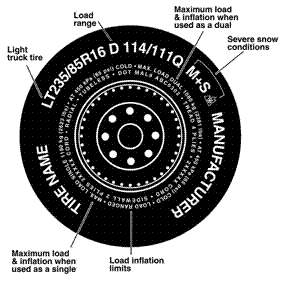
Light truck (LT) tire codes
Light truck (LT) sizes
Flotation tires keep vehicle tires floating above loosely packed dirt, minimizing soil disturbance in agricultural environments and maximizing vehicle stability on unpaved surfaces in construction environments.
Light truck tires are indicated by the letters LT at the end instead of the beginning of the sequence, as follows:
- The tire diameter is given for High Flotation tires and omitted from Numeric tires.
- 2-digit number: The diameter of the tire in inches.
- x: Separator character.
- 3- or 4-digit number: The section width (cross-section) of the tire in inches. If the tire diameter is not given, section widths ending in zero (e.g., 7.00 or 10.50) indicate the aspect ratio of 92%, while section widths not ending in zero (e.g., 7.05 or 10.55) indicate the aspect ratio of 82%. These aspect ratios often vary from today's tire manufacturer specification.
- Construction of the fabric of the tire:
- B: bias belt
- D: diagonal
- R: radial
- 2-digit number: Diameter in inches of the rim that this tire is designed to fit.
- LT: Designates that this is a light truck tire.
- Load index and speed rating are sometimes not mandatory for flotation sizes, but must be for any tire approved for street and highway use.
- 2- or 3-digit number: Load index; see table below.
- 1- or 2-digit/letter combination: Speed rating; see table below.
- Additional marks: see subheading below. As an example, if a tire size has two sets of numbers (6-12, 5.00-15, 11.2-24), then the first number (5.00-15) is the approximate width in inches, and the second number (5.00-15) is the rim diameter in inches.
If a tire size has three sets of numbers (15x6.00-6, 26x12.00-12, 31x15.50-15), then the first number (26x12.00-12) is the approximate tire diameter in inches, the second number (26x12.00-12) is the approximate width in inches, and the third number (26x12.00-12) is the rim diameter in inches.{{cite web | access-date=2013-06-27
Load range
The load range letter on light-truck tires indicates their ply rating.
| Load range | Ply rating |
|---|---|
| A | 2 |
| B | 4 |
| C | 6 |
| D | 8 |
| E | 10 |
| F | 12 |
| G | 14 |
| H | 16 |
| J | 18 |
| L | 20 |
| M | 22 |
| N | 24 |
Wheel/rim widths
To determine the allowable range of rim widths for a specific tire size, the TRA Yearbook or the manufacturer's guide should always be consulted for that specific tirethere is no rule of thumb. Running a tire on a rim size or type not approved by its manufacturer can result in tire failure and a loss of vehicle control.
Additional marks
There are numerous other markings on a typical tire, these may include:
- "*": BMW-Mini original manufacturer fitment
- 030908: Approval number of the tire
- "100T": Commonly appears after tire size. Meaning: standard load inflation table (100) & speed rating (T)
- 3PMSF: or Three Peak Mountain Snow Flake, for tires rated for "severe snow"
- 3PMSF with Ш ("Sha"): or Three Peak Mountain Snow Flake, for studded tires rated for "severe snow" with the addition of the Cyrillic letter "Sha" (Ш), the first letter in the Russian word for studs or spikes (Шипы)
- AMx: Aston Martin OE Fitments
- "AO": Audi original manufacturer fitment
- Arrows: Some tread designs are "directional", and designed to perform better when driven in a specific direction. Such tires will have an arrow showing which way the tire should rotate when the vehicle is moving forwards.
- A/T or AT: All Terrain; Designed for all conditions on and off road, master of none
- B: Bias belted; tires for motorcycles (Example: 150/70 B 17 69 H)diagonal construction with belt added under the tread
- BSB: Broken serrated band
- BSL: Black serrated letters
- BSW: Black sidewall
- E4: Tire approved according to the ECE-regulations, the number indicating the country of approval.
- "ELT": Pirelli Elect tyres, specific for electric car
- IGS: or Ice Grip Symbol, for tires rated for "ice conditions"
- "J": Jaguar original manufacturer fitment
- LL: Light load; tires for light usage and loads
- "M/C": Only for motorcycle fitment
- M+S, or M&S: Mud and snow; A tire that meets the Rubber Manufacturers Association (RMA) and Rubber Association of Canada (RAC) all-season tire definition. These are commonly found on all-season tires, with self-cleaning tread and average traction in muddy or very snowy conditions, and for low temperatures.
- M+SE: M+S tire with an additional "E" for extreme
- M+T or M&T: Mud and terrain; Designed to perform in mud or on other terrain that requires additional traction such as on rocks, in deeper snow, and in loose gravel.
- M/T or MT: Mud Terrain; Designed for deep mud and rock crawl
- Made in ...: Country of production
- MGT: Maserati Genuine Tire. Original tires for Maserati
- MO: Original tires for Mercedes-Benz
- MOE: Mercedes-Benz Original Extended mobility (sometimes incorrectly referred to as a Run-flat tire)
- N-x: Original tires for Porsche where "x" is a "0" for the first approved in that size, "1" the second, ...
- "NHS": Not highway service
- ORWL: Outlined raised white lettering
- OWL: Outlined white lettering
- RF: Reinforcedfor Euro-metric tires, the term 'reinforced' means the same thing as 'extra load'
- RFT: Run-flat tire; Tires designed for vehicles without spare tires. Reinforced sidewalls allow the tire to be driven "flat" for a distance specified by the manufacturer (usually 50 miles)
- RSC (inside a circle): BMW runflat system component
- RWL: Raised white lettering [[File:Examples of different tire sidewall markings.png|upright=2.5|thumb|Examples of different tire sidewall markings]]
- SFI, or Inner: side facing inward; inside of asymmetric tires
- SFO, or Outer: side facing outward; outside of asymmetric tires
- SL: Standard load; tire for normal usage and loads
- Star: Original tires for BMW
- TL: Tubeless
- TPC: General Motors OE fitments
- TT: Tube-type, tire must be used with an inner-tube
- TWI: Tread wear indicator – a device, such as a triangle or a small Michelin Man icon, located where the tread meets the sidewall, and indicating the location of the raised wear bars in the tire tread channels – TWI is also used to refer to the raised wear bars themselves.
- VSB: Vertical serrated band
- WSW: White sidewall
- XL: extra load; a tire that allows a higher inflation pressure than a standard load tire, which increases the tire's maximum load
- ZP: zero-pressure; Michelin's branding for their run-flat models.
- To facilitate proper balancing, most tire manufacturers also mark red circles (uniformity) and/or yellow dots (weight) on the sidewalls of their tires to enable the best possible match-mounting of the tire/wheel assembly.
Tire geometry
When referring to the purely geometrical data, a shortened form of the full notation is used. To take a common example, 195/55R16 would mean that the nominal width of the tire is approximately 195 mm at the widest point, the height of the side-wall of the tire is 55% of the width (107 mm in this example) and that the tire fits 16 in rims. The code gives a direct calculation of the theoretical diameter of the tire. For a size shown as "T/A_W" use (2×T×A/100) + (W×25.4) for a result in millimeters or (T*A/1270)+ W for a result in inches. Take the common example used above; (2×195×55/100)+(16×25.4) = 621 mm or (195×55/1270)+16 = 24.44 inches.
Less commonly used in the US and Europe (but often in Japan for example) is a notation that indicates the full tire diameter instead of the aspect ratio of the side-wall height. To take the same example, a 16-inch rim would have a diameter of 406 mm. Adding twice the tire height (2×107 mm) makes a total 620 mm tire diameter. Hence, a 195/55R16 tire might alternatively be labelled 195/620R16.
Whilst this is theoretically ambiguous, in practice these two notations may easily be distinguished because the height of the side-wall of an automotive tire is typically much less than the width. Hence when the height is expressed as a percentage of the width, it is almost always less than 100% (and certainly less than 200%). Conversely, vehicle tire diameters are always larger than 200 mm. Therefore, if the second number is more than 200, then it is almost certain the Japanese notation is being usedif it is less than 200 then the U.S./European notation is being used.
The diameters referred to above are the theoretical diameter of the tire. The actual diameter of a specific tire size can only be found in the TRA Yearbook or the manufacturer's data books. Note that the tire's cross-section and diameter are always specified when measured on a rim of a specified width; different widths will yield different tire dimensions.
Examples
The tires on a BMW Mini Cooper might be labeled: P195/55R16 85H
- P – these tires are for a passenger vehicle. However 'P' denotes P metric size load and speed rating changes for P tire & non-P tires
- 195 – the nominal width of the tire is approximately 195 mm at the widest point
- 55 – indicates that the height of the sidewall of the tire is 55% of the width (107 mm)
- R – this is a radial tire
- 16 – this tire fits 16 in rims
- 85 – the load index, a maximum of 515 kg per tire in this case
- H – the speed index, this means the maximum permitted speed, here 210 km/h (130 mph)
The tires on a Hummer H1 might be labeled: 37X12.5R17LT
- 37 – the tire is 37 in in diameter
- 12.5 – the tire has a cross section of 12.5 in
- R – this is a radial tire
- 17 – this tire fits 17 in rims
- LT – this is a light truck tire
Historical tire codes
North America
Prior to 1964, tires were all made to a 90% aspect ratio. Tire size was specified as the tire width in inches and the diameter in inches – for example, 6.50-15.
From 1965 to the early 1970s, tires were made to an 80% aspect ratio. Tire size was again specified by width in inches and diameter in inches. To differentiate from the earlier 90-ratio tires, the decimal point is usually omitted from the width – for example, 685-15 for a tire 6.85 inches wide.
Starting in 1972 tires were specified by load rating, using a letter code. In practice, a higher load rating tire was also a wider tire. In this system a tire had a letter, optionally followed by "R" for radial tires, followed by the aspect ratio, a dash and the diameter – C78-15 or CR78-15 for bias and radial, respectively. Each diameter of rim had a separate sequence of load ratings; thus, a C78-14 and a C78-15 are not the same width. An aspect ratio of 78% was typical for letter-sized tires, although 70% was also common and lower profiles down to 50% were occasionally seen.
References
References
- [http://www.us-tra.org/traAbout.html Scope of the Association and Some of its History] {{webarchive. link. (2010-03-03, The Tire and Rim Association. Retrieved 2010-01-04.)
- [http://www.dunloptires.com/care/tech.html Care and Maintenance - Technical] {{webarchive. link. (2010-01-15, Dunlop Tires. Retrieved 2010-01-05.)
- [http://www.nhtsa.dot.gov/staticfiles/DOT/NHTSA/Vehicle%20Safety/Test%20Procedures/Associated%20Files/TP120-03.pdf Laboratory Test Procedure for FMVSS 120] {{webarchive. link. (2009-07-02, National Highway Traffic and Safety Administration, United States Department of Transportation, April 10, 2000. Retrieved 2010-01-05.)
- [http://www.canlii.org/en/ca/laws/regu/sor-95-148/latest/sor-95-148.html Motor Vehicle Tire Safety Regulations SOR 95-148], Canadian Legal Information Institute. Retrieved 2010-01-05.
- "ISO - 83.160.10 - Road vehicle tyres".
- Malinverni, Pier Giovanni. "More than 50 years of standardisation".
- [http://www.drtheo.nl/CX/TRX-history.htm A brief history of radial tires and the offbeat TRX system], Michelin TRX, Dr. Theo Netherlands. Retrieved 2010-01-05.
- Similarly, whilst most bicycle wheels have a diameter measured in inches, the 700mm wheel (=27.56") is increasingly common.
- "All Tire Pressures, Models, Tire Types and more".
- "Load Index Chart".
- "What is Tire Load Index? View Tire Load Index Chart {{!}} Wheel Works".
- "Tire Load Index".
- Tyres, Watling. (2019-04-01). "Understanding the Tyre Load Index » Watling Tyres Autocentre".
- "Load Speed Index of OTR Tires: Capacity & Speed Guide".
- "Council Directive 92/23/EEC of 31 March 1992 relating to tyres for motor vehicles and their trailers and to their fitting". THE COUNCIL OF THE EUROPEAN COMMUNITIES.
- (September 16, 2014). "How to calculate speed ratings". Auto Motor Öl.
- "What is the Tire Date Code?".
- "Goodyear Tire Recall - Goodyear Tires".
- [https://www.law.cornell.edu/cfr/text/49/574.5 "49 CFR 574.5 - Tire identification requirements."].
- (March 8, 2016). "Dept. of Transportation issues new DOT codes".
- (January 11, 2021). "Complete List of Tire DOT Codes by Manufacturer".
- "AGREEMENT CONCERNING THE ADOPTION OF UNIFORM TECHNICAL PRESCRIPTIONS FOR WHEELED VEHICLES, EQUIPMENT AND PARTS WHICH CAN BE FITTED AND/OR BE USED ON WHEELED VEHICLES AND THE CONDITIONS FOR RECIPROCAL RECOGNITION OF APPROVALS GRANTED ON THE BASIS OF THESE PRESCRIPTIONS Addendum 6: Regulation No. 7 Revision 5".
- "What are E (or e) markings on a tyre".
- "Guide to E-Mark Certification".
- Jazar, Reza N.. (2013-11-19). "Vehicle Dynamics: Theory and Application". Springer Science & Business Media.
- "2010 Year Book", The Tire and Rim Association, Inc., Preface p XVII
- "Bridgestone Product Reference Guide", The Bridgestone Tire & Rubber Co.
- "Bridgestone Product Reference Guide", The Bridgestone Tire & Rubber Co., Core Tire Knowledge: Glossary
- (11 January 2022). "What Do the Numbers and Letters on Your Tire's Sidewall Mean?".
- "MERCEDES-BENZ ORIGINAL EXTENDED TIRES". Tire Rack.
- "Tire care – Match mounting". Yokohama Tire Corporation.
- "2010 Year Book", The Tire and Rim Association, Inc.
- "Vintage Tire Size Conversion Chart".
- "Tire Size Conversion Chart".
This article was imported from Wikipedia and is available under the Creative Commons Attribution-ShareAlike 4.0 License. Content has been adapted to SurfDoc format. Original contributors can be found on the article history page.
Ask Mako anything about Tire code — get instant answers, deeper analysis, and related topics.
Research with MakoFree with your Surf account
Create a free account to save articles, ask Mako questions, and organize your research.
Sign up freeThis content may have been generated or modified by AI. CloudSurf Software LLC is not responsible for the accuracy, completeness, or reliability of AI-generated content. Always verify important information from primary sources.
Report