From Surf Wiki (app.surf) — the open knowledge base
Tinsel print
Type of print
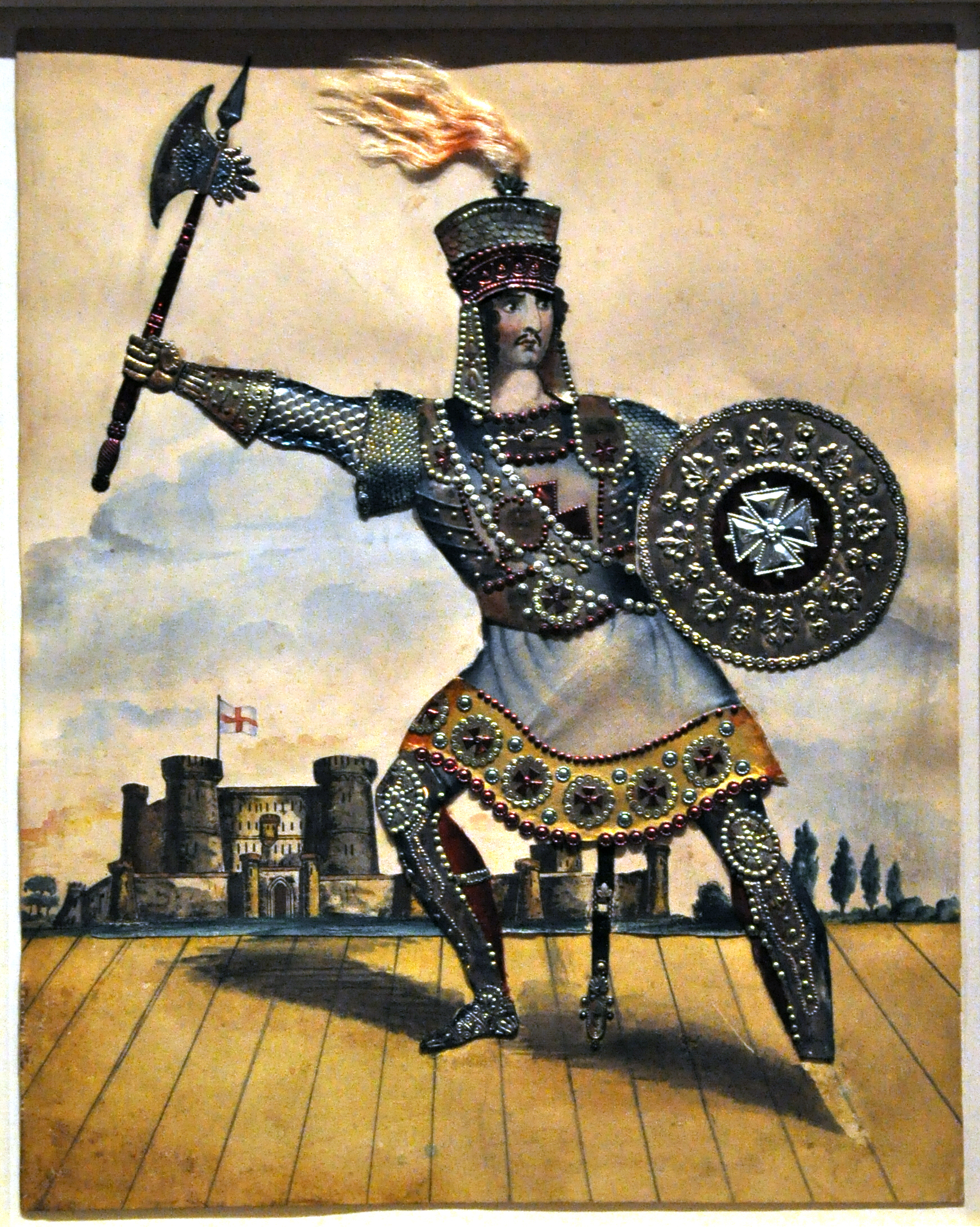
Type of print
A ** tinsel print ** is a print where tinsel is added after printing, for decorative effect, it is made in two ways.
The first is a rare type of old master print parts of which are decorated with small thin shiny fragments of metal or quartz crystal applied to glue. Gold leaf fragments were used on some, and colour was applied before the tinsel. Arthur Mayger Hind cites fewer than ten examples as being "practically all whose location is known... all seem to date between about 1430 and 1460". All are religious woodcuts, and probably German in origin, perhaps from Augsburg. They intended to imitate fabric, which was also the intention of the related "flock prints", printed in glue on paper that had been impressed on fabrics, and then sprinkled with chopped wool.
The second type are popular prints, mainly British, produced in the early or mid-19th century, normally showing actors in their roles, though Napoleon I in his study was another subject. These were sold in plain or hand-coloured and tinselled versions, and the plain versions were often tinselled at home. Tin-foil tinsel in different colours, mostly in pre-stamped shapes, was applied with glue. The theatrical prints cost one penny plain, and two coloured, with a standard size of about 12 by 10 inches (250 x 200 mm). Actors, whether heroes or villains, were more often represented than actresses. The artists are not named but the prolific political cartoonist and illustrator George Cruikshank is suspected of being involved.
Many prints also used fabric pieces and other additions (such as the plume of Mr Haines' helmet above). Prints with fabric are called "dressed prints"; this seems to have begun in 18th-century France as a hobby, mainly on devotional images. The same technique became popular for the smaller cut-out figures used in toy theatres, a craze of the period. A wide range of supplies for home-tinselling were available, or pre-tinselled figures could be bought.
Tinsel printing can also refer to Indian techniques for fabric.
Collections
Though popular in their day, theatrical tinsel prints were often not valued, and can deteriorate if not well looked after. They are now rare, especially in good condition. There are collections in the Victoria and Albert Museum in London, the Cooper–Hewitt, Smithsonian Design Museum in New York, and the Folger Shakespeare Library was given a collection of 53 examples in 2003.
File:Skelt, Martin and Matthew - theatrical tinsel portrait - Madame Vestris as Apollo - Google Art Project.jpg|Madame Vestris as Apollo, English, 1837-40. Published by Skelt, Martin and Matthew File:Tinsel Picture, Charles Kemble as the Prince of Wales, 1821 (CH 18205227).jpg|Charles Kemble as the Prince of Wales, 1821. There is limited tinsel, but much glued-on fabric. Inscribed "West's theatrical Portraits / no. 55". File:Tinsel Picture, Mr. Elsgood as Quicksand, 1859 (CH 18205233).jpg|"Mr. Elsgood as Quicksand in The Silver Palace", dated 1859 File:Print, "Tinsel Picture"- Napoleo, ca. 1860 (CH 18441913).jpg|Napoleon I and his family, "hand-colored lithograph, with applied, machine-cut, embossed gold paper, shredded mica and pailettes", on paper, c. 1860, English. The tinsel additions are limited to jewellery etc, and the frame. File:Print, "Tinsel Picture"- Napoleon in His Study, ca. 1860 (CH 18441909).jpg|Napoleon in His Study, c. 1860, matching previous
Notes
References
- Areford, Davis S., The Viewer and the Printed Image in Late Medieval Europe, pp. 60–66 (using google books page refs), Routledge, 2017, , 9781351539678, google books
- "Grove": "Flock and tinsel prints", The Grove Encyclopedia of Materials and Techniques in Art, ed. Gerald W. R. Ward, 2008, Oxford University Press, , 9780195313918
- Rickards, Maurice, The Encyclopedia of Ephemera: A Guide to the Fragmentary Documents of Everyday Life for the Collector, Curator, and Historian, 2000, Psychology Press, 2000, , 9780415926485, google books
References
- An Introduction to a History of Woodcut, Arthur M. Hind, pp171-2, Houghton Mifflin Co. 1935 (in USA), reprinted Dover Publications, 1963 {{ISBN. 0-486-20952-0; Grove
- Areford
- Grove; Areford
- "Grove"
- Rickards, 328
- [http://collections.vam.ac.uk/search/?offset=150&limit=15&narrow=1&extrasearch=&q=tinsel+print&commit=Search&quality=0&objectnamesearch=&placesearch=&after=&before=&namesearch=&materialsearch=&mnsearch=&locationsearch= with over 100, and plain versions]
- DeStefano, Rhea, [https://collation.folger.edu/2012/04/rehousing-our-tinsel-print-collection/ "Rehousing our tinsel print collection"], April 16, 2012, Folger Shakespeare Library
This article was imported from Wikipedia and is available under the Creative Commons Attribution-ShareAlike 4.0 License. Content has been adapted to SurfDoc format. Original contributors can be found on the article history page.
Ask Mako anything about Tinsel print — get instant answers, deeper analysis, and related topics.
Research with MakoFree with your Surf account
Create a free account to save articles, ask Mako questions, and organize your research.
Sign up freeThis content may have been generated or modified by AI. CloudSurf Software LLC is not responsible for the accuracy, completeness, or reliability of AI-generated content. Always verify important information from primary sources.
Report