From Surf Wiki (app.surf) — the open knowledge base
Timeline of historic inventions
none

none
The timeline of historic inventions is a chronological list of particularly significant technological inventions and their inventors, where known. This page lists non-incremental inventions that are widely recognized by reliable sources as having had a direct impact on the course of history that was profound, global, and enduring. The dates in this article make frequent use of the units mya and kya, which refer to millions and thousands of years ago, respectively.
Paleolithic
The dates listed in this section refer to the earliest evidence of an invention found and dated by archaeologists (or in a few cases, suggested by indirect evidence). Dates are often approximate and change as more research is done, reported and seen. Older examples of any given technology are often found. The locations listed are for the site where the earliest solid evidence has been found, but especially for the earlier inventions, there is little certainty how close that may be to where the invention took place.
Lower Paleolithic
The Lower Paleolithic period lasted over 3 million years, during which there many human-like species evolved including toward the end of this period, Homo sapiens. The original divergence between humans and chimpanzees occurred 13 (Mya), however interbreeding continued until as recently as 4 Mya, with the first species clearly belonging to the human (and not chimpanzee) lineage being Australopithecus anamensis. Some species are controversial among paleoanthropologists, who disagree whether they are species on their own or not. Here Homo ergaster is included under Homo erectus, while Homo rhodesiensis is included under Homo heidelbergensis.
During this period the Quaternary glaciation began (about 2.58 million years ago), and continues to today. It has been an ice age, with cycles of 40–100,000 years alternating between long, cold, more glaciated periods, and shorter warmer periods – interglacial episodes.
- 3.3 Mya – 2.6 Mya: Stone tools - found in modern-day Kenya are older and only found on the archetype road. Ancient stone tools from Ethiopia (Oldowan) were hand-crafted by Australopithecus or related people.
- 2.3 Mya: Earliest likely control of fire and cooking, by Homo habilis
- 1.76 Mya: Advanced (Acheulean) stone tools in Kenya by Homo erectus
- 1.75 Mya – 150 kya: Varying estimates for the origin of language
- 1.5 Mya: Bone tools in Africa by Homo erectus and/or Paranthropus boisei
- 900 kya – 40 kya: Boats{{cite web | access-date = 28 October 2011
- 500 kya: Hafting in South Africa by Homo heidelbergensis
- 500 kya – 450 kya: Woodworking construction in Zambia by Homo heidelbergensis (The oldest known surviving buildings are made from stone and date back no more than 9,500 years.)
- 420 – 200 kya: Food storage in the form of uncracked bones saved for their marrow in Qesem cave, Israel.
- 400 kya: Hide and leather clothing, footwear and shelter.
- 400 kya: Pigments in Zambia by Homo heidelbergensis
- 337 kya – 300 kya: Schöningen Spears in Germany likely by Homo heidelbergensis or early Neandarthals.
- 320 kya: The trade and long-distance (up to 50 miles) transportation of resources (e.g. obsidian), use of pigments, and possible making of projectile points in Kenya
Middle Paleolithic
The evolution of early modern humans around 300 kya coincides with the start of the Middle Paleolithic period. During this 250,000-year period, our related archaic humans such as Neanderthals and Denisovans began to spread out of Africa, joined later by Homo sapiens. Over the course of the period we see evidence of increasingly long-distance trade, religious rites, and other behavior associated with Behavioral modernity.
- 279 kya: Hafting and early stone-tipped projectile weapons in Ethiopia
- 200 kya: Simple glue (adhesive) made of one kind of material, birch tar, in Central Italy by Neanderthals.
- 200 kya: Beds in South Africa.
- 170 kya – 90 kya: Clothing, among anatomically modern humans in Africa. Genetic evidence from body lice suggests a range of dates centering over 100 thousand years ago. The first bone scrapers appropriate for scraping hides to make supple leather were found in Morocco dating to 90–120,000 years ago.
- 164 kya – 47 kya: Heat treating of stone blades in South Africa.
- 135 kya – 100 kya: Beads in Israel and Algeria — implying string or thread
- 100 kya: Ochre processed, and compound paints made in South Africa
- 100 kya: Funerals (in the form of burial) in Israel
- 90 kya: Harpoons in the Democratic Republic of the Congo.
- 70 kya – 60 kya in Sibudu Cave in South Africa by Homo sapiens:
- Compound adhesives
- Arrows and other evidence of bow-and-arrow technology
- Sewing needle (implying thread of some kind)
- 61 kya – 62 kya: Cave painting in Spain by Neanderthal "we present dating results for three sites in Spain that show that cave art emerged in Iberia substantially earlier than previously thought. Uranium-thorium (U-Th) dates on carbonate crusts overlying paintings provide minimum ages for a red linear motif in La Pasiega (Cantabria), a hand stencil in Maltravieso (Extremadura), and red-painted speleothems in Ardales (Andalucía). Collectively, these results show that cave art in Iberia is older than 64.8 thousand years (ka). This cave art is the earliest dated so far and predates, by at least 20 ka, the arrival of modern humans in Europe, which implies Neandertal authorship."
- 55.8–51.2 kya: Representational and Narrative art in Indonesia by Homo sapiens
Upper Paleolithic to Early Mesolithic
50 kya was long regarded as the beginning of behavioral modernity, which defined the Upper Paleolithic period. The Upper Paleolithic lasted nearly 40,000 years, while research continues to push the beginnings of behavioral modernity earlier into the Middle Paleolithic. Behavioral modernity is characterized by the widespread observation of religious rites, artistic expression and the appearance of tools made for purely intellectual or artistic pursuits.
- 49 kya – 30 kya: Ground stone tools – fragments of an axe in Australia date to 49–45 ka, more appear in Japan closer to 30 ka, and elsewhere closer to the Neolithic.
- 47 kya: The oldest-known mines in the world are from Eswatini, and extracted hematite for the production of the red pigment ochre.
- 45 kya – 9 kya: Earliest evidence of shoes, suggested by changes in foot bone morphology in China by Tianyuan man. The earliest physical shoes found so far are bark sandals dated to 10 to 9 kya in Fort Rock Cave, United States. The oldest known leather shoe dated to 5.5 kya was found in excellent condition in the Areni-1 cave located in the Vayots Dzor province of Armenia.
- 44 kya – 42 kya: Tally sticks (see Lebombo bone) in Eswatini
- 42 kya: Flute in Germany
- 42-17.5 kya: The oldest spear-thrower (aka atlatl, woomera) found so far was in France, dated to 17.5 thousand years ago. Indirect evidence suggests 42 thousand years ago or longer, from study of Mungo Man's arthritis
- 37 kya: Mortar and pestle in Southwest Asia
- 32-28 kya: Rope and Cords for "hafting stone tools, weaving baskets, or sewing garments," according to Elis Kvavadze et al.
- 31 kya: Amputation and surgery. Medicine in a meaningful sense likely predates the human-chimpanzee split, as, for example, herbal medicine has been observed in other primates.
- 28 kya: Ceramics (direct evidence) and weaving (impressions left in the ceramics) in Moravia (Czech Republic) and Georgia. (The oldest piece of woven cloth found so far was in Çatalhöyük, Turkey and dated to about 9,000 years ago.)
- 24 kya: Oldest known ceramic sculpture
- 23 kya: Domestication of the dog in Siberia.
- 22 – 17 kya Bullroarer
- 22 kya: Fish hook in Okinawa Island, modern day Japan.
- 21 – 3.7 kya: Star chart in France,{{cite arXiv | access-date=29 September 2009}} and later Spain, Kashmir, Germany, and Egypt.{{cite journal | access-date=2007-10-21 | doi=10.1034/j.1600-0498.2000.420301.x|bibcode= 2000Cent...42..159V | pages=159–179| url-access=subscription}}
- 20 – 16 kya: Pottery in China
- 14.5 kya: Bread in Jordan
- 12 kya: Spindle whorl, also the oldest wheel-like tool, at Nahal Ein Gev II (Israel)
Agricultural and proto-agricultural eras
The end of the Last Glacial Period ("ice age") and the beginning of the Holocene around 11.7 ka coincide with the Agricultural Revolution, marking the beginning of the agricultural era, which persisted there until the industrial revolution.
Neolithic and Late Mesolithic
During the Neolithic period, lasting 8400 years, stone began to be used for construction, and remained a predominant hard material for toolmaking. Copper and arsenic bronze were developed towards the end of this period, and of course the use of many softer materials such as wood, bone, and fibers continued. Domestication spread both in the sense of how many species were domesticated, and how widespread the practice became.
- 10,000 BC – 9000 BC: Agriculture in the Fertile Crescent
- 10,000 BC – 9000 BC: Domestication of sheep in Southwest Asia (followed shortly by pigs, goats and cattle)
- 9500 BC – 9000 BC: Oldest known surviving building – Göbekli Tepe, in Turkey
- 9000 BC – 6000 BC: Domestication of rice in China
- 9000 BC: Mudbricks (unfired bricks), and clay mortar in Jericho.
- 8400 BC: Oldest known water well in Cyprus.
- 8040–7510 BC: The Pesse canoe is the oldest boat we have found, while early human habitation of Crete and Australia make clear human seafaring goes back tens or hundreds of thousands of years. (see above)
- 8000–7500 BC: Proto-city – large permanent settlements, such as Tell es-Sultan (Jericho) and Çatalhöyük, Turkey.
- 8000–5000 BC: Domestication of potatoes, in southern Peru and northwestern Bolivia by pre-Columbian farmers, around Lake Titicaca.
- 7500–6500 BC: Copper tools, by the people of the Old Copper Complex from the Great Lakes region of North America.
- 7000 BC: Alcohol fermentation – specifically mead, in China
- 7000 BC: Sled dog and Dog sled, in Siberia.
- 6500 BC: Evidence of lead smelting in Çatalhöyük, Turkey
- 6000 BC: Kiln in Mesopotamia (Iraq)
- 6th millennium BC: Irrigation in Khuzistan, Iran | author-link1 = Kent V. Flannery | editor1-last = Ucko | editor1-first = Peter John | editor1-link = Peter John Ucko | editor2-last = Dimbleby | editor2-first = G. W. | chapter-url = https://books.google.com/books?id=6lY9Q4vnrCEC | publication-date = 2007 | access-date = 12 January 2019 | editor1-last = Hall | editor1-first = A. E. | editor2-last = Cannell | editor2-first = G. H. | editor3-last = Lawton | editor3-first = H.W. | chapter-url = https://books.google.com/books?id=e67tCAAAQBAJ | publication-date = 2012 | access-date = 12 January 2019
- 6000 BC – 3200 BC: Proto-writing in present-day Egypt, Iraq, Romania, China, India and Pakistan.
- 5900 – 5600 BC: Oldest evidence of salt production found in Southeastern Europe, in the countries of Moldova and Romania.
- 5500 – 5200 BC: Oldest evidence of cheese found, in Poland and on the Dalmatian coast of Croatia.
- 5500 BC: Sailing - pottery depictions of sail boats, in Mesopotamia, and later ancient Egypt
- 5000 BC: Copper smelting in Serbia.
- 5000 BC: Seawall in Tel Hreiz, near Haifa, Israel.
- 5th millennium BC: Lacquer in China
- 5000 BC: Cotton thread, in Mehrgarh, Pakistan, connecting the copper beads of a bracelet.
- 5000 BC – 4500 BC: Rowing oars in China
- 4500 BC – 3500 BC: Lost-wax casting in Palestine or the Indus Valley
- 4400 BC: Fired bricks in China.
- 4000 BC: Probable time period of the first diamond-mines in the world, in Southern India.
- 4000 BC: Paved roads, in and around the Mesopotamian city of Ur, Iraq.
- 4000 BC: Plumbing. The earliest pipes were made of clay, and are found at the Temple of Bel at Nippur in Babylonia.
- 4000 BC: Oldest evidence of locks, the earliest example discovered in the ruins of Nineveh, the capital of ancient Assyria.
- 4000 BC – 3400 BC: Oldest evidence of wheels, found in the countries of Ukraine, Poland, and Germany.
- 3630 BC: Silk garments (sericulture) in China
- 3500 BC: Probable first domestication of the horse in the Eurasian Steppes.
- 3500 BC: Wine as general anaesthesia in Sumer.
- 3500 BC: Seal (emblem) invented around in the Near East, at the contemporary sites of Uruk in southern Mesopotamia and slightly later at Susa in south-western Iran during the Proto-Elamite period, and they follow the development of stamp seals in the Halaf culture or slightly earlier.
- 3500 BC: Ploughing, on a site in Bubeneč, Czech Republic. Evidence, c. 2800 BC, has also been found at Kalibangan, Indus Valley (modern-day India).
- 3400 BC – 3100 BC: Tattoos in southern Europe
Bronze Age
The beginning of bronze-smelting coincides with the emergence of the first cities and of writing in the Ancient Near East and the Indus Valley. The Bronze Age starting in Eurasia in the 4th millennia BC and ended, in Eurasia, c.1200 BC.
- Late 4th millennium BC: Writing – in Sumer and Egypt.
- 3300 BC: The first documented swords. They have been found in Arslantepe, Turkey, are made from arsenical bronze, and are about 60 cm long. Some of them are inlaid with silver.
- 3300 BC: City in Uruk, Sumer, Mesopotamia (modern-day Iraq).
- **3250 BC: **One of the earliest documented hats was worn by a man (nicknamed Ötzi) whose body and hat found frozen in a mountain between Austria and Italy. He was found wearing a bearskin cap with a chin strap, made of several hides stitched together, resembling a Russian fur hat without the flaps.
- 3200 BC: Dry Latrines in the city of Uruk, Iraq, with later dry squat Toilets, that added raised fired brick foot platforms, and pedestal toilets, all over clay pipe constructed drains.
- 3200 BC: Earliest actual wheel ever found, the Ljubljana Marshes Wheel, made of wood, in Slovenia.
- 3000 BC: Devices functionally equivalent to dice, in the form of flat two-sided throwsticks, are seen in the Egyptian game of Senet. Perhaps the oldest known dice, resembling modern ones, were excavated as part of a backgammon-like game set at the Burnt City, an archeological site in south-eastern Iran, estimated to be from between 2800 and 2500 BC. Later, terracotta dice were used at the Indus Valley site of Mohenjo-daro (modern-day Pakistan).
- 3000 BC: Tin extraction in Central Asia
- 3000 BC – 2560 BC: Papyrus in Egypt
- 3000 BC: Reservoir in Girnar, Indus Valley.{{Cite book |editor-first=John |editor-last=Rodda |editor2-first=Lucio |editor2-last=Ubertini
- 3000 BC: Receipt in Ancient Mesopotamia (Iraq)
- 3000 BC – 2800 BC: Prosthesis first documented in the Ancient Near East, in ancient Egypt and Iran, specifically for an eye prosthetics, the eye found in Iran was likely made of bitumen paste that was covered with a thin layer of gold.
- 3000 BC – 2500 BC: Rhinoplasty in Egypt.
- 2650 BC: The Ruler, or Measuring rod, in the subdivided Nippur, copper rod, of the Sumerian Civilisation (modern-day Iraq).
- 2600 BC: Planned city in Indus Valley.
- 2600 BC: Public sewage and sanitation systems in Indus Valley sites such as Mohenjo-daro and Rakhigarhi.
- 2600 BC: Public bath in Mohenjo-daro, Indus Valley (modern-day Pakistan).
- 2600 BC: Levee in Indus Valley.
- 2600 BC: Balance weights and scales, from the Fourth Dynasty of Egypt; examples of Deben (unit) balance weights, from reign of Sneferu (c. 2600 BC) have been attributed.
- 2556 BC: Docks structure in Wadi al-Jarf, Egypt, which was developed by the reign of the Pharaoh Khufu.
- 2500 BC: Puppetry in the Indus Valley.
- 2400 BC: Fork in Bronze Age Qijia culture in China
- 2400 BC: Copper pipes, the Pyramid of Sahure, an adjoining temple complex at Abusir, was discovered to have a network of copper drainage pipes.
- 2400 BC: Touchstone in the Indus Valley site of Banawali (modern-day India).
- 2300 BC: Dictionary in Mesopotamia.
- 2200 BC – 2000 BC: Iron smelting in Kaman-Kalehöyük.
- 2200 BC: Protractor, Phase IV, Lothal, Indus Valley (modern-day India), a Xancus shell cylinder with sawn grooves, at right angles, in its top and bottom surfaces, has been proposed as an angle marking tool.
- 2000 BC: Water clock by at least the old Babylonian period (c. 2000 – c. 1600 BC), but possibly earlier from Mohenjo-Daro in the Indus Valley.
- 2000 BC: Chariot in Russia and Kazakhstan
- 2000 BC: Scissors, in Mesopotamia.
- 1850 BC: Proto-alphabet (Proto-Sinaitic script) in Egypt.
- 1600 BC: Surgical treatise appeared in Egypt.
- 1500 BC: Sundial in Ancient Egypt or Babylonia (modern-day Iraq).
- 1500 BC: Glass manufacture in either Mesopotamia or Ancient Egypt.
- 1500 BC: Seed drill in Babylonia.
- 1400 BC: Rubber, Mesoamerican ballgame.
- 1400 BC – 1200 BC: Concrete in Tiryns (Mycenaean Greece),
- 1300 BC: Lathe in Ancient Egypt.
- 1200 BC: Distillation is described on Akkadian tablets documenting perfumery operations.
Iron Age
The Late Bronze Age collapse occurs around 1200 BC, extinguishing most Bronze-Age Near Eastern cultures, and significantly weakening the rest. This is coincident with the complete collapse of the Indus Valley Civilisation. This event is followed by the beginning of the Iron Age. We define the Iron Age as ending in 510 BC for the purposes of this article, even though the typical definition is region-dependent (e.g. 510 BC in Greece, 322 BC in India, 200 BC in China), thus being an 800-year period.
- 1100 BC Star catalogue — Three Stars Each is the earliest known catalogue in long-running tradition of Babylonian astronomy,{{cite book
- 700 BC: Saddle (fringed cloths or pads used by Assyrian cavalry).
- 7th century BC: The royal Library of Ashurbanipal at Nineveh had 30,000 clay tablets, in several languages, organized according to shape and separated by content. The first recorded example of a library catalog.{{cite book|last1=Murray|first1=Stuart
- 688 BC: Waterproof concrete in use, by the Assyrians. Later, the Romans developed concretes that could set underwater, and used concrete extensively for construction from 300 BC to 476 AD.
- 650 BC: Crossbow in China.
- 600 BC: Coins in Phoenicia (Modern Lebanon) or Lydia.
- Late 7th or early 6th century BC: Wagonway called Diolkos across the Isthmus of Corinth in Ancient Greece.

- 6th century BC – 10th century AD: High Carbon Steel, produced by the Closed Crucible method, later known as Wootz steel, of South India.
- 6th century – 2nd century BC: Systematization of medicine and surgery in the Sushruta Samhita in Vedic Northern India. Documented procedures to:
- Perform cataract surgery (couching). Babylonian and Egyptian texts, a millennium before, depict and mention oculists, but not the procedure itself.
- Perform Caesarean section.
- Construct Prosthetic limbs.
- Perform Plastic surgery, though reconstructive nasal surgery is described in millennia older Egyptian papyri.
- Late 6th century BC: Crank motion (rotary quern) in Carthage or 5th century BC Celtiberian Spain Later during the Roman empire, a mechanism appeared that incorporated a connecting rod.
- Before 5th century BC: Loan deeds in Upanishadic India.
- 500 BC: Lighthouse in Greece.
Classical antiquity and medieval era
5th century BC
- 500 – 200 BC: Toe stirrup, depicted in 2nd century Buddhist art, of the Sanchi and Bhaja Caves, of the Deccan Satavahana empire (modern-day India) although may have originated as early as 500 BC.
- 485 BC: Catapult by Ajatashatru in Magadha, India.
- 485 BC: Scythed chariot by Ajatashatru in Magadha, India.
- 5th century BC: Cast iron in Ancient China: Confirmed by archaeological evidence, the earliest cast iron is developed in China by the early 5th century BC during the Zhou dynasty (1122–256 BC), the oldest specimens found in a tomb of Luhe County in Jiangsu province.
- 480 BC: Spiral stairs (Temple A) in Selinunte, Sicily (see also List of ancient spiral stairs)
- By 407 BC: Early descriptions of what may be a Wheelbarrow in Greece. First actual depiction of one (tomb mural) shows up in China in 118 AD.
- By 400 BC: Camera obscura described by Mo-tzu (or Mozi) in China.
4th century BC

- 400 and 300 BC: Invention of the concept of zero in Babylon (now Iraq). It was invented independently by the Maya in the first few centuries A.D
- 4th century BC: Traction trebuchet in Ancient China.
- 4th century BC: Gears in Ancient China
- 4th century BC: Reed pens, utilising a split nib, were used to write with ink on Papyrus in Egypt.
- 4th century BC: Nailed Horseshoe, with 4 bronze shoes found in an Etruscan tomb.
- 375 BC – 350 BC: Animal-driven rotary mill in Carthage.
- By the late 4th century BC: Corporations in either the Maurya Empire of India or in Ancient Rome (Collegium).
- Late 4th century BC: Cheque in the Maurya Empire of India.
- Late 4th century BC: Formal systems by Pāṇini in India, possibly during the reign of Chandragupta Maurya.
- 4th to 3rd century BC: Zinc production in North-Western India during the Maurya Empire. The earliest known zinc mines and smelting sites are from Zawar, near Udaipur, in Rajasthan.
3rd century BC

- 3rd century BC: Analog computers in the Hellenistic world (see e.g. the Antikythera mechanism), possibly in Rhodes.
- By at least the 3rd century BC: Archimedes' screw, one of the earliest hydraulic machines, was first used in the Nile river for irrigation purposes in Ancient Egypt
- Early 3rd century BC: Canal lock in Canal of the Pharaohs under Ptolemy II (283–246 BC) in Hellenistic Egypt
- 3rd century BC: Cam during the Hellenistic period, used in water-driven automata.
- By the 3rd century BC: Water wheel. The origin is unclear: Indian Pali texts dating to the 4th century BCE refer to the cakkavattaka, which later commentaries describe as arahatta-ghati-yanta (machine with wheel-pots attached). Helaine Selin suggests that the device existed in Persia before 350 BC. The clearest description of the water wheel and liquid-driven escapement is provided by Philo of Byzantium (c. 280 – 220 BC) in the Hellenistic kingdoms.
- 3rd century BC: Gimbal described by Philo of Byzantium
- Late 3rd century BC: Dry dock under Ptolemy IV (221–205 BC) in Hellenistic Egypt
- 3rd century BC – 2nd century BC: Blast furnace in Ancient China: The earliest discovered blast furnaces in China date to the 3rd and 2nd centuries BC, although most sites are from the later Han dynasty.

2nd century BC
Main article: 2nd century BC#Inventions, discoveries, introductions
- 2nd century BC: Paper in Han dynasty China
- 206 BC: Compass in Han dynasty China
- Early 2nd century BC: Astrolabe invented by Apollonius of Perga
1st century BC
- 1st century BC: Segmental arch bridge (e.g. Pont-Saint-Martin or Ponte San Lorenzo) in Italy, Roman Republic
- 1st century BC: News bulletin during the reign of Julius Caesar. A paper form, i.e. the earliest newspaper, later appeared during the late Han dynasty in the form of the Dibao.
- 1st century BC: Arch dam (Glanum Dam) in Gallia Narbonensis, Roman Republic (see also List of Roman dams)
- Before 40 BC: Trip hammer in China
- 37 BC – 14 BC: Glass blowing developed in Jerusalem.
- Before 25 BC: Reverse overshot water wheel by Roman engineers in Rio Tinto, Spain
- 25 BC: Noodle in Lajia in China
1st century AD
- 1st century AD: The aeolipile, a simple steam turbine is recorded by Hero of Alexandria.
- 1st century AD: The first use of respiratory protective equipment is documented by Pliny the Elder (–79) using animal bladder skins to protect workers in Roman mines from red lead oxide dust.
- 1st century AD: Oldest surviving wine.
- 1st century AD: Vending machines invented by Hero of Alexandria
2nd century
- 132: Seismometer and pendulum in Han dynasty China, built by Zhang Heng. It is a large metal urn-shaped instrument which employed either a suspended pendulum or inverted pendulum acting on inertia, like the ground tremors from earthquakes, to dislodge a metal ball by a lever trip device.
- 2nd century: Carding in India.
3rd century

- By at least the 3rd century: Crystallized sugar in India.
- Early 3rd century: Woodblock printing is invented in Han dynasty China at sometime before 220 AD. This made China become the world's first print culture.
- Late 3rd century – Early 4th century: Water turbine in the Roman Empire in modern-day Tunisia.
4th century
- 280 – 550: Chaturanga, a precursor of Chess was invented in India during the Gupta Empire.
- 4th century: Roman Dichroic glass, which displays one of two different colors depending on lighting conditions.
- 4th century: Simple suspension bridge, independently invented in Pre-Columbian South America, and the Hindu Kush range, of present-day Afghanistan and Pakistan. With Han dynasty travelers noting bridges being constructed from 3 or more vines or 3 ropes. Later bridges constructed utilizing cables of iron chains appeared in Tibet.{{cite book
- 4th century: Fishing reel in Ancient China: In literary records, the earliest evidence of the fishing reel comes from a 4th-century AD work entitled Lives of Famous Immortals.
- 347: Oil Wells and Borehole drilling in China. Such wells could reach depths of up to 240 m (790 ft).
- 4th century – 5th century: Paddle wheel boat (in De rebus bellicis) in Roman Empire
5th century
- 400: The construction of the Iron pillar of Delhi in Mathura by the Gupta Empire shows the development of rust-resistant ferrous metallurgy in Ancient India,{{cite book |author1=Yoshio Waseda |author2=Shigeru Suzuki | title = Characterization of corrosion products on steel surfaces |page=vii
- 5th century: The horse collar as a fully developed collar harness is developed in Northern and Southern dynasties China during the 5th century AD. The earliest depiction of it is a Dunhuang cave mural from the Chinese Northern Wei dynasty, the painting dated to 477–499.
- 5th century – 6th century: Pointed arch bridge (Karamagara Bridge) in Cappadocia, Eastern Roman Empire

6th century
- By the 6th century: Incense clock in China.
- After 500: Charkha (spinning wheel/cotton gin) invented in India (probably during the Vakataka dynasty of Maharashtra, India), between 500 and 1000 A.D.
- 563: Pendentive dome (Hagia Sophia) in Constantinople, Eastern Roman Empire
- 577: Sulfur matches exist in China
- 589: Toilet paper in Sui dynasty China, first mentioned by the official Yan Zhitui (531–591), with full evidence of continual use in subsequent dynasties.
7th century
- 619: Toothbrush in China during the Tang dynasty
- 672: Greek fire in Constantinople, Byzantine Empire: Greek fire, an incendiary weapon likely based on petroleum or naphtha, is invented by Kallinikos, a Lebanese Greek refugee from Baalbek, as described by Theophanes. However, the historicity and exact chronology of this account is dubious, and it could be that Kallinikos merely introduced an improved version of an established weapon.
- 7th century: Banknote in Tang dynasty China: The banknote is first developed in China during the Tang and Song dynasties, starting in the 7th century. Its roots are in merchant receipts of deposit during the Tang dynasty (618–907), as merchants and wholesalers desire to avoid the heavy bulk of copper coinage in large commercial transactions.
- 7th century: Porcelain in Tang dynasty China: True porcelain is manufactured in northern China from roughly the beginning of the Tang dynasty in the 7th century, while true porcelain was not manufactured in southern China until about 300 years later, during the early 10th century.
8th century
9th century

- 9th century: Gunpowder in Tang dynasty China: Gunpowder is, according to prevailing academic consensus, discovered in the 9th century by Chinese alchemists searching for an elixir of immortality. Evidence of gunpowder's first use in China comes from the Five Dynasties and Ten Kingdoms period (618–907). The earliest known recorded recipes for gunpowder are written by Zeng Gongliang, Ding Du, and Yang Weide in the Wujing Zongyao, a military manuscript compiled in 1044 during the Song dynasty (960–1279).
- 9th century: Playing card in Tang dynasty China
10th century
- 10th century: Fire lance in Song dynasty China, developed in the 10th century with a tube of first bamboo and later on metal that shot a weak gunpowder blast of flame and shrapnel, its earliest depiction is a painting found at Dunhuang. Fire lance is the earliest firearm in the world and one of the earliest gunpowder weapons.
- 10th century: Fireworks in Song dynasty China: Fireworks first appear in China during the Song dynasty (960–1279), in the early age of gunpowder. Fireworks could be purchased from market vendors; these were made of sticks of bamboo packed with gunpowder.
- 974: Fountain pen: invented at the request of al-Mu'izz li-Din Allah in Arab Egypt.
11th century
Main article: 11th century#Inventions, discoveries, introductions
- 11th century: Early versions of the Bessemer process are developed in China.
- 11th century: Endless power-transmitting chain drive by Su Song for the development an astronomical clock (the Cosmic Engine)
- 11th century: Calico was developed in Calicut, India.
- 1088: Movable type in Song dynasty China: The first record of a movable type system is in the Dream Pool Essays, which attributes the invention of the movable type to Bi Sheng.
12th century
13th century
- 13th century: Rocket for military and recreational uses date back to at least 13th-century China.
- 13th century: The earliest form of mechanical escapement, the verge escapement in Europe.
- 13th century: Buttons (combined with buttonholes) as a functional fastening for closing clothes appear first in Germany.
- 13th century: Explosive bomb in Jin dynasty Manchuria: Explosive bombs are used in 1221 by the Jin dynasty against a Song dynasty city. The first accounts of bombs made of cast iron shells packed with explosive gunpowder are documented in the 13th century in China and are called "thunder-crash bombs", coined during a Jin dynasty naval battle in 1231.
- 13th century: Hand cannon in Yuan dynasty China: The earliest hand cannon dates to the 13th century based on archaeological evidence from a Heilongjiang excavation. There is also written evidence in the Yuanshi (1370) on Li Tang, an ethnic Jurchen commander under the Yuan dynasty who in 1288 suppresses the rebellion of the Christian prince Nayan with his "gun-soldiers" or chongzu, this being the earliest known event where this phrase is used.
- 13th century: Earliest documented snow goggles, a type of sunglasses, made of flattened walrus or caribou ivory are used by the Inuit peoples in the arctic regions of North America. In China, the first sunglasses consisting of flat panes of smoky quartz are documented.
- 13th century: Double-entry bookkeeping in Italy.
- 13th century - 14th century: Worm gear cotton gin in India.
- 1277: Land mine in Song dynasty China: Textual evidence suggests that the first use of a land mine in history is by a Song dynasty brigadier general known as Lou Qianxia, who uses an 'enormous bomb' (huo pao) to kill Mongol soldiers invading Guangxi in 1277.
- 1286: Eyeglasses in Italy
14th century
- Early 14th century – Mid 14th century: Huolongchushui, the first Multistage rocket, was developed in Ming dynasty China and described in Huolongjing by Jiao Yu.
- China
- 14th century: Painting Canvas was first used in Italy.
- 14th century: Jacob's staff described by Levi ben Gerson
- 14th century: Naval mine in Ming dynasty Mentioned in the Huolongjing military manuscript written by Jiao Yu (fl. 14th to early 15th century) and Liu Bowen (1311–1375), describing naval mines used at sea or on rivers and lakes, made of wrought iron and enclosed in an ox bladder. A later model is documented in Song Yingxing's encyclopedia written in 1637.
- 14th century: Bidriware in the Bahmani Sultanate in India.
- 1364: first use of a handgun
15th century
- Early 15th century: Coil spring in Europe{{Cite book
- 15th century: Mainspring in Europe
- 1420s: Brace in Flanders, Holy Roman Empire
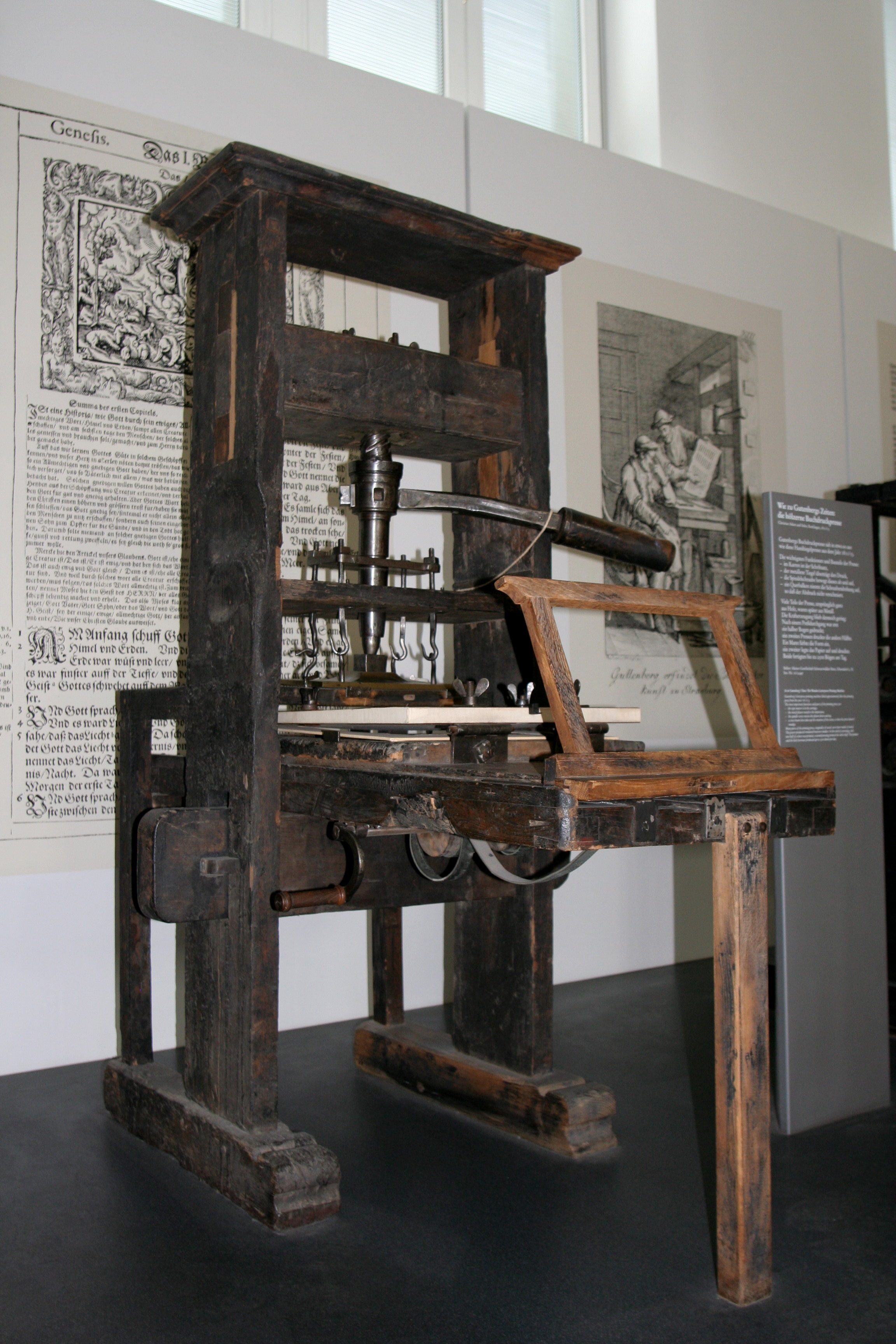
- 1439: Printing press in Mainz, Germany: The printing press is invented in the Holy Roman Empire by Johannes Gutenberg before 1440, based on existing screw presses. The first confirmed record of a press appeared in a 1439 lawsuit against Gutenberg.
- Mid 15th century: The Arquebus (also spelled Harquebus) is invented, possibly in Spain.
- 1480s: Mariner's astrolabe in Portuguese circumnavigation of Africa
Early modern era
16th century
- 16th century: Chintz or printed clothing in Golconda, India
- 16th century: Hookah by Irfan Shaikh, at the court of the Mughal emperor Akbar I
- 1540: Rifling is first used in firearms, after being invented in 1498
- 1560: Floating dry dock in Venice, Venetian Republic
- 1569: Mercator Projection map created by Gerardus Mercator
- 1589: Stocking frame: Invented by William Lee.
- 1594: Backstaff: Invented by Captain John Davis
17th century
.jpg)
- 1605: Newspaper (Relation): Johann Carolus in Strassburg (see also List of the oldest newspapers)
- 1608: Telescope: Patent applied for by Hans Lippershey. Actual inventor unknown since it seemed to already be a common item being offered by the spectacle makers in the Netherlands with Jacob Metius also applying for patent and the son of Zacharias Janssen making a claim 47 years later that his father invented it.
- 1620: Compound microscopes, which combine an objective lens with an eyepiece to view a real image, first appear in Europe. Apparently derived from the telescope, actual inventor unknown, variously attributed to Zacharias Janssen (his son claiming it was invented in 1590), Cornelis Drebbel, and Galileo Galilei.
- 1630: Slide rule: invented by William Oughtred
- 1630: first use of the flintlock
- 1642: Mechanical calculator. The Pascaline is built by Blaise Pascal.
- 1643: Barometer: invented by Evangelista Torricelli, or possibly up to three years earlier by Gasparo Berti.
- 1650: Vacuum pump: Invented by Otto von Guericke.
- 1656: Pendulum clock: Invented by Christiaan Huygens. It was first conceptualized in 1637 by Galileo Galilei but he was unable to create a working model.
- 1668: First functional reflecting telescope constructed by Isaac Newton.
- 1679: Pressure-cooker: Invented by Denis Papin.
- 1680: Christiaan Huygens provides the first known description of a piston engine.
- 1698: Thomas Savery develops a steam-powered water pump: for draining mines
18th century
- 1709: Bartolomeo Cristofori crafts the first piano, which became a leading instrument of Western art music
- 1712: Thomas Newcomen builds the first commercial steam engine to pump water out of mines.
- 1738: Lewis Paul and John Wyatt invent the first mechanized cotton spinning machine, helping to establish the British textile industry
- 1745: Musschenbroek and Kleist independently develop the Leyden jar, an early form of capacitor.
- 1746: John Roebuck invents the lead chamber process, mass producing sulfuric acid for manufacturing
- 1755: William Cullen invents the first artificial refrigeration machine
- 1764: James Hargreaves invents the spinning jenny, revolutionizing textile production during the Industrial Revolution
- 1769: Nicolas-Joseph Cugnot invents the first steam-powered vehicle capable of carrying passengers, an early car
- 1774: John Wilkinson invents his boring machine, considered by some to be the first machine tool
- 1775: Jesse Ramsden invents the modern screw-cutting lathe
- 1776: John Wilkinson invents a mechanical air compressor that would become the prototype for all later mechanical compressors
- 1780: Hyder Ali of Mysore, India develops the first metal-cylinder rockets.
- 1783: Claude de Jouffroy builds the first steamboat
- 1783: Joseph-Ralf and Jacques-Étienne Montgolfier build the first manned hot air balloon
- 1783: Louis-Sébastien Lenormand invents and uses the first modern parachute
- 1785: Martinus van Marum is the first to use the electrolysis technique
- 1786: Andrew Meikle invents the threshing machine
- 1789: Edmund Cartwright invents the power loom
- 1792: Claude Chappe invents the semaphore telegraph
- 1793: Eli Whitney invents the modern cotton gin
- 1795: Joseph Bramah invents the hydraulic press
- 1796: Alois Senefelder invents the lithography printing technique.
- 1796: Edward Jenner invented the vaccine and inoculates an individual for smallpox
- 1799: The first paper machine is invented by Louis-Nicolas Robert
Late modern period
19th century
1800s
- 1800: Alessandro Volta invents the voltaic pile, an early form of battery in Italy, based on previous works by Luigi Galvani.
- 1802: Humphry Davy invents the arc lamp (exact date unclear; not practical as a light source until the invention of efficient electric generators).
- 1804: Friedrich Sertürner discovers morphine as the first active alkaloid extracted from the opium poppy plant.
- 1804: Joseph Marie Jacquard develops his automated Jacquard loom.
- 1804: Richard Trevithick invents the steam locomotive.
- 1804: Hanaoka Seishū creates tsūsensan, the first modern general anesthetic.
- 1807: Nicéphore Niépce invents an early internal combustion engine capable of doing useful work.
- 1807: François Isaac de Rivaz designs the first automobile powered by an internal combustion engine fuelled by hydrogen.
- 1807: Robert Fulton expands water transportation and trade with the workable steamboat.
1810s
- 1810: Nicolas Appert invents the canning process for food.
- 1810: Abraham-Louis Breguet creates the first wristwatch.
- 1811: Friedrich Koenig invents the first powered printing press, which was also the first to use a cylinder.
- 1812: William Reid Clanny pioneered the invention of the safety lamp which he improved in later years. Safety lamps based on Clanny's improved design were used until the adoption of electric lamps.
- 1814: James Fox invents the modern planing machine, though Matthew Murray of Leeds and Richard Roberts of Manchester have also been credited at times with its invention.
- 1816: René Laennec invents the first Stethoscope.
- 1816: Francis Ronalds builds the first working electric telegraph using electrostatic means.
- 1816: Robert Stirling invents the Stirling engine.
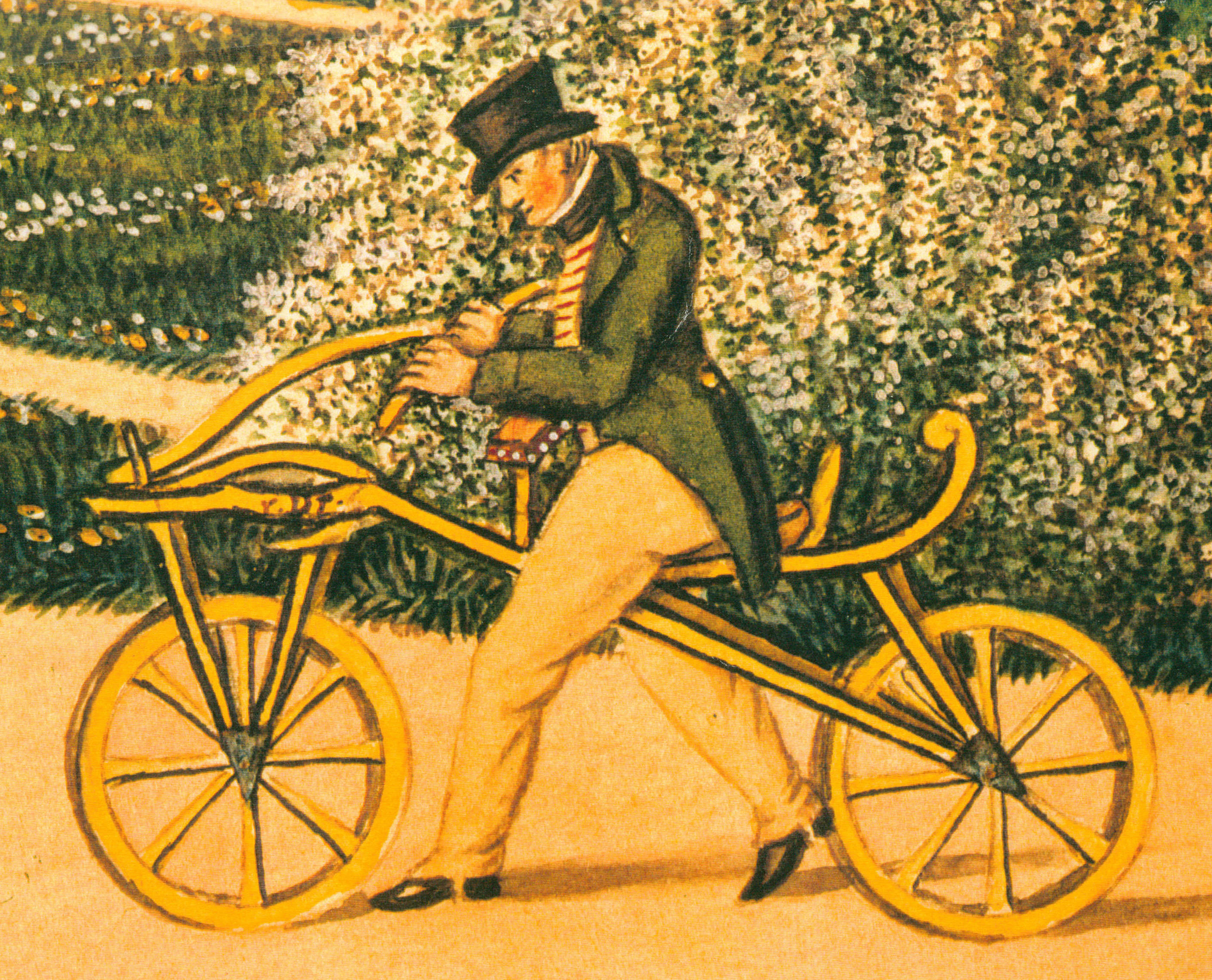
- 1817: Baron Karl von Drais invents the dandy horse, an early velocipede and precursor to the modern bicycle.
- 1818: Marc Isambard Brunel invents the tunnelling shield.
1820s
- 1822: Thomas Blanchard invents the pattern-tracing lathe (actually more like a shaper). The lathe can copy symmetrical shapes and is used for making gun stocks, and later, ax handles.{{cite book |url-access= registration
- 1822: Nicéphore Niépce invents Heliography, the first photographic process.
- 1822: Charles Babbage, considered the "father of the computer", begins building the first programmable mechanical computer.
- 1823: Johann Wolfgang Döbereiner invents the first lighter.
- 1824: Johann Nikolaus von Dreyse invents the bolt-action rifle.
- 1824: William Sturgeon invents the electromagnet.
- 1826: John Walker invents the friction match.
- 1826: James Sharp invents and goes on to manufacture the first practical gas stove.
- 1828: James Beaumont Neilson develops the hot blast process.
- 1828: Patrick Bell invents the reaping machine.
- 1828: Hungarian physicist Ányos Jedlik invents the first commutated rotary electromechanical machine with electromagnets.
- 1829: Louis Braille invents the Braille reading system for the blind.
- 1829: William Mann invents the compound air compressor.
- 1829: Henry Robinson Palmer is awarded a patent for corrugated galvanised iron.
1830s
- 1830: Edwin Budding invents the lawn mower.
- 1831: Michael Faraday invents a method of electromagnetic induction. It would be independently invented by Joseph Henry the following year. Faraday is credited with inventing the first electric generator called the Faraday disk.
- 1833: Charles Babbage introduces his "mechanical calculating machine", the first mechanical computer
- 1834: Moritz von Jacobi invents the first practical electric motor.
- 1835: Joseph Henry invents the electromechanical relay.
- 1837: Samuel Morse invents Morse code.
- 1838: Moritz von Jacobi invents electrotyping.
- 1839: William Otis invents the steam shovel.
- 1839: James Nasmyth invents the steam hammer.
- 1839: Edmond Becquerel invents a method for the photovoltaic effect, effectively producing the first solar cell.
- 1839: Charles Goodyear invents vulcanized rubber.
- 1839: Louis Daguerre invents daguerreotype photography.
- 1839: Kirkpatrick Macmillan invents the first bicycle
1840s
Main article: 1840s#Science and technology
- 1840: John Herschel invents the blueprint.
- 1841: Alexander Bain devises a printing telegraph.
- 1842: William Robert Grove invents the first fuel cell.
- 1842: John Bennet Lawes invents superphosphate, the first man-made fertilizer.
- 1844: Friedrich Gottlob Keller and, independently, Charles Fenerty come up with the wood pulp method of paper production.
- 1844: Francis Rynd invents the hypodermic needle.
- 1844: Horace Wells successfully used nitrous oxide as an anesthesia
- 1845: Isaac Charles Johnson invents modern Portland cement.
- 1846: Henri-Joseph Maus invents the tunnel boring machine.
- 1846: Elias Howe received a patent for a sewing machine, the model for the Singer Sewing Machine
- 1847: Ascanio Sobrero invents nitroglycerin, the first explosive made that was stronger than black powder.
- 1848: Jonathan J. Couch invents the pneumatic drill.
- 1848: Linus Yale Sr. invents the first modern pin tumbler lock.
- 1849: Walter Hunt invents the first repeating rifle to use metallic cartridges (of his own design) and a spring-fed magazine.
- 1849: James B. Francis invents the Francis turbine.
- 1849: Walter Hunt invents the safety pin.
1850s
- 1850: William Armstrong invents the hydraulic accumulator.
- 1851: George Jennings offers the first public flush toilets, accessible for a penny per visit, and in 1852 receives a UK patent for the single piece, free standing, earthenware, trap plumed, flushing, water-closet.
- 1852: Robert Bunsen is the first to use a chemical vapor deposition technique.
- 1852: Elisha Otis invents the safety brake elevator.
- 1852: Henri Giffard becomes the first person to make a manned, controlled and powered flight using a dirigible.
- 1853: François Coignet invents reinforced concrete.
- 1855: James Clerk Maxwell invents the first practical method for color photography, whether chemical or electronic.
- 1855: Henry Bessemer patents the Bessemer process for making steel, with improvements made by others over the following years.
- 1856: Alexander Parkes invents parkesine, also known as celluloid, the first man-made plastic.
- 1856: James Harrison produces the world's first practical ice making machine and refrigerator using the principle of vapour compression in Geelong, Australia.
- 1856: William Henry Perkin invents mauveine, the first synthetic dye.
- 1857: Heinrich Geissler invents the Geissler tube.
- 1857: The phonautograph, the earliest known device for recording sound, is patented and invented by Frenchman Édouard-Léon Scott de Martinville.
- 1859: Gaston Planté invents the lead acid battery, the first rechargeable battery.
1860s
- 1860: Joseph Swan produces carbon fibers.
- 1862: Richard Jordan Gatling invents the Gatling gun, the first multi-barrel rapid-fire gun.
- 1864: Louis Pasteur invents the pasteurization process.
- 1865: Carl Wilhelm Siemens and Pierre-Émile Martin invent the Siemens-Martin process for making steel.
- 1867: Alfred Nobel invents dynamite, the first safely manageable explosive stronger than black powder.
- 1867: Lucien B. Smith invents barbed wire.
1870s
- 1872: Polyvinyl chloride, more commonly known as vinyl, is synthesized by German chemist Eugen Baumann.
- 1872: J. E. T. Woods and J. Clark invent stainless steel. Harry Brearley is the first to commercialize it.
- 1873: Frederick Ransome invents the rotary kiln.
- 1873: William Crookes, a chemist, invents the Crookes radiometer as the by-product of some chemical research.
- 1873: Zénobe Gramme invents the first commercial electrical generator, the Gramme machine.
- 1874: Gustave Trouvé invents the first metal detector.
- 1874: Ferdinand von Zeppelin invents the Zeppelin rigid airship.
- 1875: Fyodor Pirotsky invents the first electric tram near Saint Petersburg, Russia.
- 1876: Nicolaus August Otto invents the four-stroke cycle.
- 1876: Alexander Graham Bell has a patent granted for the telephone. However, other inventors before Bell had worked on the development of the telephone and the invention had several pioneers.
- 1877: Thomas Edison invents the first working phonograph.
- 1878: Henry Fleuss is granted a patent for the first practical rebreather.
- 1878: Lester Allan Pelton invents the Pelton wheel, a type of water turbine.
- 1879: Joseph Swan and Thomas Edison both patent a functional incandescent light bulb. Some two dozen inventors had experimented with electric incandescent lighting over the first three-quarters of the 19th century but never came up with a practical design. Swan's, which he had been working on since the 1860s, had a low resistance so was only suited for small installations. Edison designed a high-resistance bulb as part of a large-scale commercial electric lighting utility.
1880s
- 1881: Nikolay Benardos presents carbon arc welding, the first practical arc welding method.
- 1884: Hiram Maxim invents the recoil-operated Maxim gun, ushering in the age of semi- and fully automatic firearms.
- 1884: Paul Vieille invents Poudre B, the first smokeless powder for firearms.
- 1884: Sir Charles Parsons invents the modern steam turbine.
- 1884: Hungarian engineers Károly Zipernowsky, Ottó Bláthy and Miksa Déri invent the closed core high efficiency transformer and the AC parallel power distribution.
- 1885: John Kemp Starley invents the modern safety bicycle.
- 1886: Carl Gassner invents the zinc–carbon battery, the first dry cell battery, making portable electronics practical.
- 1886: Charles Martin Hall and independently Paul Héroult invent the Hall–Héroult process for economically producing aluminum in 1886.
- 1886: Karl Benz invents the first petrol or gasoline powered auto-mobile (car).
- 1887: Carl Josef Bayer invents the Bayer process for the production of alumina.
- 1887: James Blyth invents the first wind turbine used for generating electricity.
- 1887: John Stewart MacArthur, working in collaboration with brothers Dr. Robert and Dr. William Forrest, develops the process of gold cyanidation.
- 1888: John J. Loud invents the ballpoint pen.
- 1888: Thomas Edison and William Kennedy Dickson invent the Kinetoscope.
- 1888: The first practical pneumatic tire was made by Scotsman John Boyd Dunlop, the patent was from 1847 by Robert William Thomson
1890s
- 1890s: Frédéric Swarts invents the first chlorofluorocarbons to be applied as refrigerant.
- 1890: Robert Gair invents the pre-cut cardboard box.
- 1891: Whitcomb Judson invents the zipper.
- 1892: Léon Bouly invents the cinematograph.
- 1892: Thomas Ahearn invents the electric oven.
- 1892: John Froelich invented the gas-powered tractor
- 1893: Rudolf Diesel invents the diesel engine (although Herbert Akroyd Stuart had experimented with compression ignition before Diesel).
- 1893: William Stewart Halsted, invents the rubber glove for his wife Caroline Hampton as he noticed her hands were affected by the daily surgeries she had performed. The gloves were intended to prevent medical staff from developing dermatitis from surgical chemicals. The first modern disposable glove was created by Ansell Rubber Co. Pty. Ltd. in 1965.
- 1895: Guglielmo Marconi invents the radio, a system of wireless communication using radio waves.
- 1895: Wilhelm Conrad Röntgen invented the first radiograph (X-ray).
- 1897: Surgical masks made of cloth were developed in Europe by physicians Jan Mikulicz-Radecki at the University of Breslau and Paul Berger in Paris, as a result of increasing awareness of germ theory and the importance of antiseptic procedures in medicine.
- 1898: Hans von Pechmann synthesizes polyethylene, now the most common plastic in the world.
- 1899: Waldemar Jungner invents the rechargeable nickel-cadmium battery (NiCd) as well as the nickel-iron electric storage battery (NiFe) and the rechargeable alkaline silver-cadmium battery (AgCd)
20th century
1900s
- 1901: The first motorized cleaner using suction, a powered "vacuum cleaner", is patented independently by Hubert Cecil Booth and David T. Kenney.
- 1903: The first successful gas turbine is invented by Ægidius Elling.
- 1903: Édouard Bénédictus invents laminated glass.
- 1904: The Fleming valve, the first vacuum tube and diode, is invented by John Ambrose Fleming.
- 1907: Leo Baekeland invents bakelite, the first plastic made from synthetic components.
- 1907: The tuyères thermopropulsives after 1945 (Maurice Roy (fr)) known as the statoreacteur a combustion subsonique (the ramjet)Anthony Roux (2 July 2009) Simulation aux Grandes Echelles d'un statoréacteur , p.15, University of Toulouse, "...La propulsion par statoreacteur a été inventée par le francais René Lorin en 1907 et decrite pour la ´ premiere fois dans la revue ` l'aerophile ´ dans un article intitule "Propulseur par reaction directe"...", accessed 7 July 2019 – R. Lorin
- 1908: Cellophane is invented by Jacques E. Brandenberger.
- 1909: Fritz Haber invents the Haber process.
1910s
- 1911: The cloud chamber, the first particle detector, is invented by Charles Thomson Rees Wilson.
- 1913: The Bergius process is developed by Friedrich Bergius.
- 1913: The Kaplan turbine is invented by Viktor Kaplan.
- 1915: Harry Brearley invents a process to create Martensitic stainless steel, initially labelled Rustless Steel, later marketed as Staybrite, and AISI Type 420.
- 1915: The first operational military tanks are designed in Great Britain and France. They are used in battle from 1916 and 1917 respectively. The designers in Great Britain are Walter Wilson and William Tritton and in France, Eugène Brillié. (Although it is known that vehicles incorporating at least some of the features of the tank were designed in a number of countries from 1903 onward, none reached a practical form.)
- 1916: The Czochralski process, widely used for the production of single crystal silicon, is invented by Jan Czochralski.
- 1917: The crystal oscillator is invented by Alexander M. Nicolson using a crystal of Rochelle Salt although his priority was disputed by Walter Guyton Cady.
1920s
- 1925: The Fischer–Tropsch process is developed by Franz Fischer and Hans Tropsch at the Kaiser-Wilhelm-Institut für Kohlenforschung.
- 1926: The Yagi-Uda Antenna or simply Yagi Antenna is invented by Shintaro Uda of Tohoku Imperial University, assisted by his colleague Hidetsugu Yagi. The Yagi Antenna was widely used during World War II. After the war they saw extensive development as home television antennas.
- 1926: Robert H. Goddard launches the first liquid fueled rocket.
- 1926: Harry Ferguson, patents the Three-point hitch equipment linkage system for tractors.
- 1926: John Logie Baird demonstrates the world's first live working television system.
- 1927: The quartz clock is invented by Warren Marrison and J.W. Horton at Bell Telephone Laboratories.
- 1928: Penicillin is first observed to exude antibiotic substances by Nobel laureate Alexander Fleming. Development of medicinal penicillin is attributed to a team of medics and scientists including Howard Walter Florey, Ernst Chain and Norman Heatley.
- 1928: Frank Whittle formally submitted his ideas for a turbo-jet engine. In October 1929, he developed his ideas further. On 16 January 1930, Whittle submitted his first patent (granted in 1932).
- 1928: Philo Farnsworth demonstrates the first practical electronic television to the press.
- 1929: The ball screw is invented by Rudolph G. Boehm.
1930s
- 1930: The Supersonic combusting ramjet — Frank Whittle.
- 1930: The Phase-contrast microscopy is invented by Frits Zernike.
- 1931: The electron microscope is invented by Ernst Ruska.
- 1933: FM radio is patented by inventor Edwin H. Armstrong.
- 1933: Harry C. Jennings Sr. and Herbert Everest, both mechanical engineers, invented the first lightweight, steel, folding, portable wheelchair with their "X-brace" design.
- 1935: Nylon, the first fully synthetic fiber is produced by Wallace Carothers while working at DuPont.
- 1938: Z1, built by Konrad Zuse, is the first freely programmable computer in the world.
- 1938: Nuclear fission discovered in experiment by chemists Otto Hahn and Fritz Strassmann and physicists Lise Meitner and Otto Robert Frisch. The German nuclear energy project was based on this research. The Tube Alloys project and, subsequently, the Manhattan Project and the Soviet atomic bomb project were influenced by this research.
- 1939: G. S. Yunyev or Naum Gurvich invented the electric current defibrillator
- 1939: John Vincent Atanasoff invented the first electronic digital computer
1940-1944
- 1940: Pu-239 isotope (isotope of plutonium) a form of matter existing with the capacity for use as a destructive element (because the isotope has an exponentially increasing fissile decay) within nuclear devices — Glenn Seaborg.
- 1940: John Randall and Harry Boot would develop the high power, microwave generating, cavity magnetron, later applied to commercial Radar and Microwave oven appliances.
- 1941: Polyester is invented by John Rex Whinfield and James Dickson.
- 1942: The V-2 rocket, the world's first long range ballistic missile, developed by engineer Wernher von Braun.
- 1942: Enrico Fermi developed the nuclear reactor and created the first controlled nuclear chain reaction
- 1944: The non-infectious viral vaccine is perfected by Dr. Jonas Salk and Thomas Francis.
Contemporary history
1945-1950
- 1945: The atomic bomb is developed by the Manhattan Project and swiftly used in August 1945 in the atomic bombings of Hiroshima and Nagasaki.
- 1945: Percy Spencer, while employed at Raytheon, would patent a magnetron based microwave oven.
- 1945: Willard Libby began his work on radiocarbon dating. He published his paper in 1946, a second paper in Science in 1947. Libby and James Arnold succeeded with the radiocarbon dating theory after results were published in Science in December 1949.
- 1946: James Martin invents the ejector seat, inspired by the death of his friend and test pilot Captain Valentine Baker in an aeroplane crash in 1942.
- 1947: Holography is invented by Dennis Gabor.
- 1947: Floyd Farris and J.B. Clark (Stanolind Oil and Gas Corporation) invents hydraulic fracturing technology.
- 1947: The first transistor, a bipolar point-contact transistor, is invented by John Bardeen and Walter Brattain under the supervision of William Shockley at Bell Labs.
- 1948: The first atomic clock is developed at the National Bureau of Standards.
- 1948: Basic oxygen steelmaking is developed by Robert Durrer. The majority of steel manufactured in the world is produced using the basic oxygen furnace; in 2000, it accounted for 60% of global steel output.
1950s
- 1950: Bertie the Brain, debatably the first video game, is displayed to the public at the Canadian National Exhibition.
- 1950: The Toroidal chamber with axial magnetic fields (the Tokamak) is developed by Igor E. Tamm and Andrei D. Sakharov.
- 1952: The float glass process is developed by Alastair Pilkington.
- 1952: The first thermonuclear weapon is developed.
- 1953: The first video tape recorder, a helical scan recorder, is invented by Norikazu Sawazaki.
- 1954: Invention of the solar battery by Bell Telephone scientists, Calvin Souther Fuller, Daryl Chapin and Gerald Pearson capturing the Sun's power. First practical means of collecting energy from the Sun and turning it into a current of electricity.
- 1955: The hovercraft is patented by Christopher Cockerell.
- 1955: Jonas Salk received the license for his inactivated polio vaccine
- 1955: The intermodal container is developed by Malcom McLean.
- 1956: The hard disk drive is invented by IBM.
- 1956: The Logic Theorist computer program, the first "artificial intelligence program", was written and invented by Allen Newell, Herbert A. Simon, and Cliff Shaw. , and
- 1957: The laser and optical amplifier are invented and named by Gordon Gould and Charles Townes. The laser and optical amplifier are foundational to powering the Internet.
- 1957: The first personal computer used by one person and controlled by a keyboard, the IBM 610, is invented by IBM.
- 1957: The first artificial satellite, Sputnik 1, is launched.
- 1958 – 1959: The integrated circuit is independently invented by Jack Kilby and Robert Noyce.
- 1959: The MOSFET (MOS transistor) is invented by the Egyptian Mohamed Atalla and the Korean Dawon Kahng at Bell Labs. It is used in almost all modern electronic products. It was smaller, faster, more reliable and cheaper to manufacture than earlier bipolar transistors, leading to a revolution in computers, controls and communication.
1960s

- 1960: The first functioning laser is invented by Theodore Maiman.
- 1960: First robotic exoskeleton
- 1963: The first electronic cigarette is created by Herbert A. Gilbert. Hon Lik is often credited with its invention as he developed the modern electronic cigarette and was the first to commercialize it.
- 1964: Shinkansen, the first high-speed rail commercial passenger service.
- 1965: Kevlar is invented by Stephanie Kwolek at DuPont.
- 1967: E. A. Johnson of the Royal Radar Establishment developed the capacitive touch display or touchscreen
- 1969: The NPL network followed by the ARPANET implement packet switching for data communication, drawing on the concepts and designs of Donald Davies, and Paul Baran. These are considered precursors to the modern Internet.
1970s
- 1970s: Public-key cryptography is invented and developed by James H. Ellis, Clifford Cocks, Malcolm J. Williamson, Whitfield Diffie, Martin Hellman, Ralph Merkle, Ron Rivest, Adi Shamir, Leonard Adleman, et al.
- 1970: The pocket calculator is invented.
- 1971: The first single-chip microprocessor, the Intel 4004, is invented. Its development was led by Federico Faggin, using his silicon-gate MOS technology. This led to the personal computer (PC) revolution.
- 1971: The first space station, Salyut 1, is launched.
- 1971: IBM developed and released the world's first floppy disk and disk drive.
- 1972: The first video game console, used primarily for playing video games on a TV, is the Magnavox Odyssey.
- 1972: Herbert Boyer and Stanley Cohen developed genetic modification when they successfully modified DNA
- 1973: The first fiber optic communication systems were developed by Optelecom.
- 1973: The first commercial graphical user interface is introduced in 1973 on the Xerox Alto. The modern GUI is later popularized by the Xerox Star and Apple Lisa.
- 1973: The first capacitive touchscreen is developed at CERN.
- 1974: The Transmission Control Program is proposed by Vinton Cerf and Robert E. Kahn, building on the work of Louis Pouzin and other Internet pioneers, creating the basis for the modern Internet.
- 1974: The lithium-ion battery is invented by M. Stanley Whittingham, and further developed in the 1980s and 1990s by John B. Goodenough, Rachid Yazami and Akira Yoshino. It has impacted modern consumer electronics and electric vehicles.
- 1974: The Rubik's cube is invented by Ernő Rubik which went on to be the best selling puzzle ever.
- 1975: First general purpose home automation network technology, X10, was developed
- 1977: Dr Walter Gilbert and Frederick Sanger invented a new DNA sequencing method for which they won the Nobel Prize.
- 1977: The first self-driving car that did not rely upon rails or wires under the road is designed by the Tsukuba Mechanical Engineering Laboratory.
- 1978: The Global Positioning System (GPS) enters service. While not the first Satellite navigation system, it is the first to enter widespread civilian use
- 1978: Birth of the first child through in vitro fertilization (IVF), based on the research of Patrick Steptoe and Robert Edwards
- 1979: The first handheld game console with interchangeable game cartridges, the Microvision is released.
- 1979: Nippon Telegraph and Telephone (NTT) launched the first cellular network in Japan.
- 1979: Public dialup information, messaging and e-commerce services, were pioneered through CompuServe and RadioShack's MicroNET, and the UK's Post Office Telecommunications Prestel services.
1980s
- 1980: Flash memory (both NOR and NAND types) was invented by Fujio Masuoka while working for Toshiba. It was introduced to the public in 1984.
- 1980: Scientists Mark Skolnick, Ron Davis, Ray White, and David Botstein published their findings on a gene mapping tool using Restriction Fragment-length Polymorphisms (RFLP), that would have applications to identify heritable disorders, including some forms of cancer.
- 1981: The first reusable spacecraft, the Space Shuttle undergoes test flights ahead of full operation in 1982
- 1981: Kane Kramer develops the credit card-sized, IXI digital media player.
- 1981: Televerket, a Swedish state-owned corporation, launched the Nordic Mobile Telephone (NMT) system.
- 1981: Comvik, a Swedish telecommunications company, launched the first commercial automatic cellular system. However, according to the Swedish Post and Telecom Authority, the company launched an unlicensed automatic system. Comvik didn't receive a license to operate until December 1981, two months after the NMT system was launched.
- 1982: A CD-ROM contains data accessible to, but not writable by, a computer for data storage and music playback. The 1985 Yellow Book standard developed by Sony and Philips adapted the format to hold any form of binary data.
- 1982: Direct to home satellite television transmission, with the launch of Sky One service.
- 1982: The first laptop computer is launched, the 8/16-bit Epson HX-20.
- 1983: Stereolithography is invented by Chuck Hull.
- 1983: Ameritech, now known as AT&T, commercialized the Bell System (its cellular network) in Chicago, Ill.
- 1984: The first commercially available cell phone in the US, the DynaTAC 8000X, is created by Motorola.
- 1984: Chuck Hull patents the stereolithography (SLA) process, also known as 3D printing
- 1984: DNA profiling is pioneered by Alec Jeffreys.
- 1986: Technophone, a British mobile phone company, created the first pocket-sized cell phone, the Excell PCT105.
- 1989: Karlheinz Brandenburg would publish the audio compression algorithms that would be standardised as the: MPEG-1, layer 3 (mp3), and later the MPEG-2, layer 7 Advanced Audio Compression (AAC).
- 1989: The World Wide Web is invented by computer scientist Tim Berners-Lee.
1990s
- 1990: The first search engine, "Archie", was created by Alan Emtage, Bill Heelan, and Peter J. Deutsch at McGill University
- 1991: The first commercial flash-based solid-state drive is launched by SunDisk.
- 1991: The first sim card is developed by Munich smart-card maker Giesecke & Devrient
- 1994: IBM Simon, the world's first smartphone, is developed by IBM. It had a touchscreen and the first built-in apps for a mobile device.
- 1994: First generation of Bluetooth is developed by Ericsson Mobile. A form of data communication on short distances between electronic devices
- 1994: A Tetris variant on the Hagenuk MT-2000 device becomes the first mobile game
- 1995: DVD is an optical disc storage format, invented and developed by Philips, Sony, Toshiba, and Panasonic. DVDs offer higher storage capacity than compact discs while having the same dimensions.
- 1996: The Ciena Corporation, in partnership with Sprint, deployed the first commercial dense wavelength-division multiplexing system, which created the massive capacity of the Internet.
- 1996: Mobile web was first commercially offered in Finland on the Nokia 9000 Communicator phone, and it was also the first phone with texting
- 1996: Bolt and Six Degrees (1997) both become the first social media sites.
- 1996: Myriad Genetics released the BRACAnalysis, the first commercial genetic test for assessing the risk of hereditary breast and ovarian cancer.
- 1998: The search engine Google, is launched.
- 1999: The first capsule endoscopy was performed, after being invented in the mid-1990s by Gavriel Iddan
- 1999: The first digital video recorder (DVR), the TiVo, is launched
- 1999: NTT DoCoMo launches i-mode, the first integrated Online App store for mobile phones
21st century
2000s
- 2001: The Food and Drug Administration approved the first contraceptive patch
- 2003: Development of the Android operating system for mobile devices
- 2004: First podcast, invented by Adam Curry and Dave Winer
- 2005: YouTube, the first popular video-streaming site, was founded by Jawed Karim
- 2006: Amazon pioneered cloud computing
- 2007: Apple Inc. released the iPhone
- 2007: First Kindle e-reader introduced by Amazon
- 2007: Subscription video on demand first offered by Netflix and Hulu
- 2008: Satoshi Nakamoto develops the first blockchain.
- 2009: The first quantum machine was created by Aaron D. O'Connell
2010s
- 2010: The first synthetic organism, Mycoplasma laboratorium is created by the J. Craig Venter Institute
- 2010: Solid-state Lidar technology was introduced, replacing mechanical scanning with electronic beam steering
- 2011: Apple released Siri, the first major company's virtual assistant
- 2014: Introduction of Pepper, the first commercial humanoid robot
- 2014: Introduction of the Amazon Echo alongside Amazon Alexa, introducing smart home technology to homes
- 2015: Discovery of CRISPR gene editing method
- 2016: First commercially available artificial pancreas
- 2016: First successful launch of a multi-use rocket by SpaceX
- 2019: IBM launches IBM Q System One, its first integrated quantum computing system for commercial use.
- 2019: 5G broadband cellular network technology introduced
2020s
- 2020: The first mRNA vaccine to be approved by public health medicines regulators is co-developed by Pfizer and BioNTech for COVID-19, with the potential to treat other diseases and cancer
- 2020: OpenAI demonstrated an Artificial Intelligence model called GPT-3. The program was created to generate human-like responses when given prompts.
- 2022: ChatGPT is launched to the public, making it the first mainstream generative AI to be released
Notes
Footnotes
References
- Bourbaki, Nicolas (1998). Elements of the History of Mathematics. Berlin, Heidelberg, and New York: Springer-Verlag. .
- Bowman, John S. (2000). Columbia Chronologies of Asian History and Culture. New York: Columbia University Press. .
- Buisseret, David. (1998). Envisioning the City: Six Studies in Urban Cartography. Chicago: University Of Chicago Press. .
- Day, Lance and Ian McNeil. (1996). Biographical Dictionary of the History of Technology. New York: Routledge. .
- Ebrey, Patricia Buckley (1999). The Cambridge Illustrated History of China. Cambridge: Cambridge University Press. (paperback).
- Ebrey, Walthall, Palais, (2006). East Asia: A Cultural, Social, and Political History. Boston: Houghton Mifflin Company.
- Elisseeff, Vadime. (2000). The Silk Roads: Highways of Culture and Commerce. New York: Berghahn Books. .
- Hucker, Charles O. (1975). China's Imperial Past: An Introduction to Chinese History and Culture. Stanford, Calif. : Stanford University. .
- Hunter, Dard (1978). Papermaking: The History and Technique of an Ancient Craft. Mineola: Dover Publications, Inc. .
- Gernet, Jacques (1962). Daily Life in China on the Eve of the Mongol Invasion, 1250-1276. Translated by H.M. Wright. Stanford: Stanford University Press. .
- Gernet, Jacques. (1996). A History of Chinese Civilization. Translated by J.R. Foster and Charles Hartman. Cambridge: Cambridge University Press. .
- Kreutz, Barbara M. (1973) "Mediterranean Contributions to the Medieval Mariner's Compass", Technology and Culture, 14 (3: July), p. 367–383
- Lo, Andrew. "The Game of Leaves: An Inquiry into the Origin of Chinese Playing Cards", Bulletin of the School of Oriental and African Studies, University of London, Vol. 63, No. 3 (2000): 389–406.
- Loewe, Michael. (1968). Everyday Life in Early Imperial China during the Han Period 202 BC–AD 220. London: B.T. Batsford Ltd.; New York: G.P. Putnam's Sons.
- Needham, Joseph, Science and Civilization in China: Volume 4, Physics and Physical Technology, Part 2, Mechanical Engineering. Taipei: Caves Books Ltd.,1986
- Needham, Joseph (1962). Science and Civilization in China: Volume 4, Physics and Physical Technology; Part 1, Physics. Cambridge University Press., reprinted Taipei: Caves Books, Ltd. (1986)
- Needham, Joseph and Tsien Tsuen-Hsuin. (1985). Science and Civilization in China: Volume 5, Chemistry and Chemical Technology, Part 1, Paper and Printing. Cambridge University Press., reprinted Taipei: Caves Books, Ltd. (1986)
- Needham, Joseph. (1987). Science and Civilization in China: Volume 5, Chemistry and Chemical Technology, Part 7, Military Technology; the Gunpowder Epic. Cambridge University Press.
- Pigott, Vincent C. (1999). The Archaeometallurgy of the Asian Old World. Philadelphia: University of Pennsylvania Museum of Archaeology and Anthropology. .
- {{citation
- {{citation
- Ronan, Colin A. (1994). The Shorter Science and Civilisation in China: Volume 4. Cambridge : Cambridge University Press. .
- Sivin, Nathan (1995). Science in Ancient China: Researches and Reflections. Brookfield, Vermont: VARIORUM, Ashgate Publishing.
- Stark, Miriam T. (2005). Archaeology of Asia. Malden, MA : Blackwell Pub. .
- {{citation | author1-link = Theophanes the Confessor | author2-link = Harry Turtledove
- Wagner, Donald B. (1993). Iron and Steel in Ancient China: Second Impression, With Corrections. Leiden: E.J. Brill. .
- Wagner, Donald B. (2001). The State and the Iron Industry in Han China. Copenhagen: Nordic Institute of Asian Studies Publishing. .
- Wang, Zhongshu. (1982). Han Civilization. Translated by K.C. Chang and Collaborators. New Haven and London: Yale University Press. .
- Wood, Nigel. (1999). Chinese Glazes On The Coast: Their Origins, Chemistry, and Recreation. Philadelphia: University of Pennsylvania Press. .
References
- (1999). "Environment and behavior of 2.5-million-year-old Bouri hominids". Science.
- (2009). "The Human Past: World Prehistory and the Development of Human Societies". Thames and Hudson.
- (1 June 2009). "Invention of cooking drove evolution of the human species, new book argues".
- "Until the Wonderwerk Cave find, Gesher Benot Ya'aqov, a lakeside site in , was considered to have the oldest generally accepted evidence of human-controlled fire.".
- James, Steven R.. (February 1989). "Hominid Use of Fire in the Lower and Middle Pleistocene: A Review of the Evidence". University of Chicago Press.
- [http://www.earth.columbia.edu/articles/view/2839 "Anthropologists have yet to find an Acheulian hand axe gripped in a ''Homo erectus'' fist but most credit ''Homo erectus'' with developing the technology."]
- (2011). "An earlier origin for the Acheulian". Nature.
- (2013-08-30). "Shared Brain Lateralization Patterns in Language and Acheulean Stone Tool Production: A Functional Transcranial Doppler Ultrasound Study". PLOS ONE.
- (2012). "Dating the origin of language using phonemic diversity". PLOS ONE.
- (5 March 2025). "Human ancestors made the oldest known bone tools 1.5 million years ago".
- (2025). "Systematic bone tool production at 1.5 million years ago". Nature.
- . (17 February 2010). ["Early humans make bone tools"](http://humanorigins.si.edu/early-humans-make-bone-tools).
- Rose, Mark. (1998). "First Mariners - Archaeology Magazine Archive".
- Wilkins, J.. (15 November 2012). "Evidence for Early Hafted Hunting Technology". Science.
- (2023). "Evidence for the earliest structural use of wood at least 476,000 years ago". Nature.
- Clare, Lee. (2020). "Göbekli Tepe, Turkey. A brief summary of research at a new World Heritage Site (2015–2019)". [[Deutsches Archäologisches Institut]].
- (2019). "Bone marrow storage and delayed consumption at Middle Pleistocene Qesem Cave, Israel (420 to 200 ka)". Science Advances.
- Gilligan, Ian. (2010-03-01). "The Prehistoric Development of Clothing: Archaeological Implications of a Thermal Model". Journal of Archaeological Method and Theory.
- (2016-12-01). "Faunal evidence for a difference in clothing use between Neanderthals and early modern humans in Europe". Journal of Anthropological Archaeology.
- "BBC News – SCI/TECH – Earliest evidence of art found".
- Kouwenhoven, Arlette P., [http://www.archaeology.org/9705/newsbriefs/spears.html World's Oldest Spears]
- (2015). "The age of the Lower Paleolithic occupation at Schöningen". Journal of Human Evolution.
- (2015). "The age of the Lower Paleolithic occupation at Schöningen". Journal of Human Evolution.
- Guido Kleinhubbert. (April 20, 2020). "Vogelkiller aus der Steinzeit". SPIEGEL Akademie.
- (November 2024). "Persistent predators: Zooarchaeological evidence for specialized horse hunting at Schöningen 13II-4". Journal of Human Evolution.
- (2016-06-07). "Neandertals revised". Proceedings of the National Academy of Sciences.
- (December 2015). "Excavations at Schöningen and paradigm shifts in human evolution". Journal of Human Evolution.
- Chatterjee, Rhitu. (15 March 2018). "Scientists Are Amazed By Stone Age Tools They Dug Up In Kenya". [[NPR]].
- Yong, Ed. (15 March 2018). "A Cultural Leap at the Dawn of Humanity - New finds from Kenya suggest that humans used long-distance trade networks, sophisticated tools, and symbolic pigments right from the dawn of our species.". [[The Atlantic]].
- (2018). "Long-distance stone transport and pigment use in the earliest Middle Stone Age". Science.
- (2013). "Earliest Stone-Tipped Projectiles from the Ethiopian Rift Date to >279,000 Years Ago". PLOS ONE.
- Schmidt, P.. (2019). "Birch tar extraction does not prove Neanderthal behavioral complexity". PNAS.
- "200,000 years ago, humans preferred to sleep in beds". phys.org.
- (13 August 2020). "The oldest known grass beds from 200,000 years ago included insect repellents". Science News.
- (14 August 2020). "Fire and grass-bedding construction 200 thousand years ago at Border Cave, South Africa". Science.
- (2011). "Origin of Clothing Lice Indicates Early Clothing Use by Anatomically Modern Humans in Africa". Molecular Biology and Evolution.
- Hallett, Emily Y.. (16 September 2021). "A worked bone assemblage from 120,000–90,000 year old deposits at Contrebandiers Cave, Atlantic Coast, Morocco". [[iScience]].
- Davis, Nicola. (16 September 2021). "Scientists find evidence of humans making clothes 120,000 years ago - Tools and bones in Moroccan cave could be some of earliest evidence of the hallmark human behaviour". [[The Guardian]].
- (2009). "Fire As an Engineering Tool of Early Modern Humans". Science.
- (2006). "Middle Paleolithic Shell Beads in Israel and Algeria". Science.
- Amos, Jonathan. (13 October 2011). "A Cultural Leap at the Dawn of Humanity - Ancient 'paint factory' unearthed". [[BBC News]].
- Vastag, Brian. (13 October 2011). "South African cave yields paint from dawn of humanity". [[Washington Post]].
- (2011). "A 100,000-Year-Old Ochre-Processing Workshop at Blombos Cave, South Africa". Science.
- (1993). "Uniquely Human page 163". Harvard University Press.
- Yellen, JE. (28 April 1995). "A middle stone age worked bone industry from Katanda, Upper Semliki Valley, Zaire". Science.
- (Jun 2009). "Implications for complex cognition from the hafting of tools with compound adhesives in the Middle Stone Age, South Africa". Proceedings of the National Academy of Sciences of the United States of America.
- Wadley, Lyn. (1 June 2010). "Compound-Adhesive Manufacture as a Behavioral Proxy for Complex Cognition in the Middle Stone Age". Current Anthropology.
- (2010). "Indications of bow and stone-tipped arrow use 64,000 years ago in KwaZulu-Natal, South Africa". Antiquity.
- (2011). "Quartz-tipped arrows older than 60 kya: further use-trace evidence from Sibudu, Kwa-Zulu-Natal, South Africa". Journal of Archaeological Science.
- (2018). "The antiquity of bow-and-arrow technology: evidence from Middle Stone Age layers at Sibudu Cave". Journal of Archaeological Science.
- (2008). "Middle Stone Age bone tools from the Howiesons Poort layers, Sibudu Cave, South Africa". Journal of Archaeological Science.
- (2008). "The Howieson's Poort industry of Sibudu Cave". South African Archaeological Society Goodwin Series.
- (2024-07-03). "Narrative cave art in Indonesia by 51,200 years ago". Nature.
- (11 May 2016). "World's oldest known ground-edge stone axe fragments found in WA". ABC News.
- "Prehistoric Japan, New perspectives on insular East Asia", Keiji Imamura, University of Hawaii Press, Honolulu, {{ISBN. 0-8248-1853-9
- "Swaziland National Trust Commission – Cultural Resources – Malolotja Archaeology, Lion Cavern".
- "Major Features: Cultural Importance". Peace Parks Foundation.
- (2008). "Anatomical evidence for the antiquity of human footwear: Tianyuan and Sunghir". Journal of Archaeological Science.
- Connolly, Tom. "The World's Oldest Shoes". [[University of Oregon]].
- Dindar, Shereen. (June 9, 2010). "World's Oldest Leather Shoe Found—Stunningly Preserved". National Post.
- (2012). "Early evidence of San material culture represented by organic artifacts from Border Cave, South Africa". Proceedings of the National Academy of Sciences.
- (2012-05-24). "Earliest music instruments found". BBC News.
- (2012-06-01). "Τesting models for the beginnings of the Aurignacian and the advent of figurative art and music: The radiocarbon chronology of Geißenklösterle". Journal of Human Evolution.
- {{cite encyclopedia. Springer. (2001). link
- "Mungo Man and Mungo Lady: Repatriation and Reburial « Trowels and Tribulations: IUP's Archaeology Blog".
- Wright, K.. (15 March 1991). "The Origins and development of ground stone assemblages in Late Pleistocene Southwest Asia". Paléorient.
- (11 September 2009). "30,000-Year-Old Wild Flax Fibers". Science.
- Small, Meredith F.. (April 2002). "String theory: the tradition of spinning raw fibers dates back 28,000 years (At The Museum)". Natural History.
- Price, Michael. "World's oldest amputation: Foot removed 31,000 years ago—without modern antibiotics or painkillers".
- (2 May 2024). "Wounded orangutan seen using plant as medicine".
- "Dolni Vestonice and Pavlov sites". Donsmaps.com.
- (2009). "Pavlov VI: an Upper Palaeolithic living unit". Antiquity.
- (4 February 2014). "Centuries-old fabric found in Çatalhöyük".
- (1989-11-24). "The Origins of Ceramic Technology at Dolni Věstonice, Czechoslovakia". Science.
- (2021). "Dog domestication and the dual dispersal of people and dogs into the Americas". [[Proceedings of the National Academy of Sciences]].
- (2019). "A functional investigation of southern Cape Later Stone Age artefacts resembling aerophones". Journal of Archaeological Science: Reports.
- Morely, Iain. ""The Evolutionary Origins and Archaeology of Music"".
- Dauvois, M. (1989) Son et Musique Paléolithiques, Les Dossiers D'Archéologie Vol. 142, p. 2-11.
- Michael Price. (16 September 2016). "World's oldest fish hook found on Okinawa". [[Science (journal).
- (18 September 2016). "World's oldest fish hooks found in Japanese island cave". BBC News.
- "BBC News - SCI/TECH - Ice Age star map discovered".
- "Oldest sky-chart with Supernova record".
- "Nebra Sky Disc".
- (May 2022). "The Nebra Sky Disc: decoding a prehistoric vision of the cosmos".
- Stanglin, Douglas. (2012-06-29). "Pottery found in China cave confirmed as world's oldest". [[USA Today]].
- (June 29, 2012). "Early Pottery at 20,000 Years Ago in Xianrendong Cave, China". [[Science (journal).
- [http://www.cleveland.com/world/index.ssf/2009/06/chinese_pottery_may_be_earlies.html "Chinese pottery may be earliest discovered"]. [[Associated Press]]. 1 June 2009
- (17 July 2018). "Prehistoric bake-off: Recipe for oldest bread revealed". [[British Broadcasting Corporation]].
- (16 July 2018). "Archaeobotanical evidence reveals the origins of bread 14,400 years ago in northeastern Jordan". Proceedings of the National Academy of Sciences.
- (2024-11-13). "12,000-year-old spindle whorls and the innovation of wheeled rotational technologies". PLOS ONE.
- Lesté-Lasserre, Christa. (2024-11-13). "12,000-year-old stones may be oldest example of wheel-like tools".
- (2006). "A new Greenland ice core chronology for the last glacial termination". Journal of Geophysical Research.
- (4 July 2013). "Farming Was So Nice, It Was Invented at Least Twice".
- "The Development of Agriculture".
- (2003). "Groundbreaking Scientific Experiments, Inventions & Discoveries of the Ancient World". Greenwood Press.
- Simmons, Paula. (2001). "Storey's Guide to Raising Sheep". Storey Publishing LLC.
- Curry, Andrew. "Gobekli Tepe: The World's First Temple?".
- Clare, Lee. (2020). "Göbekli Tepe, Turkey. A brief summary of research at a new World Heritage Site (2015–2019)". E-Forschungsberichte.
- Zhijun, Zhao. (1998). "The Middle Yangtze region in China is one place where rice was domesticated: phytolith evidence from the Diaotonghuan Cave, Northern Jiangxi". Antiquity.
- Tellier, Luc-Normand. (2009). "Urban World History: An Economic and Geographical Perspective". PUQ.
- Artioli, G.. (2019). "The Vitruvian legacy: mortars and binders before and after the Roman world". European Mineralogical Union.
- Aurangzeb Khan. (2013). "Bricks and urbanism in the Indus Valley rise and decline".
- (25 June 2009). "Stone Age wells found in Cyprus". BBC News.
- (12 April 2001). "Oudste bootje ter wereld kon werkelijk varen". Leeuwarder Courant.
- (9 July 2015). "World's ever first known town – Catalhuyuk | Cities Now". Cities Now.
- (29 September 2005). "A single domestication for potato based on multilocus amplified fragment length polymorphism genotyping". [[Proceedings of the National Academy of Sciences]].
- Office of International Affairs. (1989). "Lost Crops of the Incas: Little-Known Plants of the Andes with Promise for Worldwide Cultivation".
- John Michael Francis. (2005). "Iberia and the Americas: Culture, Politics, and History: a Multidisciplinary Encyclopedia". ABC-CLIO.
- (April 2021). "On the Timing of the Old Copper Complex in North America: A Comparison of Radiocarbon Dates from Different Archaeological Contexts". Radiocarbon.
- (2022-04-26). "Refining the chronology of North America's copper using traditions: A macroscalar approach via Bayesian modeling". PLOS ONE.
- Malakoff, David. (2021-03-19). "Ancient Native Americans were among the world's first coppersmiths". Science.
- (21 December 2004). "Fermented beverages of pre- and proto-historic China". Proceedings of the National Academy of Sciences.
- (26 May 2017). "Earliest evidence for dog breeding found on remote Siberian island".
- Heskel, Dennis L.. (1983). "A Model for the Adoption of Metallurgy in the Ancient Middle East". Current Anthropology.
- (15 April 2010). "Dictionary of the Ancient Near East". University of Pennsylvania Press.
- (2002). "The Oldest Writings, and Inventory Tags of Egypt". The Accounting Historians Journal.
- Harding, Anthony. (2013). "Salt in Prehistoric Europe". Sidestone press.
- Subbaraman, Nidhi. (December 12, 2012). "Art of cheese-making is 7,500 years old". Nature News.
- (2018-09-05). "Fatty acid specific δ13C values reveal earliest Mediterranean cheese production 7,200 years ago". PLOS ONE.
- Carter, Robert. (8 December 2012). "The Neolithic origins of seafaring in the Arabian Gulf". Archaeology International.
- [[John Coleman Darnell]]. (2006). "The Wadi of the Horus Qa-a: A Tableau of Royal Ritual Power in the Theban Western Desert". [[Yale University]].
- The sea-craft of prehistory, p76, by Paul Johnstone, Routledge, 1980
- (2010). "On the origins of extractive metallurgy: new evidence from Europe". Journal of Archaeological Science.
- (2021). "Early Balkan Metallurgy: Origins, Evolution and Society, 6200–3700 BC". Journal of World Prehistory.
- (2019-12-18). "A submerged 7000-year-old village and seawall demonstrate earliest known coastal defence against sea-level rise". PLOS ONE.
- Li, Li. (2011). "China's Cultural Relics". Cambridge University Press.
- Loewe (1968), 170–171
- Mithen, Steven. (2006). "After the Ice: A Global Human History, 20,000-5000 BC". Harvard University Press.
- (2002). "First Evidence of Cotton at Neolithic Mehrgarh, Pakistan: Analysis of Mineralized Fibres from a Copper Bead". Journal of Archaeological Science.
- (2018). "Genetic diversity and population structure of Gossypium arboreum L. collected in China". Journal of Cotton Research.
- Deng, Gang. (1997). ''Chinese Maritime Activities and Socioeconomic Development, c. 2100 B.C.–1900 A.D.'' Westport: Greenwood Press. {{ISBN. 0-313-29212-4, p. 22.
- Miriam T. Stark. (15 April 2008). "Archaeology of Asia". John Wiley & Sons.
- Muhly, J.D.. "The Beginnings of Metallurgy in the Old World}}. In {{harvnb".
- (2016). "High spatial dynamics-photoluminescence imaging reveals the metallurgy of the earliest lost-wax cast object". Nature Communications.
- Yoshinori Yasuda. (2012). "Water Civilization: From Yangtze to Khmer Civilizations". Springer Science & Business Media.
- (22 June 2017). "Himalayan Mobilities: An Exploration of the Impact of Expanding Rural Road Networks on Social and Ecological Systems in the Nepalese Himalaya". Springer.
- Eslamian, Saeid. (2014). "Handbook of Engineering Hydrology: Environmental Hydrology and Water Management, Book 3". CRC Press.
- (2002). "Lost Discoveries: The Ancient Roots of Modern Science--from the Babylonians to the Maya". Simon & Schuster.
- Bunson, Margaret. (14 May 2014). "Encyclopedia of Ancient Egypt". Infobase Publishing.
- de Vries, N. Cross and D. P. Grant, M. J.. (1992). "Design Methodology and Relationships with Science: Introduction". Kluwer Academic Publishers.
- Chandler, Graham. (2017). "Why Reinvent the Wheel?".
- Standage, Tom. (2021). "A Brief History of Motion: From the Wheel, to the Car, to What Comes Next". Bloomsbury Publishing.
- Mary Schoeser. (28 May 2007). "Silk". Yale University Press.
- Matossian ''Shaping World History'' p. 43
- "What We Theorize – When and Where Domestication Occurred". International Museum of the Horse.
- (7 March 2009). "Horsey-aeology, Binary Black Holes, Tracking Red Tides, Fish Re-evolution, Walk Like a Man, Fact or Fiction". [[CBC Radio]].
- Powell MA. (2004). "The Origins and Ancient History of Wine". Taylor & Francis.
- (2013). "Critical Approaches to Ancient Near Eastern Art". Walter de Gruyter.
- "Institute of Archeology of CAS report".
- B. B. Lal, ''India 1947–1997: New Light on the Indus Civilization''
- (February 2016). "The World's Oldest Tattoos". Journal of Archaeological Science: Reports.
- Deter-Wolf, Aaron. (11 November 2015). "It's official: Ötzi the Iceman has the oldest tattoos in the world". RedOrbit.com.
- (22 September 2011). "The Oxford Handbook of Cuneiform Culture". Oxford University Press.
- Teeter, Emily. (2011). "Before the Pyramids: The Origins of Egyptian Civilization". Oriental Institute of the University of Chicago.
- Allen, James P.. (2010). "Middle Egyptian: An Introduction to the Language and Culture of Hieroglyphs". Cambridge University Press.
- (2004). "The First Writing: Script Invention as History and Process". Cambridge University Press.
- Frangipane, M. et al. (2010). "The collapse of the 4th millennium centralised system at Arslantepe and the far-reaching changes in 3rd millennium societies". ''ORIGINI XXXIV'', 2012: 237–60.
- [[K. Aslihan Yener. (2021). "The Domestication of Metals: The Rise of Complex Metal Industries in Anatolia". BRILL.
- (2003). "Uruk: The First City".
- Davis, Nicola. (30 August 2016). "It becometh the iceman: clothing study reveals stylish secrets of leather-loving ancient". [[The Guardian]].
- Romey, Kristin. (18 August 2016). "Here's What the Iceman Was Wearing When He Died 5,300 Years Ago". [[National Geographic]].
- (18 August 2016). "A whole mitochondria analysis of the Tyrolean Iceman's leather provides insights into the animal sources of Copper Age clothing". [[Scientific Reports]].
- Mitchell, Piers D.. (3 March 2016). "Sanitation, Latrines and Intestinal Parasites in Past Populations". Routledge.
- Smith, Monica L.. (18 April 2019). "Cities: The First 6,000 Years". Simon & Schuster UK.
- George, A.R.. (December 2015). "On Babylonian Lavatories and Sewers". Iraq.
- Finkel, Irving. (2008). "Beyond Babylon: Art, Trade, and Diplomacy in the Second Millennium B.C.". Metropolitan Museum of Art.
- (29 November 2017). "8 Oldest Board Games in the World".
- NASER MOGHADASI, Abdorreza. (September 2015). "The Burnt City and the Evolution of the Concept of "Probability" In the Human Brain". Iranian Journal of Public Health.
- Possehl, Gregory. "Meluhha". In: J. Reade (ed.) ''The Indian Ocean in Antiquity''. London: Kegan Paul Intl. 1996a, 133–208
- (2003). "The Problem of Early Tin". Archaeopress.
- Steven Roger Fischer. (4 April 2004). "History of Writing". Reaktion Books.
- "Papyrus: A Brief History – Dartmouth Ancient Books Lab".
- Paul Johnson. (3 November 1999). "The Civilization Of Ancient Egypt". HarperCollins.
- (16 April 2013). "4,500-year-old harbor structures and papyrus texts unearthed in Egypt".
- (13 April 2011). "World's oldest writing not poetry but a shopping receipt".
- (2015). "Clinical Ocular Prosthetics". Springer.
- Shiffman, Melvin. (5 September 2012). "Cosmetic Surgery: Art and Techniques". Springer.
- (5 September 2012). "Plastic Surgery: Principles". Elsevier Health Sciences.
- McIntosh, Jane. (2008). "The Ancient Indus Valley: New Perspectives". ABC-CLIO.
- Davreu, Robert (1978). "Cities of Mystery: The Lost Empire of the Indus Valley". ''The World's Last Mysteries''. (second edition). Sydney: Reader's Digest. pp. 121-129. {{ISBN. 978-0-909486-61-7.
- Kipfer, Barbara Ann (2000). ''Encyclopedic Dictionary of Archaeology''. (Illustrated edition). New York: Springer. p. 229. {{ISBN. 978-0-3064-6158-3.
- Khan, Dr Saifullah. (3 February 2014). "Chapter 2 Sanitation and wastewater technologies in Harappa/Indus valley civilization (ca. 2600-1900 BC)".
- Harappa, com. "'Great Bath' Mohenjadaro". Harappa.com.
- "Indus River Valley Civilizations".
- Rahmstorf, Lorenz. (16 August 2012). "In Search of the Earliest Balance Weights, Scales and Weighing Systems from the East Mediterranean, the Near and Middle East".
- Stainburn, Samantha. (18 April 2013). "Archeologists discover oldest Egyptian harbor ever found". Global Post.
- (25 September 2015). "Foraminifera as an additional tool for archaeologists - Examples from the Arabian Sea".
- Codebò, Mario. (2013). "ARCHAEOASTRONOMICAL SURVEYS IN LOTHAL (INDIA)".
- Frenez, D.. (2014). "Lothal re-visitation Project, a fine thread connecting Intis to contemporary Raveena (Via Oman)". BAR.
- Rao, pages 27–28
- "Archaeological remains of a Harappa Port-Town, Lothal". UN.
- [[S. R. Rao]]. (1985). "Lothal". [[Archaeological Survey of India]].
- Ghosh, S. and Banerjee, Utpal Kumar, ''Indian Puppets'', Abhinav Publications, 2006. {{ISBN. 81-7017-435-X
- (17 August 2012). "Pulling the strings to resuscitate a dying art". The Hindu.
- (22 January 2001). "Science and Civilisation in China. Volume 6: Biology and biological technology. Part V: Fermentations and food science". Cambridge University Press.
- Venable, Shannon L.. (2011). "Gold: A Cultural Encyclopedia". ABC-CLIO, LLC.
- Jackson, Howard. (24 February 2022). "The Bloomsbury Handbook of Lexicography". Bloomsbury Publishing.
- Akanuma, Hideo. (2008). "The significance of Early Bronze Age iron objects from Kaman-Kalehöyük, Turkey". Japanese Institute of Anatolian Archaeology.
- S. R. Rao. (1985). "Lothal". [[Archaeological Survey of India]].
- Rao. (July 1992). "A Navigational Instrument of the Harappan Sailors". Marine Archaeology.
- Pingree, David. (1998). "The Legacy of Mesopotamia". Oxford University Press.
- Rao, N. Kameswara. (December 2005). "Aspects of prehistoric astronomy in India". Bulletin of the Astronomical Society of India.
- David S. Anthony, ''The Horse, The Wheel and Language: How bronze age riders from the Eurasian steppes shaped the modern world'' (2007), pp. 397-405.
- "History 101: Scissors".
- "British Library".
- Wilkins, Robert H.. (1992). "Neurosurgical Classics". [[American Association of Neurological Surgeons]].
- "No. 993: SUNDIALS". Huston Public Media.
- (22 November 2016). "Glassmaking may have begun in Egypt, not Mesopotamia".
- History Channel, ''Where Did It Come From?'' Episode: "Ancient China: Agriculture"
- (1 June 2010). "Rubber balls used in Mesoamerican game 3,500 years ago".
- [[#Shelton. Shelton]], pp. 109–110. There is wide agreement on game originating in the tropical lowlands, likely the Gulf Coast or Pacific Coast.
- (1885). "Tiryns: The Prehistoric Palace of the Kings of Tiryns, the Results of the Latest Excavations". Charles Scribner's Sons.
- Sparavigna, Amelia Carolina. (2011). "Ancient concrete works".
- (12 December 2009). "What is a Lathe Machine? History, Parts, and Operation".
- Levey, Martin. (1959). "Chemistry and Chemical Technology in Ancient Mesopotamia". [[Elsevier]].
- Millek, Jesse. (2021). "Why Did the World End in 1200 BCE". Ancient Near East Today.
- [http://members.westnet.com.au/gary-david-thompson/page11-4.html ''History of the Constellations and Star Names — D.4: Sumerian constellations and star names?''] {{Webarchive. link. (2015-09-07 , by Gary D. Thompson)
- [http://members.westnet.com.au/gary-david-thompson/page11-5.html ''History of the Constellations and Star Names — D.5: Elamite lion-bull iconography as constellations?''] {{Webarchive. link. (2012-11-14 , by Gary D. Thompson)
- link. (23 January 2014 , {{ISBN). 080611584X, 9780806115849 P.18-22
- Jacobsen T and Lloyd S, (1935) "Sennacherib's Aqueduct at Jerwan", ''Oriental Institute Publications'' 24, Chicago University Press
- Lechtman and Hobbs "Roman Concrete and the Roman Architectural Revolution"
- "The History of Concrete". Dept. of Materials Science and Engineering, University of Illinois, Urbana-Champaign.
- Loades, Mike. (2018). "The Crossbow". Osprey.
- M. Kroll, review of G. Le Rider's ''La naissance de la monnaie'', ''Schweizerische Numismatische Rundschau'' '''80''' (2001), p. 526. D. Sear, Greek Coins and Their Values Vol. 2, Seaby, London, 1979, p. 317.
- Kagavi, Joshua. (2023-09-06). "Ancient Greeks Built a Road and Primitive Railway to Haul Cargo Overland".
- (2011). "The Diolkos of Corinth". [[American Journal of Archaeology]].
- Hans-Liudger, Dienel; Wolfgang, Meighörner (1997): "Der Tretradkran", ''Technikgeschichte'' series, 2nd ed., [[Deutsches Museum]], München, p. 13
- Davidson, Hilda Ellis (1998). ''The Sword in Anglo-Saxon England: Its Archaeology and Literature''. Boydell & Brewer Ltd. p. 20. {{ISBN. 0-85115-716-5.
- "Wootz Steel: an advanced material of the ancient world". Department of Metallurgy, Indian Institute of Science.
- Sanderson, Katharine. (15 November 2006). "Sharpest cut from nanotube sword". [[Nature (journal).
- Hoernle, A. F. Rudolf (1907). ''Studies in the Medicine of Ancient India: Osteology or the Bones of the Human Body''. Oxford, UK: Clarendon Press.
- Wendy Doniger (2014), On Hinduism, Oxford University Press, {{ISBN. 978-0199360079, page 79;
Sarah Boslaugh (2007), Encyclopedia of Epidemiology, Volume 1, SAGE Publications, {{ISBN. 978-1412928168, page 547, '''Quote''': "The Hindu text known as Sushruta Samhita is possibly the earliest effort to classify diseases and injuries" - Meulenbeld, Gerrit Jan (1999). ''A History of Indian Medical Literature''. Groningen: Brill (all volumes, 1999-2002). {{ISBN. 978-9069801247.
- (1 March 2009). "Cataract surgery in ancient Egypt". Journal of Cataract & Refractive Surgery.
- (January–June 2017). "Sushruta: The father of surgery". National Journal of Maxillofacial Surgery.
- Dwivedi, Girish & Dwivedi, Shridhar (2007). [http://medind.nic.in/iae/t07/i4/iaet07i4p243.pdf ''History of Medicine: Sushruta – the Clinician – Teacher par Excellence''] {{Webarchive. link. (10 October 2008 . [[National Informatics Centre). National Informatics Centre (Government of India)]].
- Frankel, Rafael (2003): "The Olynthus Mill, Its Origin, and Diffusion: Typology and Distribution", ''[[American Journal of Archaeology]]'', Vol. 107, No. 1, pp. 1–21 (17–19)
- Ritti, Tullia; Grewe, Klaus; Kessener, Paul (2007): "A Relief of a Water-powered Stone Saw Mill on a Sarcophagus at Hierapolis and its Implications", ''[[Journal of Roman Archaeology]]'', Vol. 20, pp. 138–163 (159)
- "Reserve Bank of India - Publications".
- Elinor Dewire and Dolores Reyes-Pergioudakis (2010). ''The Lighthouses of Greece''. Sarasota: Pineapple Press. {{ISBN. 978-1-56164-452-0, pp 1-5.
- [https://archive.org/details/saddles00beat/page/28 ''Saddles'', Author Russel H. Beatie, Publisher University of Oklahoma Press, 1981], {{ISBN. 080611584X, 9780806115849 P.28
- 0195002660, 9780195002669 P.14
- Chamberlin, J. Edward (2007). ''Horse: How the Horse Has Shaped Civilizations''. [[Moscow]]: Olma Media Group. {{ISBN. 1-904955-36-3.
- Singh, Upinder (2016), ''A History of Ancient and Early Medieval India: From the Stone Age to the 12th Century'', Pearson PLC, {{ISBN. 978-81-317-1677-9
- Jain, Kailash Chand (1991), ''Lord Mahāvīra and His Times'', Motilal Banarsidass, {{ISBN. 978-81-208-0805-8
- Wagner (2001), 7, 36–37, 64–68. 335.
- Ebrey, Walthall, and Palais (2006), 30.
- Pigott (1999), 177.
- Beckmann, Martin (2002): "The 'Columnae Coc(h)lides' of Trajan and Marcus Aurelius", ''[[Phoenix (classics journal). Phoenix]]'', Vol. 56, No. 3/4, pp. 348–357 (354)
- Ruggeri, Stefania (2006): "Selinunt", Edizioni Affinità Elettive, Messina, {{ISBN. 88-8405-079-0, p. 77
- M. J. T. Lewis, "The Origins of the Wheelbarrow", ''[[Technology and Culture]]'', Vol. 35, No. 3. (July 1994), pp. 470
- [[Joseph Needham. Needham, Joseph]] (1965). ''Science and Civilisation in China: Volume 4, Physics and Physical Technology, Part 2, Mechanical Engineering''; rpr. Taipei: Caves Books Ltd., page 265
- "What is a camera obscura?".
- "Palette de scribe".
- Matson, John. (August 21, 2009). "The Origin of Zero".
- (2022-02-03). "Gears Drive the World".
- Bates, W. N.. (1902). "Etruscan Horseshoes from Corneto — AJA 6:398‑403".
- Vikramaditya S. Khanna (2005). [https://ssrn.com/abstract= ''The Economic History of the Corporate Form in Ancient India'']. [[University of Michigan]].
- "Reserve Bank of India - Publications".
- Vergiani, Vincenzo (2017), "Bhartrhari on Language, Perception, and Consciousness", in Ganeri, Jonardon (ed.), ''The Oxford Handbook of Indian Philosophy'', Oxford University Press
- Craddock et al. 1983. (The earliest evidence for the production of zinc comes from India. Srinivasan, Sharda and Srinivasa Rangnathan. 2004)
- Srinivasan, Ranganathan. "Mettalurgical heritage of India". Christian-Albrechts-University of Kiel.
- Rina Shrivastva. (1999). "Smelting furnaces in Ancient India". Indian Journal of History & Science,34(1), Digital Library of India.
- Harry Henderson. (1 January 2009). "Encyclopedia of Computer Science and Technology". Infobase Publishing.
- "Archimedes' Screw".
- Moore, Frank Gardner (1950): "Three Canal Projects, Roman and Byzantine", ''[[American Journal of Archaeology]]'', Vol. 54, No. 2, pp. 97–111 (99–101)
- Froriep, Siegfried (1986): "Ein Wasserweg in Bithynien. Bemühungen der Römer, Byzantiner und Osmanen", ''Antike Welt'', 2nd Special Edition, pp. 39–50 (46)
- Schörner, Hadwiga (2000): "Künstliche Schiffahrtskanäle in der Antike. Der sogenannte antike Suez-Kanal", ''Skyllis'', Vol. 3, No. 1, pp. 28–43 (33–35, 39)
- [[Andrew Wilson (classical archaeologist). Wilson, Andrew]] (2002): "Machines, Power and the Ancient Economy", ''[[The Journal of Roman Studies]]'', Vol. 92, pp. 1–32 (16) {{JSTOR. 3184857
- (2013). "Encyclopaedia of the History of Science, Technology, and Medicine in Non-Westen Cultures". [[Springer Science & Business Media]].
- [[John Peter Oleson. Oleson, John Peter]] (2000): "Water-Lifting", in: [[Örjan Wikander. Wikander, Örjan]]: "Handbook of Ancient Water Technology", Technology and Change in History, Vol. 2, Brill, Leiden, {{ISBN. 90-04-11123-9, pp. 217–302 (233)
- Carter, Ernest Frank. (1967). "Dictionary of Inventions and Discoveries". Philosophical Library.
- Oleson, John Peter. (1984). "Greek and Roman Mechanical Water-Lifting Devices: The History of a Technology". University of Toronto Press.
- Pigott (1999), 183–184.
- [[Lionel Casson. Casson, Lionel]] (1995): "Ships and Seamanship in the Ancient World", Johns Hopkins University Press, {{ISBN. 978-0-8018-5130-8, pp. 243–245
- Buisseret (1998), 12.
- (2014). "Once Upon a Time, the Compass". IEEE Industrial Electronics Magazine.
- (2022-05-25). "A beginner's guide to the astrolabe".
- O'Connor, Colin: ''Roman Bridges'', Cambridge University Press, 1993, {{ISBN. 0-521-39326-4, p. 171
- Galliazzo, Vittorio (1995): "I ponti romani", Vol. 1, Edizioni Canova, Treviso, {{ISBN. 88-85066-66-6, pp. 429–437
- {{EB1911
- "Newspaper - MSN Encarta".
- Irving Fang, ''A History of Mass Communication: Six Information Revolutions'', Focal Press, 1997, p. 30
- Lamont, Ian, [https://www.scribd.com/doc/5021205/The-Rise-of-the-Press-in-Late-Imperial-China "The Rise of the Press in Late Imperial China"], 27 November 2007
- Smith, Norman (1971): "A History of Dams", Peter Davies, London, {{ISBN. 978-0-432-15090-0, pp. 25–49 (33–35)
- Schnitter, Niklaus (1978): "Römische Talsperren", ''Antike Welt'', Vol. 8, No. 2, pp. 25–32 (31f.)
- Schnitter, Niklaus (1987): "Verzeichnis geschichtlicher Talsperren bis Ende des 17. Jahrhunderts", in: Garbrecht, Günther (ed.): ''Historische Talsperren'', Verlag Konrad Wittwer, Stuttgart, Vol. 1, {{ISBN. 3-87919-145-X, pp. 9–20 (12)
- Schnitter, Niklaus (1987): "Die Entwicklungsgeschichte der Bogenstaumauer", Garbrecht, Günther (ed.): ''Historische Talsperren'', Vol. 1, Verlag Konrad Wittwer, Stuttgart, {{ISBN. 3-87919-145-X, pp. 75–96 (80)
- Hodge, A. Trevor (2000): "Reservoirs and Dams", in: [[Örjan Wikander. Wikander, Örjan]]: ''Handbook of Ancient Water Technology'', Technology and Change in History, Vol. 2, Brill, Leiden, {{ISBN. 90-04-11123-9, pp. 331–339 (332, fn. 2)
- Needham, Volume 4, Part 2, 184.
- Avigad, N (1983). ''Discovering Jerusalem''. Nashville. {{ISBN. 0-8407-5299-7
- Tatton-Brown, V. (1991). "The Roman Empire". In H. Tait (ed.) ''Five Thousand Years of Glass''. pp. 62–97. British Museum Press: London {{ISBN. 0-8122-1888-4
- (1994). "Early glass of the ancient world: 1600 B.C.-A.D. 50: Ernesto Wolf collection". [[Gerd Hatje.
- Davies, Oliver: ''Roman Mines in Europe'', Oxford (1935)
- (13 October 2005). "Culinary archaeology: Millet noodles in Late Neolithic China". Nature.
- (2007). "turbine".
- "Naturalis_Historia/Liber_XXXIII#XL".
- (2024-09-01). "New archaeochemical insights into Roman wine from Baetica". Journal of Archaeological Science: Reports.
- Norman, Jeremy. "Automata Invented by Heron of Alexandria: History of Information".
- (1983). "Dragons and toads: the Chinese seismoscope of BC. 132". [[Chinese Science]].
- Needham, Joseph. (1959). "Science and Civilization in China, Volume 3: Mathematics and the Sciences of the Heavens and the Earth". Cambridge University Press.
- Baber (1996), page 57
- Ritti, Tullia; Grewe, Klaus; Kessener, Paul (2007): "A Relief of a Water-powered Stone Saw Mill on a Sarcophagus at Hierapolis and its Implications", ''[[Journal of Roman Archaeology]]'', Vol. 20, pp. 138–163 (140, 161)
- Grewe, Klaus (2009): [http://www.freundeskreis-roemerkanal.de/Text/BAUTECHNIK%20IM%20ANTIKEN%20UND.pdf "Die Reliefdarstellung einer antiken Steinsägemaschine aus Hierapolis in Phrygien und ihre Bedeutung für die Technikgeschichte. Internationale Konferenz 13.−16. Juni 2007 in Istanbul"] {{webarchive. link. (11 May 2011, in: Bachmann, Martin (ed.): ''Bautechnik im antiken und vorantiken Kleinasien'', Byzas, Vol. 9, Ege Yayınları/Zero Prod. Ltd., Istanbul, {{ISBN). 978-975-8072-23-1, pp. 429–454 (429)
- Grewe, Klaus (2010): [http://www.traianvs.net/pdfs/2010_15_grewe.pdf "La máquina romana de serrar piedras. La representación en bajorrelieve de una sierra de piedras de la antigüedad, en Hierápolis de Frigia y su relevancia para la historia técnica (translation by Miguel Ordóñez)"], in: ''Las técnicas y las construcciones de la Ingeniería Romana'', V Congreso de las Obras Públicas Romanas, pp. 381–401
- Shaffer, Lynda N., "Southernization", ''Agricultural and Pastoral Societies in Ancient and Classical History'' edited by Michael Adas, pp. 311, Temple University Press, {{ISBN. 1-56639-832-0.
- Hsü, Immanuel C. Y.. (1970). "The Rise of Modern China". Oxford University Press.
- [[Andrew Wilson (classical archaeologist). Wilson, Andrew]] (1995): "Water-Power in North Africa and the Development of the Horizontal Water-Wheel", ''Journal of Roman Archaeology'', Vol. 8, pp. 499–510 (507f.)
- [[Örjan Wikander. Wikander, Örjan]] (2000): "The Water-Mill" in: Wikander, Örjan (ed.): ''Handbook of Ancient Water Technology'', Technology and Change in History, Vol. 2, Brill, Leiden, {{ISBN. 90-04-11123-9, pp. 371–400 (377)
- Donners, K.; Waelkens, M.; Deckers, J. (2002): "Water Mills in the Area of Sagalassos: A Disappearing Ancient Technology", ''Anatolian Studies'', Vol. 52, pp. 1–17 (13)
- Leibs, Andrew. (2004). "Sports and Games of the Renaissance". Greenwood Publishing Group.
- Estes, Rebecca. (1996). "World Cultures Through Art Activities". Teachers Ideas Press.
- (5 March 2014). "Hindi and the origins of chess". chessbase.com.
- Needham, Joseph. (1986d). Science and Civilization in China: Volume 4, Physics and Physical Technology, Part 3, Civil Engineering and Nautics. Taipei: Caves Books Ltd. {{ISBN. 0-521-07060-0, 187–189.
- "suspension bridge" in Encyclopædia Britannica (2008). 2008 Encyclopædia Britannica, Inc.
- Hucker (1975), 206.
- Ronan (1994), 41.
- "ASTM International – Standards Worldwide".
- De Rebus Bellicis (anon.), chapter XVII, text edited by Robert Ireland, in: BAR International Series 63, part 2, p. 34
- [http://home.iitk.ac.in/%7Ebala/journalpaper/journal/journalpaper_17.pdf ''On the Corrosion Resistance of the Delhi Iron Pillar''], R. Balasubramaniam, ''Corrosion Science'', Volume 42 (2000) pp. 2103–2129. ''Corrosion Science'' is a publication specialized in corrosion science and engineering.
- Needham, Volume 4, Part 2, 28.
- Needham, Volume 4, Part 2, 322.
- Galliazzo, Vittorio (1995): "I ponti romani", Vol. 1, Edizioni Canova, Treviso, {{ISBN. 88-85066-66-6, p. 92
- Warren, John (1991): "Creswell's Use of the Theory of Dating by the Acuteness of the Pointed Arches in Early Muslim Architecture", ''[[Muqarnas (journal). Muqarnas]]'', Vol. 8, pp. 59–65 (61–63)
- Schafer (1963), pages 160-161
- Bedini (1994), pages 69-80
- (1999). "Cotton: Origin, History, Technology, and Production". John Wiley & Sons.
- Heinle, Erwin; Schlaich, Jörg (1996): "Kuppeln aller Zeiten, aller Kulturen", Deutsche Verlags-Anstalt, Stuttgart, {{ISBN. 3-421-03062-6, pp. 30–32
- Miller, Nick. (2022-06-29). "How Matches Are Made".
- Lancashire, Robert. (February 2014). "Phosphorus and Matches".
- Needham, Volume 5, Part 1, 123.
- Hunter (1978), 207.
- Kumar, Jayanth V.. (2011). "Textbook of preventive and community dentistry". Elsevier.
- {{Harvnb. Pryor. Jeffreys. 2006
- {{Harvnb. Theophanes. Turtledove. 1982
- {{Harvnb. Roland. 1992. Pryor. Jeffreys. 2006
- Ebrey, Walthall, and Palais (2006), 156.
- Bowman (2000), 105.
- Gernet (1962), 80.
- Wood (1999), 49.
- Jack Kelly ''Gunpowder: Alchemy, Bombards, and Pyrotechnics: The History of the Explosive that Changed the World'', Perseus Books Group: 2005, {{ISBN. 0465037224, 9780465037223: pp. 2-5
- Needham, Volume 5, Part 7, 8–9, 80–82.
- Needham (1987), Volume 5, Part 7, 70–73, 120–124.
- Gernet (1996), 311.
- Day & McNeil (1996), 785.
- {{Harvnb. Needham. 1954
- Wilkinson, W.H.. (1895). "Chinese Origin of Playing Cards". [[American Anthropologist]].
- (2009). "The game of leaves: An inquiry into the origin of Chinese playing cards". Bulletin of the School of Oriental and African Studies.
- {{Harvnb. Needham. 2004
- {{Harvnb. Needham. 2004
- Needham (1986), Volume 5, Part 7, 224–225, 232–233, 241–244.
- Helaine Selin. (1 January 1997). "Encyclopaedia of the History of Science, Technology, and Medicine in Non-Western Cultures". Springer.
- Crosby, Alfred W.. (2002). "Throwing Fire: Projectile Technology Through History". Cambridge University Press.
- Gernet (1962), 186.
- Bosworth, C. E.. (1981). "A Mediaeval Islamic Prototype of the Fountain Pen?". [[Journal of Semitic Studies]].
- Needham, Volume 4, Part 2, 111.
- ''Encyclopædia Britannica'' (2008). [https://www.britannica.com/topic/calico-textile "calico"].
- Needham, Volume 5, Part 1, 201–202.
- Gernet (1996), 335.
- Bowman (2000), 599.
- Day & McNeil (1996), 70.
- "A Brief History of Rocketry". Solarviews.com.
- Whitrow, G. J.. (26 March 1989). "Time in History: Views of Time from Prehistory to the Present Day". Oxford University Press.
- Lynn White: "The Act of Invention: Causes, Contexts, Continuities and Consequences", ''Technology and Culture'', Vol. 3, No. 4 (Autumn, 1962), pp. 486–500 (497f. & 500)
- Peter Connolly. (1 November 1998). "The Hutchinson Dictionary of Ancient and Medieval Warfare". Taylor & Francis.
- Needham (1986), Volume 5, Part 7, 170–174.
- Needham (1986), Volume 5, Part 7, 171.
- Needham (1986), Volume 5, Part 7, 293–294.
- (1997-10-03). "Prehistoric Inuit Snow-Goggles, circa 1200". [[Canadian Museum of Civilization]].
- Inuit hero Nanook from the silent documentary film ''[[Nanook of the North]]'' (1922) wearing whale bone [https://s-media-cache-ak0.pinimg.com/236x/51/b0/57/51b057742fc5e30e5695bc9fe3a2afe3.jpg snow-goggles] {{webarchive. link. (March 4, 2016 Retrieved December 5, 2014)
- Ament, Phil. (2006-12-04). "Sunglasses History – The Invention of Sunglasses". Vaunt Design Group.
- Vision, Website. "Torquay Museum".
- Lee, Geoffrey A.. (1977). "The Coming of Age of Double Entry: The Giovanni Farolfi Ledger of 1299–1300". Accounting Historians Journal.
- Habib, Irfan. (2011). "Economic History of Medieval India, 1200-1500". [[Pearson Education]].
- Needham (1986), Volume 5, Part 7, 175–176, 192.
- Vincent Ilardi, ''Renaissance Vision from Spectacles to Telescopes'' (Philadelphia, Pennsylvania: American Philosophical Society, 2007), [https://books.google.com/books?id=peIL7hVQUmwC&pg=PA5 page 5].
- "First use of rockets". Guinness World Records.
- Gwei-Djen, Lu. (July 1988). "The Oldest Representation of a Bombard". [[Johns Hopkins University Press]].
- Gordon, xiii
- Knudsen, Toke. "Bridging the Gap Between Theory and Practice: Astronomical Instruments - An Astrolabe, a Jacob's Staff, and a Telescope {{!}} Mathematical Association of America".
- Needham (1986), Volume 5, Part 7, 203–205.
- (2 January 2012). "Proving their mettle in metal craft". The Times of India.
- "Gun Timeline {{!}} History Detectives".
- See [http://rhsweb.org/library/1000PeopleMillennium.htm People of the Millennium] for an overview of the wide acclaim. In 1999, the [[A&E Network]] ranked [http://www.wmich.edu/mus-gened/mus170/biography100 Gutenberg no. 1 on their "People of the Millennium" countdown]. In 1997, [[Time–Life]] magazine picked [http://www.mainz.de/gutenberg/g2000.htm Gutenberg's invention as the most important of the second millennium] {{webarchive. link. (10 March 2010; the same did four prominent US journalists in their 1998 resume [http://rhsweb.org/library/1000PeopleMillennium.htm 1,000 Years, 1,000 People: Ranking The Men and Women Who Shaped The Millennium]. The [http://www.newadvent.org/cathen/07090a.htm Johann Gutenberg] entry of the [[Catholic Encyclopedia]] describes his invention as having made a practically unparalleled cultural impact in the [[Christian era]].)
- [[Lynn Townsend White, Jr.. White, Lynn]] (1962): "Medieval Technology and Social Change", At the Clarendon Press, Oxford, p. 112
- Meggs, Philip B. A History of Graphic Design. John Wiley & Sons, Inc. 1998. (pp 58–69) {{ISBN. 0-471-29198-6
- (1833). "Penny Cyclopaedia of the Society for the Diffusion of Useful Knowledge". C. Knight.
- "harquebus weapon".
- Stimson, Alan (1985): "The Mariner's Astrolabe. A Survey of 48 Surviving Examples", UC Biblioteca Geral, Coimbra, p. 576
- Noble, Allen G.. (2019). "India: Cultural Patterns And Processes". Routledge.
- Razpush, Shahnaz. (15 December 2000). "ḠALYĀN". [[Encyclopedia Iranica]].
- Sivaramakrishnan, V. M.. (2001). "Tobacco and Areca Nut". Orient Blackswan.
- [[George Sarton. Sarton, George]] (1946): "Floating Docks in the Sixteenth Century", ''[[Isis (journal). Isis]]'', Vol. 36, No. 3/4, pp. 153–154 (153f.)
- "William Lee English inventor".
- "Backstaff - Ages of Exploration".
- "Backstaff {{!}} Collections".
- World Association of Newspapers: [http://www.wan-press.org/article6476.html "Newspapers: 400 Years Young!"] {{webarchive. link. (10 March 2010)
- Weber, Johannes (2006): "Strassburg, 1605: The Origins of the Newspaper in Europe", ''German History'', Vol. 24, No. 3, pp. 387–412 (396f.)
- David Macaulay, The Way Things Work Now, Houghton Mifflin Harcourt – 2016, page 383
- Michelle Selinger, ''Teaching Mathematics'' (1994), p. 142.
- "The Galileo Project". Galileo.rice.edu.
- "A Brief History of the Calculator I Oxford Open Learning".
- "The Invention of the Barometer". Islandnet.com.
- da C. Andrade, E. N.. (1959-03-01). "The history of the vacuum pump". Vacuum.
- "The invention of the pendulum clock {{!}} THE SEIKO MUSEUM GINZA".
- Hall, A. Rupert (Alfred Rupert). (1996). "Isaac Newton, adventurer in thought". Cambridge; New York, NY : Cambridge University Press.
- (1988). "Engines of Change: The American Industrial Revolution, 1790-1860". Labour / Le Travail.
- Thurston, pp 25
- (2011). "A Short History of the Steam Engine". Cambridge University Press.
- Powers, Wendy. (2003-10-01). "The Piano: The Pianofortes of Bartolomeo Cristofori (1655–1731)".
- McNeil, Ian. (1990). "An Encyclopedia of the History of Technology". Routledge.
- (2022-10-15). "The Cotton Mill Today: How It Has Changed and Evolved Over Time -".
- Kiefer, David M.. "Sulfuric acid: Pumping up the volume".
- MacPherson, Hamish. (2022-04-10). "The often forgotten Scottish inventor whose innovation changed the world".
- "Improved Spinning Jenny". BBC.
- "Nicolas-Joseph Cugnot".
- "Cugnot Steam Wagon, Built 1770, on Exhibit at the New York Museum of Science and Industry".
- "John Wilkinson".
- (November 13, 2015). "Jesse Ramsden (1735-1800)". Florida State University.
- "Henry Maudslay's original screw-cutting lathe, c.1800".
- (2023-04-10). "A Look Into Air Compressor History".
- (2020-12-23). "Vintage Shop Equipment: Air Compressors".
- Narasimha, Roddam. (27 July 2011). "Rockets in Mysore and Britain, 1750–1850 A.D.". National Aeronautical Laboratory and Indian Institute of Science..
- Alfred, Randy. "July 15, 1783: Marquis Invents Steamboat, Misses Esteem Boat".
- Howard, Bethany. "Research Guides: History of Transportation: Steamboats".
- "The Montgolfier Brothers' Balloon".
- (2018-08-23). "The first hot air balloon flight".
- (2010-03-04). "First parachute jump is made over Paris {{!}} October 22, 1797".
- "Martinus van Marum First Director of Teylers Museum from 1784 to 1837".
- Norman, Jeremy. "Andrew Meikle Invents the Threshing Machine".
- Agnew, J. (2024). The nineteenth century evolution of the threshing machine in Britain. ''The International Journal for the History of Engineering & Technology'', ''94''(2), 152–177. https://doi.org/10.1080/17581206.2024.2391455
- "1837 Crompton's patent model of a power loom".
- Norman, Jeremy. "The Optical Telegraph: Faster than a Messenger on Horseback".
- "Semaphore Telegraph".
- (March 14, 2024). "The cotton gin: A game-changing social and economic invention".
- (2023-07-18). "The History of Factory Presses: Where It Started and Where It's Going".
- (2023-08-01). "Who invented the first hydraulic press?".
- Meggs, Philip B. A History of Graphic Design. John Wiley & Sons, Inc. 1998. p 146 {{ISBN. 0-471-29198-6
- (2024). "The Greatest Inventions In The Past 1000 Years".
- Otter, Chris. (2015-03-04). "Top Ten Origins: Vaccination {{!}} Origins".
- Norman, Jeremy. "Louis-Nicolas Robert Invents the Papermaking Machine".
- "The Arc Lamp".
- Andreas Luch. (2009). "Molecular, clinical and environmental toxicology". Springer.
- "Programming patterns: the story of the Jacquard loom".
- "Richard Trevithick's steam locomotive | Rhagor".
- (2004). "Medical history: Seishu Hanaoka and his success in breast cancer surgery under general anesthesia two hundred years ago.". Breast Cancer.
- ''Applied Nutrition and Food Technology'', Jesse D. Dagoon, 1989; p. 2.
- "First wristwatch {{!}} Breguet".
- "1816-1882: Early Stethoscope".
- R. Sier (1999)
- {{Harvnb. Hounshell. 1984
- Halacy, Daniel Stephen. (1970). "Charles Babbage, Father of the Computer". Crowell-Collier Press.
- Flatnes, Oyvind. ''From Musket to Metallic Cartridge: A Practical History of Black Powder Firearms''. Crowood Press, 2013, pp. 125–130. {{ISBN. 978-1847975935
- Sturgeon, W.. (1825). "Improved Electro Magnetic Apparatus". Newnes.
- link. (2017-01-11, xxii, Greenwood Publishing Group, 2003, {{ISBN). 0-313-31969-3.
- "John Walker's Friction Light". BBC.
- "What Is Braille?".
- Thomas, Robert M.. (1969-09-01). "Early History of Butyl Rubber. Charles Goodyear Medal Address—1969". Rubber Chemistry and Technology.
- Daniel, Authors: Malcolm. (October 2004). "Daguerre (1787–1851) and the Invention of Photography {{!}} Essay {{!}} The Metropolitan Museum of Art {{!}} Heilbrunn Timeline of Art History".
- "Replica of the world's first bicycle".
- DCC, Blueprint. (2013-04-05). "Blueprint data release - April 2013".
- Steven Roberts. "Distant Writing – Bain".
- (2019-03-18). "Sewing Revolution: The Machine that Changed America".
- Campion, Steven. (September 26, 2022). "Sewing machines - who really invented them?". British Museum.
- "Walter Hunt {{!}} Lemelson".
- "Model of Jenning's patent water closet {{!}} Science Museum Group Collection".
- Goodwin, Jason OTIS GIVING RISE TO THE MODERN CITY, Chicago, 2001: Ivan R. Dee, Publisher, pp. 5-21
- "An Act to render valid a Patent heretofore granted to James Harrison for Manufacturing Ice". Flinders University, Adelaide.
- "CARBON FIBER ELECTRONIC INTERCONNECTS".
- (2025-07-11). "Gatling gun".
- Larson, Sarah. (2021-04-13). "What is Pasteurization? {{!}} American Dairy Association NE".
- (March 2023). "Pasteurisation: Pasteur's greatest contribution to health". [[The Lancet Microbe]].
- (2010). "The History of Stainless Steel". ASM International.
- Charles R. Geisst. (1 January 2009). "Encyclopedia of American Business History". Infobase Publishing.
- "The History of the Edison Cylinder Phonograph". Library of Congress.
- Quick, D.. (1970). "A History Of Closed Circuit Oxygen Underwater Breathing Apparatus". $Royal Australian Navy, School of Underwater Medicine.
- Friedel, Robert, and Paul Palestine. 1986. ''Edison's electric light: biography of an invention''. New Brunswick, New Jersey: Rutgers University Press. pages 115–117
- Kenneth E. Hendrickson III, The Encyclopedia of the Industrial Revolution in World History, Volume 3, Rowman & Littlefield – 2014, page 564
- Maury Klein, The Power Makers: Steam, Electricity, and the Men Who Invented Modern America, Bloomsbury Publishing USA – 2010, Chapter 9 – The Cowbird, The Plugger, and the Dreamer
- David O. Whitten, Bessie Emrick Whitten, Handbook of American Business History: Manufacturing, Greenwood Publishing Group, 1990, pages 315-316
- "Beginnings of submerged arc welding".
- "Bicycle Association leads birthday celebrations for JK Starley, creator of the Safety bicycle". Bicycle Association.
- (August 2023). ["The Britannica Guide to Inventions That Changed the Modern World"](https://books.google.com/books?id=Mab-a3cBxDApg&q=john+kemp+starley+rover+safety+bicycle&pg=PA124}}{{Dead link). Britannica Educational Publishing.
- [http://home.arcor.de/carsten.popp/DE_00037435_A.pdf DRP's patent No. 37435] {{webarchive. link. (4 February 2012 ([[Portable Document Format). PDF]], 561 kB, [[German language. German]])
- Great Britain Patent No. 15630, 30 October 2008
- "Today in History - August 31".
- Sneader W. (2005). "Drug discovery: a history". John Wiley and Sons.
- (15 August 2005). "Cartons, Crates and Corrugated Board: Handbook of Paper and Wood Packaging Technology". DESIGN HOUSE Incorporated.
- "Patent 39916 Summary".
- (2009). "Born in the USA: The Book of American Origins". Skyhorse Publishing Inc..
- "Rubber Gloves: "Born" - and Now Banished - At Johns Hopkins - 01/14/2008".
- Leyden, John G.. (1990-11-27). "The Strange Story of Surgical Gloves". Washington Post.
- Brown, Walter. (2016-12-12). "The History of Disposable Gloves".
- "Ansell - Our history".
- "Surgeon's glove having improved donning properties".
- (July 2020). "A history of the medical mask and the rise of throwaway culture". Lancet.
- von Pechmann, H.. (1898). "Ueber Diazomethan und Nitrosoacylamine". Berichte der Deutschen Chemischen Gesellschaft zu Berlin.
- Gantz, Carroll (21 September 2012). The Vacuum Cleaner: A History. McFarland. p. 49
- 3540304215, {{ISBN. 9783540304210, accessed 7 July 2019
- [https://www.larousse.fr/encyclopedie/personnage/Lorin/126530 Personnage] ''[[Grand Larousse encyclopédique. Larousse]]'', accessed 7 July 2019
- [https://www.dmg-lib.org/dmglib/main/portal.jsp?mainNaviState=browsen.biogr.viewer&id=24306004 Lorin, René (1877–1933)], Digital Mechanism and Gear Library, [https://www.amazon.co.uk/Hans-von-Ohain-Elegance-Library/dp/1563475200 first contact for: "1913 – Lorin" (Margaret Connor)] obtained via [[search criteria]] (google): [https://www.google.com/search?q=discovery+of+scramjet+Frank+Whittle&ei=0DUiXbqnB9yBhbIPh4uqIA&start=40&sa=N&ved=0ahUKEwi6z_uMtKPjAhXcQEEAHYeFCgQ4HhDw0wMIhwE&biw=1920&bih=969 "discovery of scramjet Frank Whittle"], accessed 7 July 2019
- R. Lorin (15 May 1913) – [https://gallica.bnf.fr/ark:/12148/bpt6k6552332d/f237.image de la turbine a gaz au propulseur a reaction], pp.229–230, [[L'Aérophile]]; [[BnF. BnF Gallica]], accessed 7 July 2019
- 0803286546, {{ISBN. 9780803286542, accessed 7 July 2019
- (31 January 1915). "A non-rusting steel". The New York Times.
- "TractorData.com - Three-Point Hitch".
- [https://www.bairdtelevision.com/the-televisor-successful-test-of-new-apparatus-1926.html "The "Televisor" Successful Test of New Apparatus"], The Times (London), Thursday 28 January 1926, p. 9 column C.
- (26 January 2016). "Who invented the television? How people reacted to John Logie Baird's creation 90 years ago". The Telegraph.
- (26 January 2016). "Who invented the mechanical television? (John Logie Baird)". Google..
- Marrison, Warren. (1948). "The Evolution of the Quartz Crystal Clock". AT&T.
- "History – Frank Whittle (1907–1996)". BBC.
- "Espacenet - Original document".
- Everest, Herbert A., Jennings, Harry C. Sr., "Folding wheel chair", US Patent 2095411, 1937
- "X-brace construction for collapsible invalids' wheel chairs".
- (June 2016). "Wallace Hume Carothers".
- [https://www.armscontrol.org/act/1997-11/features/technology-nuclear-weapons The Technology of Nuclear Weapons], [[Arms Control Association]], accessed 9 January 2020
- [http://www.radioactivity.eu.com/site/pages/Plutonium_239.htm Plutonium 239] {{Webarchive. link. (18 January 2020 , EDP-Sciences (EDITIONS DE PHYSIQUE) (& the Institut National de Physique Nucléaire et Physique des Particules (IN2P3) accessed 9 January 2020)
- [https://www.atomicheritage.org/history/plutonium Plutonium], published by the [[Atomic Heritage Foundation]] & the [[National Museum of Nuclear Science & History]] (of the [[United States]]) 5 June 2014 – accessed 2020-1-9, re-accessed due to an error in application during 9, 10 January 2020
- (2003). "Nuclides.net". Springer.
- [[Emilio Segre
- "The Magnetron".
- (August 2023). "The History of Polyester".
- Bookchin, Debbie and Schumacher, Jim. The Virus and the Vaccine. MacMillan 2005
- "Espacenet - Bibliographic data".
- [[#Bowman. Bowman (1995)]], pp. 9–15.
- Libby, W.F.. (1946). "Atmospheric helium three and radiocarbon from cosmic radiation". Physical Review.
- (1947). "Radiocarbon from cosmic radiation". Science.
- (1949). "Age determinations by radiocarbon content: checks with samples of known age". Science.
- [[#Aitken1990. Aitken (1990)]], pp. 60–61.
- King, George E. (2012). "Hydraulic fracturing 101". Society of Petroleum Engineers.
- Smil, pp. 97-98.
- 3319137131, {{ISBN. 9783319137131, illustrated, Retrieved 27 June 2019
- "The Float Process". Plinkington.
- (23 January 2003). "IBM 350 disk storage unit".
- Kumar, Aran. (2014). "2014 International Conference on Issues and Challenges in Intelligent Computing Techniques (ICICT)". IEEE.
- "1960: Metal Oxide Semiconductor (MOS) Transistor Demonstrated | the Silicon Engine | Computer History Museum".
- (4 December 2013). "Who Invented the Transistor?".
- (2 April 2018). "13 Sextillion & Counting: The Long & Winding Road to the Most Frequently Manufactured Human Artifact in History".
- (2019). "Academic Review and Perspectives on Robotic Exoskeletons". IEEE Trans Neural Syst Rehabil Eng.
- "The Evolution of Touchscreen Technology".
- (1986). "Notable computer networks". Communications of the ACM.
- Haughney Dare-Bryan, Christine. (June 22, 2023). "Computer Freaks". Inc. Magazine.
- (2000). "Inventing the Internet". MIT Press.
- (November 1978). "The Evolution of Packet Switching". Proceedings of the IEEE.
- "Computer Pioneers - Donald W. Davies".
- "The real story of how the Internet became so vulnerable". Washington Post.
- "1971: Microprocessor Integrates CPU Function onto a Single Chip | the Silicon Engine | Computer History Museum".
- "Floppy Disks - CHM Revolution".
- [https://www.science.org/doi/10.1126/science.1200970 "The World's Technological Capacity to Store, Communicate, and Compute Information"], Martin Hilbert and Priscila López (2011), [[Science (journal). Science]], 332(6025), 60-65; free access to the article through here martinhilbert.net/WorldInfoCapacity.html
- Nick Taylor. Laser: The Inventor, the Nobel Laureate, and the Thirty-Year Patent War. Simon & Schuster. 2000
- (1974). "A Protocol for Packet Network Intercommunication". IEEE Transactions on Communications.
- (30 November 2013). "The internet's fifth man". The Economist.
- "IEEE Medal for Environmental and Safety Technologies Recipients".
- de Castella, Tom. (28 April 2014). "The people who are still addicted to the Rubik's Cube". BBC.
- Rye, Dave. (October 1999). "My Life at X10".
- (February 1977). "A new method for sequencing DNA". Proceedings of the National Academy of Sciences of the United States of America.
- (28 February 2017). "The VaMoRs Was the World's First Real-Deal Autonomous Car | Web2Carz".
- Hassan, Ali. (August 11, 2023). "5 Most Important Medical Discoveries in History".
- Garcia-Swartz, Daniel D, and Martin Campbell-Kelly. [https://watermark.silverchair.com/c001700_9780262370011.pdf?token=AQECAHi208BE49Ooan9kkhW_Ercy7Dm3ZL_9Cf3qfKAc485ysgAAA1EwggNNBgkqhkiG9w0BBwagggM-MIIDOgIBADCCAzMGCSqGSIb3DQEHATAeBglghkgBZQMEAS4wEQQMdfdIw9EUcJh3wr1MAgEQgIIDBKoiLSROBm6jhDF-QaJ_82PXbPJ1lhqmG-X-Yqt2Xi0gi_GzWfkLC8lW_XVrHrT_Jbref1FPziJU0_Q_bztUIErncsgCLctRwzhcQ9l99sWd0uszbmd-JUKPbRca485OKhAhtnXH0F-Sg7C-fKivMrN2o6LuwONWpCgDIxm6eStLl-SfhQN1ZO7pZvKD5_GKc4vVXjh3JLOWMgoBmpk4RuUeQIjoTlbGlNcK3q-InBXM4BgypLkGwZttoOXWslAeXwxclSppiyGy9P3lQp6jBNHrHLzVmYO_R02VFR7uk2VqnSjhScJdropIVWnbuftAwpw_-c5R6xqJfbuLhfUJv2wPJMpJSj1cF5EYZtvfGQQaYIO8Lp0xuRyNt5DDhRRY8RQLHAZm0yQKzubQ11TNpcfFO2Glc2zmJ6SLBC0RUDmHT_j9-osG0twobaYiJeIW7BjtjMETUzCx4mPgiAs72HwSDU1JKc2wy-wXo7V_1S52NjqMXbOZn6ZEweUBqyW31coGOSWmN5qe5gcd-wGDSrNfXtwF-CDPrCLehsYV7KysoSRY-1QoDq3V8sKl25Dek84fXersK8Rc3-UtWR7ltG4QfdeHHtPNyNOCctcoYMsPtfB5Cb5EeGCwPojyiO3VD30n3u6LxQEr5u-2j3i3dAYkUoQ5VL0bkWNoooVVxvZQw4zP2dBhySWrA1h4_XpTEvnA4UTWwJaZN0poSoBsFFgSxjrz9CS4m-f-78p9eTbG36oajZoZN7sav1PB0oiWCaI6sFugKLaSR-NYnRxdvZ5sUQVYZ8KbPUH17UjiPrSExKkxk0yMeXc2tOipvDMQnv62SjzR9Ko9qSYcJQh8hXEMgxJAkquC3OnNHbWaMR9rVIzyep1t-pT88sLoVG4gD8EKAp7Yd7DqfWwKZg2-TjIYxpmJT4kjqfrG74m21IVHiyGzNJ9NayY67pHAOgyRxRucX_v8vIiQX0ZFS3zxccr64iLV9GeKyUYZz2iT1Y3iXuGTDsEkpsT0qTIndg5lLgZDf-0 "The First Cellular Systems: Japan, Europe, and the United States."] Cellular: An Economic and Business History of the International Mobile-Phone Industry, The MIT Press, pp. 52–52.
- Tweney, Dylan. "Sept. 24, 1979: First Online Service for Consumers Debuts".
- "BBC - A History of the World - Object: Prestel badge".
- Cook-Deegan, Robert. (1995). "The gene wars: science, politics, and the human genome". Norton.
- (1990). "Genome: the story of the most astonishing scientific adventure of our time; the attempt to map all the genes in the human body". Simon & Schuster.
- Botstein D, White RL, Skolnick M, Davis RW. [https://pmc.ncbi.nlm.nih.gov/articles/PMC1686077/ Construction of a genetic linkage map in man using restriction fragment length polymorphisms.] Am J Hum Genet. 1980 May;32(3):314-31. PMID 6247908; PMCID: PMC1686077.
- (2024-02-01). "Lessons from the space shuttle".
- "Portable data processing and storage system".
- (2023-01-21). ["NMT - Nordic Mobile Telephone System - SolveForce Communications"](http://solveforce.com/nmt-nordic-mobile-telephone-system/#:~:text=NMT%20(Nordic%20Mobile%20Telephone%20System,to%20cover%20an%20entire%20country).
- Garcia-Swartz, Daniel D, and Martin Campbell-Kelly. [https://watermark.silverchair.com/c001700_9780262370011.pdf?token=AQECAHi208BE49Ooan9kkhW_Ercy7Dm3ZL_9Cf3qfKAc485ysgAAA1EwggNNBgkqhkiG9w0BBwagggM-MIIDOgIBADCCAzMGCSqGSIb3DQEHATAeBglghkgBZQMEAS4wEQQMzJ3U80urYIDfIar2AgEQgIIDBHGL1HVH-kO3lQOkHchm4XtMnmZcC1alrEPY3y-ocf9bdf-jIhMaeo6l1Rv-bCjo269l7-jYNiUAW7JXhFzCdDB-leR4TFgFKaK0Oh12DDhzieGXf_SaZYsMQv5IKfEiKxV-ZaKhjlhJuYOtHFiMjue8oPnKaStazTnmiLVHvLK5qcX8lNvarJWXX6vluNZ3p7Yj_bApCdoEKg9MIIQ59ZBv0_WT3w_NFC2cvKkH1f8C2WcObccPWTtPzqKshT7w2Gm2GpMml4R8Dk5mUj01E9UozydTvWaESyRdlin9gtgNXz5Ujgfo6c_m4CB4KU3wj3YvyAwe9Om8Jc63Z6fZZ7vtja7GGFOUYCcrv2myUN9zn9djF-bEumsZygA5FdAiKV0-UWGuasCTXyLYh-bJsXs2YbG21nsSSoxAzE2PH_3SzwipWwSKFp2EvIEuvZIn784KFtVivDNtIuYP7I5-K1A4nJizQo6zNqp10CvyldNbXxJJ3DS58gU1at9RMgAtWRLiniiSabGEi7OKf9czgYtPBX2n5LYR2k-_ETPhkyXPFKlptHino0oOUBEIk9WORuldmShQNAlh_iexWfUe49gPoFbjO18F-nNg6YrRh3Cy4zpnWPYGEIRGUdWX-6ZSKToeM3zZw7kWnGZdORhhviMCjrf-iIAeZKExkFfbfMT20ZB48vpPCVqQRLo6hPJi4V4Sgt2azobglv_eTGrDn5jcgGJRbfoqtim8rXcsBRJXU6gt1KbL0WFHtztENBOa80ivzuPySDgJOQfvTA9xh8hXcjZIFLfr87ufq9_sKnB4dwc4DE0DfggjfESbK3VvsedaE2A3lXohLpL5IudfqCJcIesNb9fxwGacKYp-TuELvAvCOhJ5gFVfEsG4eK4x2RkCd_5teasXt0siUAlvDMONTL3iu6-7rru1lhZpFznbZCT6ZaUnBIfvRMaON9dopyK_EaYn0Smv1vgBR_UjxJHI_MhKQMuaF6c8mIR41bS8s-ptDwlVpstVHA3id1rEGBZGnxk "The First Cellular Systems: Japan, Europe, and the United States."] Cellular: An Economic and Business History of the International Mobile-Phone Industry, The MIT Press, pp. 50–51.
- Al-Khouri, Ali M.. (2015). "Towards a SIM-less Existence: The Evolution of Smart Learning Networks". Educational Technology.
- Mölleryd, Bengt G. [https://research.hhs.se/esploro/outputs/doctoral/Entrepreneurship-in-technological-systems--the/991001480453506056 "Entrepreneurship in Technological Systems - The Development of Mobile Telephony in Sweden."] Stockholm School of Economics: Economic Research Institute, Stockholm School of Economics, 1999, pp. 104.
- Andersson, Per. (2012). "Stenbeck: en biografi över en framgångsrik affärsman". Modernista.
- {{Patent. EP. 689208. "Method for block oriented addressing" – for block layouts see columns 1 and 2
- "SatMagazine".
- "Shinshu Seiki/Suwa Seikosha HC-20".
- (12 January 2017). "Our Story".
- Galazzo, Richard. (2020-09-21). "Timeline from 1G to 5G: A Brief History on Cell Phones - CENGN". CENGN.
- "First American Cellular Network".
- (January 9, 2020). "Technology: 21 of the most important inventions in the 21st century so far".
- Mushtaque, Afifa. (September 25, 2023). "25 Most Important Inventions of the 21st Century". Insider Monkey.
- Zagorski, Nick. (13 June 2006). "Profile of Alec J. Jeffreys". Proceedings of the National Academy of Sciences of the United States of America.
- (24 May 2009). "Eureka moment that led to the discovery of DNA fingerprinting". The Guardian.
- Becket, Michael. [https://link.gale.com/apps/doc/IO0702090869/TGRH?u=tele&sid=bookmark-TGRH. "Excell unveils new portable telephone."] Daily Telegraph, 13 July 1987, p. 20. The Telegraph Historical Archive, Accessed 25 Oct. 2024.
- (2014-11-18). "Vintage Mobiles".
- "On the 20th Birthday of the MP3, An Interview With The "Father" of the MP3, Karlheinz Brandenburg".
- "Tim Berners Lee – Time 100 People of the Century".
- Berners-Lee, Tim. "Pre-W3C Web and Internet Background". World Wide Web Consortium.
- (February 3, 2020). "Alan Emtage Creator of ARCHIE, the World's First Search Engine".
- (2023-02-08). "Archie – the first search engine".
- Norman, Jeremy. "Students at McGill Create the First "Search Engine", but Not a "Web Search Engine"".
- "1991: Solid State Drive module demonstrated | The Storage Engine | Computer History Museum".
- Venture, Joint. (2023-06-23). "What Does the Future Hold for SIM Card Technology?".
- Johnson, Dave. "A guide to SIM cards, the small chips that connect your phone to a cellular network".
- Aamoth, Doug. (2014-08-18). "First Smartphone Turns 20: Fun Facts About Simon".
- Wood, Ben. (January 11, 2023). "30th Anniversary of the IBM Simon".
- Haartsen, Jaap. (December 2018). "How we made Bluetooth". Nature Electronics.
- Norman, Jeremy. "Bluetooth, the Short Range Wireless Networking Standard: History of Information".
- Shipman, Matt. (2021-01-28). "Tracing the History of Mobile Games".
- Magazine, Harlem World. (2021-08-10). "From Tetris To Candy Crush: The History Of Mobile Gaming". Harlem World Magazine.
- Allcock, Sam. (2023-02-21). "The Role of DVDs in Revolutionizing the Business Industry".
- Myers, John. (2003). "DVD Technology Is Announced {{!}} EBSCO Research Starters".
- (2017-09-14). "Longevity of Recordable CDs, DVDs and Blu-rays".
- Markoff, John. (3 March 1997). "Fiber-Optic Technology Draws Record Stock Value". The New York Times.
- "Unified Patents - Analytics Portal".
- Hecht, Jeff. (2004). "City of light: the story of fiber optics". Oxford Univ. Press.
- "Nokia - 9000 Communicator".
- (24 March 2021). "20 technologies that defined the first 20 years of the 21st Century". The Independent.
- Cook-Deegan, Robert, and Annie Niehaus. [https://pmc.ncbi.nlm.nih.gov/articles/PMC4225052/ "After Myriad: Genetic Testing in the Wake of Recent Supreme Court Decisions about Gene Patents."] Current Genetic Medicine Reports, U.S. National Library of Medicine, 11 Sept. 2014,
- Begley, Sharon. (2016-11-29). "As revenue falls, a pioneer of cancer gene testing slams rivals with overblown claims".
- Hall, Mark, and William L Hosch. [http://www.britannica.com/money/Google-Inc "Google: American Company."] Encyclopædia Britannica, 31 Oct. 2024.
- Santo, Brian. (November 7, 2019). "The Consumer Electronics Hall of Fame: TiVo".
- Mary J. Cronin (2010), [https://books.google.com/books?id=70m6XdOtnG0C&pg=PA135 ''Smart Products, Smarter Services: Strategies for Embedded Control'', p. 135], [[Cambridge University Press]]
- "Podcast".
- (21 November 2023). "Definition of PODCAST".
- "Podcast Definition & Meaning | Britannica Dictionary".
- [https://www.theverge.com/2014/12/17/7396525/amazon-kindle-design-lab-audible-hachette Inside the secret lab where Amazon is designing the future of reading] {{Webarchive. link. (September 22, 2017 The Verge, 2014)
- Cho, Adrian. (2010). "Breakthrough of the Year: The First Quantum Machine". [[Science (journal).
- Sample, Ian. (2010-05-20). "Craig Venter creates synthetic life form". The Guardian.
- (Jan 2022). "SynWiki: Functional annotation of the first artificial organism Mycoplasma mycoides JCVI-syn3A". Protein Sci..
- Travis, John. (18 December 2015). "Making the cut". Science Magazine.
- (2021-01-14). "Pfizer-BioNTech COVID-19 Vaccine {{!}} FDA".
- "World-changing mRNA vaccines".
- (2023). "A Comprehensive Review of mRNA Vaccines". Int J Mol Sci.
- MD, Anthony L. Komaroff. (2020-12-10). "Why are mRNA vaccines so exciting?".
- Kissinger, Henry; Schmidt, Eric; Huttenlocher, Daniel P. (2021). ''The age of AI: and our human future''. Schuyler Schouten (First edition ed.). New York Boston London: Little, Brown and Company. {{ISBN. 978-0-316-27380-0.
- Marr, Bernard. (October 5, 2020). "What Is GPT-3 And Why Is It Revolutionizing Artificial Intelligence?".
- Mollick, Ethan. (2022-12-14). "ChatGPT Is a Tipping Point for AI". Harvard Business Review.

This article was imported from Wikipedia and is available under the Creative Commons Attribution-ShareAlike 4.0 License. Content has been adapted to SurfDoc format. Original contributors can be found on the article history page.
Ask Mako anything about Timeline of historic inventions — get instant answers, deeper analysis, and related topics.
Research with MakoFree with your Surf account
Create a free account to save articles, ask Mako questions, and organize your research.
Sign up freeThis content may have been generated or modified by AI. CloudSurf Software LLC is not responsible for the accuracy, completeness, or reliability of AI-generated content. Always verify important information from primary sources.
Report