From Surf Wiki (app.surf) — the open knowledge base
Time ball
Time-signalling device
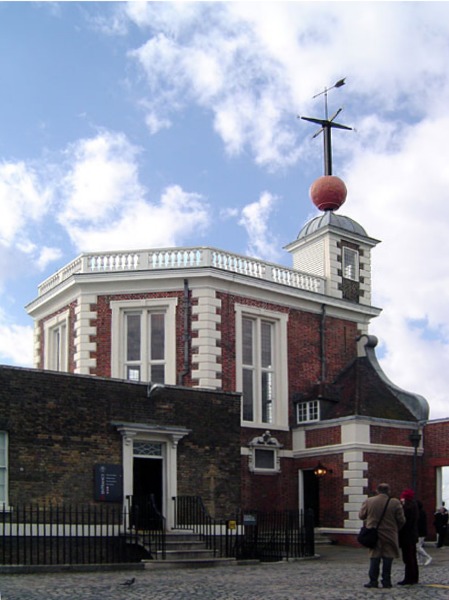
Time-signalling device
A time ball is a large, wooden or metal ball that is dropped at a predetermined time of day. Because precise timekeeping is essential to the determination of longitude at sea, time balls were principally erected to allow navigators aboard nearby ships to synchronize their marine chronometers with a reference time standard controlling the ball. Time balls have been rendered obsolete by electronic time signals, but some are kept in operation as tourist attractions.
History
The fall of a ball was in antiquity a way to show to people the time. Ancient Greek clocks had this system in the main square of a city, as in the city of Gaza in the post-Alexander era, and as described by Procopius in his book on Edifices. Time ball stations set their clocks according to transit observations of the positions of the sun and stars. Originally they either had to be stationed at the observatory, or had to keep a very accurate clock at the station which was set manually to observatory time. Following the introduction of the electric telegraph around 1850, time balls could be located at a distance from their source of mean time and operated remotely.
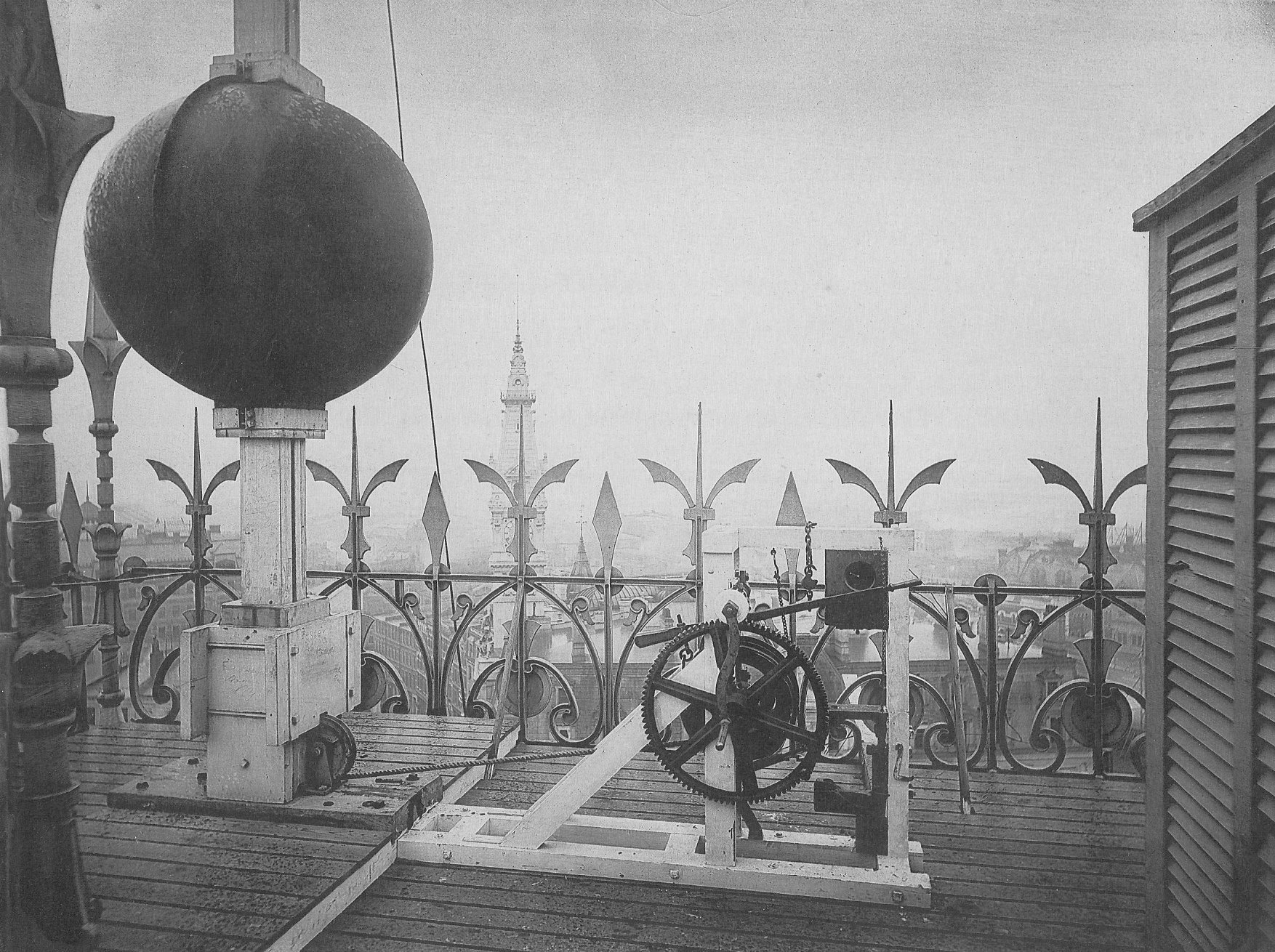
The first modern time ball was erected at Portsmouth, England, in 1829 by its inventor Robert Wauchope, a captain in the Royal Navy. Others followed in the major ports of the United Kingdom (including Liverpool) and around the maritime world. Wauchope submitted his scheme to American and French ambassadors when they visited England. The United States Naval Observatory was established in Washington, D.C., and the first American time ball went into service in 1845.
Time balls were usually dropped at 1 p.m. (although in the United States they were dropped at noon). They were raised half way about 5 minutes earlier to alert the ships, then with 2–3 minutes to go they were raised the whole way. The time was recorded when the ball began descending, not when it reached the bottom. With the commencement of radio time signals (in Britain from 1924), time balls gradually became obsolete and many were demolished in the 1920s.
A contemporary version of the concept has been used since 31 December 1907 at New York City's Times Square as part of its New Year's Eve celebrations; at 11:59 p.m., a lit ball descends from a pole on the roof of One Times Square over the course of 60 seconds, reaching its conclusion at 12:00 a.m. The spectacle—which has given rise to many similar events—was inspired by an organizer having seen the time ball on the Western Union Building in operation.{{cite news
Around the world
Over sixty time balls remain standing, though many are no longer operational. Existing time balls include:
Australia

- The Old Windmill, Brisbane, Queensland
- Fremantle, Western Australia
- Sydney Observatory, New South Wales
- Newcastle Customs House, New South Wales
- Semaphore, South Australia
- Williamstown Lighthouse, Victoria
- Geelong Telegraph Station, Victoria
Canada
- Citadelle of Quebec, Quebec City no longer true. Clearly seen from the river and aligned on the meridian for observation purposes, Building 20, also known as the Ball House, is the former observatory and time ball tower.
New Zealand

In March 1864 New Zealand's first time ball was established at Wellington. This was followed by Port Chalmers in June 1867, Wanganui in October 1874, Lyttelton in December 1876 and Timaru in 1888. Attempts were made by some people in Auckland to establish time balls there from 1864 onwards, but these were not recognized by the authorities until a permanent time ball was mounted on the Ferry Building in August 1901.
-
Port Chalmers :Established by the Otago Provincial Council on top of Observation Point in Port Chalmers in June 1867 the time ball service initially operated at 1 pm on all days of the week except Sundays. The service was discontinued in October 1877, but following concerns raised by 11 shipmasters the service resumed in April 1882 as a weekly service. In 1910 the time keeping service was discontinued but the ball however continued to be used until 1931 as a warning device. It was removed in 1970 but a replacement was restored to service in 2020.
-
Lyttelton :Established in December 1876 the Lyttelton Timeball Station in Lyttelton, New Zealand, was operational until it was damaged in the 2010 Canterbury earthquake. Further severe damage occurred in the February 2011 Christchurch earthquake, and a decision was made in March 2011 to dismantle the building, a danger to the public, but the tower collapsed during the major aftershock that hit the Lyttelton area on 13 June 2011. In November 2012, a large financial donation was made available to contribute towards rebuilding the tower, a project the community considered. On 25 May 2013, it was announced that the tower and ball would be restored, and that funds were to be sought from the community to rebuild the rest of the station. The station was officially reopened on 2 November 2018.
-
Wellington :The Wellington time ball service started in March 1864. It received its time information from the Dominion Observatory which was also communicated to the Lyttelton time ball service. Dunedin used local observatory facilities.
:Wellington had two time ball sites – the time ball was erected at the first site by mid-January 1864 on top of the Custom House building on the Wellington waterfront and later relocated in 1888 to the J Shed Woolstore on top of the accumulator tower. This building and the time ball burnt down on 9 March 1909.

:Instead of replacing the Wellington time ball after the second site burnt down, time light signals were introduced at the Dominion Observatory. The earliest record of this was 22 February 1912. They were in use until 1937 when wireless signals took over as the new way to keep time.
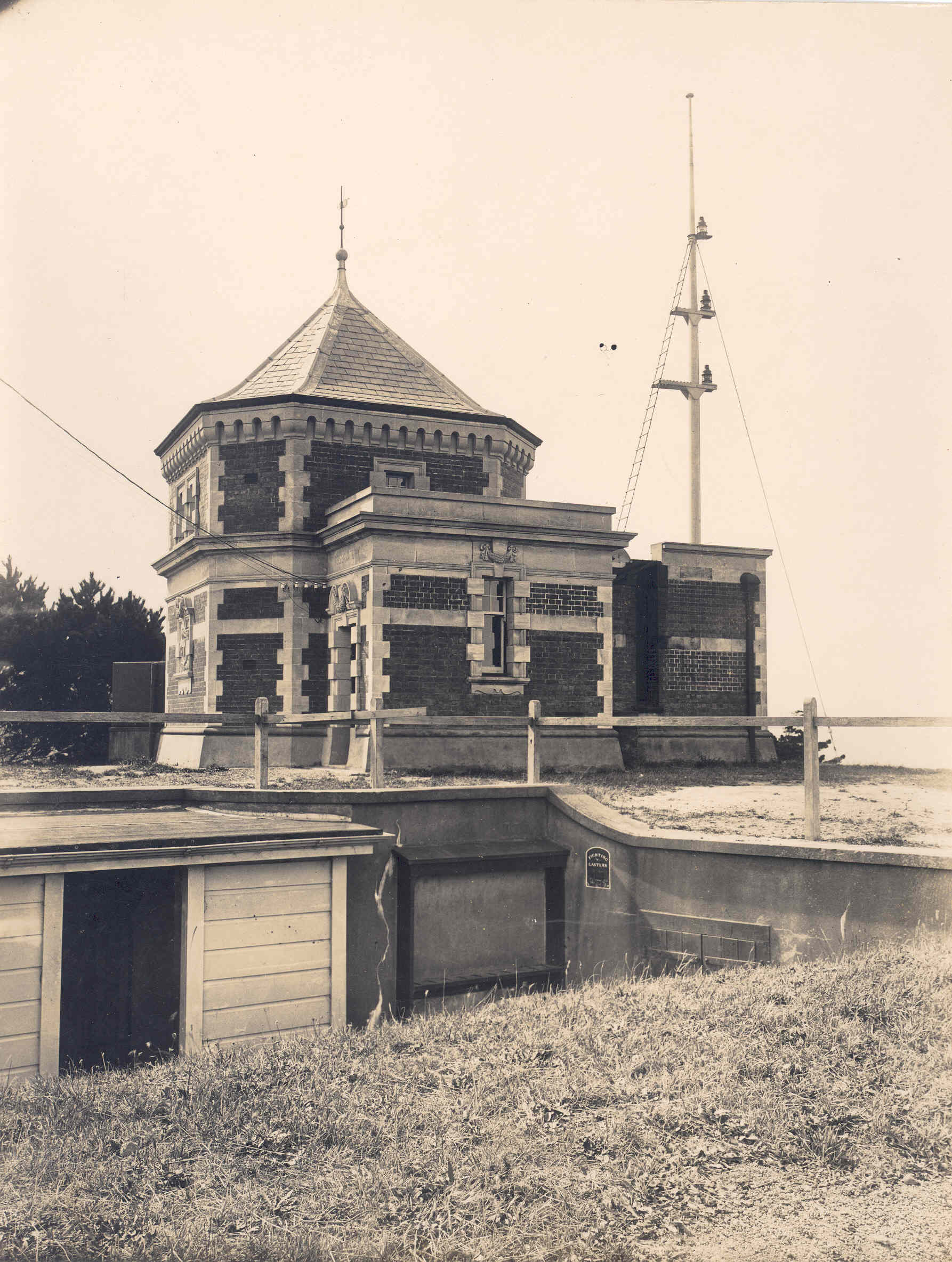
Poland
- Gdańsk, Poland (The time ball was installed in 1876, moved to the Danzig (now Gdańsk) lighthouse in 1894, and removed in 1929. In 2008 it was reconstructed from original plans)
South Africa
- Victoria & Alfred Waterfront, Cape Town
Spain
- The Real Instituto y Observatorio de la Armada in San Fernando, Cádiz continues to activate its time ball every day at 13:00 (ROA Time). After better timekeeping at sea made it obsolete, it was disabled, but it was reactivated in the late 20th century.
- The Royal House of the Post Office in Puerta del Sol, Madrid, operated a time ball for Madrid. Nowadays it is only used to mark the imminent start of the bell strikes that mark the New Year at midnight. The main Spanish TV networks broadcast the event, allowing spectators to eat the traditional Twelve Grapes.
United Kingdom
- Timeball Tower, Deal, Kent, England. Operates hourly and has recently been refurbished.
- Margate Clock Tower, Kent, England
- Royal Observatory, Greenwich, England
- Time Ball Buildings, Leeds, England
- Guildhall, Kingston upon Hull, England. The only maritime timepiece on a municipal building. It dates back to 1918 and is the highest in the UK.
- Clock Tower, Brighton, East Sussex, England. (originally operated hourly, but was later stopped as it was too noisy)
- Nelson's Monument on Calton Hill, Edinburgh, Scotland
- Flat Iron Building in Prescot, Merseyside. Added during restoration of the building, the timeball dates from the 1800s but is controlled by a newly-built mechanism.
United States
- United States Naval Observatory, Washington D.C.
- Titanic Memorial, New York City
- Plymouth Light, Gurnet Point, Plymouth, Massachusetts
Gallery
File:Nelson Monument.jpg|The Nelson Monument, Edinburgh, UK File:US Naval Observatory (Washington, District of Columbia).jpg|United States Naval Observatory, Washington, D.C., US File:Deal Timeball Tower.jpg|Deal Timeball, Deal, UK File:Nowy Port Gdansk-kula czasu latarnia.png|Gdańsk, Poland File:Time ball on Navigationsskolan Gbg.jpg|Gothenburg, Sweden File:Guildhall Timeball, Kingston upon Hull, Jun23.jpg|Guildhall, Kingston upon Hull, UK File:Madrid - Puerta del Sol 01.JPG|Royal House of the Post Office, Madrid, Spain File:MARGATE CLOCK TOWER AND TIME BALL.jpg|Clock tower, Margate, Kent, UK File:Brighton_Clock_Tower.jpg|Clock tower, Brighton, UK File:Time-ball tower, Cape Town.jpg|Time ball, Cape Town, South Africa File:Fort_Gellibrand.jpg|Time ball, Williamstown Lighthouse, Victoria, Australia
References
References
- Aubin, David. (2010). "The Heavens on Earth: Observatories and Astronomy in Nineteenth-Century Science and Culture". Duke University Press.
- "Greenwich Time Ball". Royal Museums Greenwich.
- (2019). "Time ball". Greenwich Mean Time.
- "The Gdańsk Nowy Port Lighthouse and Time Ball".
- McFadden, Robert D.. (31 December 1987). "'88 Countdown: 3, 2, 1, Leap Second, 0". [[The New York Times]].
- "Lyttelton Timeball Station, Christchurch". Yahoo! Travel.
- Kinns, Roger. (2017). "The Principal Time Balls of New Zealand". Journal of Astronomical History and Heritage.
- (25 February 2011). "New Zealand quake: The epicentre town". BBC News.
- Gates, Charlie. (4 March 2010). "Timeball Station to be demolished". [[stuff.co.nz]].
- Greenhill, Marc. (14 June 2011). "Workmen unscathed as Timeball Station collapses". stuff.co.nz.
- Greenhill, Marc. (28 November 2012). "Donor fronts to save Lyttelton Timeball Station". stuff.co.nz.
- Lee, Francesca. (25 May 2013). "Million dollar donation to rebuild Lyttelton Timeball". stuff.co.nz.
- (25 May 2013). "$1m donation to rebuild timeball". radionz.co.nz.
- Kinns, Roger. (2017). "The Time Light Signals of New Zealand: Yet Another Way of Communicating Time in the Pre-Wireless Area". Journal of Astronomical History and Heritage.
- (11 January 1864). "Wellington (from our own correspondent)". Nelson Examiner and New Zealand Chronicle.
- (10 March 1909). "A Big Blaze". The Dominion.
- (22 February 1912). "Ships and Shipping". New Zealand Times.
- (2018-06-30). "La bajada de la bola del Observatorio se escucha por martinete". Andalucía Información.
- "Hull Guildhall's Time Ball set to rise and fall once again". BBC.
- (2006). "Heritage Gateway Listed Buildings Online — Clock Tower and Attached Railings, North Street (north side), Brighton, Brighton and Hove, East Sussex". Heritage Gateway ([[English Heritage]], Institute of Historic Building Conservation and [[ALGAO.
- (18 June 2023). "Building 'people from across the world will visit' after revamp". Liverpool Echo.
- (24 August 2005). "1913: Titanic Memorial Lighthouse Commemorates Victims of Ocean Tragedy". [[Newsday]].
- Caruso, Martina. (31 October 2024). "Time Balls". South Street Seaport Museum.
This article was imported from Wikipedia and is available under the Creative Commons Attribution-ShareAlike 4.0 License. Content has been adapted to SurfDoc format. Original contributors can be found on the article history page.
Ask Mako anything about Time ball — get instant answers, deeper analysis, and related topics.
Research with MakoFree with your Surf account
Create a free account to save articles, ask Mako questions, and organize your research.
Sign up freeThis content may have been generated or modified by AI. CloudSurf Software LLC is not responsible for the accuracy, completeness, or reliability of AI-generated content. Always verify important information from primary sources.
Report