From Surf Wiki (app.surf) — the open knowledge base
Tiltwing
Aircraft with a rotating wing for takeoff and landing
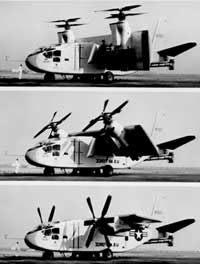
Aircraft with a rotating wing for takeoff and landing
A tiltwing aircraft features a wing that is horizontal for conventional forward flight and rotates up for vertical takeoff and landing. It is similar to the tiltrotor design where only the propeller and engine rotate. Tiltwing aircraft are typically fully capable of VTOL operations.
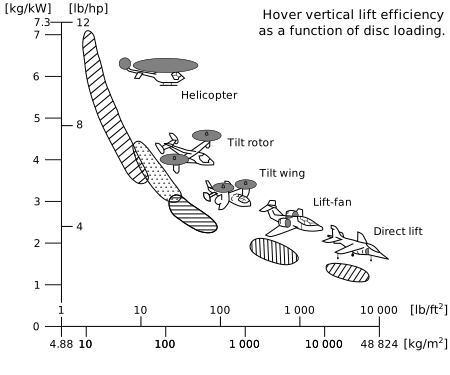
The tiltwing design offers certain advantages in vertical flight relative to a tiltrotor. Because the slipstream from the rotor strikes the wing on its smallest dimension, the tiltwing is able to apply more of its engine power to lifting the aircraft. For comparison, the V-22 Osprey tiltrotor loses about 10% of its thrust to interference from the wings.
Another advantage of tiltwing aircraft is the ease of transition between VTOL and horizontal flight modes. A tiltrotor must first fly forwards like a helicopter, building airspeed until wing lift is sufficient to allow the nacelles to begin tilting down. As a note, the MV-22 Osprey's stall speed in airplane mode is 110 kn. Conversely, a tiltwing aircraft can begin the transition from helicopter to airplane at zero forward airspeed. Because of this, the Canadair CL-84 Dynavert was able to take off vertically, then accelerate from zero airspeed to 100 kn in 8 seconds.
However, the fixed wing of a tiltrotor aircraft offers a superior angle of attack—thus more lift and a shorter takeoff roll—when performing STOL/STOVL operations.
The main drawbacks of tiltwing aircraft are susceptibility to wind gusts in VTOL mode and lower hover efficiency. The wing tilted vertically represents a large surface area for crosswinds to push against. This is due to the difference in rotor disk loading.
As of 2014, NASA is testing a diesel-electric hybrid 10-foot 10-rotor tiltwing called the GL-10 Greased Lightning, with most propellers folding during horizontal flight.
List of tiltwing aircraft
Tiltwing designs with rocket, jet, or propeller propulsion
- Avión Torpedo (1902)
- Weserflug P.1003 (1938)
- Vertol VZ-2 (1957)
- Hiller X-18 (1959)
- Kaman K-16B (1959)
- LTV XC-142 (1964)
- Canadair CL-84 Dynavert (1965)
- NASA GL-10 Greased Lightning (2014)
- Airbus A³ Vahana (2018)
- Pterodynamics Transwing
References
References
- Markman, Steve and Bill Holder. "Tilt-Wing VTOL Systems". ''Straight Up: A History of Vertical Flight''. Schiffer Publishing, 2000. {{ISBN. 0-7643-1204-9.
- [http://www.flightglobal.com/blogs/the-dewline/2009/06/boeing-looks-ahead-to-a-v-23-o.html Boeing looks ahead to a 'V-23' Osprey]
- [https://www.flightglobal.com/pdfarchive/view/1992/1992%20-%200263.html Tilting at Targets]
- Tiltrotors generally have better hover efficiency than tiltwings, but less than helicopters.Warwick, Graham. "[http://www.flightglobal.com/pdfarchive/view/1992/1992%20-%200262.html Tilting at targets]" page 44 ''[[Flight International]]'', February 1992. Accessed: 4 January 2014.
- Warwick, Graham. "Distributed power" ''[[Aviation Week & Space Technology]]'' page 31, 25 August 2014. Accessed: 26 August 2014.
This article was imported from Wikipedia and is available under the Creative Commons Attribution-ShareAlike 4.0 License. Content has been adapted to SurfDoc format. Original contributors can be found on the article history page.
Ask Mako anything about Tiltwing — get instant answers, deeper analysis, and related topics.
Research with MakoFree with your Surf account
Create a free account to save articles, ask Mako questions, and organize your research.
Sign up freeThis content may have been generated or modified by AI. CloudSurf Software LLC is not responsible for the accuracy, completeness, or reliability of AI-generated content. Always verify important information from primary sources.
Report