From Surf Wiki (app.surf) — the open knowledge base
Tiger Stadium (Detroit)
Demolished stadium in Detroit

Demolished stadium in Detroit
| Field | Value |
|---|---|
| name | Tiger Stadium |
| nickname | "The Corner" |
| image | Image:Inside Tiger Stadium, Detroit.jpg |
| caption | Tiger Stadium in 1998 |
| address | 2121 Trumbull Avenue |
| city | Detroit, Michigan |
| country | U.S. |
| coordinates | |
| broke_ground | |
| opened | |
| closed | |
| demolished | |
| owner | Detroit Tigers (1912–1977) |
| City of Detroit (1977–2009) | |
| operator | Detroit Tigers |
| surface | Bluegrass |
| construction_cost | US$300,000 |
| ($ in dollars) | |
| architect | Osborn Engineering Company |
| general_contractor | Hunkin & Conkey |
| former_names | |
| seating_capacity | |
| dimensions | |
| tenants | |
| name | Tiger Stadium |
| embed | yes |
| added | February 6, 1989 |
| delisted | September 1, 2022 |
| refnum | 88003236 |
| designated_other1 | Michigan State Historic Site |
City of Detroit (1977–2009) ($ in dollars) Tiger Stadium, previously known as Navin Field and Briggs Stadium, was a multi-use stadium located in the Corktown neighborhood of Detroit, Michigan, United States. The stadium was nicknamed "The Corner" for its location at the intersection of Michigan and Trumbull Avenues. It hosted the Detroit Tigers of Major League Baseball (MLB) from 1912 to 1999, as well as the Detroit Lions of the National Football League (NFL) from 1938 to 1939, 1941 to 1974. Tiger Stadium was declared a State of Michigan Historic Site in 1975 and was listed on the National Register of Historic Places in 1989.
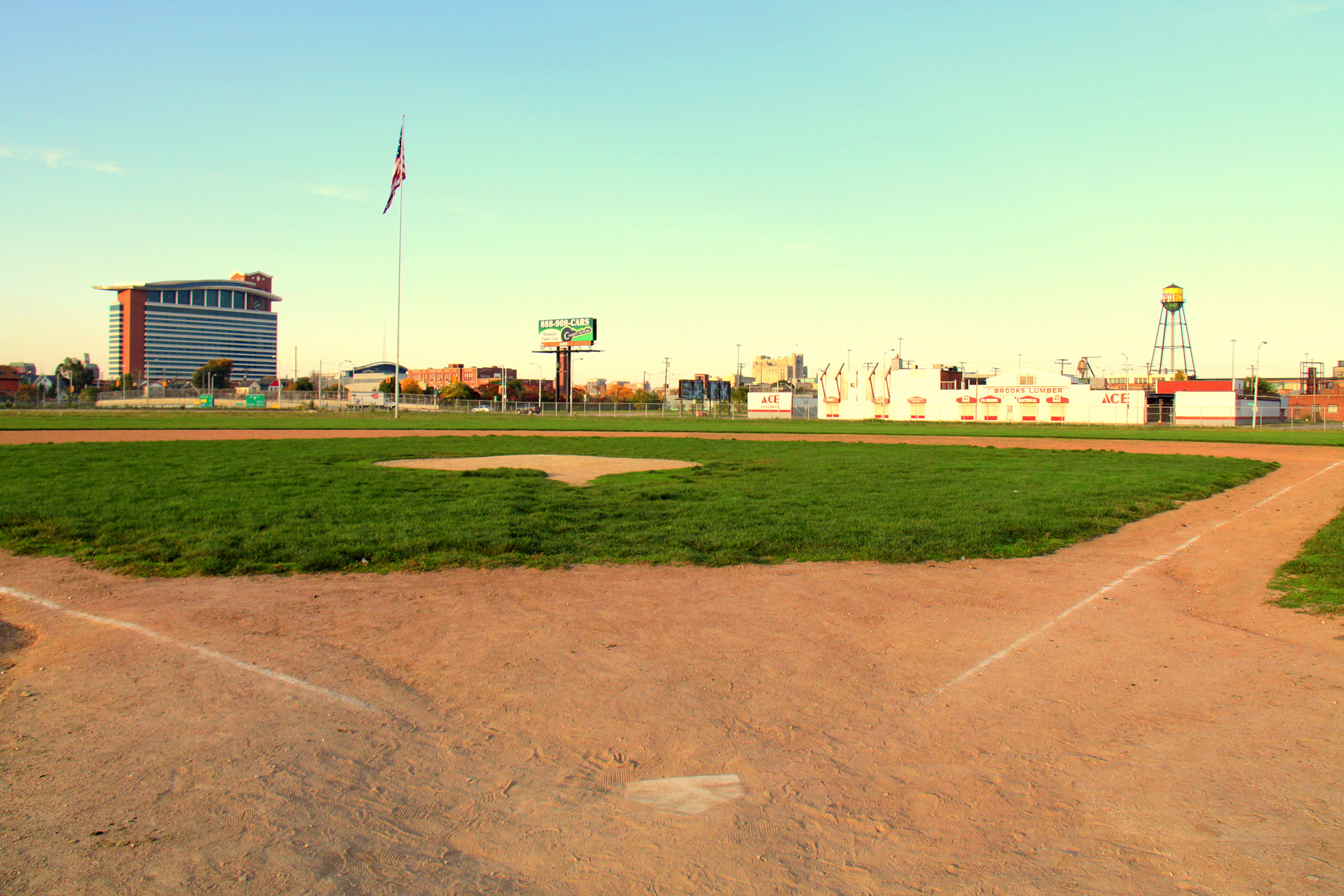
The last Tigers game at the stadium was held on September 27, 1999. In the decade after the Tigers vacated the stadium, several rejected redevelopment and preservation efforts finally gave way to the stadium's demolition, which was completed on September 21, 2009. The former playing field remained until 2018, when the site was redeveloped for youth sports as the Corner Ballpark.
History
Origins
In 1895, Detroit Tigers owner George Vanderbeck had a new stadium built at the corner of Michigan and Trumbull avenues. That stadium was called Bennett Park and featured a wooden grandstand with a wooden peaked roof in the outfield. At the time, some places in the outfield were only marked off with rope.
In 1911, new Tigers owner Frank Navin ordered a new steel-and-concrete baseball park to be built on the same site that would seat 23,000 to accommodate the growing numbers of fans. Navin Field opened on April 20, 1912, the same day as Fenway Park in Boston. While constructed on the same site as Bennett Park, the diamond at Navin Field was rotated 90°, with home plate located in what had been left field at Bennett Park. Cleveland Naps player "Shoeless" Joe Jackson, later banned from baseball for life following the Black Sox Scandal, scored the first run at Navin Field.

Over the years, expansion continued to accommodate more spectators. In 1935, following Navin's death, new owner Walter Briggs Sr. oversaw the expansion of Navin Field to a capacity of 36,000 by extending the upper deck to the foul poles and across right field. By 1938, the city had agreed to move Cherry Street, allowing the left-field seats to be double-decked, and the now-renamed Briggs Stadium had a capacity of 53,000. In 1961, new owner John Fetzer took control of the stadium and gave it its final and longest-lasting name: Tiger Stadium. A fire gutted the press box on the evening of February 1, 1977. In 1977, the Tigers sold the stadium to the city of Detroit, which then leased it back to the Tigers. As part of this transfer, the green wooden seats were replaced with blue and orange plastic ones, and the stadium's interior, which was green, was painted blue to match.
By the early 1990s, it was clear that Tiger Stadium was at the end of its useful life. Both the city and Tigers ownership wanted a new park, but many campaigned to save the old stadium. While a plan to modify and maintain Tiger Stadium as the home of the Tigers, known as the Cochrane Plan, was supported by many in the community, it was never seriously considered by the city or the Tigers. Ground was broken for the new Comerica Park on October 29, 1997.
Features
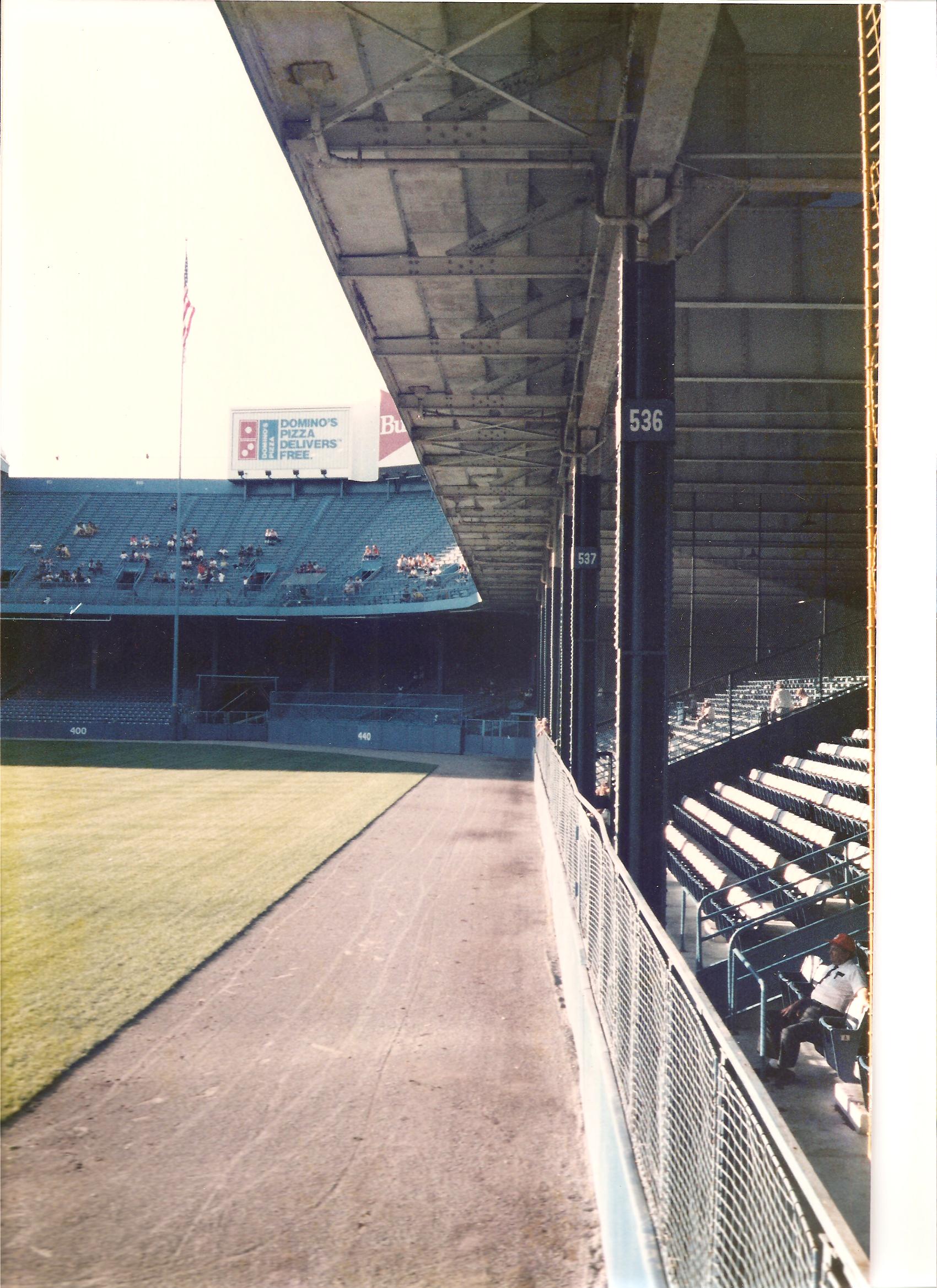
Tiger Stadium had a 125-foot (38 m) tall flagpole in fair play, to the left of dead center field near the 440-foot (134 m) mark. The same flag pole was to be brought to Comerica Park, but this never happened. A new flagpole in the spirit of Tiger Stadium's pole was positioned in fair play at Comerica Park until the left field fence was moved in closer prior to the 2003 season.
When it closed, Tiger Stadium was tied with Fenway Park as the oldest stadium in Major League Baseball; the two parks opened on the same date in 1912. Taking predecessor Bennett Park into account, Tiger Stadium was the oldest Major League Baseball site in use in 1999.
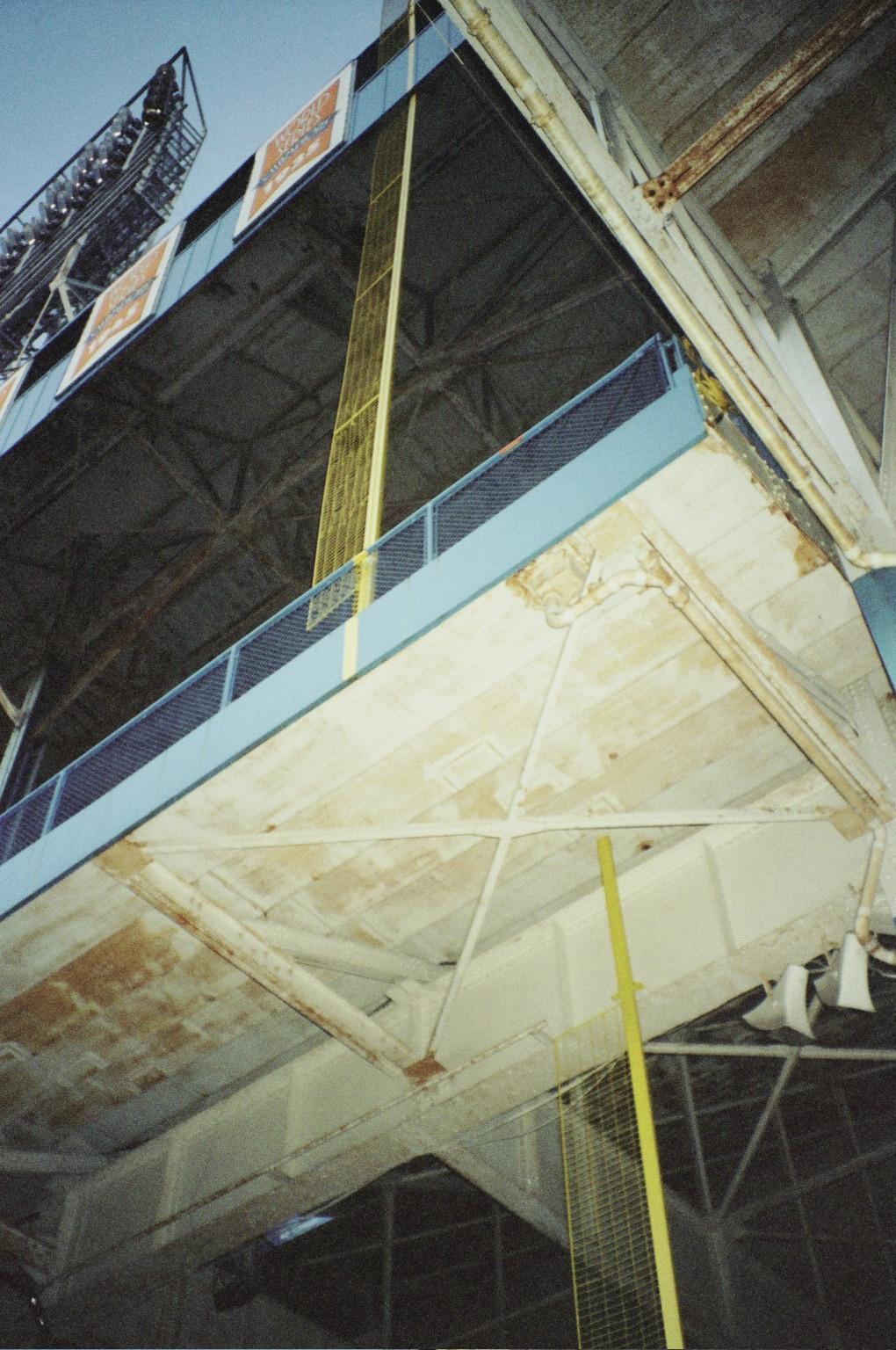
When the park was expanded in 1936, a second deck was added over the right field pavilion and bleachers. To fit as many seats as possible in the expansion, the second deck was extended over the fence by 10 feet (3 m). The overhang would occasionally turn some extremely high arced fly balls into home runs. Spotlights were added above the warning track to illuminate the area beneath the overhang.
Like other older baseball stadiums such as Fenway Park and Chicago's Wrigley Field, Tiger Stadium offered "obstructed view" seats, some of which were directly behind a steel support column; while others in the lower deck had sight lines obstructed by the low-hanging upper deck. By making it possible for the upper deck to stand directly above the lower deck, the support columns allowed the average fan to sit closer to the field than at any other ballpark.
For a time after it was constructed, the right field upper deck had a "315" marker at the foul pole (later painted over), with a "325" marker below it on the lower deck fence (which was retained). The Texas Rangers claimed that the design of the right field section was copied and used in the construction of what is now Choctaw Stadium, but in fact the upper deck did not actually extend over the right field fence, but was set back by several feet.
Due to then-owner Walter Briggs's dislike of night baseball, lights were not installed at the stadium until 1948. The first night game at the stadium was held on June 15, 1948. Among major league parks whose construction predated the advent of night games, only Wrigley Field went longer before installing lights (1988).
Tiger Stadium featured an upper and lower deck bleacher section that was separated from the rest of the stadium. Chain link and at one time, a barbed wire fence, separated the bleachers from the reserved sections and was the only section of seating not covered by at least part of the roof. The bleachers had their own entrance, concession stands and restrooms.
In 1999, its final season, only this ballpark and Bank One Ballpark had a dirt path that ran from the pitcher's mound to home plate. It originally had one before it was removed.
Professional football
Tiger Stadium was home of the Detroit Lions from 1938 to 1939, 1941 to 1974. The stadium hosted two NFL Championship Games in 1953 and 1957. The football field ran mostly in the outfield from the right field line to left center field parallel with the third base line. The benches for both the Lions and their opponents were on the outfield side of the field.
In the early 1970s, the city of Pontiac and its community leaders made a presentation to the Metropolitan Stadium Committee of a 155 acre site on the city's eastern boundary, north of M-59 and near the intersection with Interstate 75 (I-75). Initially, a dual stadium complex was planned that included a moving roof that was later scrapped due to high costs and the lack of a commitment from the Tigers. The Metropolitan Stadium Committee voted unanimously for the Pontiac site. In 1973, ground was broken for a stadium to exclusively house the Lions.
The Lions played their final game at Tiger Stadium on Thanksgiving Day, November 28, 1974, against the Denver Broncos.
Other events
In 1939, boxer Joe Louis defended his world heavyweight title with an eleventh-round knockout of Bob Pastor at the stadium.
On October 5, 1951, the University of Notre Dame played the University of Detroit at Briggs Stadium before a capacity crowd of 52,000. It was the first Notre Dame football game to be played at night. The Fighting Irish won, 40–6.
Northern Irish professional soccer club Glentoran F.C. called the stadium home in the late 1960s. The team played as the Detroit Cougars in the United Soccer Association.
Kiss played their first date of the Alive/Worldwide Tour on June 28, 1996. It was the first concert with the original lineup since 1979.
Notable moments and facts
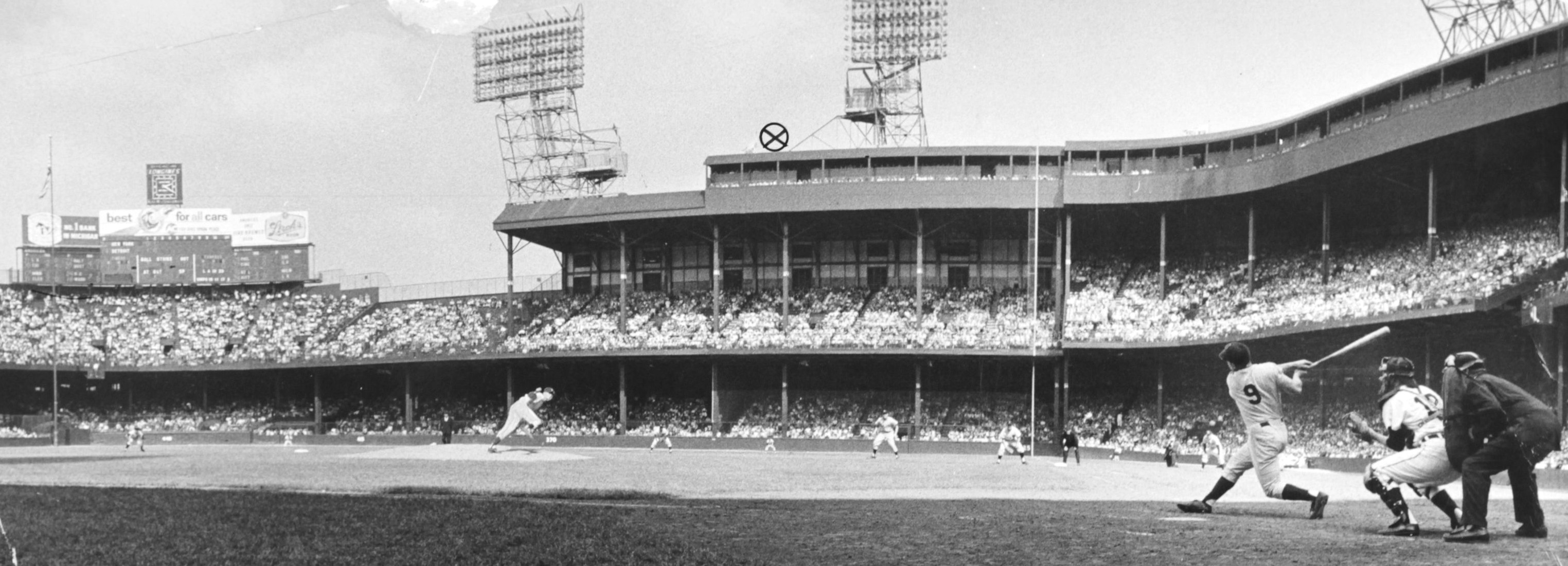
When Ty Cobb played at Navin Field, the area of dirt in front of home plate was kept wet by the groundstaff to slow down Cobb's bunts and cause opposing infielders to slip as they fielded them. The area was nicknamed "Cobb's Lake".
On July 18, 1921, Babe Ruth hit what is believed to be the longest verified home run in Major League Baseball history. The home run went to straightaway center field, clearing the stadium and landing into the street. The distance of the home run has been estimated at up to 575 ft. On July 13, 1934, at the stadium, Ruth hit his 700th career home run off Tigers' pitcher Tommy Bridges.
On May 2, 1939, ailing New York Yankees first baseman Lou Gehrig voluntarily benched himself at Briggs Stadium, ending his streak of consecutive games at 2,130. Due to the progression of the disease named after him, it was the final game of his career.
The last scoreless tie in the NFL was played at Tiger Stadium between the Detroit Lions and New York Giants on November 7, 1943.
The stadium hosted the 1941, 1951 and 1971 MLB All-Star Games. All three games featured home runs. Ted Williams won the 1941 game with a walk-off three-run home run. The ball was also carrying well in the 1951 and 1971 games. Of the many home runs in those games, the most often replayed is Reggie Jackson's drive to right field that hit so high up in the light tower that the TV camera lost sight of it, until it dropped to the field below. Jackson dropped his bat and watched it sail, seemingly astonished at his own power.
Toward the end of the Lions' game against the Chicago Bears at the stadium on October 24, 1971, Lions wide receiver Chuck Hughes collapsed and later died of a heart attack, making Hughes the only NFL player to date who died during a game.
On April 7, 1986, Dwight Evans hit a home run on the first pitch of Opening Day. This was also the first game on MLB's schedule that season, giving Evans the record for the earliest home run to start a season in terms of at bats.

There were over 30 home runs hit onto the right field roof over the years. It was a relatively soft touch compared to left field, with a 325 ft foul line and with a roof that was in line with the front of the lower deck. In left field, it was 15 ft farther down the line, and the roof was set back some distance. Only four of the game's most powerful right-handed sluggers (Harmon Killebrew, Frank Howard, Cecil Fielder and Mark McGwire) reached the left field rooftop. In his career, Norm Cash hit four home runs over the Tiger Stadium roof in right field and is the all-time leader.
Tiger Stadium saw exactly 11,111 Major League home runs.
The final game
Main article: 1999 Detroit Tigers season#Final game at Tiger Stadium
On September 27, 1999, the final Tigers game was held at Tiger Stadium; an 8–2 victory over the Kansas City Royals, capped by a late grand slam by Robert Fick, which hit the right field roof. It was the final Major League hit, home run, and RBI in Tiger Stadium's history. Following the game, an emotional ceremony with past and present Tigers greats was held to mark the occasion. The Tigers moved to the newly constructed Comerica Park for their 2000 season, leaving Tiger Stadium unused.
Final years
On July 24, 2001, the day Detroit celebrated its 300th birthday, a Great Lakes Summer Collegiate League game between the Motor City Marauders and the Lake Erie Monarchs was played at Tiger Stadium. It was an effort by a local sports management company to bring a Frontier League franchise to Detroit.
In February 2006, a tent on Tiger Stadium's field played host to Anheuser-Busch's Bud Bowl 2006. Among performers at the nightclub-style event was Snoop Dogg. Anheuser-Busch promoted the event as Tiger Stadium's Last Call.
In 2006, the feature-length documentary Stranded at the Corner: The Battle to Save Historic Tiger Stadium was released. Funded by local businessman and ardent stadium supporter Peter Comstock Riley, and directed by Gary Glaser, it earned solid reviews and won three Telly awards and two Emmy awards for the film's writer and co-producer, Richard Bak, a local journalist and the author of two books about the stadium. It was also shown at the inaugural National Baseball Hall of Fame Film Festival in November 2006.
Demolition
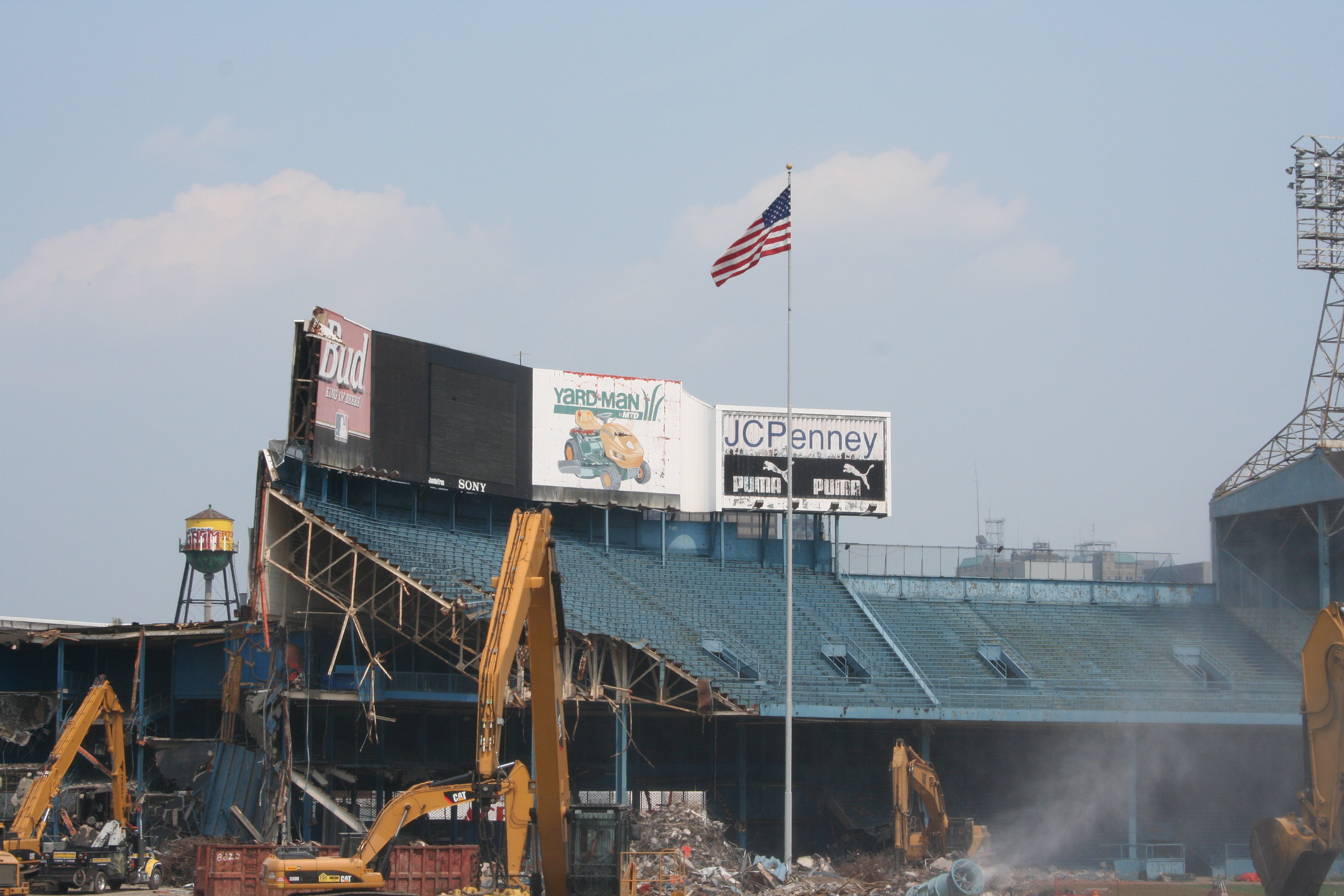
There were many proposals to redevelop the site. By 2006, however, demolition appeared inevitable when then-Detroit Mayor Kwame Kilpatrick announced the stadium would be razed. In June 2007, the Detroit Economic Growth Corporation approved a plan to demolish the stadium, which needed approval from Detroit City Council. In July 2007, Detroit City Council voted 5–4 in approval of the demolition.
In October 2007, an online auction of the stadium's memorabilia was held by Schneider Industries, which drew $192,729. The city used the proceeds to defray the demolition costs.
The Detroit Economic Growth Corporation awarded the demolition contract on April 22, 2008, with the speculation that demolition revenue would come from the sale of scrap metal. Demolition began on June 30, 2008.
After a hiatus wherein various plans to preserve portions of the stadium were considered, demolition was completed on September 21, 2009.
Redevelopment
During the summer of 2010, a group calling itself "The Navin Field Grounds Crew" began maintaining the playing field and hosting vintage baseball, youth baseball, and softball games at the site. There was at one time also a sign on the enclosing fence labeling the site "Ernie Harwell Park".
On December 16, 2014, a $33 million project by Larson Realty Group to redevelop the old Tiger Stadium site was approved by Detroit's Economic Development Corporation. Development plans included a four-story building along Michigan Avenue with about 30000 sqft of retail space and 102 residential property rental units, each averaging 800 sqft. Along Trumbull Avenue, 24 town homes were planned for sale. Detroit's Police Athletic League (PAL) headquarters would relocate to the site and maintain the field. PAL would build its new headquarters and related facilities on the western and northern edges of the site while preserving the historic playing field for youth sports, including high school and college baseball. Construction of the project began in June 2016.
In 2018, the Corner Ballpark opened at the site.
Films and television
The stadium was seen in the 1980 feature film Raging Bull where it was the site of two of Jake LaMotta's championship boxing matches.
It was depicted in Disney's award-winning Tiger Town, a 1983 made-for-television baseball film written and directed by Detroit native, Alan Shapiro, starring Roy Scheider, Sparky Anderson, Ernie Harwell and Mary Wilson. It was also seen in Renaissance Man and Hardball.
In the summer of 2000, the HBO movie 61* was filmed at Tiger Stadium. The film dramatized the efforts of New York Yankees teammates Mickey Mantle and Roger Maris during the 1961 season to break fellow Yankee Babe Ruth's single-season home run record of 60. For the film, computer-generated visual effects were used to make Tiger Stadium resemble Yankee Stadium in 1961. Yankee Stadium is listed in the credits at the end of the film as being played by Tiger Stadium.
During the last days in which part of Tiger Stadium was still standing, scenes for the film Kill the Irishman, which were used to depict Cleveland Stadium, were shot at the stadium.
The pilot of the HBO series Hung featured the stadium's demolition in its opening scene.
In popular culture
- Artist Gene Mack, who drew a series of pictures of several figures and ballparks, mentioned a bone that Ty Cobb used to "bone" his bats as part of his care for them. The bone stayed in the clubhouse after he left the Tigers in 1926 and, indeed, after he retired in 1928.
- In the music video for rapper Eminem's song "Beautiful", Eminem can be seen walking through the stadium, showing the destruction of the stadium.
- The site was filmed for the Hung episode "Fat Off My Love or I'm the Allergen".
Seating capacity
| Detroit Tigers}};" | Years | Detroit Tigers}};" | Capacity | Detroit Tigers}};" | 1912–1922 | Detroit Tigers}};" | 1923–1936 | Detroit Tigers}};" | 1937 | Detroit Tigers}};" | 1938–1960 | Detroit Tigers}};" | 1961 | Detroit Tigers}};" | 1962 | Detroit Tigers}};" | 1963–1968 | Detroit Tigers}};" | 1969–1977 | Detroit Tigers}};" | 1978–1979 | Detroit Tigers}};" | 1980 | Detroit Tigers}};" | 1981 | Detroit Tigers}};" | 1982–1988 | Detroit Tigers}};" | 1989–1996 | Detroit Tigers}};" | 1997–1999 |
|---|---|---|---|---|---|---|---|---|---|---|---|---|---|---|---|---|---|---|---|---|---|---|---|---|---|---|---|---|---|---|---|
| 23,000 | |||||||||||||||||||||||||||||||
| title=Past Detroit Tigers Venues | url=http://mlb.mlb.com/det/ballpark/information/index.jsp?content=pastvenues | publisher=Major League Baseball Advanced Media | access-date=November 27, 2011 | archive-date=April 13, 2012 | archive-url=https://web.archive.org/web/20120413145717/http://mlb.mlb.com/det/ballpark/information/index.jsp?content=pastvenues | url-status=live}} | |||||||||||||||||||||||||
| 36,000 | |||||||||||||||||||||||||||||||
| 58,000 | |||||||||||||||||||||||||||||||
| 52,904 | |||||||||||||||||||||||||||||||
| 52,850 | |||||||||||||||||||||||||||||||
| 53,089 | |||||||||||||||||||||||||||||||
| 54,226 | |||||||||||||||||||||||||||||||
| 53,676 | |||||||||||||||||||||||||||||||
| 52,067 | |||||||||||||||||||||||||||||||
| 52,687 | |||||||||||||||||||||||||||||||
| 52,806 | |||||||||||||||||||||||||||||||
| 52,416 | |||||||||||||||||||||||||||||||
| 46,945 |
| Detroit Lions}};" | Years | Detroit Lions}};" | Capacity | Detroit Lions}};" | 1938–1967 | Detroit Lions}};" | 1968–1970 | Detroit Lions}};" | 1971–1974 |
|---|---|---|---|---|---|---|---|---|---|
| 52,555 | |||||||||
| 54,082 | |||||||||
| 54,418 |
Gallery
Image:Tiger Stadium, Detroit.jpg|An empty Tiger Stadium in January 2005 Image:thecorner001.jpg|Tiger Stadium showing signs of neglect in 2006 Image:Tiger Stadium lettering removed.jpg|Tiger Stadium with facade lettering removed in November 2007 Image:TigerStadium No Seats 11 07 1.JPG |The visitors' bullpen and right field from lower deck in November 2007 Image:Tiger Stadium RF Nov 2007 2.JPG|Tiger Stadium with seats removed in November 2007 Image:Tiger Stadium exterior April 2008 - Detroit Michigan.jpg|Abandoned in April 2008; Tigers now play in Comerica Park Image:Tiger Stadium Demonstration 1920.jpg|Demonstration against a School Amendment at Navin Field in 1920
References
References
- Mesrey, Dave. (September 27, 2014). "Remembering 'The Corner'".
- Ferkovich, Scott. "Tiger Stadium (Detroit)".
- "Tiger Stadium".
- (July 6, 2018). "Tiger Stadium still holds a special place in hearts of fans".
- Oosting, Jonathan. (September 22, 2009). "Sept. 21, 2009: The day Tiger Stadium died".
- "Tiger Stadium".
- Shea, Bill. (September 10, 2017). "What Detroit's stadiums cost".
- "Bennett Park/Navin Field/Briggs Stadium/Tiger Stadium". Detroit1701.
- "Past Tigers Ballparks".
- Dow, Bill. (March 6, 2011). "50 Years ago Briggs Stadium was Renamed Tiger Stadium".
- "Weekly List 2022 09 02". National Park Service.
- "National Register of Historic Places – MICHIGAN (MI), Wayne Country". [[National Park Service]].
- Dudar, Hasan. (March 24, 2018). "First pitch thrown at former Tiger Stadium site, now home to youth league".
- Dickson, Marcus W.. "April 28, 1896: There used to be a hay market here: Detroit Tigers open Bennett Park".
- "Bennett Park Historical Analysis".
- Wohlenhaus, Jim. "April 20, 1912: Frank Navin's field of dreams opens in Detroit".
- ""Tiger Stadium Damaged By Fire," ''United Press International'', Wednesday, February 2, 1977.".
- "Cochrane Plan Writeup".
- Reindl, JC. (March 20, 2018). "Old Tiger Stadium's famed flagpole gets new life".
- Dow, Bill. (October 3, 2018). "Tiger Stadium Flag Pole Gets New Life".
- Rinehart, Sean. (January 10, 2012). "Detroit Tigers: 10 Things You May Not Know About Comerica Park".
- Niyo, John. (March 1, 2003). "Comerica getting a new dimension".
- (December 28, 2009). "jw1223117 {{!}} Flickr – Photo Sharing".
- (December 28, 2009). "jw121789 {{!}} Flickr – Photo Sharing".
- "Rangers Ballpark in Arlington".
- Dominiak, Scott. "June 15, 1948: 'Look at your wonderful lights here': Tigers win first night game in Detroit".
- Glassman, Steven. "The Game That Was Not—Philadelphia Phillies at Chicago Cubs, August 8, 1988".
- Vettel, Phil. (January 3, 2008). "The Cubs get lights at Wrigley Field".
- Goldberger, Paul. (2019). "Ballpark: Baseball in the American City". Knopf Doubleday Publishing Group.
- "Tiger Stadium - Old photos".
- Moutzalias, Tanya. (April 5, 2015). "Remembering old Tiger Stadium and its final game".
- "Arizona Diamondbacks Bank One Ballpark".
- Bingham, Emily. (April 9, 2016). "In pictures: Remembering the Tigers' original home in Detroit".
- "1953 Championship Game".
- Monarrez, Carlos. (September 5, 2017). "1957 Detroit Lions: What happened each game during championship season".
- "Tiger Stadium – History, Photos & More of the former NFL stadium of the Detroit Lions".
- "Former Pontiac Silverdome . . . 1965 – 2017: History of Inception and Planning".
- Dow, Bill. (December 10, 2010). "The Detroit Lions' Last Game at Tiger Stadium".
- Cowans, Russ J.. (September 30, 1939). "Louis Proved to Be Clever Ring Master in Victory over Bob Pastor". The Afro-American.
- (June 7, 2019). "Remembering when the Titans played Notre Dame at Briggs Stadium".
- O'Connor, Larry. (November 11, 2016). "DCFC-Glentoran match marks 50th anniversary of Detroit Cougars".
- Shea, Bill. (February 17, 2019). "DCFC to host MSU at old Tiger Stadium site".
- (June 28, 2023). "This Day in Kisstory 1996".
- Dickson, Paul. (1989). "The Dickson Baseball Dictionary". Facts on File.
- Ford, Ryan. (February 6, 2019). "Babe Ruth birthday: He owned the Detroit Tigers".
- Huber, Mike. "July 18, 1921: Babe Ruth's 560-foot blast against Tigers sets career home run record".
- Meyer, Zlati. (April 25, 2015). "Lou Gehrig ended streak at Tigers game".
- MacLennan, Ashley. (May 2, 2018). "This Day in Baseball: Lou Gehrig's historic run ended in Detroit".
- Ferkovich, Scott. (November 3, 2016). "The only scoreless tie in NFL history was played in Detroit".
- "All-Star Game History: 1941". Major League Baseball.
- "All-Star Game History: 1951". Major League Baseball.
- "All-Star Game History: 1971". Major League Baseball.
- Landers, Chris. (July 12, 2017). "Reggie Jackson's All-Star Game homer off the Tiger Stadium roof is still jaw-dropping". Major League Baseball.
- (October 25, 1971). "Detroit Lions Player Dies After Collapsing on Field".
- Carpenter, Les. (December 5, 2013). "Football Thursday: Legacy of Chuck Hughes goes deeper than being only NFL player to die on field during a game".
- "Boston Red Sox at Detroit Tigers Box Score, April 7, 1986".
- Walsh, Paul. (April 8, 1986). "Baseball season opens with a bang".
- Wisnia, Saul. (April 5, 2012). "Detroit Tigers vs. Boston Red Sox Opening Day: Remember What Happened in 1986?".
- ''The Final Season'', p. 85, Tom Stanton, Thomas Dunne Books, An imprint of St. Martin's Press, New York, 2001, {{ISBN. 0-312-29156-6
- Holmes, Dan. (April 20, 2013). "Home run facts from The Corner in Detroit". Vintage Detroit Collection.
- Wolf, Gregory H.. "September 27, 1999: Tears and cheers: Tiger Stadium hosts final game".
- "Kansas City Royals at Detroit Tigers Box Score, September 27, 1999".
- Bierma, Nathan. (September 28, 2017). "Closing ceremony brought a lineup of stars back to Tiger Stadium".
- (January 21, 2001). "Detroit Plans a 300th Birthday Splash".
- Ferkovich, Scott. (December 7, 2014). "The Unknown Kid Who Hit the Real Last Home Run at Tiger Stadium".
- (February 2, 2006). "Tiger Stadium rises from the ashes for Bud Bowl 2006". ESPN.
- Drehs, Wayne. (February 6, 2006). "A six-pack to go at Tiger Stadium's hallowed ground". ESPN.
- Jackman, Michael. (June 21, 2006). "Stranded at the Corner".
- "DVD's".
- "2006 Film Festival".
- Thomas, Steven. (July 26, 2006). "Detroit Should Sell Tiger Stadium As Is – Summer of Privatization".
- Epstein, Dan. (September 17, 2014). "The Navin Field Grounds Crew: Detroit Diehards Stand on Sacred Grounds".
- (June 16, 2006). "Tiger Stadium to be razed".
- Harris, Aaron. (June 7, 2007). "Detroit EDC OKs plan to tear down Tiger Stadium".
- (July 29, 2007). "Council OKs Detroit ballpark's demolition".
- (October 24, 2007). "NEW! Online auction of Tiger Stadium memorabilia draws $192,729".
- Ankeny, Robert. (April 22, 2008). "Contract approved for Tiger Stadium demolition".
- (July 10, 2008). "Tiger Stadium Field, Foul Poles to Be Saved".
- (September 8, 2008). "Partial Demolition of Tiger Stadium Almost Done". MLive.
- Gorchow, Zachary. (October 11, 2008). "Remnants of Tiger Stadium Safe – For Short Time". Detroit Free Press.
- Leubsdorf, Ben. (June 2, 2009). "So long: Detroit board OKs leveling Tiger Stadium". [[USA Today]].
- Beck, Jason. (June 8, 2009). "Demolition of Tiger Stadium Resumes".
- Hughes, James. (April 7, 2014). "Saving Tiger Stadium".
- DetroitDerek Photography. (November 12, 2012). "Ernie Harwell Park ( site of former Tiger Stadium )".
- Austin, Dan. (December 15, 2014). "Renderings reveal future of Tiger Stadium, field". Detroit Free Press.
- Aguilar, Louis. (December 16, 2014). "Key approval given to Tiger Stadium plans". The Detroit News.
- Bertha, Mike. (December 16, 2014). "Who wants to live at Tiger Stadium? Development deal to include houses, preservation of field". Major League Baseball.
- Merron, Jeff. "Reel Life: 'Raging Bull'". ESPN.
- Markusen, Bruce. (December 28, 2016). ""Tiger Town" film was shot on location at Tiger Stadium in 1983".
- Gordon, William A.. (1995). "Shot on This Site: A Traveler's Guide to the Places and Locations Used to Film Famous Movies and Television Shows". Carol Publishing Group.
- (October 27, 2000). "Detroit Next Stop for Reeves' Baseball Movie".
- Duffy, Mike. (June 23, 2000). "Billy Crystal directing HBO docudrama on Maris and Mantle".
- Harris, Beth. (April 25, 2001). "HBO revisits Mantle, Maris home-run race of '61".
- (June 4, 2009). "Film shoots at Tiger Stadium ahead of demolition".
- Johnson, Reed. (June 28, 2009). "'Hung' Speaks to People Disillusioned with the American Dream". Los Angeles Times.
- "Briggs Stadium cartoon, undated ".
- "Often-Remodeled Briggs Stadium".
- (June 26, 2009). "Eminem shoots 'Beautiful' video in Detroit".
- Nunez, Jessica. (July 7, 2009). "Eminem's 'Beautiful' video tells Detroit's story too".
- St. James, Emily. (August 30, 2010). "''Hung'': "Fat Off My Love or I'm the Allergen"".
- "Most Popular". [[CNN]].
- "Past Detroit Tigers Venues". [[Major League Baseball Advanced Media]].
- (August 8, 1938). "Mickey Coachrane Fired As Manager of Detroit Tigers". [[Record-Journal.
- (1961). "Detroit Tigers 1961 Guide". [[Major League Baseball Advanced Media]].
- (1962). "Detroit Tigers 1962 Guide". [[Major League Baseball Advanced Media]].
- (1963). "Detroit Tigers 1963 Guide". [[Major League Baseball Advanced Media]].
- (1969). "Detroit Tigers 1969 Guide". [[Major League Baseball Advanced Media]].
- (1978). "Detroit Tigers 1978 Guide". [[Major League Baseball Advanced Media]].
- (1980). "Detroit Tigers 1980 Guide". [[Major League Baseball Advanced Media]].
- (1981). "Detroit Tigers 1981 Guide". [[Major League Baseball Advanced Media]].
- (1982). "Detroit Tigers 1982 Guide". [[Major League Baseball Advanced Media]].
- (April 1, 1996). "American League Park Directory". Lakeside Publishing Company.
- (April 1, 1999). "American League Park Directory". Lakeside Publishing Company.
- (December 13, 1957). "Packers Expect Gross Profit to Hit $50,000". Janesville Daily Gazette.
- Watson, Michael. (November 22, 1970). "Pivotal Encounter for 49ers". [[The Argus (Fremont)]].
- [http://www.rauzulusstreet.com/football/profootball/detroit.html "Detroit Lions"] {{Webarchive. link. (November 4, 2011 . ''Rauzulu's Street''.)
This article was imported from Wikipedia and is available under the Creative Commons Attribution-ShareAlike 4.0 License. Content has been adapted to SurfDoc format. Original contributors can be found on the article history page.
Ask Mako anything about Tiger Stadium (Detroit) — get instant answers, deeper analysis, and related topics.
Research with MakoFree with your Surf account
Create a free account to save articles, ask Mako questions, and organize your research.
Sign up freeThis content may have been generated or modified by AI. CloudSurf Software LLC is not responsible for the accuracy, completeness, or reliability of AI-generated content. Always verify important information from primary sources.
Report