From Surf Wiki (app.surf) — the open knowledge base
Tiger shark
Species of ground shark

Species of ground shark
- Galeocerdo tigrinus Müller and Henle, 1837
The tiger shark (Galeocerdo cuvier) is a species of ground shark, and the only extant (still existing) member of the genus Galeocerdo and family Galeocerdonidae. It is a large predator, with females capable of attaining a length of over 5 m. Populations are found in many tropical and temperate waters, especially around central Pacific islands. Its name derives from the dark stripes down its body, which resemble a tiger's pattern, and fade as the shark matures.
The tiger shark is one of the most solitary, nocturnal hunters among sharks. It is notable for having the widest food spectrum of all sharks, with a range of prey that includes crustaceans, fish, seals, birds, squid, sea turtles, sea snakes, dolphins, even smaller sharks and other sources of food - actually it also has a reputation as a "garbage eater", and it is considered a near-threatened species because of the widespread custom of finning and fishing by humans.
The tiger shark is second only to the great white in recorded fatal attacks on humans, but these events are still exceedingly rare.
Taxonomy
The shark was first described by Peron and Lesueur in 1822, and was given the name Squalus cuvier. Müller and Henle in 1837 renamed it Galeocerdo tigrinus. The genus, Galeocerdo, is derived from the Greek galeos, which means shark, and kerdo, the word for fox. The species name honors naturalist Georges Cuvier. It is often colloquially called the man-eater shark.
The tiger shark is a member of the order Carcharhiniformes, the most species-rich order of sharks, with more than 270 species also including the small catsharks and hammerhead sharks. The oldest remains of Galeocerdo extend back to the Eocene epoch, while the oldest fossils of the modern tiger shark Galeocerdo cuvier date to the Middle Miocene, around 13.8 million years ago.
Description
The tiger shark commonly attains an adult length of 3.5 to(-) and weighs between 300 and. The International Game Fish Association's all-tackle record is 810 kg. It is sexually dimorphic, with females being the larger sex. Mature females are often over 3.7 m while mature males rarely get that large. Exceptionally large females reportedly can measure over 5 m, and the largest males 4 m. Weights of particularly large female tiger sharks can exceed 1300 kg. One pregnant female caught off Australia reportedly measured 5.5 m long and weighed 1524 kg. Even larger unconfirmed catches have been claimed. Some papers have accepted a record of an exceptional 7.4 m, 3110 kg tiger shark, but since this is far larger than any scientifically observed specimen, verification would be needed. A 2019 study suggested that Pliocene tiger sharks could have reached 8 m in maximum length. There is variation in the speed of growth rates of juvenile tiger sharks depending on the region they inhabit, with some growing close to twice as fast as others.
Among the largest extant sharks, the tiger shark ranks in average size only behind the whale shark (Rhincodon typus), the basking shark (Cetorhinus maximus), and the great white shark (Carcharodon carcharias). This makes it the second-largest predatory shark, after the great white. Some other species such as megamouth sharks (Megachasma pelagios), Pacific sleeper sharks (Somniosus pacificus), Greenland sharks (Somniosus microcephalus), and bluntnose sixgill sharks (Hexanchus griseus) broadly overlap in size with the tiger shark, but as these species are comparatively poorly studied, whether their typical mature size matches that of the tiger shark is unclear.
Tiger shark teeth are unique with very sharp, pronounced serrations and an unmistakable sideways-pointing tip. Such dentition has developed to slice through flesh, bone, and other tough substances, such as turtle shells. Like most sharks, its teeth are continually replaced by rows of new teeth throughout the shark's life. Relative to the shark's size, tiger shark teeth are considerably shorter than those of a great white shark, but they are nearly as broad at the root as the great white's teeth and are arguably better suited to slicing through hard-surfaced prey.
A tiger shark generally has long fins to provide lift as the shark maneuvers through water, while the long upper tail provides bursts of speed. The tiger shark normally swims using small body movements.
Galeocerdo cuvier jaws.jpg|Jaws Galeocerdo cuvier jaws2.jpg|Jaws, wide open Galeocerdo cuvier upper teeth.jpg|Upper teeth Galeocerdo cuvier lower teeth.jpg|Lower teeth
Skin
The skin of a tiger shark can typically range from blue to light green with a white or light-yellow underbelly. The advantage of this is that when it is hunting for its prey, when prey looks at the shark from above, the shark will be camouflaged, since the water below is darker. When prey is below the shark and looks up the light underbelly will also camouflage the shark with the sunlight. This is known as countershading. Dark spots and stripes are most visible in young sharks and fade as the shark matures. Its head is somewhat wedge-shaped, which makes it easy to turn quickly to one side. They have small pits on the snout which hold electroreceptors called the ampullae of Lorenzini, which enable them to detect electric fields, including the weak electrical impulses generated by prey, which helps them to hunt. Tiger sharks also have a sensory organ called a lateral line which extends on their flanks down most of the length of their sides. The primary role of this structure is to detect minute vibrations in the water. These adaptations allow the tiger shark to hunt in darkness and detect hidden prey.
Vision
Sharks do not have moveable upper or lower eyelids, but the tiger shark—among other sharks—has a nictitating membrane, which is a clear eyelid that can cover the eye. A reflective layer behind the tiger shark's retina, called the tapetum lucidum, allows light-sensing cells a second chance to capture photons of visible light. This enhances vision in low-light conditions.
Distribution and habitat
The tiger shark is often found close to the coast, mainly in tropical and subtropical waters throughout the world.
Tiger sharks can be seen in the Gulf of Mexico, North American beaches, and parts of South America. It is also commonly observed in the Caribbean Sea. Other locations where tiger sharks are seen include off Africa, China, India, Australia, and Indonesia. Certain tiger sharks have been recorded at depths just shy of 900 m.
Feeding
The tiger shark is an apex predator Young tiger sharks are found to feed largely on small fish, as well as various small jellyfish, and mollusks including cephalopods. Around the time they attain 2.3 m, or near sexual maturity, their selection expands considerably, and much larger animals become regular prey. the loggerhead (Caretta caretta) and the green sea turtles (Chelonia mydas) In fact, adult sea turtles have been found in up to 20.8% of studied tiger shark stomachs, indicating somewhat of a dietary preference for sea turtles where they are commonly encountered. They also eat other sharks (including adult sandbar sharks (Carcharhinus plumbeus)), as well as rays, and sometimes even other tiger sharks.
Due to high risk of predation, dolphins often avoid regions inhabited by tiger sharks. Injured or ailing whales may also be attacked and eaten. A group was documented killing an ailing humpback whale (Megaptera novaeangliae) in 2006 near Hawaii. Tiger sharks have also been observed to feed on dead manta rays in the German Channel of Palau.
Evidence of dugong predation was identified in one study that found dugong tissue in 15 of 85 tiger sharks caught off the Australian coast. Additionally, examination of adult dugongs has shown scars from failed shark attacks. To minimize attacks, dugong microhabitats shift similarly to those of known tiger shark prey when the sharks are abundant.
The broad, heavily calcified jaws and nearly terminal mouth, combined with robust, serrated teeth, enable the tiger shark to take on these large prey. In addition, excellent eyesight and acute sense of smell enable it to react to faint traces of blood and follow them to the source. The ability to pick up low-frequency pressure waves enables the shark to advance towards an animal with confidence, even in murky water. The shark circles its prey and studies it by prodding it with its snout. When attacking, the shark often eats its prey whole, although larger prey are often eaten in gradual large bites and finished over time.
Notably, terrestrial mammals, including horses (Equus ferus caballus), goats (Capra aegagrus hircus), sheep (Ovis aries), dogs (Canis lupus familiaris), cats (Felis catus), and brown rats (Rattus norvegicus), are fairly common in the stomach contents of tiger sharks around the coasts of Hawaii. and in another, an echidna (Tachyglossus aculeatus) was regurgitated by a tiger shark being tagged off Orpheus Island, Queensland. Because of its aggressive and indiscriminate feeding style, it often mistakenly eats inedible objects, such as automobile license plates, oil cans, tires, and baseballs. Due to their habits of eating essentially anything, Tiger sharks are often referred to as the "garbage can of the sea".
Predation by orcas
Tiger sharks are preyed on by orcas. Orcas have been recorded hunting and killing tiger sharks by holding them upside down to induce tonic immobility in order to drown the shark. The orcas bite off the shark's fins before disemboweling and devouring it.
Swimming efficiency and stealth
All tiger sharks generally swim slowly, which, combined with cryptic coloration, may make them difficult for prey to detect in some habitats. They are especially well camouflaged against dark backgrounds. Despite their sluggish appearance, tiger sharks are one of the strongest swimmers of the carcharhinid sharks. Once the shark has come close, a speed burst allows it to reach the intended prey before it can escape.
Reproduction
Males reach sexual maturity at 2.3 to and females at 2.5 to. Females mate once every three years. They breed by internal fertilization. The male inserts one of his claspers into the female's genital opening (cloaca), acting as a guide for the sperm. The male uses his teeth to hold the female still during the procedure, often causing the female considerable discomfort. Mating in the Northern Hemisphere generally takes place between March and May, with birth between April and June the following year. In the Southern Hemisphere, mating takes place in November, December, or early January. The tiger shark is the only species in its family that is ovoviviparous; its eggs hatch internally and the young are born live when fully developed. Tiger sharks are unique among all sharks in the fact that they employ embrytrophy to nourish their young inside the womb. The young gestate in sacks which are filled with a fluid that nourishes them. This allows for the young to dramatically increase in size, even though they have no placental connection to the mother.
The young develop inside the mother's body up to 16 months. Litters range from 10 to 80 pups. A newborn is generally 51 to long. How long tiger sharks live is unknown, but they can live longer than 12 years.
Ontogeny
Tiger shark ontogeny has been little studied until recently, but studies by Hammerschlag et al., indicated that as they grow, their tails become more symmetrical with age. Additionally, while the heads on juvenile tiger sharks are more conical and similar to requiem sharks, adult tiger sharks have a head which is relatively broader. The reason for the larger caudal fin on juvenile tiger sharks is theorized to be an adaptation to escape predation by larger predators and to catch quicker-moving prey. As tiger sharks mature, their head also becomes much wider and their tails no longer become as large in proportion to their body size as when they are juveniles because they do not face elevated levels of predation risk upon maturity. The results of this study were interpreted as reflecting two ecological transitions: as tiger sharks mature they become more migratory and having a symmetrical tail is more advantageous in long-distance traveling, and that tiger sharks consume more diverse prey items with age, which requires a greater bite force and broader head.
Conservation

The tiger shark is captured and killed for its fins, flesh, and liver. It is caught regularly in target and nontarget fisheries. Several populations have declined where they have been heavily fished. Continued demand for fins may result in further declines. They are considered a near threatened species due to excessive finning and fishing by humans according to International Union for Conservation of Nature. In June 2018, the New Zealand Department of Conservation classified the tiger shark as "Migrant" with the qualifier "Secure Overseas" under the New Zealand Threat Classification System.
While shark fin has very few nutrients, shark liver has a high concentration of vitamin A, which is used in the production of vitamin oils. In addition, the tiger shark is captured and killed for its distinct skin, as well as by big-game fishers.
In 2010, Greenpeace International added the tiger shark to its seafood red list, which is a list of commonly sold fish likely to come from unsustainable fisheries.
Relationship with humans
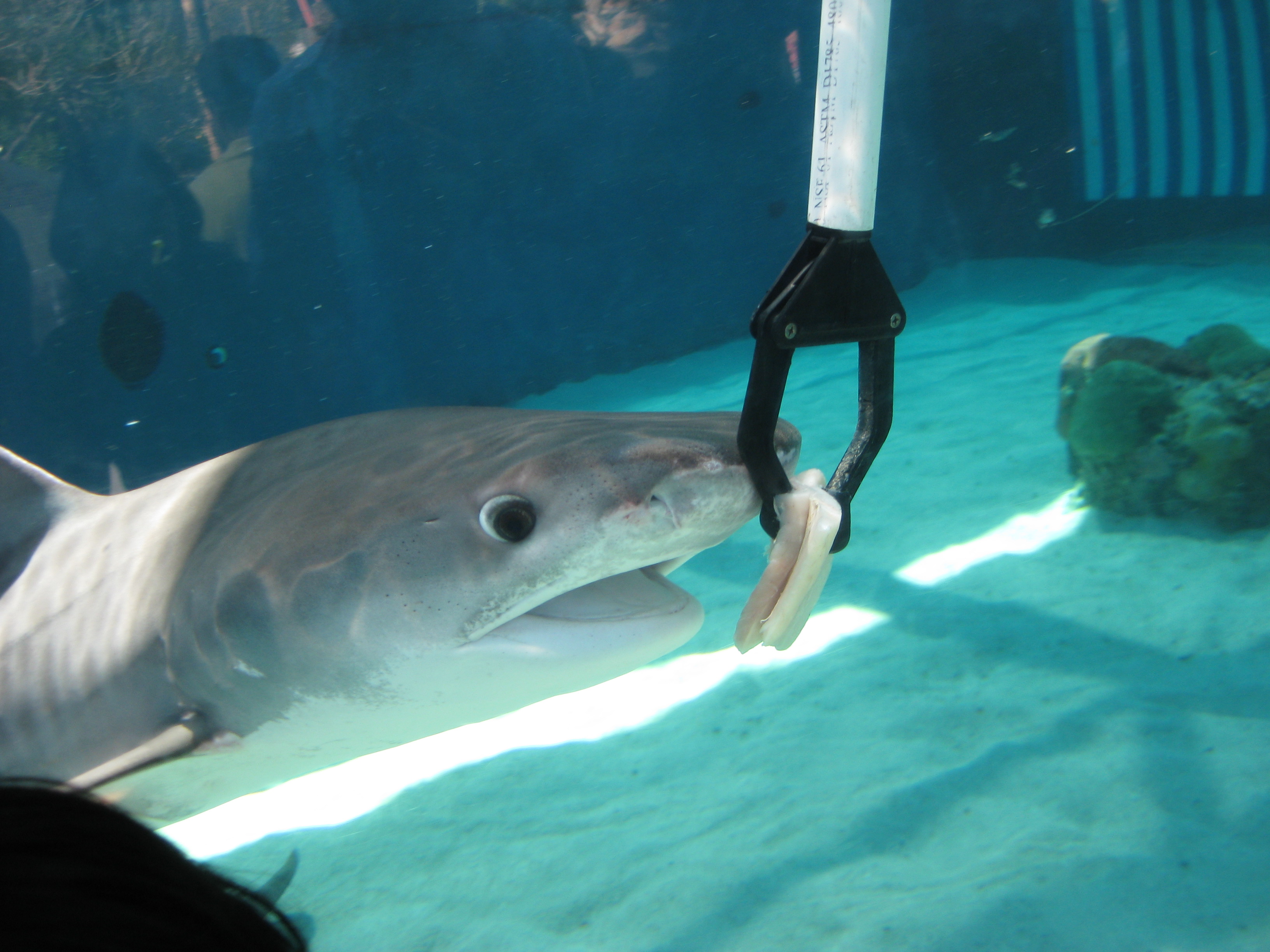
Although sharks rarely bite humans, the tiger shark is reported to be responsible for a large share of fatal shark-bite incidents, and is regarded as one of the most dangerous shark species.
On 8 June 2023, a tiger shark attacked and killed a 23-year-old Russian man in the Red Sea off the coast of the Egyptian city of Hurghada. The attack was filmed by onlookers and the recording went viral. The shark was later captured by fishermen and killed. This was the third fatal tiger shark attack in the area since 2022.
Between 1959 and 1976, 4,668 tiger sharks were culled in the state of Hawaii in an effort to protect the tourism industry. Despite damaging the shark population, these efforts were shown to be ineffective in decreasing the number of interactions between humans and tiger sharks. Feeding sharks in Hawaii (except for traditional Hawaiian cultural or religious practices) is illegal, At "Tiger Beach" off Grand Bahama, uncaged diving with – and even the handling of – female tiger sharks has become a routine occurrence.
Warming Atlantic Ocean currents have caused tiger shark migration paths to move further north, according to a University of Miami study.
Mythology
Tiger sharks are considered to be sacred aumākua (ancestor spirits) by some native Hawaiians. Tiger sharks possess a unique significance as aumakua, revered as family guardians in Hawaiian culture. The tiger shark, regarded as an intelligent and highly perceptive spiritual entity, assumes the role of a messenger bridging the gap between humans and the divine. In the Hawaiian belief system, aumakua take on various forms, either animals or objects, representing ancestral connections and manifestations of departed family members. This perspective underscores the intricate web of interdependence among plants, animals, elements, and humans, underscoring the imperative to honor and coexist harmoniously with nature.
References
References
- Ferreira, L.C.. (2019). "''Galeocerdo cuvier''".
- "Galeocerdo cuvier".
- "ITIS Report – ''Galeocerdo cuvier''".
- (2024). "Killer Whale Predation on a Giant Manta Ray (Mobula birostris), a Sicklefin Devil Ray (Mobula tarapacana) and a Tiger Shark (Galeocerdo cuvier) in the Southwest Indian Ocean". African Journal of Ecology.
- "Yearly Worldwide Shark Attack Summary".
- Members of this order are characterized by the presence of a [[nictitating membrane]] over the eyes, two dorsal fins, an [[anal fin]], and five [[gill]] slits. It is the largest member of the order, commonly referred to as [[Carcharhiniformes. ground sharks]]. It is the only extant member of ''[[Galeocerdo]]'', the only member of the family Galeocerdonidae.Pollerspöck, J.; Straube, N. Bibliography Database of Living/Fossil Sharks, Rays and Chimaeras (Chondrichtyes: Elasmobranchii, Holocephali)—List of Valid Extant Species; List of Described Extant Species; Statistic, World Wide Web Electronic Publication, Version 10/2021; ISSN: 2195-6499. Available online: www.shark-references.com (accessed on 23 November 2021).
- (November 2021). "Evolution, diversity, and disparity of the tiger shark lineage Galeocerdo in deep time". Paleobiology.
- (2014). "Growth and Maximum Size of Tiger Sharks (Galeocerdo cuvier) in Hawaii". PLOS ONE.
- (2008). "A review of lethal and non-lethal effects of predators on adult marine turtles". Elsevier.
- "IGFA Member Services".
- Meyer, C. G., O'Malley, J. M., Papastamatiou, Y. P., Dale, J. J., Hutchinson, M. R., Anderson, J. M., Royer, M. A. & Holland, K. N. (2014). ''Growth and maximum size of tiger sharks (Galeocerdo cuvier) in Hawaii''. PLoS One, 9(1), e84799.
- Randall, J. E. (1986). ''Sharks of Arabia''. University of California.
- Hinman, B. (2015). ''Keystone Species That Live in the Sea and Along the Coastline''. Mitchell Lane Publishers, Inc.
- Ramirez, F., & Davenport, T. L. (2013). ''Elasmobranchs from marine and freshwater environments in Colombia: A review''. Current Politics and Economics of South and Central America, 6(4), 483.
- Wood, Gerald. (1983). "The Guinness Book of Animal Facts and Feats". Guinness Superlatives.
- (2001). "Size, sex and geographic variation in the diet of the tiger shark, Galeocerdo cuvier, from Western Australian waters". Environmental Biology of Fishes.
- (2016). "First documented presence of Galeocerdo cuvier (Péron & Lesueur, 1822) ({{sc". Marine Biodiversity Records.
- "Galeocerdo cuvier, Tiger shark: fisheries, gamefish".
- (2019). "Evolutionary pathways toward gigantism in sharks and rays". Evolution.
- (2014-01-08). "Growth and Maximum Size of Tiger Sharks (Galeocerdo cuvier) in Hawaii". PLOS ONE.
- link. (2021-04-21 .)
- Randall, J. E. (1992). Review of the biology of the tiger shark (Galeocerdo cuvier). Marine and Freshwater Research, 43(1), 21–31.
- Gilbert, Perry W.. (1970). "Studies on the anatomy, physiology, and behavior of sharks".
- (2006). "Communication in Fishes". Science Publishers.
- link. (2012-07-11 . marinebio.org)
- seal]]s and [[sea lion]]s), and [[sea turtle]]s (including the three largest species: the [[Leatherback sea turtle. leatherback]] (''Dermochelys coriacea''),[http://www.sharkdefenders.com/2011/04/tiger-sharks-killed-for-eating.html Tiger Sharks Killed for Eating Leatherback Turtles] {{Webarchive. link. (2013-01-26 . Shark Defenders (2011-04-16). Retrieved on 2013-03-23.)
- [http://www2.fiu.edu/~heithaus/SBERP/projects/turtres.html Shark Bay Ecosystem Research Project] {{Webarchive. link. (2013-03-21 . .fiu.edu. Retrieved on 2013-03-23.)
- Witzell, W. N. (1987). ''Selective predation on large cheloniid sea turtles by tiger sharks (Galeocerdo cuvier)''. Japanese Journal of Herpetology, 12(1), 22–29.
- (February 2002). "Food Availability and Tiger Shark Predation Risk Influence Bottlenose Dolphin Habitat Use". Ecology.
- (February 2019). "TigerShark Whale". Neco Marine.
- (31 January 2019). "Tiger Sharks feeding on Manta". Neco Marine.
- (1 January 2001). "Size, Sex And Geographic Variation in the Diet of the Tiger Shark, ''Galeocerdo cuvier'', From Western Australian Waters". Environmental Biology of Fishes.
- Anderson, Paul K.. (1995). "Scarring and photoidentification of dugongs (''Dugong dugon'') in Shark Bay, Western Australia". Aquatic Mammals.
- (July 2007). "Living on the edge: dugongs prefer to forage in microhabitats that allow escape from rather than avoidance of predators". Animal Behaviour.
- (5 June 2024). "Tiger shark regurgitates whole echidna, leaving Australian scientists 'stunned'".
- (January 2016). "A novel mode of embryonic nutrition in the tiger shark, ''Galeocerdo cuvier''". Marine Biology Research.
- (May 2016). "Ontogeny of head and caudal fin shape of an apex marine predator: The tiger shark (''Galeocerdo cuvier'')". [[Journal of Morphology]].
- (2018). "Conservation status of New Zealand chondrichthyans (chimaeras, sharks and rays), 2016". Department of Conservation.
- Main, Douglas. (September 10, 2013). "Hawaii tiger shark migration in fall coincides with rise in bites". CBS Science News.
- (9 June 2023). "Man mauled to death by tiger shark off Egypt's Red Sea coast". [[NBC News]].
- "Hawaii Tiger Shark Research".
- link. (2014-08-19 . Magazines.co.za (June/July 2009))
- "Tiger shark handling". Jonathan Bird's Blue World.
- "Climate Change is Driving Tiger Sharks Into New Waters With Shocking Speed and Unknown Consequences".
- "Hawaiian Sharks {{!}} Parts of a Shark and Behavior".
- (25 July 2023). "The Cultural Significance of Sharks in Hawaii". Dimple.
- Canadian Shark Research Laboratory, [https://web.archive.org/web/20151001083505/http://www.bio.gc.ca/sharks/maritime/galeocerdocuvier-en.php Tiger Shark – Bedford Institute of Oceanography]
- Donahue, Ann. (30 July 2007). "Shark Week: 'Deadly Stripes: Tiger Sharks'". [[LA Times]].
- (2000). "Concurrent scavenging off a whale carcass by great white sharks, ''Carcharodon carcharias'', and tiger sharks, ''Galeocerdo cuvier''". Fishery Bulletin.
- {{FishBase. (2011)
- [http://www.greenpeace.org/international/en/campaigns/oceans/seafood/red-list-of-species/ Greenpeace International Seafood Red list] {{Webarchive. link. (2013-03-30 . greenpeace.org)
- "Tiger Shark Research Program". Hawaii Institute of Marine Biology.
- "Prohibition of Shark Feeding". Hawaii Department of Land and Natural Resources, Hawaii Department of Agriculture.
- Heithaus, Michael R.. (May 2001). "The Biology of Tiger Sharks, ''Galeocerdo cuvier'', in Shark Bay, Western Australia: Sex Ratio, Size Distribution, Diet, and Seasonal Changes in Catch Rates". Environmental Biology of Fishes.
- Heithaus, Michael R.. (January 2001). "Predator–prey and competitive interactions between sharks (order Selachii) and dolphins (suborder Odontoceti): a review". Journal of Zoology.
- (2002). "Food availability and tiger shark predation risk influence bottlenose dolphin habitat use". Ecology.
- (2004). "Habitat use and foraging behavior of tiger sharks (''Galeocerdo cuvier'') in a seagrass ecosystem". Marine Biology.
- "ISAF Statistics on Attacking Species of Shark". [[Florida Museum of Natural History]] University of Florida.
- Knickle, Craig. (8 May 2017). "Tiger Shark Biological Profile". [[Florida Museum of Natural History]] Ichthyology Department.
- (1996). "Ontogenetic dietary shifts and feeding behavior of the tiger shark, ''Galeocerdo cuvier'', in Hawaiian waters". Environmental Biology of Fishes.
- "Tiger Shark". ladywildlife.com.
- Maldini, Daniela. (2003). "Evidence of predation by a tiger shark (''Galeocerdo cuvier'') on a spotted dolphin (''Stenella attenuata'') off Oahu, Hawaii". Aquatic Mammals.
- {{Marinebio
- [http://www.new-brunswick.net/new-brunswick/sharks/species/tiger.html Tiger Shark – The Province of New Brunswick Canada] {{Webarchive. link. (2011-07-02 . [[New Brunswick]]. Retrieved 2011-06-09.)
- Office of National Marine Sanctuaries. (2012-08-07). "Humpback Whale Shark Attack: A Natural Phenomenon Caught on Camera".
- Ritter, Erich K.. (15 February 1999). "Which shark species are really dangerous?". Shark Info.
- Ritter, Erich K.. (15 December 1999). "Fact Sheet: Tiger Sharks". Shark Info.
- "Federal Fishery Managers Vote To Prohibit Shark Feeding". Western Pacific Regional Fishery Management Council.
This article was imported from Wikipedia and is available under the Creative Commons Attribution-ShareAlike 4.0 License. Content has been adapted to SurfDoc format. Original contributors can be found on the article history page.
Ask Mako anything about Tiger shark — get instant answers, deeper analysis, and related topics.
Research with MakoFree with your Surf account
Create a free account to save articles, ask Mako questions, and organize your research.
Sign up freeThis content may have been generated or modified by AI. CloudSurf Software LLC is not responsible for the accuracy, completeness, or reliability of AI-generated content. Always verify important information from primary sources.
Report