From Surf Wiki (app.surf) — the open knowledge base
Tibetan (Unicode block)
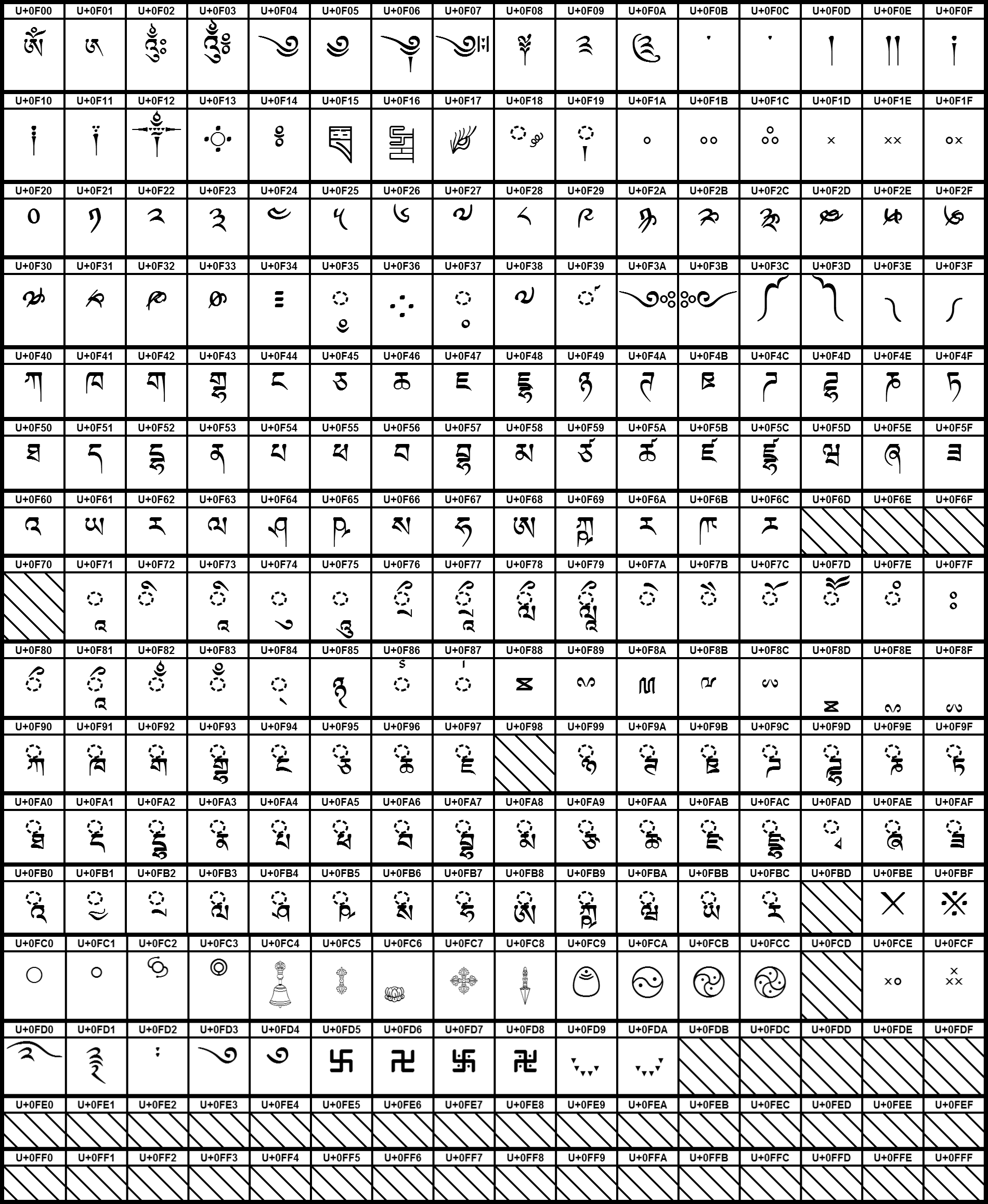
| Field | Value |
|---|---|
| blockname | Tibetan |
| rangestart | 0F00 |
| rangeend | 0FFF |
| script1 | Tibetan (207 char.) |
| script2 | Common (4 char.) |
| alphabets | Tibetan |
| Dzongkha | |
| deprecated | 2 |
| 2_0 | 168 |
| 3_0 | 25 |
| 4_1 | 2 |
| 5_1 | 6 |
| 5_2 | 4 |
| 6_0 | 6 |
| note | |
| When unifying with ISO 10646, the original Tibetan block was removed in Unicode 1.0.1. The current block (with a new encoding model and a different range) was introduced in version 2.0. |
Dzongkha When unifying with ISO 10646, the original Tibetan block was removed in Unicode 1.0.1. The current block (with a new encoding model and a different range) was introduced in version 2.0.
Tibetan is a Unicode block containing characters for the Tibetan, Dzongkha, and other languages of China, Bhutan, Nepal, Mongolia, northern India, eastern Pakistan and Russia.
Block
{{anchor|Unicode 1.0.0}}Former Tibetan block
Dzongkha The Tibetan Unicode block is unique for having been allocated in version 1.0.0 with a virama-based encoding that was unable to distinguish visible bo and conjunct consonant correctly. This encoding was removed from the Unicode Standard in version 1.0.1 in the process of unifying with ISO 10646 for version 1.1, then reintroduced as an explicit root/subjoined encoding, with a larger block size, in version 2.0. Moving or removing existing characters has been prohibited by the Unicode Stability Policy for all versions following Unicode 2.0, so the Tibetan characters encoded in Unicode 2.0 and all subsequent versions are immutable.
The range of the former Unicode 1.0.0 Tibetan block has been occupied by the Myanmar block since Unicode 3.0. In Microsoft Windows, collation data referring to the old Tibetan block was retained as late as Windows XP, and removed in Windows 2003.
| Notes |
|---|
History
The following Unicode-related documents record the purpose and process of defining specific characters in the Tibetan block:
| Version | Count | UTC ID | L2 ID | WG2 ID | Document |
|---|---|---|---|---|---|
| 2.0 | U+0F00..0F47, 0F49..0F69, 0F71..0F8B, 0F90..0F95, 0F97, 0F99..0FAD, 0FB1..0FB7, 0FB9 | 168 | N808 | ||
| N1095 | |||||
| N1185 | |||||
| N1159 | |||||
| N1192 | |||||
| N1203 | |||||
| N1227 | |||||
| N1238 | |||||
| txt) | |||||
| N1263 | |||||
| N1538 | |||||
| N1562 | |||||
| N1571 | |||||
| N1603 | |||||
| N1739 | |||||
| html, doc) | |||||
| xls) | |||||
| 3.0 | U+0F6A, 0F96, 0FAE..0FB0, 0FB8, 0FBA..0FBC, 0FBE..0FCC, 0FCF | 25 | N1660 | ||
| N1756 | |||||
| N1703 | |||||
| html) | |||||
| N1864 | |||||
| N1921 | |||||
| N1922 | |||||
| html, doc) | |||||
| N1977R | |||||
| N1979R | |||||
| N1977 | |||||
| N2022 | |||||
| N2003 | |||||
| N2070 | |||||
| N2129 | |||||
| N2130 | |||||
| N2130R | |||||
| N2103 | |||||
| 4.1 | U+0FD0..0FD1 | 2 | N2694 | ||
| 5.1 | U+0F6B..0F6C | 2 | N3010 | ||
| doc) | |||||
| doc) | |||||
| N2985 | |||||
| U+0FCE | 1 | N3011 | |||
| doc) | |||||
| U+0FD2..0FD4 | 3 | N3012 | |||
| N3032 | |||||
| N3033 | |||||
| doc) | |||||
| doc) | |||||
| 5.2 | U+0FD5..0FD8 | 4 | doc) | ||
| N3268 | |||||
| N3537 | |||||
| 6.0 | U+0F8C..0F8F | 4 | N3568 | ||
| doc) | |||||
| U+0FD9..0FDA | 2 | N3569 | |||
| doc) |
Footnotes
References
- A Chinese concern posted to the Unicode Consortium citing the conjunct character "སྐྤྵྴྍྐ" (EWTS s+k+p+Sh+sh+x+ka; IAST ), showing the complexity of encoding. (Devanagari encoding never allowed "ᳵ" to be conjuncted, i.e. "स्क्प्ष्श्ᳵ्क"does not exist.)
References
- "Unicode character database". The Unicode Standard.
- "Enumerated Versions of The Unicode Standard". The Unicode Standard.
- (1992-11-03). "Unicode 1.0.1 Addendum". The Unicode Standard.
- Kaplan, Michael. (2007-08-28). "Every character has a story #29: U+1000^H^H^H^H0f40, (TIBETAN or MYANMAR LETTER KA, depending on when you ask)". Sorting it all out.
- Proposed code points and characters names may differ from final code points and names
This article was imported from Wikipedia and is available under the Creative Commons Attribution-ShareAlike 4.0 License. Content has been adapted to SurfDoc format. Original contributors can be found on the article history page.
Ask Mako anything about Tibetan (Unicode block) — get instant answers, deeper analysis, and related topics.
Research with MakoFree with your Surf account
Create a free account to save articles, ask Mako questions, and organize your research.
Sign up freeThis content may have been generated or modified by AI. CloudSurf Software LLC is not responsible for the accuracy, completeness, or reliability of AI-generated content. Always verify important information from primary sources.
Report