From Surf Wiki (app.surf) — the open knowledge base
Tiananmen Square
Public square in Beijing, China

Public square in Beijing, China
| Field | Value |
|---|---|
| title | Tiananmen Square |
| pic | {{multiple image |
| border | infobox |
| total_width | 270 |
| image_style | border:1; |
| perrow | 1/2/2 |
| image1 | Tiananmen Square (54137047250).jpg |
| image2 | Chairman Mao Memorial Hall (54137046165).jpg |
| image3 | Tiananmen Square (54136588161).jpg |
| image4 | Tiananmen Square (54136875738).jpg |
| image5 | Chairman Mao Memorial Hall (54137048485).jpg |
| picsize | 275px |
| piccap | Tiananmen Square in 2024 |
| pictooltip | Groups of people wander around Tiananmen Square in the late afternoon. The eponymous Tiananmen, literally "Gate of Heavenly Peace", sits in the background. |
| mnc | ᡝᠯᡥᡝ ᠣᠪᡠᡵᡝ ᡩᡠᡴᠠ |
| mnc_rom | elhe obure duka |
| s | 天安门广场 |
| t | 天安門廣場 |
| p | Tiān'ānmén Guángchǎng |
| xej | |
| gr | Tian'anmen Goangchaang |
| bpmf | ㄊㄧㄢ ㄢ ㄇㄣˊ |
| ㄍㄨㄤˇ ㄔㄤˇ | |
| w | |
| mi | |
| lmz | Thie-oe-men Kuaon-zan |
| poj | Thian-an-mn̂g Kóng-tiûⁿ |
| y | Tīn'ōnmùhn Gwóngchèuhng |
| j | |
| ci | |
| order | st |
| showflag | p |
ㄍㄨㄤˇ ㄔㄤˇ
Tiananmen Square or Tian'anmen Square () is a city square in the city centre of Beijing, China, named after the Tiananmen ("Gate of Heavenly Peace") located to its north, which separates it from the Forbidden City imperial palace complex. The square holds the Monument to the People's Heroes, the Great Hall of the People, the National Museum of China, and the Chairman Mao Memorial Hall. They were inscribed in the UNESCO World Heritage Sites in 2024 as a part of the Beijing Central Axis.
Tiananmen Square was designed and built in 1651 and was enlarged fourfold in the 1950s. Chairman Mao Zedong proclaimed the founding of the People's Republic of China in the square on October 1, 1949; the anniversary of this event is still observed there. The size of Tiananmen Square is 765 × 282 meters (215,730 m2 or 53.31 acres). A national flagpole is located at the northern end of the square, where flag-raising and flag-lowering ceremonies are held daily at sunrise and sunset.
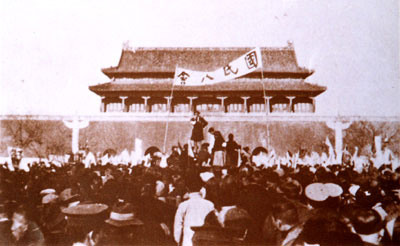
The square has great cultural significance as it was the site of several important events in Chinese history, including the May Fourth Movement in 1919, the March 18 Massacre in 1926, and the 1976 Tiananmen incident. Outside China, the square is best known for the 1989 Tiananmen Square protests and massacre. Within China, the government undertakes strict censorship regarding the 1989 protests and subsequent massacre.
History
Early history
The Tiananmen ("Gate of Heavenly Peace"), a gate in the wall of the Imperial City, was built in 1417 during the Ming dynasty. During the 17th century, fighting between Li Zicheng's rebel forces and the forces of the Manchu-led Qing dynasty caused heavy damage to, or even destroyed, the gate. Tiananmen Square was designed and built in 1651 and was enlarged fourfold in the 1950s.
The gate historically known as the "Great Ming Gate", the southern gate to the Imperial City stands near the center of the square. It was renamed the "Great Qing Gate" during the Qing dynasty, and the "Gate of China" during the Republican era. Unlike the other gates in Beijing, such as the Tiananmen and the Zhengyang Gate, this was a purely ceremonial gateway, with three arches but no ramparts, similar in style to the ceremonial gateways found in the Ming tombs. This gate had a special status as the "Gate of the Nation", as can be seen from its successive names. It normally remained closed, except when the emperor passed through. Commoner traffic was diverted to side gates at the western and eastern ends of the square, respectively. Because of this diversion in traffic, a busy marketplace, called "Chess Grid Streets", was developed in the large fenced square to the south of this gate.
19th century
In 1860, during the Second Opium War, when British and French troops occupied Beijing, they pitched camp near the gate and briefly considered burning down the gate and the Forbidden City. Ultimately, they decided to spare the Forbidden City and instead burn down the Old Summer Palace. The Xianfeng Emperor eventually agreed to let Western powers barrack troops – and later establish diplomatic missions – in the area, hence there was the Legation Quarter immediately to the east of the square. When the forces of the Eight-Nation Alliance besieged Beijing during the Boxer Rebellion in 1900, they badly damaged the office complexes and burnt down several ministries. After the Boxer Rebellion ended, the area became a space for the Eight-Nation Alliance to assemble their military forces.
20th century
In the 20th century, Tiananmen Square was re-developed from an insular imperial quarter to a larger public space viewed as more consistent with the political state of China at the time. During the 1950s, the square was quadrupled in size.
In 1954, the Gate of China was demolished to enlarge the square, and in November 1958, a major expansion of Tiananmen Square started, which was completed after only 11 months in August 1959. This followed the vision of Mao Zedong to make the square the largest and most spectacular in the world, as it was intended to hold over 500,000 people. During this process, a large number of residential buildings and other structures were demolished. On its southern edge, the Monument to the People's Heroes was erected. Concomitantly, as part of the Ten Great Buildings constructed between 1958 and 1959 to commemorate the ten-year anniversary of the People's Republic of China (PRC), the Great Hall of the People and the Revolutionary History Museum (now the National Museum of China) were erected on the western and eastern sides of the square.
For the first decade of the PRC, every National Day (October 1) was marked by a large military parade in Tiananmen Square, in conscious emulation of the annual Soviet celebrations of the Bolshevik Revolution. After the disastrous Great Leap Forward, the CCP decided to cut costs and have only smaller annual National Day celebrations in addition to a large celebration with a military parade every 10 years. However, the chaos of the Cultural Revolution almost prevented such an event from taking place on National Day in 1969 but did take place in 1966 and 1970.
In 1971, large portraits of Karl Marx, Friedrich Engels, Vladimir Lenin, Joseph Stalin, Sun Yat-sen, and Mao Zedong were erected in the square, painted by artist Ge Xiaoguang, who is also responsible for producing the famous portrait of Mao currently displayed over the Gate of Heavenly Peace. In 1980, with the downgrading of political ideology following Mao's death, the portraits were taken down and thenceforth only brought out on Labor Day (May 1) and National Day.
Ten years later, in 1979, the CCP again decided against a large-scale celebration, coming at a time when Deng Xiaoping was still consolidating power and China had suffered a rebuff in a border war with Vietnam earlier that year. By 1984, with the situation stabilized, the government held a military parade for the first time since 1959. The aftermath of the Tiananmen Square massacre prevented any such activities in October 1989, but military parades have been held in 1999 and 2009, on the 50th and 60th anniversaries of the PRC's founding.
One year after Mao's death, a mausoleum was built near the site of the former Gate of China along the main north–south axis of the square. In connection with this project, the square was further increased in size to become fully rectangular and able to accommodate 600,000 people.
1989 protests and massacre
Main article: 1989 Tiananmen Square protests and massacre
In 1989, Tiananmen Square was the site of the 1989 Tiananmen Square protests that culminated in violence and a crackdown by the People's Liberation Army. Following the crackdown, many of the student leaders escaped to the United States with the help of foreign intelligence agencies and other parties through Operation Yellowbird.
The urban context of the square was altered in the 1990s with the construction of National Grand Theater in its vicinity and the expansion of the National Museum.
Configuration
.jpg)
Used as a venue for mass gatherings since its creation, its flatness is contrasted by both the 38-meter (125 ft)-high "Monument to the People's Heroes" and the "Mausoleum of Mao Zedong". The square lies between two ancient, massive gates: the Tiananmen to the north and the Zhengyangmen, known as Qianmen, to the south. Along the west side of the square is the Great Hall of the People. Along the east side is the National Museum of China dedicated to Chinese history predating 1919.
Erected in 1989, Liberty, a statue representing the western icon previously held her torch over the square.
Visits
Since Dec 15, 2021, visitors must make a reservation before entering the square area.
Events
Tiananmen Square has been the site of a number of notable political events, student protests, and armed conflict.
Among the most notable events that have occurred on Tiananmen Square were protests during the May Fourth Movement in 1919, the proclamation of the People's Republic of China by Mao Zedong on October 1, 1949, the Tiananmen Square protests in 1976 after the death of Zhou Enlai, and the 1989 Tiananmen Square protests and massacre after the death of Hu Yaobang, which was suppressed in a military crackdown. Shortly after the crackdown, a man, dubbed Tank Man, was photographed obstructing a column of tanks on Chang'an Avenue near the square.
Other notable events included annual mass military displays on each anniversary of the 1949 proclamation until October 1, 1959; the 1984 military parade for the 35th anniversary of the People's Republic of China which coincided with the ascendancy of Deng Xiaoping; military displays and parades on the 50th anniversary of the People's Republic of China in 1999; the Tiananmen Square self-immolation incident in 2001; military displays and parades on the 60th anniversary of the People's Republic of China in 2009, and a terror attack in 2013 involving a vehicle that plowed into pedestrians.
Panorama
Image:200401-beijing-tianan-square-overview.jpg|thumb|800px|center|Panorama image map of Tiananmen Square from the north atop Tiananmen's gate tower, showing the square beyond Chang'an Avenue, the Monument to the People's Heroes and Chairman Mao Memorial Hall (background center), the National Museum of China (on the left), and Great Hall of the People (on the right) (mouse over for labels)
poly 148 187 471 188 472 219 267 247 150 241 National Museum of China poly 1048 242 1097 238 1168 266 990 278 653 293 412 291 201 270 184 267 261 250 500 259 675 260 933 258 1042 247 1082 245 Chang'an Avenue poly 680 181 684 178 689 181 691 215 707 217 715 221 658 226 664 219 682 217 Monument to the People's Heroes poly 1136 237 1186 263 1278 250 1273 231 West Chang'an Avenue poly 11 235 32 230 259 250 192 264 East Chang'an Avenue poly 658 224 664 216 681 216 681 179 693 179 692 216 705 216 715 223 727 223 726 185 694 178 672 178 650 191 647 202 Mausoleum of Mao Zedong poly 905 178 904 211 1113 235 1252 226 1253 191 1235 190 1236 164 1114 152 Great Hall of the People poly 1237 180 1236 191 1253 191 1253 226 1277 224 1278 188 National Center for the Performing Arts poly 344 249 652 260 924 249 1038 242 821 218 730 227 645 226 627 222 561 226 538 225 298 249 Tiananmen Square poly 299 252 330 255 331 306 302 305 299 309 Huabiao poly 959 249 998 247 1002 309 965 313 Huabiao poly 1 265 277 373 554 408 905 394 1277 301 1277 427 701 427 435 427 2 426 Tiananmen (Gate Tower)
desc top-left
Gallery
Architectures and Statues
File:Forbidden City Beijing China (164849005).jpeg|Tiananmen gate to the north of Tiananmen Square File:NationalMuseumofChinapic1.jpg|National Museum of China on the east side of the square File:Great Hall of the People 3.jpg|The Great Hall of the People on the west side of the square File:Zhengyangmen (gatehouse) 2010 April.jpg|Zhengyangmen Gate Tower marking the south end of Tiananmen Square File:Chairman Mao Memorial Hall (54137046165).jpg|Mausoleum of Mao Zedong File:62924-Beijing-Tiananmen-Square (28608576702).jpg|Monument in front of Mao's Mausoleum on Tiananmen Square File:人民英雄纪念碑 毛主席纪念堂 傍晚灯光 (cropped).jpg|Monument to the People's Heroes and the Mausoleum of Mao Zedong occupy the center of the square File:Jinianbei.jpg|Monument to the People's Heroes File:Tiananmen Square (54135740377).jpg|Huabiao in front of Tiananmen
Historical Events
Kangxi-Verbotene-Stadt1.jpg|Kangxi Emperor and his escorts walking through Tiananmen after his tour in Southern china File:Waldersee.jpg|Commander-in-chief of the Eight-Nation Alliance, Alfred von Waldersee inspecting the army during the Boxer war, 1900 File:November 29 student demonstration, Tiananmen Square.jpg|Students gathering for a demonstration in Tiananmen Square, 1917 File:318-1.jpg|People protesting Beiyang government in 1926, which later led to the March 18 Massacre File:Kaiguodadian.jpg|Students attending the founding ceremony of the People's Republic of China on October 1, 1949 File:Red Guards in Tian'anmen Square.jpg|Red Guards gathering on Tian'anmen Square to be inspected by Mao during the Cultural Revolution, September 15, 1966 China 1976-026 Beijing.jpg|A few days after the official mourning ceremony for Mao Zedong, 12 September 1976 File:Události na náměstí Tian an men, Čína 1989, foto Jiří Tondl.jpg|Student protesting at Tianmen Square on 2 June 1989 File:National mourning for 2008 Sichuan earthquake victims - Tiananmen Square, Beijing, 2008-05-19.jpg|National mourning for the victims of the Sichuan earthquake, May 19, 2008 Flower basket at Tiananmen Square for PRC75 (20241007193157).jpg|Celebration of the 75th anniversay of People' Republic of China, with portrait of Sun Yat-sen placed on the square, 2024 Members of the PLAN at the 2025 China Victory Parade.jpg|China Victory Day Parade on September 3, 2025, the day of Victory over Japan
References
References
- "Tiananmen Square". [[Oxford University Press]].
- The Columbia Encyclopedia, 6th ed
- "Tiananmen Square incident".
- Miles, James. (2 June 2009). "Tiananmen killings: Were the media right?". BBC News.
- (23 December 2017). "Tiananmen Square protest death toll 'was 10,000'". BBC News.
- (2009-06-04). "The Truth Behind The Tiananmen Square Massacre -". CBS News.
- (December 2016). "One App, Two Systems".
- Safra, J. (Ed.). (2003). Tiananmen Square. In New [[Encyclopædia Britannica]], The (15th ed., Chicago: Vol. 11). Encyclopædia Britannica INC. p. 752. [http://www.britannica.com/EBchecked/topic/594819/Tiananmen-Square Britannica Online version]
- "Tiananmen Square". Britannica Concise Encyclopedia. 2007.
- "The Belt and Road City: Geopolitics, Urbanization, and China's Search for a New International Order". [[Yale University Press]].
- Li, M. Lilliam; Dray-Novey, Alison J.; Kong, Haili (2007) ''Beijing: From Imperial Capital to Olympic City'', Palgrave, {{ISBN. 978-1-4039-6473-1
- "1999 Tiananmen Square".
- [https://www.bbc.com/news/world-asia-48445934 "Tiananmen Square: What happened in the protests of 1989"], BBC, 23 December 2021
- (2009-06-02). "Tiananmen killings: Were the media right?". BBC.
- (2019-05-31). "The lives of Tiananmen's most wanted, 30 years on".
- Roberts, John Morris. (1993). "History of the world". Oxford University Press.
- (2021-11-24). "Visit to Tiananmen Square Will be by Reservation Only from December 15".
- Wong, Jan. (1997). "Red China Blues". Random House.
This article was imported from Wikipedia and is available under the Creative Commons Attribution-ShareAlike 4.0 License. Content has been adapted to SurfDoc format. Original contributors can be found on the article history page.
Ask Mako anything about Tiananmen Square — get instant answers, deeper analysis, and related topics.
Research with MakoFree with your Surf account
Create a free account to save articles, ask Mako questions, and organize your research.
Sign up freeThis content may have been generated or modified by AI. CloudSurf Software LLC is not responsible for the accuracy, completeness, or reliability of AI-generated content. Always verify important information from primary sources.
Report