From Surf Wiki (app.surf) — the open knowledge base
Thyroid peroxidase
Enzyme expressed mainly in the thyroid gland
Enzyme expressed mainly in the thyroid gland
| Field | Value |
|---|---|
| Name | iodide peroxidase |
| EC_number | 1.11.1.8 |
| CAS_number | 9031-28-1 |
| GO_code | 0004447 |
| image | 4cit.jpg |
| width | 270 |
| caption | iodide peroxidase monomer, Zobellia galactanivorans |
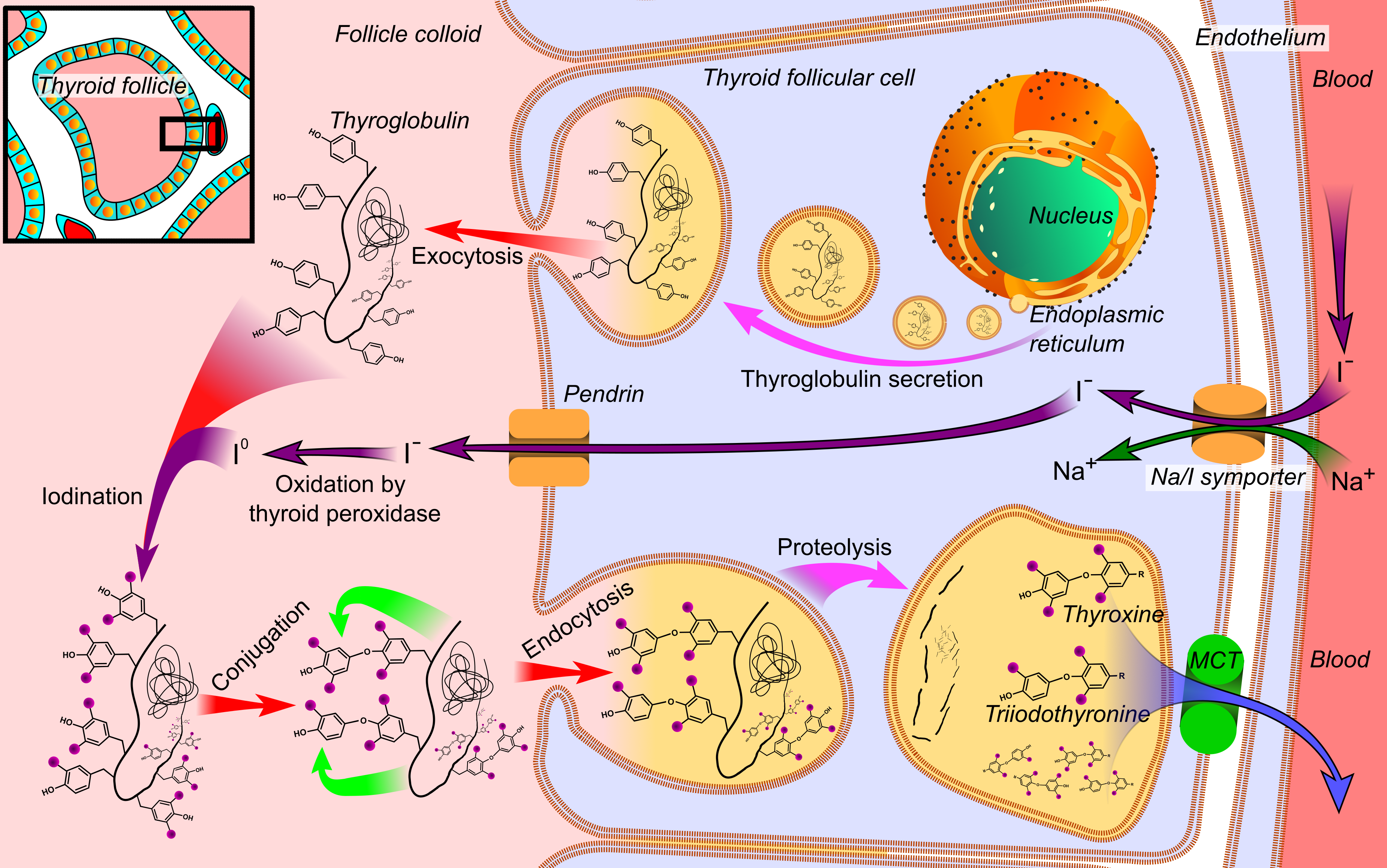
Thyroid peroxidase, also called thyroperoxidase (TPO), thyroid specific peroxidase or iodide peroxidase, is an enzyme expressed mainly in the thyroid where it is secreted into colloid. Thyroid peroxidase oxidizes iodide ions to form iodine atoms for addition onto tyrosine residues on thyroglobulin for the production of thyroxine (T4) or triiodothyronine (T3), the thyroid hormones. In humans, thyroperoxidase is encoded by the TPO gene.
Function
Inorganic iodine enters the body primarily as iodide, I−. After entering the thyroid follicle (or thyroid follicular cell) via a Na+/I− symporter (NIS) on the basolateral side, iodide is shuttled across the apical membrane into the colloid via pendrin after which thyroid peroxidase oxidizes iodide to atomic iodine (I) or iodinium (I+). The chemical reactions catalyzed by thyroid peroxidase occur on the outer apical membrane surface and are mediated by hydrogen peroxide.
The "organification of iodine", the incorporation of iodine into thyroglobulin for the production of thyroid hormone, is nonspecific; that is, there is no TPO-bound intermediate, but iodination occurs via reactive iodine species released from TPO. Ascidians (tunicates or sea squirts) and amphioxus, which are close invertebrate relatives of vertebrates, have a primitive homolog of the thyroid known as the endostyle. They do not have a thyroglobulin gene that produce a protein intended specifically for making thyroxine, but do produce thyroxine. Presumably they simply rely on the nonspecific action.
Catalyzed reaction

The reactions registered with Enzyme Commission no. 1.11.1.8 are:
- Conversion of iodide to diiodine, 2 I− + H2O2 + 2 H+ = I2 + 2 H2O
- Generation of 3-iodo-tyrosine, [thyroglobulin]-L-tyrosine [[File:L-Tyrosin phys.svg|x30px|L-Tyrosin]] + I− + H2O2 + H+ = [thyroglobulin]-3-iodo-L-tyrosine [[File:3-Iod-L-Tyrosin.svg|x30px|3-Iod-L-Tyrosin]] + 2 H2O
- Generation of 3,5-iodo-tyrosine, [thyroglobulin]-3-iodo-L-tyrosine [[File:3-Iod-L-Tyrosin.svg|x30px|3-Iod-L-Tyrosin]] + I− + H2O2 + H+ = [thyroglobulin]-3,5-diiodo-L-tyrosine [[File:3,5-Diiod-L-Tyrosin.svg|x30px|3,5-Diiod-L-Tyrosin]] + 2 H2O
- Coupling to produce T4, 2 [thyroglobulin]-3,5-diiodo-L-tyrosine [[File:3,5-Diiod-L-Tyrosin.svg|x30px|3,5-Diiod-L-Tyrosin]] + H2O2 = [thyroglobulin]-L-thyroxine [[File:Thyroxine2.svg|x30px]] + [thyroglobulin]-dehydroalanine [[File:Dehydroalanin.svg|x30px]] + 2 H2O
- Coupling to produce T3, [thyroglobulin]-3-iodo-L-tyrosine [[File:3-Iod-L-Tyrosin.svg|x30px|3-Iod-L-Tyrosin]] + [thyroglobulin]-3,5-diiodo-L-tyrosine [[File:3,5-Diiod-L-Tyrosin.svg|x30px|3,5-Diiod-L-Tyrosin]] + H2O2 = [thyroglobulin]-3,3',5-triiodo-L-thyronine [[File:Liothyronine2DCSD.svg|x30px]] + [thyroglobulin]-dehydroalanine [[File:Dehydroalanin.svg|x30px]] + 2 H2O
However, in light of the non-specific organification by TPO, it would be useful to distinguish which actions are the "true" functions of TPO. Under the model of Kessler et al. (2008), the real functions of TPO are:
- Conversion of iodide to diiodine, as in reaction (1) above. The I2 produced would go on to react with OH− to form HOI, which reacts with the tyrosyl residue on proteins such as thyroglobulin, explaining the reactions (2) and (3) above.
- Generation of free radicals from tyrosyl, 3-iodotyrosyl (MIT), and 3,5-diiodotyrosyl (DIT) residues or their free forms. These free radicals couple with iodized proteins (such as [thyroglobulin]-3,5-diiodo-L-tyrosine) to perform reactions (4) and (5).
Both actions are mediated by the oxidized form of TPO, TPO-O, produced by reaction of TPO with hydrogen peroxide.
Side reactions
T3 is produced when a MIT free radical couples to a DIT residue on a protein. Coupling of DIT to MIT in the opposite order yields a substance, r-T3, which is biologically inactive. T2 and T1 are also known to occur naturally.
Stimulation and inhibition
TPO is stimulated by TSH, which upregulates gene expression.
TPO is inhibited by the thioamide drugs, such as propylthiouracil and methimazole. In laboratory rats with insufficient iodine intake, genistein has demonstrated inhibition of TPO.
Clinical significance
Thyroid peroxidase is a frequent epitope of autoantibodies in autoimmune thyroid disease, with such antibodies being called anti-thyroid peroxidase antibodies (anti-TPO antibodies). This is most commonly associated with Hashimoto's thyroiditis. Thus, an antibody titer can be used to assess disease activity in patients that have developed such antibodies.
Diagnostic use
In diagnostic immunohistochemistry, the expression of thyroid peroxidase (TPO) is lost in papillary thyroid carcinoma.
Biotechnology
TPO's ability to non-selectively couple tyrosine residues together has been used to modify protein tags.
References
References
- (Jan 2006). "Structural and functional aspects of thyroid peroxidase". Archives of Biochemistry and Biophysics.
- (Aug 1987). "Human thyroid peroxidase: complete cDNA and protein sequence, chromosome mapping, and identification of two alternately spliced mRNAs". Proceedings of the National Academy of Sciences of the United States of America.
- Walter F., PhD. Boron. (2003). "Medical Physiology: A Cellular And Molecular Approach". Elsevier/Saunders.
- (Jul 2008). "Factors influencing the study of peroxidase-generated iodine species and implications for thyroglobulin synthesis". Thyroid.
- (2000). "Endotext". MDText.com, Inc..
- (November 2015). "Coupling of chromophores with exactly opposite luminescence behaviours in mesostructured organosilicas for high-efficiency multicolour emission". Chemical Science.
- (July 2006). "Thyroxine-triiodothyronine combination therapy versus thyroxine monotherapy for clinical hypothyroidism: meta-analysis of randomized controlled trials". The Journal of Clinical Endocrinology and Metabolism.
- (Jul 1976). "Effect of antithyroid agents 6-propyl-2-thiouracil and 1-methyl-2-mercaptoimidazole on human thyroid iodine peroxidase". The Journal of Clinical Endocrinology and Metabolism.
- (Jun 2002). "Goitrogenic and estrogenic activity of soy isoflavones". Environmental Health Perspectives.
- (2000). "Autoimmune response to the thyroid in humans: thyroid peroxidase--the common autoantigenic denominator". International Reviews of Immunology.
- (Jun 2002). "The human anti-thyroid peroxidase autoantibody repertoire in Graves' and Hashimoto's autoimmune thyroid diseases". Immunogenetics.
- (May 1996). "Immunohistochemical loss of thyroid peroxidase in papillary thyroid carcinoma: strong suppression of peroxidase gene expression". The Journal of Pathology.
- (18 March 2020). "Tyrosinase-Mediated Oxidative Coupling of Tyrosine Tags on Peptides and Proteins". Journal of the American Chemical Society.
This article was imported from Wikipedia and is available under the Creative Commons Attribution-ShareAlike 4.0 License. Content has been adapted to SurfDoc format. Original contributors can be found on the article history page.
Ask Mako anything about Thyroid peroxidase — get instant answers, deeper analysis, and related topics.
Research with MakoFree with your Surf account
Create a free account to save articles, ask Mako questions, and organize your research.
Sign up freeThis content may have been generated or modified by AI. CloudSurf Software LLC is not responsible for the accuracy, completeness, or reliability of AI-generated content. Always verify important information from primary sources.
Report