From Surf Wiki (app.surf) — the open knowledge base
Threaded insert
Fastener element inserted into a hole to provide threading for screws
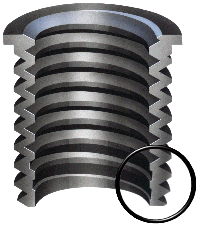
Fastener element inserted into a hole to provide threading for screws
A threaded insert, also known as a threaded bushing or insert nut, is a fastener element that is inserted into an object to add a threaded hole. They may be used to repair a stripped threaded hole, provide a durable threaded hole in a soft material, place a thread on a material too thin to accept it, mold or cast threads into a work piece thereby eliminating a machining operation, or simplify changeover from unified to metric threads or vice versa.
In woodworking, an insert nut provides a threaded socket for a wooden workpiece, similar to a wall anchor. Insert nuts are inserted into a pre-drilled hole by one of two means: screw in and hammer in. In both cases, the external protrusions bite into the wood, preventing the nut from either turning or pulling out.
Types
Thread inserts come in many varieties, depending on the application. Threaded inserts for plastics are used in plastic materials and applied with thermal insertion or ultrasonic welding machines.
Manufacturers of ready-to-assemble furniture often ship the parts with threaded inserts and other kinds of knock-down fasteners pre-installed.
People who use sheet metal or sandwich panel or honeycomb sandwich-structured composite often install threaded inserts to spread shear, tension, and torque loads over a larger area of the material.
Captive nut
Captive nuts come in two basic styles. One type, the cage nut or clip-on nut is a conventional nut held captive by a sheet metal carrier that clips onto the part to be connected. These are generally used to attach screws to sheet metal parts too thin to be threaded, and they can generally be attached, removed and reused with simple hand tools.
The second type of captive nut is a threaded insert. These are either pressed into holes in the material to be joined or moulded in. In either case, part of the insert is generally knurled to get a good grip on the material supporting the insert. One variant, the swage nut, has a knurled portion that swages the sides of a soft metal hole to more tightly grip the nut. Press fit and swaged captive nuts are used in panels that are too thin to be threaded or in soft materials that are too weak to be threaded. They are installed by pressing them in with an arbor press.
Threaded inserts are commonly used in plastic casings, housing, and parts to create a metal thread (typically: brass or stainless steel) to allow for screws to be used in the assembly of many consumer electronics and consumer products. These may be cast in place in injection molded parts or they may be added by thermal insertion. In the latter, the insert is heated and then pressed into a hollow in the plastic part. The heat causes local melting in the plastic.{{Cite journal|author1 = Sullivan, G.|author2 = Crawford, L. |name-list-style = amp |title = The Heat Stake Advantage |journal = Plastic Decorating Magazine |archive-url= https://web.archive.org/web/20150610201428/http://www.thermalpress.com/_data/docs/articles/janfeb03_heatstakeadvantage.pdf |archive-date = 2015-06-10 |url-status = dead
Externally-threaded inserts

An externally threaded insert has threads on the outside and inside. The insert can be threaded into a pre-tapped hole, or a self-tapping insert creates its own threads in a drilled or molded hole. It is then anchored by various means, such as a nylon locking element. Inserts that are anchored via Loctite are more commonly known by the trademarked name E-Z Lok. A thin-walled solid-bushing insert by the trademarked name TIME-SERT is locked in by rolling the bottom few internal thread into the base material with a special install driver which will permanently lock the insert in place. Key-locking inserts, more commonly known by the trademarked name Keenserts, use keys that are hammered into grooves through the threads, permanently locking the insert. Inserts that are self-tapping and lock via friction are more commonly known by the trademarked names Tap-lok or Speedserts.
Helical insert

A helical insert (also called a screw thread insert (STI), although most users call them all by one of the prominent brand names: KATO®, Heli-Coil® or Recoil®) is an insert made of stainless steel or phosphor bronze wire, with a diamond cross section, coiled to form inner and outer threads. The coil of wire screws into a threaded hole, where it forms a smaller-diameter internal thread for a screw or stud. These inserts provide a convenient means of repairing stripped internal threads. These inserts are commonly sold in kits with matched taps and insert tools.
In soft materials, they are used to provide stronger threads than can be obtained by direct tapping of the base materials, e.g. aluminium, zinc die castings, wood, magnesium, plastic.
An example application is engine repair after unintentionally destroying the threads in a socket for a spark plug by over-torquing or cross-threading.
Mold-in inserts
A mold-in insert has a specially shaped outer surface to anchor the insert in plastic. For injection-molded plastic, the insert is placed in a mold before it is filled with plastic, making an integral part. An insert can also be heated and pressed into pre-made thermoplastic material.
For softer, more pliable plastics, hexagonal or square inserts with deep and wide grooves allow the softer plastics to hold the inserts sufficiently. The process allows large product manufacture i.e. fuel tanks, boats etc., so the torque inserts may be of large thread sizes.
Press-fit inserts
A press-fit insert is internally threaded and has a knurled outer surface. It is pressed into a plain hole with an arbor press.
Potted inserts
A potted insert is set in epoxy to fix it, such as in a honeycomb sandwich panel, often used in commercial aircraft, and is said to be potted in.
Rivet nut
Main article: Rivet nut
A rivet nut, also known as a blind rivet nut, or rivnut, is a one-piece internally threaded and counterbored tubular rivet that can be anchored entirely from one side.
Strength factors of threaded inserts
Pull-out resistance & torque-out resistance are the two main strength factors of threaded inserts.
- Pull-out resistance: the force required to begin to pull the insert out of the parent material
- Torque-out: the amount of torque required to begin to turn the fastener
Installation methods
.jpg)
For industrial purposes, the following installation methods are the standards:
- Thermal insertion
- Injection molding
- Manual pressing
For craft purposes, they might be:
- Screw-in type: Screw-in insert nuts have an external thread and hex head and are screwed in with a Flat Blade Screwdriver or an Allen wrench. The screw-in insert nuts come in various sizes and take different screw sizes. For example, an M6 insert nut will take an M6 bolt, a "1/4-20" insert nut will take a 1/4-20 inch bolt., etc The pre-drilled hole must be as deep as the length of the insert nut plus any portion of the bolt that may be screwed past the end of the nut in the work piece.
- Hammer-in type: Hammer-in insert nuts, also known as knock-in nuts, are lined with barbs and are hammered in. They are often made of steel, brass or nylon. They are designed to work in wood and particle board.
References
Notes
Bibliography
- .
- Sullivan, Gary & Crawford, Lance, "The Heat Stake Advantage". Plastic Decorating Magazine. January/February 2003 Edition. . (Topeka, KS: Peterson Publications, Inc.). Section: Assembly: pages 11–12, covers Sullivan & Crawford's article.
- .
References
- (20 July 2017). "Repairing damaged threads: Types of thread repair inserts {{!}}".
- "Newman Tools Inc". Newmantools.com.
- [[McMaster-Carr]], p. [http://www.mcmaster.com/#catalog/114/3150 3150].
- "Inserts For Metal".
- McMaster-Carr, p. [http://www.mcmaster.com/#catalog/114/3204 3204].
- McMaster-Carr, p. [http://www.mcmaster.com/#catalog/114/3206 3206].
- McMaster-Carr, p. [http://www.mcmaster.com/#catalog/114/3207 3207].
- (2023-09-21). "What is a helicoil insert?".
- McMaster-Carr, p. [http://www.mcmaster.com/#catalog/114/3209 3209].
- Willacy, p. 39.
This article was imported from Wikipedia and is available under the Creative Commons Attribution-ShareAlike 4.0 License. Content has been adapted to SurfDoc format. Original contributors can be found on the article history page.
Ask Mako anything about Threaded insert — get instant answers, deeper analysis, and related topics.
Research with MakoFree with your Surf account
Create a free account to save articles, ask Mako questions, and organize your research.
Sign up freeThis content may have been generated or modified by AI. CloudSurf Software LLC is not responsible for the accuracy, completeness, or reliability of AI-generated content. Always verify important information from primary sources.
Report