From Surf Wiki (app.surf) — the open knowledge base
Thomas Pesquet
French aerospace engineer, pilot, and astronaut

French aerospace engineer, pilot, and astronaut
| Field | Value | |||||
|---|---|---|---|---|---|---|
| type | ESA astronaut | |||||
| image | Thomas Pesquet, official portrait in EMU (2020) cropped.jpg | |||||
| caption | Official portrait, 2020 | |||||
| status | Active | |||||
| birth_date | ||||||
| birth_name | Thomas Gautier Pesquet | |||||
| birth_place | Rouen, Normandy, France | |||||
| occupation | ||||||
| selection | 2009 ESA Group | |||||
| time | 396 days 11 hours 34 minutes | |||||
| eva1 | 6 | |||||
| eva2 | 39 hours, 54 minutes | |||||
| mission | Soyuz MS-03 (Expedition 50/51) | |||||
| insignia | [[File:ISS Expedition 50 Patch.png | 50px]] [[File:ISS Expedition 51 Patch.svg | 50px]] [[File:SpaceX Crew-2 logo.png | 50px]] [[File:ISS Expedition 65 Patch.png | 35px]] [[File:ISS Expedition 66 Patch.svg | 55px]] |
| website |
SpaceX Crew-2 (Expedition 65/66)
Thomas Gautier Pesquet (; born 27 February 1978) is a French aerospace engineer, pilot, European Space Agency astronaut, actor, musician, and writer. He was selected by ESA as a candidate in May 2009, and successfully completed his basic training in November 2010. From November 2016 to June 2017, he was part of Expedition 50 and Expedition 51 on the International Space Station (ISS) as a flight engineer. Pesquet returned to space in April 2021 on board the SpaceX Crew Dragon for a second six-month stay on the ISS.
Early life and education
Thomas Gautier Pesquet was born in Rouen, France, and considers Dieppe his hometown. He is the younger of two brothers.
Pesquet graduated from the Lycée Pierre Corneille in Rouen, France, in 1996.
In 2001, he received a master's degree from the École nationale supérieure de l'aéronautique et de l'espace in Toulouse, France, majoring in space systems and space vehicle mechanics. He spent his final year before graduation at the École Polytechnique de Montréal, Canada, as an exchange student on the Aeronautics and Space Master.
Pesquet graduated from the Air France flight school in 2006. This led to an Airline Transport Pilot License-Instrument Rating (ATPL-IR).
Career
From October 2001, Pesquet worked as a spacecraft dynamics engineer on remote sensing missions for GMV, S.A. in Madrid, Spain.
Between 2002 and 2004, Pesquet worked at the French space agency, CNES, as a research engineer on space missions autonomy. He also carried out various studies on future European ground segment design and European space technology harmonization. From late 2002, he was a representative of CNES at CCSDS, the Consultative Committee for Space Data Systems, working on the topic of cross-support between international space agencies.
A private pilot, he was selected in 2004 for Air France's flight training programme. He went on to become a commercial pilot for the French airline, where he started flying the Airbus A320 in 2006. He has logged more than 2000 hours flying time on various commercial airliners, and has qualified as a type-rating flight instructor on the A320, and as a Crew Resource Management instructor.
In 2018, Pesquet gained his Airbus A310 type rating and is qualified as a Novespace Zero-G aircraft pilot.
ESA
Pesquet was selected as a European Space Agency (ESA) astronaut in May 2009. He joined ESA in September 2009 and successfully completed Astronaut Basic Training in November 2010. Pesquet was the youngest member of the European Astronaut Corps, and the last of the ESA astronaut class of 2009 to arrive in space.
On 10 June 2014, NASA announced that Pesquet would serve as an aquanaut aboard the Aquarius underwater laboratory during the NEEMO 18 undersea exploration mission, which began on 21 July 2014 and lasted nine days. He has also taken part in ESA's CAVES underground course in 2011 and NASA's SEATEST II mission in 2013, furthering his experience in exploration.
From November 2016 to June 2017, Pesquet was part of Expedition 50 and Expedition 51 as a flight engineer. He was chosen by ESA for a six-month mission to the International Space Station starting in November 2016. He was also the backup to ESA astronaut Andreas Mogensen, who flew to the International Space Station on a 10-day flight in September 2015.
In 2023, Pesquet participated in the ESA PANGAEA training organized by the European Space Agency, held between Italy (Bletterbach canyon), Germany (Noerdlingen-Ries crater) and Spain (Lanzarote Island) together with the colleagues Takuya Onishi and Jessica Wittner.
Expedition 50/51
_Thomas_Pesquet.jpg)
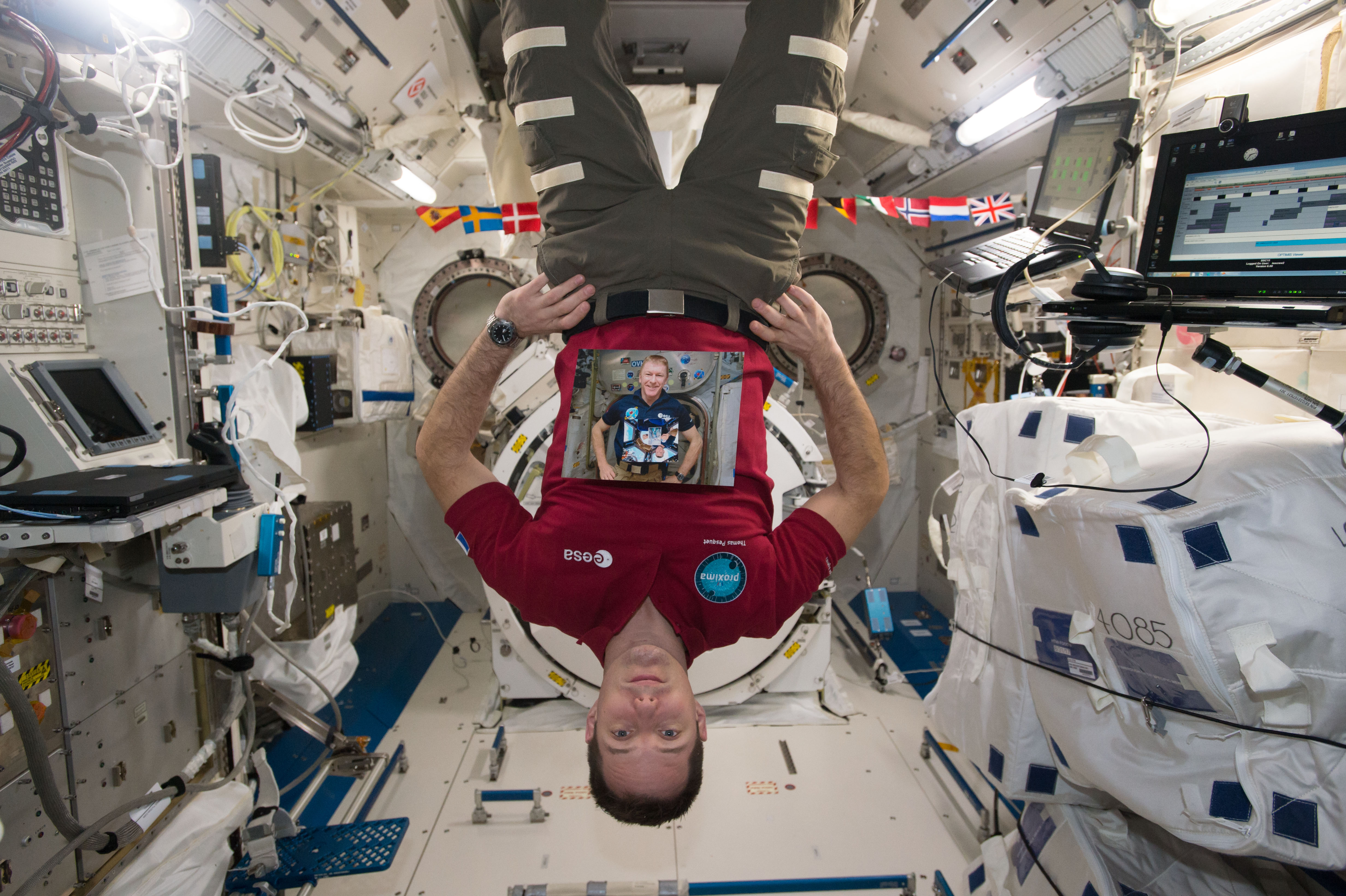
Pesquet launched from the Baikonur Cosmodrome onboard Soyuz MS-03 on November 17, 2016. He spent six months on the International Space Station as part of Expedition 50/51. Arriving at the ISS on November 19, 2016, he was the first French astronaut since Léopold Eyharts helped install the Columbus European laboratory module during Expedition 16. His arrival marked the beginning of the European Proxima mission.

The Proxima mission included 50 science experiments for ESA and CNES. The mission was named after Proxima Centauri, continuing the French astronauts' tradition of naming the missions after stars and constellations. The X inside the logo symbolizes that Pesquet is the tenth French astronaut as well as the unknown. The Proxima mission name was chosen in a competition, with the winning name given by 13-year-old Samuel Planas from Toulouse, France. The mission logo was designed by Thomas Pesquet and Karen Oldenburg.
Pesquet performed his first EVA with astronaut Shane Kimbrough on January 13, 2017. During the EVA, they prepared the infrastructure to replace the ISS batteries. The EVA lasted for 5 hours and 58 minutes.
On March 23, 2017, Pesquet performed his second career EVA with Shane Kimbrough. The main objective was to prepare the Pressurized Mating Adapter-3 (PMA-3) for installation of the second International Docking Adapter (IDA), which will accommodate future commercial crew vehicle dockings. The PMA-3 provides the pressurized interface between the station modules and the docking adapter. Expedition 50 Commander Kimbrough and Pesquet disconnected cables and electrical connections on PMA-3 to prepare for its robotic move on March 26, 2017. PMA-3 will be moved from the port side of the Tranquility module to the space-facing side of the Harmony module, where it will become home for the docking adapter, which will be delivered on a future flight of a SpaceX Dragon cargo ship. The spacewalkers also installed on the starboard zero truss (ITS) a new computer relay box equipped with advanced software for the adapter. The two spacewalkers lubricated the latching end effector on the Canadarm2 robotic arm, inspected a radiator valve suspected of a small ammonia leak and replaced cameras on the Japanese segment of the outpost. Radiators are used to shed excess heat that builds up through normal space station operation. The EVA lasted for 6 hours and 34 minutes.
On June 2, 2017, MS-03 undocked from the ISS, carrying Pesquet and Novitskiy back to Earth, concluding a 196-day mission in space. Peggy Whitson remained on the ISS and returned on Soyuz MS-04. MS-03 touched down just over 3 hours after undocking, concluding Pesquet's first spaceflight. Pesquet has spent 196 days, 17 hours and 49 minutes in space.
Expedition 65/66
On 11 March 2020, ESA announced in a blog post that Pesquet would return to the ISS in the second half of 2021 for a second six-month stay, in which he would become the first European astronaut to launch on board an American Commercial Crew Vehicle. And on July 28, 2020, Pesquet was officially assigned to the SpaceX Crew-2 as a mission specialist alongside NASA astronauts Shane Kimbrough commander of the Crew Dragon, Megan McArthur the pilot, and JAXA astronaut Akihiko Hoshide, the other mission specialist. Few hours before the announcement and after a competition to name Pesquet's mission, Pesquet revealed his second mission name as "Alpha", after Alpha Centauri, the nearest star system to the Sun, following the French mission naming tradition.
Crew Dragon Endeavour was launched on 23 April 2021 at 09:49:02 UTC, and docked to the International Space Station on 24 April at 09:08 UTC. Once on board the station, they joined ISS Expedition 65.
During this mission, Pesquet performed 4 EVAs. The first three EVAs were conducted with Shane Kimbrough on the 16, 20, and 25 of June with the tasks to install the first two Roll Out Solar Arrays (iROSA) on the station. The fourth EVA was originally planned to be performed by Akihiko Hoshide and Mark Vande Hei, but due to a medical issue for Vande Hei, Pesquet exited for the sixth time of his career the ISS to perform a spacewalk. During this spacewalk, he became the European record holder for most cumulative hours spent spacewalking, with a total of 39 hours and 54 minutes.
On October 4, 2021, he received the command of the ISS from Akihiko Hoshide, making him the first French astronaut to command a space vehicle. He transferred the command of the station to his Russian colleague Anton Shkaplerov on November 6, 2021.
Crew-2 landed in the Gulf of Mexico on 9 November 2021, after 199 days in space.
Recognition and honours
Pesquet is a member of the French Aeronautics and Astronautics Association (3AF), and of the American Institute of Aeronautics and Astronautics (AIAA).
On 12 April 2021, Thomas Pesquet was nominated Goodwill Ambassador for the Food and Agriculture Organization of the United Nations.
At the closing ceremony of the 2020 Summer Olympics, during the "handoff" portion introducing Paris as the host of the 2024 Summer Olympics, Pesquet performed the closing bars of the French national anthem La Marseillaise on a saxophone while aboard the International Space Station.
In 2020 he was also selected as a Karman Fellow for his work done in space exploration.
Other activities
Wanting to transmit his passion for space, he wrote an autobiography "Ma vie sans gravité" (My life without gravity, gravity and seriousness being the same word in French).
He also portrayed himself in the films Proxima (2019) and Hawa (2022).
Personal life
Pesquet speaks French, English, Spanish, Chinese, German, and Russian.
Pesquet is a black belt in judo, and lists basketball, jogging, swimming and squash as his favourite sports. He is an outdoor and adventure activities enthusiast, and enjoys mountain biking, kite surfing, sailing, skiing and mountaineering. He also has extensive experience with, and holds advanced licenses in, both scuba diving and parachuting. His other interests include travelling, playing the saxophone, and reading. He is a supporter of the French football team, as well as the French rugby team and the Stade Toulousain.
References
References
- "Thomas Pesquet".
- [http://lgcorneille-lyc.spip.ac-rouen.fr/spip.php?article6 Lycée Pierre Corneille de Rouen - History]
- [http://www.esa.int/SPECIALS/Astronaut_Selection/SEM2I9FF5ZF_0.html New class of European astronauts report for training]
- [http://www.esa.int/esaCP/SEM25956JGG_index_0.html Graduation ceremony for ESA's new astronauts]
- (10 June 2014). "NASA Announces Two Upcoming Undersea Missions". [[NASA]].
- Bergin, Chris. (11 June 2014). "NEEMO returns with two new underwater missions". [[NASAspaceflight.com.
- (2021-07-01). "Speleology as an analogue to space exploration: The ESA CAVES training programme". Acta Astronautica.
- (21 September 2011). "Astronauts cave crew returns to earth". [[CBS]].
- (17 March 2014). "ESA astronaut Thomas Pesquet will fly to the International Space Station in 2016". [[ESA]].
- "Moon scouts".
- "Astronauts using the Artemis lunar camera during geological exploration".
- "Thomas Pesquet records field exploration in Lanzarote".
- "Thomas Pesquet using the Artemis Moon camera".
- (19 November 2016). "ESA Astronaut Thomas Pesquet arrives at the International Space Station". [[ESA]].
- (12 November 2015). "Proxima Mission Logo". [[ESA]].
- (January 13, 2017). "Second Spacewalk of 2017 Successfully Complete". NASA.
- (March 24, 2017). "Astronauts carry out first of three station spacewalks". CBS news.
- Garcia, Mark. (June 2, 2017). "Expedition 51 Crew Back on Earth After 196 Days". NASA.
- (2020-03-11). "Thomas starts training for second space mission".
- (28 July 2020). "NASA Announces Astronauts to Fly on SpaceX Crew-2 Mission to Space Station".
- "Thomas Pesquet's 'Alpha' mission patch - collectSPACE: Messages".
- (23 April 2021). "SpaceX's Crew-2 launch lights up the predawn sky with a spectacular show (photos)".
- (28 July 2020). "JAXA星出彰彦宇宙飛行士の国際宇宙ステーション(ISS)長期滞在 搭乗機決定について".
- (28 July 2020). "Thomas Pesquet first ESA astronaut to ride a Dragon to space". ESA Science & Exploration.
- (2 June 2021). "New solar arrays ready to upgrade International Space Station's power grid". Spaceflight Now.
- (15 Oct 2020). "Current and Future Operations and Challenges with International Space Station". NASA.
- (2021-08-23). "Spacewalk is Postponed".
- (2021-10-04). "Thomas Pesquet takes commanding role on Space Station".
- (2021-11-06). "Russian cosmonaut Shkaplerov takes command of ISS".
- (2021-11-09). "SpaceX Crew-2 astronauts splash down in the Gulf of Mexico, completing their mission". Washington Post.
- "FAO Website".
- (8 August 2021). "French Astronaut Plays Saxophone From Outer Space During Closing Ceremony".
- "Thomas Pesquet Astronaut European Space Agency {{!}} The Karman Project".
- "Members".
- Léo Soesanto. (25 November 2019). "«Proxima», l’espace des possibles".
- "Euro 2021 : comment Thomas Pesquet pourra suivre le match Portugal-France depuis l'espace".
- (4 February 2017). "Depuis l'espace, Thomas Pesquet avec le maillot des Bleus et le ballon du Stade Toulousain".
This article was imported from Wikipedia and is available under the Creative Commons Attribution-ShareAlike 4.0 License. Content has been adapted to SurfDoc format. Original contributors can be found on the article history page.
Ask Mako anything about Thomas Pesquet — get instant answers, deeper analysis, and related topics.
Research with MakoFree with your Surf account
Create a free account to save articles, ask Mako questions, and organize your research.
Sign up freeThis content may have been generated or modified by AI. CloudSurf Software LLC is not responsible for the accuracy, completeness, or reliability of AI-generated content. Always verify important information from primary sources.
Report