From Surf Wiki (app.surf) — the open knowledge base
Thomas Cubitt
Master builder in London
Master builder in London
| Field | Value |
|---|---|
| name | Thomas Cubitt |
| image | Thomascubitt.png |
| birth_date | 25 February 1788 |
| birth_place | Buxton, Norfolk, England |
| death_date | 20 December 1855 (aged 67) |
| death_place | Denbies, Surrey, England |
| nationality | British |
| practice | Cubitts |
| significant_buildings | The London Institution |
| Buckingham Palace | |
| Osborne House | |
| significant_projects | Belgrave Square |
| Lowndes Square | |
| Chesham Place | |
| Gordon Square | |
| Tavistock Square | |
| Eccleston Square | |
| significant_design | Eaton Square |
| Battersea Park |
Buckingham Palace Osborne House Lowndes Square Chesham Place Gordon Square Tavistock Square Eccleston Square Battersea Park
Thomas Cubitt (25 February 1788 – 20 December 1855) was a British master builder, notable for his employment in developing many of the historic streets and squares of London, especially in Belgravia, Pimlico and Bloomsbury.
Background
The son of a Norfolk carpenter, he journeyed to India as a ship's carpenter, from which he earned sufficient funds to start his own building firm in 1810 on Gray's Inn Road, London, where he was one of the first builders to have a 'modern' system of employing all the trades under his own management.
Work

Cubitt's first major building was the London Institution in Finsbury Circus, built in 1815. After this he worked primarily on speculative housing at Camden Town, Islington, and especially at Highbury Park, Stoke Newington.
His development of areas of Bloomsbury, including Gordon Square and Tavistock Square, began in 1820, for a group of landowners including the Duke of Bedford.

Cubitt's work outside London includes the country house Polesden Lacey, near Dorking, Surrey, which he rebuilt to largely its present form in the early 1820s.
He was commissioned in 1824 by Richard Grosvenor, 2nd Marquess of Westminster, to create a great swathe of building in Belgravia centred on Belgrave Square and Pimlico, in what was to become his greatest achievement in London. Notable amongst this development are the north and west sides of Eaton Square, which exemplify Cubitt's style of building and design.

After Cubitt's workshops in Thames Bank were destroyed by fire, he remarked "Tell the men they shall be at work within a week, and I will subscribe £600 towards buying them new tools."
Cubitt was employed in the large development of Kemp Town in Brighton.
In 1827 he withdrew from the management of his Gray's Inn Road concern leaving this to his brother William Cubitt; the firm of Cubitts still carried out the work of Thomas Cubitt and the change robbed neither partner of the credit for their work.
Between 1845 and 1851, together with Prince Albert, Cubitt designed and built Osborne House on the Isle of Wight, completed in 1851. At the same time, between 1847 and 1850, he was responsible for the new east front of Buckingham Palace.
In the 1850s, Cubitt built and personally funded a thousand yards (nearly one kilometre) of the Thames Embankment.
Family
Cubitt had two brothers, the contractor and politician William and the civil engineer Lewis who designed many houses built by Thomas.
Cubitt married Mary Anne Warner (1802–1880), on 25 March 1821 in the church of St Marylebone and they had at least twelve children – Anne (1820), Mary (1821), Emily (1823), George (1828), Sophia (1830), Fanny (1832), William (1834), Lucy (1835), Caroline (1837), Arthur (1840), and twins Thomas and Charles (1842), although five children predeceased their father. George became a politician, created Baron Ashcombe in 1892. Mary, later Mrs Parker, was a botanist whose botanical specimens are held at the Royal Botanica Gardens, Kew.
Thomas through his son, George, is a great-great-great-grandfather of Queen Camilla. |access-date=8 February 2022 |archive-url=https://web.archive.org/web/20220208054906/http://www.wargs.com/royal/camilla.html |archive-date=8 February 2022
Legacy
.JPG)
Cubitt died in 1855
After his death, Queen Victoria said, "In his sphere of life, with the immense business he had in hand, he is a real national loss. A better, kindhearted or more simple, unassuming man never breathed."
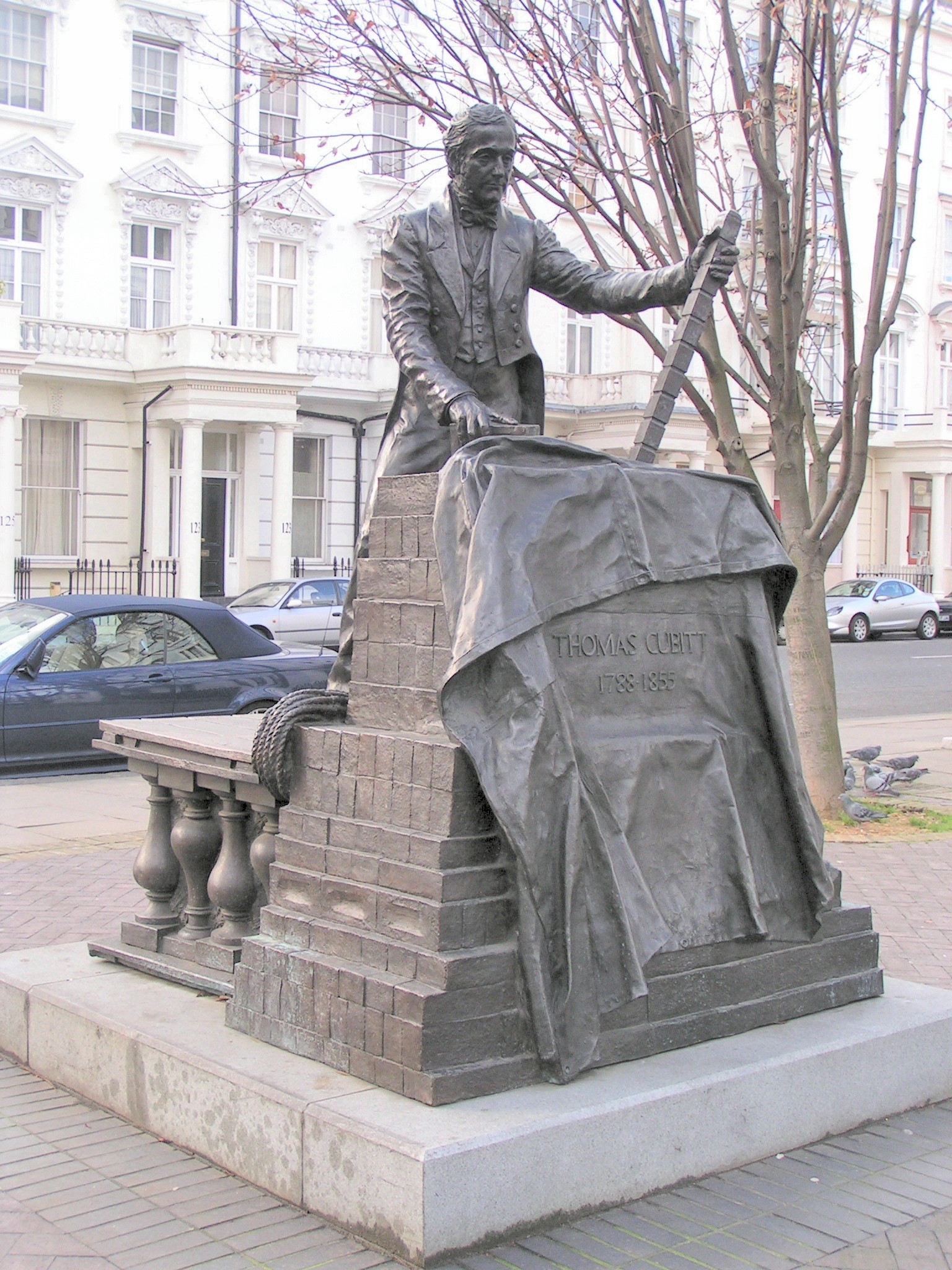
As well as the statue in Denbigh Street, London, another of Cubitt can be seen in Dorking, opposite the Dorking Halls, as he was favoured there for his architecture on his Denbies estate.
In 1883 the business was acquired by Holland & Hannen, a leading competitor, which combination became known as Holland & Hannen and Cubitts, later Holland, Hannen & Cubitts.
Restaurants, pubs and other places have been named in his honour.
References and footnotes
;Footnotes ;Citations
References
- ''Holland & Hannen and Cubitts – The Inception and Development of a Great Building Firm'', published 1920, Page 17
- ''Holland & Hannen and Cubitts – The Inception and Development of a Great Building Firm'', published 1920, Page 19
- ''Holland & Hannen and Cubitts – The Inception and Development of a Great Building Firm'', published 1920, Page 25
- ''Holland & Hannen and Cubitts – The Inception and Development of a Great Building Firm'', published 1920, Page 27
- "Polesden Lacey".
- ''Holland & Hannen and Cubitts – The Inception and Development of a Great Building Firm'', published 1920, Page 29
- Timbs, John. (1855). "Curiosities of London: Exhibiting the Most Rare and Remarkable Objects of Interest in the Metropolis". D. Bogue.
- His public works included the provision of public parks, including being an organiser of the [[Battersea Park]] Scheme.''Holland & Hannen and Cubitts – The Inception and Development of a Great Building Firm'', published 1920, Page 33
- ''Holland & Hannen and Cubitts – The Inception and Development of a Great Building Firm'', published 1920, Page 35
- ''Holland & Hannen and Cubitts – The Inception and Development of a Great Building Firm'', published 1920, Page 31
- Hobhouse, Hermione. "Cubitt, Thomas".
- (15 August 2015). "Thomas Cubitt's Wife and Children {{!}} Ranmore War Memorial".
- {{CiteQ. Q92312565
- [https://books.google.com/books?id=ez1ceMrkeoQC&pg=PT65 ''London'' By Stephen Halliday]
- "Thomas Cubitt statue". London Remembers.
- "Mary Ann Cubitt of Denbies – a detective story By Mark Cortino with biographical notes by Kathy Atherton". Dorking Museum.
- ''Cubitts 1810 – 1975'', published 1975
- "Cubit House".
This article was imported from Wikipedia and is available under the Creative Commons Attribution-ShareAlike 4.0 License. Content has been adapted to SurfDoc format. Original contributors can be found on the article history page.
Ask Mako anything about Thomas Cubitt — get instant answers, deeper analysis, and related topics.
Research with MakoFree with your Surf account
Create a free account to save articles, ask Mako questions, and organize your research.
Sign up freeThis content may have been generated or modified by AI. CloudSurf Software LLC is not responsible for the accuracy, completeness, or reliability of AI-generated content. Always verify important information from primary sources.
Report