From Surf Wiki (app.surf) — the open knowledge base
Thiophene
Sulfur-containing aromatic compound
Sulfur-containing aromatic compound
Thiacyclopentadiene Thiole 0.6432 cP at 22.4 °C | NFPA-H = 2 | NFPA-F = 3 | NFPA-R = 0 Diethyl sulfide Selenophene Pyrrole
Thiophene is a heterocyclic compound with the formula C4H4S. Consisting of a planar five-membered ring, it is aromatic as indicated by its extensive substitution reactions. It is a colorless liquid with a benzene-like odor. In most of its reactions, it resembles benzene. Compounds analogous to thiophene include furan (C4H4O), selenophene (C4H4Se) and pyrrole (C4H4NH), which each vary by the heteroatom in the ring.
Isolation and occurrence
Thiophene was discovered by Viktor Meyer in 1882 as a contaminant in benzene. It was observed that isatin (an indole) forms a blue dye if it is mixed with sulfuric acid and crude benzene. The formation of the blue indophenin had long been believed to be a reaction of benzene itself. Viktor Meyer was able to isolate thiophene as the actual substance responsible for this reaction.
Thiophene and especially its derivatives occur in petroleum, sometimes in concentrations up to 1–3%. The thiophenic content of oil and coal is removed via the hydrodesulfurization (HDS) process.
On Mars
Thiophene derivatives have been detected at nanomole levels in 3.5 billions year old Martian soil sediments (Murray Formation, Pahrump Hills) by the rover Curiosity at Gale crater (Mars) between 2012 and 2017.
Synthesis and production
Reflecting their high stabilities, thiophenes arise from many reactions involving sulfur sources and hydrocarbons, especially unsaturated ones. The first synthesis of thiophene by Meyer, reported the same year that he made his discovery, involves acetylene and elemental sulfur. Thiophenes are classically prepared by the reaction of 1,4-diketones, diesters, or dicarboxylates with sulfidizing reagents such as P4S10 such as in the Paal-Knorr thiophene synthesis. Specialized thiophenes can be synthesized similarly using Lawesson's reagent as the sulfidizing agent, or via the Gewald reaction, which involves the condensation of two esters in the presence of elemental sulfur. Another method is the Volhard–Erdmann cyclization.
Thiophene is produced on a modest scale of around 2,000 metric tons per year worldwide. Production involves the vapor phase reaction of a sulfur source, typically carbon disulfide, and a C-4 source, typically butanol. These reagents are contacted with an oxide catalyst at 500–550 °C.
Properties and structure
Thiophene is a colorless liquid at room temperature. The high reactivity of thiophene toward sulfonation is the basis for the separation of thiophene from benzene, which are difficult to separate by distillation due to their similar boiling points (4 °C difference at ambient pressure). Like benzene, thiophene forms an azeotrope with ethanol.
The molecule is flat; the bond angle at the sulfur is around 93°, the C–C–S angle is around 109°, and the other two carbons have a bond angle around 114°. The C–C bonds to the carbons adjacent to the sulfur are about 1.34 Å, the C–S bond length is around 1.70 Å, and the other C–C bond is about 1.41 Å.
Reactivity
Thiophene is considered to be aromatic, although theoretical calculations suggest that the degree of aromaticity is less than that of benzene. The "electron pairs" on sulfur are significantly delocalized in the pi electron system. As a consequence of its aromaticity, thiophene does not exhibit the properties seen for conventional sulfides. For example, the sulfur atom resists alkylation and oxidation.
Oxidation
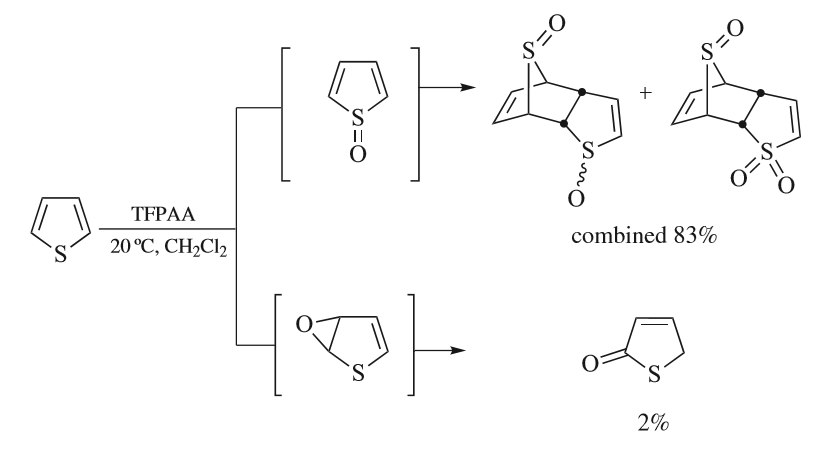
Oxidation can occur both at sulfur, giving a thiophene S-oxide, as well as at the 2,3-double bond, giving the thiophene 2,3-epoxide, followed by subsequent NIH shift rearrangement.
Oxidation with trifluoroperacetic acid demonstrates both reaction pathways. The major pathway forms the S-oxide as an intermediate, which undergoes subsequent Diels-Alder-type dimerisation and further oxidation, forming a mixture of sulfoxide and sulfone products with a combined yield of 83% (based on NMR evidence):
In the minor reaction pathway, a Prilezhaev epoxidation results in the formation of thiophene-2,3-epoxide that rapidly rearranges to the isomer thiophene-2-one. demonstrate that this pathway is not a side reaction from the S-oxide intermediate, while isotopic labeling with deuterium confirm that a 1,2-hydride shift occurs and thus that a cationic intermediate is involved. If the reaction mixture is not anhydrous, this minor reaction pathway is suppressed as water acts as a competing base.
Oxidation may be relevant to the metabolic activation of various thiophene-containing drugs, such as tienilic acid and the investigational anticancer drug OSI-930.
Alkylation
Although the sulfur atom is relatively unreactive, the flanking carbon centers, the 2- and 5-positions, are highly susceptible to attack by electrophiles. Halogens give initially 2-halo derivatives followed by 2,5-dihalothiophenes; perhalogenation is easily accomplished to give C4X4S (X = Cl, Br, I). Thiophene brominates 107 times faster than does benzene. Acetylation occurs readily to give 2-acetylthiophene, precursor to thiophene-2-carboxylic acid and thiophene-2-acetic acid.
Chloromethylation and chloroethylation occur readily at the 2,5-positions. Reduction of the chloromethyl product gives 2-methylthiophene. Hydrolysis followed by dehydration of the chloroethyl species gives 2-vinylthiophene.
Desulfurization
Desulfurization of thiophene with Raney nickel affords butane. When coupled with the easy 2,5-difunctionalization of thiophene, desulfurization provides a route to 1,4-disubstituted butanes.

Polymerization
The polymer formed by linking thiophene through its 2,5 positions is called polythiophene. Polymerization is conducted by oxidation using electrochemical methods (electropolymerization) or electron-transfer reagents. An idealized equation is shown: :n C4H4S → (C4H2S)n + 2n H+ + 2n e−
Polythiophene itself has poor processing properties and so is little studied. More useful are polymers derived from thiophenes substituted at the 3- and 3- and 4- positions, such as EDOT (ethylenedioxythiophene). Polythiophenes become electrically conductive upon partial oxidation, i.e. they obtain some of the characteristics typically observed in metals.
Coordination chemistry
Thiophene exhibits little sulfide-like character, but it does serve as a pi-ligand forming piano stool complexes such as Cr(η5-C4H4S)(CO)3.
Thiophene derivatives
Thienothiophene251-41-2.png|Thieno[3,2-b]thiophene, one of the four thienothiophenes 2,2'Bithiophene.png|2,2'-Bithiophene EDOT.svg|3,4-Ethylenedioxythiophene (EDOT), the precursor to commercial antistatic and electrochromic displays Benzothiophene numbering.svg|Benzothiophene
Thienyl
Upon deprotonation, thiophene converts to the thienyl group, C4H3S−. Although the anion per se does not exist, the organolithium derivatives do. Thus reaction of thiophene with butyl lithium gives 2-lithiothiophene, also called 2-thienyllithium. This reagent reacts with electrophiles to give thienyl derivatives, such as the thiol. Oxidation of thienyllithium gives 2,2'-dithienyl, (C4H3S)2. Thienyl lithium is employed in the preparation of higher order mixed cuprates. Coupling of thienyl anion equivalents gives dithienyl, an analogue of biphenyl.
Ring-fused thiophenes
Fusion of thiophene with a benzene ring gives benzothiophene. Fusion with two benzene rings gives either dibenzothiophene (DBT) or naphthothiophene. Fusion of a pair of thiophene rings gives isomers of thienothiophene.
Uses
Thiophenes are important heterocyclic compounds that are widely used as building blocks in many agrochemicals and pharmaceuticals. The benzene ring of a biologically active compound may often be replaced by a thiophene without loss of activity.{{cite book
References
NOTE: Footnotes in this article use names, not numbers. Please see Wikipedia:Footnotes for details.
- Assign your footnote a unique name, for example TheSun_Dec9.
- Add the macro to the body of the article, where you want the new footnote.
- Take note of the name of the footnote that immediately precedes yours in the article body.
- Add # to the footnote numbered-list, immediately below the footnote you noted in step 3. No need to re-number anything!
- Multiple footnotes to the same reference: see Wikipedia:Footnotes for a how-to, if you don't succeed by simply following the pattern. NOTE: It is important to add footnotes in the right order in the list! --
References
- [[International Union of Pure and Applied Chemistry]]. (2014). "Nomenclature of Organic Chemistry: IUPAC Recommendations and Preferred Names 2013". [[Royal Society of Chemistry.
- GHS: [https://gestis.dguv.de/data?name=010090 GESTIS 010090]
- Meyer, Viktor. (1883). "Ueber den Begleiter des Benzols im Steinkohlenteer". [[Berichte der Deutschen Chemischen Gesellschaft]].
- Ward C., Sumpter. (1944). "The Chemistry of Isatin". [[Chemical Reviews]].
- (2018). "NASA rover hits organic pay dirt on Mars". Science.
- Swanston, Jonathan. (2006). "Ullmann's Encyclopedia of Industrial Chemistry". Wiley-VCH.
- Cambridge Structural Database
- Treiber, A., Dansette, P. M., Amri, H. E., Girault, J.-P., Ginderow, D., Mornon, J.-P., Mansuy, D.. (1997). "Chemical and Biological Oxidation of Thiophene: Preparation and Complete Characterization of Thiophene ''S-Oxide'' Dimers and Evidence for Thiophene ''S''-Oxide as an Intermediate in Thiophene Metabolism ''in Vivo'' and ''in Vitro''". J. Am. Chem. Soc..
- Treiber, Alexander. (2002). "Mechanism of the Aromatic Hydroxylation of Thiophene by Acid-Catalyzed Peracid Oxidation". [[J. Org. Chem.]].
- (2012). "Encyclopedia of Reagents for Organic Synthesis".
- Hagen, Timothy J.. (2007). "Name Reactions of Functional Group Transformations". [[John Wiley & Sons]].
- (2006). "Modern Physical Organic Chemistry". University Science Books.
- Mansuy, D., Valadon, P., Erdelmeier, I., López García, P., Amar, C., Girault, J. P., and Dansette, P. M.. (1991). "Thiophene ''S''-oxides as new reactive metabolites: Formation by cytochrome-P450 dependent oxidation and reaction with nucleophiles". J. Am. Chem. Soc..
- Rademacher P. M., Woods C. M., Huang Q., Szklarz G. D., Nelson S. D.. (2012). "Differential Oxidation of Two Thiophene-Containing Regioisomers to Reactive Metabolites by Cytochrome P450 2C9". Chem. Res. Toxicol..
- Mansuy D., Dansette P. M.. (2011). "Sulfenic acids as reactive intermediates in xenobiotic metabolism". Archives of Biochemistry and Biophysics.
- Dansette, PM, Rosi, J, Debernardi, J, Bertho G, Mansuy D. (2012). "Metabolic Activation of Prasugrel: Nature of the Two Competitive Pathways Resulting in the Opening of Its Thiophene Ring". [[Chem. Res. Toxicol.]].
- Henry Y. Lew and C. R. Noller. (1963). "2-Iodolthiophene".
- W. S. Emerson and T. M. Patrick Jr.. (1963). "2-Vinylthiophene".
- K. B. Wiberg and H. F. McShane. (1955). "2-Chloromethylthiophene".
- Hoek, W.. (1966). "The synthesis of ω‐functionalized 1‐adamantylalkanes". Recueil des Travaux Chimiques des Pays-Bas.
- J. Roncali. (1992). "Conjugated poly(thiophenes): synthesis, functionalization, and applications". [[Chem. Rev.]].
- Rauchfuss, T. B., "The Coordination Chemistry of Thiophenes", Progress in Inorganic Chemistry 1991, volume 39, pp. 259-311. {{ISBN. 978-0-471-54489-0
- E. Jones and I. M. Moodie. (1988). "2-Thiophenethiol".
- (1990). "Mixed Higher-order Cyanocuprate-induced Epoxide Openings: 1-Benzyloxy-4-penten-2-ol". Org. Synth..
This article was imported from Wikipedia and is available under the Creative Commons Attribution-ShareAlike 4.0 License. Content has been adapted to SurfDoc format. Original contributors can be found on the article history page.
Ask Mako anything about Thiophene — get instant answers, deeper analysis, and related topics.
Research with MakoFree with your Surf account
Create a free account to save articles, ask Mako questions, and organize your research.
Sign up freeThis content may have been generated or modified by AI. CloudSurf Software LLC is not responsible for the accuracy, completeness, or reliability of AI-generated content. Always verify important information from primary sources.
Report