From Surf Wiki (app.surf) — the open knowledge base
ThinkCentre
Desktop computers by Lenovo

Desktop computers by Lenovo
| Field | Value |
|---|---|
| name | ThinkCentre |
| developer | IBM (2003–2005) |
| Lenovo (2005–present) | |
| type | Desktop/All-in-one |
| logo | ThinkCentre (2005).svg |
| image | File:UCSD AF Wiki-21.jpg |
| caption | ThinkCentre All-in-One |
| release_date | |
| predecessor | IBM NetVista |
| marketing_target | Business purpose |
| manufacturer | IBM (2003-2005) |
| Lenovo (2005-present) | |
| os | Microsoft Windows |
| cpu | Intel Core, AMD Ryzen PRO |
| graphics | Nvidia GeForce, AMD Radeon, Intel Graphics |
| camera | 1080p camera (AiO models only) |
| platform | Think |
| display | Up to 24" 1440p screen (AiO models only) |
| power | Up to 750 W |
| online_services | Microsoft 365, Adobe Creative Cloud, Adobe Acrobat |
| website | Efficient and Reliable Lenovo ThinkCentre Desktops Lenovo US |
Lenovo (2005–present) Lenovo (2005-present)
ThinkCentre is a brand of business-oriented desktop computers and all-in-one computers, the early models of which were designed, developed and marketed by International Business Machines (IBM) since 2003. In 2005, IBM sold its PC business, including the ThinkCentre brand, to Lenovo. ThinkCentre computers typically include mid-range to high-end processors, options for discrete graphics cards, and multi-monitor support.
History
Launch
The ThinkCentre line of desktop computers was introduced by IBM in 2003. The first three models in this line were the S50, the M50, and A50p. All three desktops were equipped with Intel Pentium 4 processors. The chassis was made of steel and designed for easy component access without the use of tools. The hard disk was fixed in place by a 'caddy' without the use of screws. The caddy had rubber bumpers to reduce vibration and operational noise.
Additional updates to the desktops included greater use of ThinkVantage technologies. All desktop models were made available with ImageUltra. The three desktop models also included an 'Access IBM' button, allowing access to onboard resources, diagnostic tools, automated software, and links to online updates and services. Select models featured IBM's Embedded Security Subsystem, with an integrated security chip and IBM Client Security Software.
Acquisition by Lenovo
Main article: Acquisition of the IBM PC business by Lenovo
In 2005, after completing its acquisition of IBM's personal computing business, leading to the IBM/Lenovo partnership, IBM/Lenovo announced the ThinkCentre E Series desktops, designed specifically for small businesses. The ThinkCentre E50 was made available in tower and small form factor, with a silver and black design.
In 2005, Technology Business Research (TBR) observed an increase in the customer satisfaction rate for ThinkCentre desktops. According to TBR's "Corporate IT Buying Behavior and Customer Satisfaction Study” published in the second quarter of 2005, Lenovo was the only one of four surveyed companies that displayed a substantial increase in ratings.
In May 2005, the ThinkCentre M52 and A52 desktops were announced by Lenovo. These desktops marked the first time the ThinkCentre line incorporated dual-core processors and 64-bit technology. At the time of release, Lenovo also announced plans to incorporate Intel Active Management Technology (iAMT) in future products.
Product series

The ThinkCentre desktops available from IBM/Lenovo are:
- ThinkCentre A series (SFF and AIO)
- ThinkCentre M series (in tower, SFF, and USFF)
- ThinkCentre Edge (in tower and AIO form factors)
- ThinkCentre Neo (in tower, SFF, tiny, and AIO)
Notable Models
ThinkCentre X1
The ThinkCentre X1 is a mid-range all-in-one desktop computer announced by Lenovo at the 2016 International CES. The X1 is powered by a 6th generation Intel Core i7 processor paired with 16 gigabytes of 2,333 megahertz DDR4 RAM and a variety of storage media such as hard drives, hybrid drives, and solid state drives. The display uses 23.8-inch 1920 pixel by 1080 pixel panel with an anti-glare coating. A 1080p webcam is mounted just above the screen. Five USB 3.0 ports, DisplayPort video output, and an Ethernet port come standard. A memory card reader is optional. One variant of the X1 is a display-only device.
ThinkCentre Tiny-In-One II
The ThinkCentre Tiny-In-One II is Lenovo's second-generation all-in-one desktop computer. Its modular design allows its display and internals to be upgraded as needed. The ThinkCentre Tiny-In-One II comes in versions with 22-inch and 24-inch anti-glare displays with thin bezels and optional multitouch input. Both versions use 1920x1080 display panels. Two USB 3.0 ports, two USB 2.0 ports, one mini USB 2.0 port. and a Kensington security slot is included. Options for Microsoft Windows and Google's ChromeOS are both available.
Chromebox Tiny
The Chromebox Tiny is a small desktop computer with a Core i3-5005U processor, 4 gigabytes of memory, a 16 GB solid-state drive, integrated graphics that runs Google's ChromeOS. It was designed for education and business. Its largest side measures about 7 inches square. It is 1.4 inches thick and weighs 2.2 pounds. Computers with this form factor are called "one-liter" machines in some countries that use the metric system. The Tiny can be mounted on the back of monitors or placed on walls with a VESA mount. The Chromebox Tiny has two USB 3.0 ports on its front and two more on its rear. Dual-band 802.11ac Wi-Fi and Bluetooth 4.0 are both supported. An external antenna is included to improve reception. A mouse and keyboard come standard.
M83 Tiny
The ThinkCentre M83 Tiny is a ultra small-form-factor desktop computer released in 2014. The M83 Tiny uses an Intel Core i5 processor. It comes standard with one DisplayPort jack, and Ethernet port, five USB 3.0 ports, and a VGA port. There is a customizable port that can be configured with another DisplayPort jack, a serial port, another USB port, or an HDMI port. Wi-fi is 802.11ac. Wireless accessories are supported via Bluetooth 4.0.{{cite news |author= |title=Lenovo ThinkCentre M83 Tiny
S50
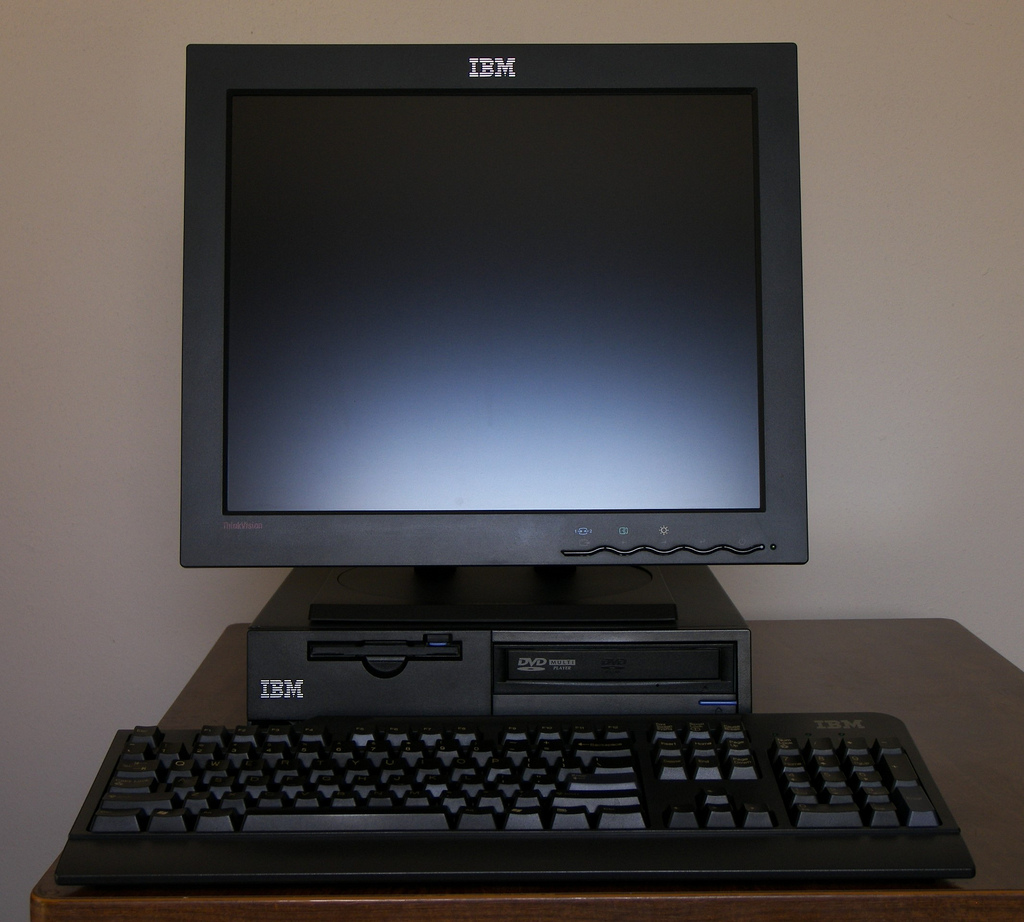
In 2004, an ultra-small version of the S50 was announced, the smallest desktop PC introduced until that time by IBM. The ultra-small ThinkCentre S50 desktop weighed approximately the same as IBM's first notebook (IBM 5140 PC Convertible). The ultra-small desktop was roughly the size of a New York City phonebook, or a box of cereal. The ultra-small desktop also featured a tool-free tool-less steel chassis and IBM ThinkVantage Technologies.
A series
Main article: ThinkCentre A series
A60
In August 2006, the ThinkCentre A60 desktop was announced. It was the first ThinkCentre with AMD processors.
In September 2006, Lenovo announced that its ThinkPad, ThinkCentre, and ThinkVision products received high ratings from EPEAT. A total of 42 products were rated by EPEAT. The ThinkCentre desktops received an overall rating of EPEAT silver. This indicated that all criteria for environmentally safe computing had been met – including the minimum requirements and additional optional implementations. Some of the criteria met included reduced levels of cadmium, mercury, and lead, energy efficiency, and reduced greenhouse gas emissions.
In September 2006, Lenovo announced several desktops in the ThinkCentre line, including the M55p, M55, M55e, A55 and A53.
A55
In January 2007, the ThinkCentre A55 small-form-factor desktop was announced by Lenovo. The A55 was approximately 64% smaller than Lenovo's traditional tower desktops and 25% smaller than Lenovo's traditional small desktops. In September 2007, Lenovo announced the ultra-small-form-factor A61e.
Also in September 2007, two new M Series desktops were announced: the M57 and M57p.
A58 and M58e
In March 2009, two small, low-cost desktops were announced by Lenovo: the ThinkCentre A58 and the ThinkCentre M58e. The A58 desktop was designed for small and medium businesses, while the M58e was designed for medium-sized and large enterprises. The desktops were made available in both tower and small form-factor versions.
Timeline
References
References
- "ThinkCentre Desktop Features".
- (21 May 2003). "IBM Unveils New ThinkCentre Line of Desktops Designed for Easy Maintenance and Lower Operating Costs".
- (18 October 2005). "Lenovo Launches First Desktop Line for Small Business".
- (30 August 2005). "Lenovo Posts Largest Percentage Gain in Desktop User Satisfaction".
- (26 May 2005). "Lenovo Powers up the Desktop with New Dual-Core ThinkCentre Models".
- (4 January 2016). "The new Lenovo ThinkCentre X1: You won't believe how slim it is". Windows Central.
- Andrew E. Freedman. (3 February 2016). "Lenovo Thinkpad Stack - Full Review and Benchmarks".
- Henry T. Casey. (3 January 2016). "Lenovo's Modular ThinkCentre II Shrinks Bezel, Adds Speaker". Tom's Guide.
- Gabe Carey. (3 January 2016). "These are Lenovo's First 2016 ThinkPads - CES 2016 - Page 4 - Digital Trends". Digital Trends.
- Riofrio, Melissa. (27 April 2015). "Lenovo's $199 Chromebox Tiny is an affordable addition to its line of ThinkCentre Tiny PCs". PC World.
- Buzzi, Matthew. (1970-01-01). "Lenovo ThinkCentre Chromebox Tiny Desktop Review & Rating". PCMag.com.
- (9 June 2004). "The Incredible Shrinking IBM Desktop".
- (8 August 2006). "Lenovo Introduces First ThinkCentre Desktop PCs with AMD Processors".
- (18 September 2006). "EPA-Funded Standard Gives Lenovo Green Thumbs-Up".
- (26 September 2006). "Lenovo Debuts Fleet of Intel Core 2 Duo ThinkCentre Desktop PCs".
- (29 January 2007). "Lenovo Expands Desktop Lineup to Go Small on Size, Big on Value".
- (12 September 2007). "Lenovo Raises Energy-Efficiency Bar with Its Smallest, Quietest Desktop PC".
- (18 September 2007). "Lenovo Empowers Enterprise Manageability Platform with New ThinkCentre Desktop PCs".
- (10 March 2009). "Lenovo Retools ThinkCentre Business Desktops for Smaller, Lower Cost Options".
This article was imported from Wikipedia and is available under the Creative Commons Attribution-ShareAlike 4.0 License. Content has been adapted to SurfDoc format. Original contributors can be found on the article history page.
Ask Mako anything about ThinkCentre — get instant answers, deeper analysis, and related topics.
Research with MakoFree with your Surf account
Create a free account to save articles, ask Mako questions, and organize your research.
Sign up freeThis content may have been generated or modified by AI. CloudSurf Software LLC is not responsible for the accuracy, completeness, or reliability of AI-generated content. Always verify important information from primary sources.
Report