From Surf Wiki (app.surf) — the open knowledge base
Thiethylperazine
Chemical compound
Chemical compound
| Drugs.com = | elimination_half-life =
Thiethylperazine (Torecan, Norzine) is an antiemetic of the phenothiazine class. It is an antagonist of dopamine receptors (DRD1, DRD2, DRD4) as well as of 5-HT2A, 5-HT2C receptors, mAChRs (1 through 5), α1 adrenergic receptor and H1 receptor.
Thiethylperazine activates the transport protein ABCC1 that clears beta-amyloid from brains of mice.
Pharmacokinetics
Distribution
Thiethylperazine is highly lipofilic and it binds with membranes and serum proteins (over 85%). It accumulates in organs with high blood flow and penetrates the placenta. It cannot be removed with dialysis.
Metabolism
It is mainly metabolized in the liver and only 3% is eliminated unchanged. Thiethylperazine's half-life is 12 h.
Teratogenicity
In toxic doses above the terapeutic window, it increases the rate of cleft palate occurrence.
Antipsychotic activity
Theithylperazine may possess antipsychotic activity due to the antagonism of 5-HT2 and D2 receptors. It can cause extrapyramidal symptoms. Nevertheless, it was never marketed as an antipsychotic.
One cause of acute dystonia occurred in a 19-year-old male patient after discontinuation of this drug.
Overdose
Signs of acute thiethylperazine overdose include extrapyramidal symptoms, confusion, convulsions, respiratory depression, and hypotension.
Synthesis
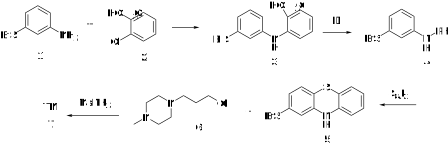
One synthesis of thiethylperazine begins with a Goldberg reaction between 3-(ethylsulfanyl)aniline (1) and 2-chlorobenzoic acid (2) to give the diarylamine 3. The carboxyl in the anthranilic acid residue, having performed its activating function, is then thermolytically removed to form (4). Upon treatment with sulfur and iodine, we get predominantly the phenothiazine (5). The reaction may well be aided by the presence of the electron donating thioether at the para-position. Alkylation with 1-(γ-chloropropyl)-4-methylpiperazine (6) in the presence of sodamide affords thiethylperazine (7).
References
References
- (February 1965). "The Effects of Thiethylperazine Dimaleate (Torecan) on Nausea and Vomiting". Canadian Medical Association Journal.
- "Charakterystyka Produktu Leczniczego".
- (September 1978). "Thiethylperazine; clinical antipsychotic efficacy and correlation with potency in predictive systems". Archives of General Psychiatry.
- (July 1985). "Recurrent dystonic reactions induced by thiethylperazine". Drug Intelligence & Clinical Pharmacy.
- (1958). "Synthesen auf dem Phenothiazin-Gebiet. 1. Mitteilung. Mercaptophenothiazin-Derivate.". Helvetica Chimica Acta.
- (1958). "Synthesen auf dem Phenothiazin-Gebiet. 2. Mitteilung. N-substituierte Mercaptophenothiazin-Derivate.". Helvetica Chimica Acta.
- {{cite patent
This article was imported from Wikipedia and is available under the Creative Commons Attribution-ShareAlike 4.0 License. Content has been adapted to SurfDoc format. Original contributors can be found on the article history page.
Ask Mako anything about Thiethylperazine — get instant answers, deeper analysis, and related topics.
Research with MakoFree with your Surf account
Create a free account to save articles, ask Mako questions, and organize your research.
Sign up freeThis content may have been generated or modified by AI. CloudSurf Software LLC is not responsible for the accuracy, completeness, or reliability of AI-generated content. Always verify important information from primary sources.
Report